

P0102 on 2000-2005 Mitsubishi Eclipse 2.4L: MAF Circuit Low Causes and Fixes
For a 2000-2005 Mitsubishi Eclipse with a 2.4L engine, code P0102 is most often caused by a dirty or faulty Mass Airflow (MAF) sensor. Cleaning the sensor with a dedicated MAF cleaner is the first and most common fix. If that fails, a replacement sensor is likely needed, costing between $60-$150 for an aftermarket part. Always check for vacuum leaks at the intake hose before replacing the sensor.
- Always start with the cheapest and easiest fix: clean the MAF sensor with dedicated cleaner.
- Thoroughly inspect the air intake hose between the sensor and the throttle body for cracks; this is a very common failure point.
- If you replace the MAF sensor, consider using a reputable brand like Denso or an OEM part, as some owners report issues with cheap, no-name aftermarket sensors.
- A dirty or overly-oiled aftermarket air filter can directly cause this code by contaminating the sensor.
- If cleaning or replacing the sensor doesn't work, investigate the wiring and connector for damage or a poor connection before suspecting a larger issue.
What's Unique About the 2000-2005 Mitsubishi Eclipse
The third-generation Eclipse (3G) with the 4G64 engine uses a MAF sensor (OEM Part MD336501, also labeled E5T08171) that is known to become contaminated or fail, leading to this common trouble code. 🎬 Watch this video on P0102 causes and fixes. While the causes are typical for any vehicle with a MAF sensor, owners report that these sensors can be sensitive. Aftermarket oiled air filters are a frequent cause of contamination. The diagnostic process is straightforward, but it's crucial to rule out simple issues like vacuum leaks from a cracked intake boot or a dirty sensor before condemning the part itself, as these are very common failure points on this model.
Symptoms You May Notice
- Check Engine Light is on
- Engine runs rough or idles poorly
- Stalling, especially shortly after a cold start or when coming to a stop.
- Hesitation or lack of power during acceleration
- Black smoke from the exhaust, indicating a rich fuel condition
- Decreased fuel economy
- Difficulty starting the engine
- Replacing the MAF sensor without first checking for vacuum leaks or attempting to clean the original sensor.
- Replacing oxygen sensors, as a bad MAF reading can cause the engine to run rich, mimicking a fuel system issue.
- Replacing the MAF sensor when the actual problem is a poor electrical connection or a damaged pigtail connector.
Most Likely Causes
- Dirty or Contaminated MAF Sensor 🔴 High Probability → Shop Fuel Injection Air Flow Meter Oil from aftermarket 'wet' air filters can contaminate the sensor's hot wire. Dust and debris can also accumulate over time, insulating the sensing element and causing it to read airflow incorrectly.
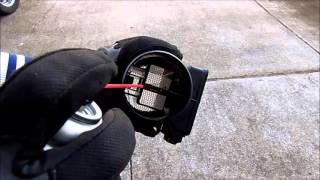
How to confirm: Visually inspect the sensor's sensing wire inside the housing. If it appears dirty, coated in oil, or has debris on it, it needs cleaning.
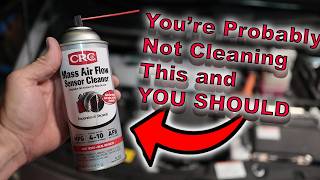
Typical fix: Remove the sensor and clean it carefully using only a dedicated Mass Airflow Sensor cleaner spray. 🎬 See how to clean the MAF sensor and throttle body. Do not touch the delicate wires. Allow it to air dry completely before reinstalling.
Est. part cost: $5-$15 for MAF cleaner - Faulty Mass Airflow (MAF) Sensor 🟡 Medium Probability → Shop Fuel Injection Air Flow Meter The sensor's internal electronics can fail with age and heat cycles, causing it to send a persistently low or no signal to the ECM.
How to confirm: After cleaning, if the code returns and symptoms persist, test the sensor's output voltage with a multimeter or scan tool. The voltage should increase smoothly with engine RPM from a low baseline at idle. If it's stuck low or doesn't respond, the sensor is likely bad. Unplugging the MAF sensor may cause the engine to run better (using default ECU values), which strongly indicates a faulty sensor.
Typical fix: Replace the MAF sensor assembly. 🎬 Watch this step-by-step MAF sensor replacement walkthrough. Many owners report issues with cheap aftermarket sensors and recommend sticking with OEM (Mitsubishi) or reputable OE-equivalent brands like Denso or Hitachi.
Est. part cost: $60-$150 (Aftermarket), $400+ (OEM) - Vacuum Leak 🟡 Medium Probability Cracks in the rubber air intake hose between the MAF sensor and the throttle body are very common as the rubber ages and becomes brittle. This allows unmetered air to enter the engine, which the MAF sensor doesn't measure, leading the ECM to believe airflow is lower than it is.
How to confirm: Visually inspect the intake boot for cracks or loose connections, paying close attention to the accordion-like sections. Perform a smoke test to definitively pinpoint any leaks in the intake system.
Typical fix: Replace the cracked or leaking intake hose.
Est. part cost: $30-$80 - Damaged Wiring or Loose Connector ⚪ Low Probability Vibrations and heat can cause wires to fray or the connector pins to lose tension over time, resulting in an intermittent or lost signal.
How to confirm: Inspect the MAF sensor connector for corrosion, damage, or loose pins. Wiggle the harness while the engine is running to see if it affects the idle, which would indicate a wiring issue. Check for proper voltage (typically 12V power, 5V reference) and ground at the connector terminals using a multimeter.
Typical fix: Repair the damaged wiring or replace the pigtail connector.
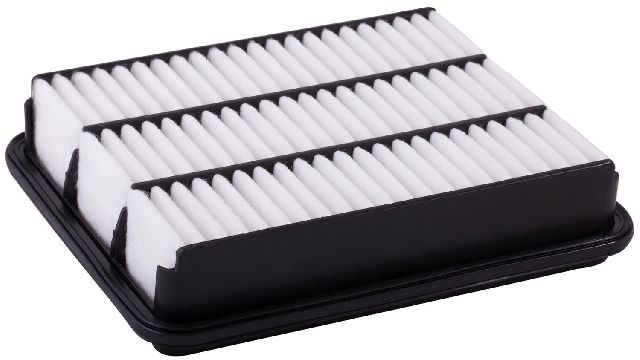
Est. part cost: $15-$40 for a new connector - Clogged Engine Air Filter ⚪ Low Probability → Shop Air Cleaner Assembly
How to confirm: Visually inspect the engine air filter. If it is visibly dirty or clogged, it will restrict airflow and can contribute to a P0102 code.
Typical fix: Replace the engine air filter.
Est. part cost: $15-$30
Rare But Worth Checking
- Failed Engine Control Module (ECM): This is very rare. The ECM should only be considered after all other possibilities, including the sensor and its entire circuit, have been thoroughly tested and ruled out.
Diagnosis Steps
- Check for Other Codes: Use an OBD-II scanner to see if any other codes are present that could point to a related issue, such as an IAT sensor code (P0113).
- Inspect the Air Intake System: → Shop Engine Air Intake Resonator Check the engine air filter and replace it if it's dirty. Carefully inspect the entire air intake tract, especially the flexible boot between the MAF sensor and the throttle body, for any cracks, tears, or loose connections.
- Inspect the MAF Sensor and Connector: → Shop Fuel Injection Air Flow Meter Unplug the MAF sensor and inspect the electrical connector pins for corrosion, damage, or poor pin tension. Ensure it's plugged in securely.
- Clean the MAF Sensor: → Shop Fuel Injection Air Flow Meter Remove the MAF sensor from its housing. Using only dedicated MAF sensor cleaner, spray the sensing elements (hot wire and thermistor). Do not touch them with anything. Let it dry completely before reinstalling.
- Clear Code and Test Drive: Clear the P0102 code with a scanner and perform a test drive, including a cold start if possible, to see if the code returns.
- Check for Vacuum Leaks: If the code returns, perform a smoke test to check for any vacuum leaks in the intake manifold or related hoses that were not visible.
- Test the MAF Circuit: Using a multimeter, check for proper power (battery voltage) and ground at the MAF sensor connector. With the sensor plugged in and the engine running, back-probe the signal wire to monitor its voltage. The voltage should be low at idle (around 0.6-1.0V) and increase smoothly to 2-3V or more as you raise the engine RPM. A static low voltage indicates a bad sensor or a circuit problem.
- Replace the MAF Sensor: → Shop Fuel Injection Air Flow Meter If the sensor has proper power and ground but the signal voltage is incorrect, the sensor itself has likely failed and should be replaced. Consider using an OEM or high-quality aftermarket part to avoid compatibility issues.
Parts You'll Likely Need
- Mass Airflow (MAF) Sensor
(OEM #MD336501)— This is the most common part to fail, either through contamination or internal electronic failure, directly causing the P0102 code.
Trusted brands: Mitsubishi (OEM), Denso, Hitachi, Walker Products
OEM price range: $450-$500
Aftermarket price range: $60-$150 - Engine Air Filter — A severely clogged air filter can restrict airflow enough to trigger this code and is a basic maintenance item that should be checked first.
Trusted brands: Wix, Fram, Purolator
OEM price range: $25-$40
Aftermarket price range: $15-$30 - Air Intake Hose — The rubber hose can crack with age, creating a vacuum leak of unmetered air that confuses the ECM and can trigger a P0102 code. This is a very frequent point of failure.
Trusted brands: Mitsubishi Genuine, Dorman
OEM price range: $60-$100
Aftermarket price range: $30-$80
Related Codes That Often Appear With This One
- P0171 — System Too Lean (Bank 1). This can occur if there is a large vacuum leak, allowing unmetered air to enter the engine after the MAF sensor.
- P0170 — Fuel Trim Malfunction. The incorrect airflow reading from the MAF sensor causes the ECM to struggle to maintain the proper air-fuel ratio.
- P0113 — Intake Air Temperature (IAT) Sensor Circuit High. The IAT sensor is often integrated into the MAF sensor assembly on this vehicle. A fault in the MAF sensor or its connector can trigger codes for both components.
Mechanic-Grade Diagnostic Values
- MAF Sensor Signal Voltage at Idle (Engine Warm) — expected: 0.5V - 1.5V. Failure: Voltage is stuck below 0.2V or does not rise with RPM.
- MAF Sensor Signal Voltage at 3000 RPM — expected: 2.0V - 2.5V. Failure: Voltage does not increase significantly from idle.
- MAF Sensor Signal Voltage at Key On, Engine Off (KOEO) — expected: 0.2V - 0.3V. Failure: Voltage is 0V or above 0.5V.
- Live Data: MAF Reading at Idle (Warm) — expected: 2.0 - 2.5 g/s. Failure: Reading is below 1.5 g/s or does not increase with RPM.
- ECM Code Trigger Threshold — expected: N/A. Failure: The ECM will set P0102 if the MAF sensor output voltage is lower than 0.2 volts for 2 seconds or more.
Wiring & Ground Locations
- MAF Sensor Connector (A-05) — On the MAF sensor housing, between the air filter box and the throttle body intake hose.. This is the primary connection point for the MAF sensor. Damage, corrosion, or loose pins here will directly cause a P0102 code.
- MAF Signal Wire (to ECM) — For 2000-2003 models, this is a YELLOW wire. For 2004-2005 models, it is a LIGHT BLUE wire. This wire runs from Pin 3 on the MAF sensor connector to Pin 87 on the ECM connector (B-109).. This wire carries the critical airflow voltage signal to the ECM. An open or short to ground on this wire will cause a P0102 code.
- MAF Power Supply Wire — This wire receives power from the MFI relay (terminal 2) and connects to the MAF sensor connector. It should have battery voltage with the key on.. No power to the sensor will result in no signal, triggering the code.
- MAF Ground Wire — This wire provides the ground for the sensor circuit and runs to Pin 88 of the ECM.. A poor or missing ground will cause incorrect sensor readings and can trigger a P0102.
Real Owner Repair Stories
- Reddit user in r/MitsubishiEclipse (2003 Eclipse RS) — Car would stall immediately unless the accelerator was slammed. It was basically undriveable.
❌ Tried (didn't work) Replacing the IAC valve, Replacing the throttle body and TPS, Replacing the starter, Mechanic performed a smoke test which found no vacuum leaks
✅ What actually fixed it The user unplugged the MAF sensor, and the engine immediately ran better. Replacing the MAF sensor with a Duralast brand part completely resolved the stalling and drivability issues.
OEM Part Supersession History
MD336501→MD336501 remains the primary OEM number.— N/A
Heads up: The sensor is also commonly identified by its manufacturer part number, E5T08171, which is functionally identical.
Model Year Variations Within This Range
- 2000-2003 vs 2004-2005: The MAF signal wire color changed. For 2000-2003 models, the signal wire is YELLOW. For 2004-2005 models, the signal wire is LIGHT BLUE.
Diagnostic Flowchart
Other Known Issues on This Vehicle
Issues unrelated to this code that are worth knowing about as an owner of this generation:
- Leaking Valve Cover Gasket / Spark Plug Tube Seals 🟠 Medium → Shop Engine Valve Cover — Very common as the vehicle ages. The seals harden and allow oil to leak into the spark plug wells, causing misfires (P0300).
- Manual Transmission Shifting Difficulty / Clutch Vibration 🟡 Low — Reported by some owners, includes difficulty engaging gears or a noticeable vibration from the clutch when starting from a stop.
- Body Rust 🟠 Medium — The body, particularly in the rear quarter panels and wheel wells, is prone to rust, especially in regions that use road salt.
- Timing Belt Maintenance 🔴 High — The 4G64 is an interference engine. The timing belt, tensioner, and idler pulleys must be replaced at the recommended interval (typically 60,000 miles) to prevent catastrophic engine damage if the belt fails.
- Sunroof Mechanism Failure 🟡 Low — The sunroof can become stuck or have difficulty moving, a common issue on early 2000s models.
Used vs. New Parts: Buying Guide for This Vehicle
When a used part is the smart pick: A used OEM MAF sensor from a low-mileage donor vehicle can be a cost-effective alternative to a new OEM part, especially given the high price of a new one. It is often a better choice than a cheap, new aftermarket sensor of unknown quality.
Donor-vehicle mileage cap: roughly under 80000 miles for the part to have meaningful remaining life.
What to inspect on the donor part:
- Ensure the donor vehicle was not in a front-end collision.
- Inspect the connector pins for any signs of corrosion or damage.
- Look inside the sensor housing; avoid any units with visible oil contamination or debris on the sensing element.
- If possible, get the part from a reputable salvage yard that offers a short warranty or return period.
OEM-only on this vehicle (don't cheap out):
- While not strictly 'OEM-only', many owners report drivability issues and premature failure with budget aftermarket MAF sensors. Sticking to the original Mitsubishi part (new or used) or a high-quality OE equivalent is strongly recommended.
Aftermarket brands forum-validated for this vehicle:
- Denso
- Hitachi
- Walker Products
- Duralast (as reported by at least one owner with a positive outcome)
Brands owners have reported issues with on this vehicle:
- Unbranded, low-cost sensors from online marketplaces are frequently reported to be poorly calibrated or fail quickly.
Real Owner Stories
Aggregated from forums and TSBs cited above. Mileages and costs reflect what owners reported in those sources.
2004 Mitsubishi Eclipse RS 2.4L
Symptoms: Start-and-stall condition even after replacing the MAF sensor and connector.
What fixed it: The owner's report highlighted the need to investigate a deeper electrical issue in the circuit beyond just replacing the sensor.
Source hint: Reddit r/AskMechanics
2003 Mitsubishi Eclipse 2.4L
Symptoms: Error code P0102 present.
What fixed it: The owner sought advice regarding the P0102 error code specific to the 2003 model year.
Source hint: Reddit r/MechanicAdvice
Related OBD-II Codes
Frequently Asked Questions
Why does my 2000-2005 Mitsubishi Eclipse stall shortly after a cold start or when coming to a stop?
Should I buy a cheap aftermarket MAF sensor for my Eclipse RS/GS?
Can my aftermarket 'wet' air filter cause a P0102 code on my 2.4L Eclipse?
How can I tell if my MAF sensor is actually bad or if it just needs cleaning?
Is there a simple way to test if the MAF sensor is causing my engine to run rough?
What should I check on the intake boot of my 4G64 engine?
Helpful Videos
We Have This Part in Stock




The information in this article is provided for general reference and educational purposes only. Vehicle specifications, procedures, and part compatibility can vary by production date, trim level, and region. Always consult your vehicle's factory service manual and verify part numbers before purchasing or performing repairs. Safety-critical components such as airbags, seat belts, and braking systems should be installed by a qualified professional.
- Mitsubishi Eclipse:
- 🧭 Diagnostic Flowchart
- 🎬 Helpful Videos
- 🛍️ Shop This Part
- What's Unique About the 2000-2005 Mitsubishi Eclipse
- Symptoms You May Notice
- Most Likely Causes
- Rare But Worth Checking
- Diagnosis Steps
- Parts You'll Likely Need
- Related Codes That Often Appear With This One
- Mechanic-Grade Diagnostic Values
- Wiring & Ground Locations
- Real Owner Repair Stories
- OEM Part Supersession History
- Model Year Variations Within This Range
- Other Known Issues on This Vehicle
- Used vs. New Parts: Buying Guide for This Vehicle
- Real Owner Stories
- 2004 Mitsubishi Eclipse RS 2.4L
- 2003 Mitsubishi Eclipse 2.4L
- Related OBD-II Codes
- Frequently Asked Questions
- 🎟️ Get 5% Off