

P0102 on 2005-2006 Saab 9-2X: MAF Circuit Low Causes and Fixes
For the 2005-2006 Saab 9-2X, code P0102 most often points to a dirty or faulty Mass Airflow (MAF) sensor, or a vacuum leak in the intake system, especially a cracked turbo inlet hose. Cleaning the MAF sensor is a common first step, but replacement or fixing a vacuum leak may be necessary for a permanent solution.
- P0102 on your Saab 9-2X means the MAF sensor circuit has a low input, usually due to a dirty sensor, a vacuum leak, or a failed sensor.
- Remember your Saab 9-2X has a Subaru WRX engine (EJ205); all engine parts and common problems are from Subaru.
- Before buying a new MAF sensor, try cleaning it with dedicated MAF cleaner and perform a smoke test to check for vacuum leaks, especially the turbo inlet hose.
- If you have an aftermarket oiled air filter, be careful not to over-oil it, as this is a primary cause of MAF sensor contamination.
- This is a DIY-friendly repair. Cleaning or replacing the MAF sensor is straightforward and requires basic tools.
What's Unique About the 2005-2006 Saab 9-2X
The Saab 9-2X, particularly the 'Aero' model with the 2.0L turbo engine, is mechanically a Subaru Impreza WRX (a 'Saabaru'). This means all engine components, including the MAF sensor and engine management system, are Subaru parts. This platform is well-known for having issues with vacuum leaks in the intake tract, especially the turbo inlet hose, which can crack with age and heat. The split often occurs right underneath the hose clamp on the turbo side. Additionally, the use of aftermarket oiled air filters is common, and excess oil can contaminate the MAF sensor, leading to inaccurate readings and triggering this specific code.
Symptoms You May Notice
- Check Engine Light is on
- Rough or erratic idle
- Engine stalling, especially at idle or when coming to a stop
- Hesitation or lack of power during acceleration
- Decreased fuel economy
- Black smoke from the exhaust
- Hard starting
- Replacing the oxygen (O2) sensors. A vacuum leak or bad MAF reading can cause a rich fuel condition (and a corresponding P0172 code), which might lead someone to incorrectly blame the O2 sensor.
- Assuming the MAF sensor is bad without checking for vacuum leaks first. On this platform, a cracked turbo inlet hose is a very common cause of P0102 and can be mistaken for a failed sensor.
Most Likely Causes
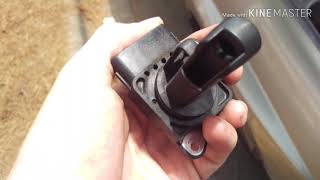
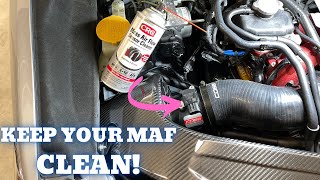
- Dirty or Contaminated MAF Sensor 🔴 High Probability → Shop Fuel Injection Air Flow Meter Often caused by using aftermarket oiled air filters where excess oil contaminates the sensor's hot wire. General dust and debris can also accumulate over time.
How to confirm: Remove the sensor and visually inspect the sensing element for dirt, oil, or debris. The wires should be clean.
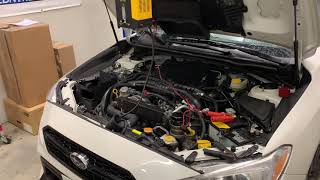
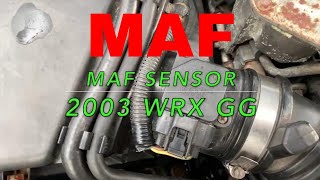
Typical fix: Clean the sensor using a dedicated MAF sensor cleaner spray. 🎬 Watch: How to clean your Subaru MAF sensor properly. Do not touch the sensor wires. Note that some technicians report cleaning is a 50/50 chance for a long-term fix, and replacement is often more reliable.
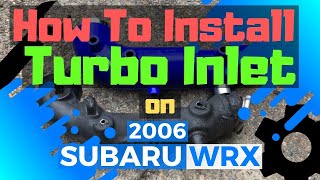
Est. part cost: $10-$15 for cleaner spray - Vacuum Leak 🔴 High Probability The plastic turbo inlet pipe on the EJ205 engine is notorious for cracking with age and heat, creating a large source of unmetered air. The tear commonly develops right at the turbo connection, under the hose clamp. Other vacuum hoses can also become brittle and crack.
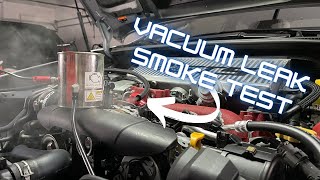
How to confirm: Perform a smoke test on the intake system to identify leaks. Visually inspect all 🎬 See how to perform a smoke test for vacuum leaks. intake hoses between the MAF sensor and the throttle body for cracks, loose clamps, or disconnections. Pay close attention to the turbo inlet.
Typical fix: Replace the cracked or leaking hose. The turbo inlet pipe is a common replacement. A temporary DIY fix for a small tear on the inlet has been demonstrated using a silicone bracelet to seal 🎬 Watch: Step-by-step guide to installing a new turbo inlet hose. the rip under the clamp.
Est. part cost: $50-$250 depending on the hose - Faulty MAF Sensor 🟡 Medium Probability → Shop Fuel Injection Air Flow Meter The sensor can fail electronically over time due to age and heat cycles. Sometimes cleaning is not enough to restore function.
How to confirm: After confirming the sensor is clean and there are no vacuum leaks, use a scan tool to monitor MAF sensor readings (g/s). If the readings are stuck at a very low value (e.g., 0.0) or don't increase with engine RPM, the sensor is likely faulty. A simple test is to unplug the sensor while the engine is running rough; if the idle smooths out, it strongly points to a bad MAF.
Typical fix: Replace the MAF sensor. It is recommended to use an OEM or high-quality aftermarket brand like Denso or Hitachi. A Reddit user with a Saab experiencing P0102, P0300, and P1181 confirmed a new MAF sensor resolved the issues.
Est. part cost: $70-$250 - Damaged Wiring or Loose Connector ⚪ Low Probability Wiring can become brittle or pins can get bent/corroded over time, especially the connector at the MAF sensor itself.
How to confirm: Inspect the MAF sensor's electrical connector for corrosion or loose pins. Wiggle the wiring harness near the connector while monitoring live MAF data on a scan tool to see if the reading drops out. Check for voltage at the connector pins.
Typical fix: Repair the damaged wiring or clean/replace the connector. A user on a Finnish Saab forum traced their P0102 to a bent pin in the PSG16 connector. Another Subaru owner found a broken wire at the MAF plug was the cause.
Est. part cost: $10-$50
Rare But Worth Checking
- Clogged Air Filter: → Shop Air Cleaner Assembly A severely clogged engine air filter can restrict airflow enough to cause the MAF reading to be lower than expected. This is easy to check and should be part of routine maintenance.
- Faulty ECM: This is extremely rare, but the Engine Control Module itself can fail. This should only be considered after all other possibilities have been exhaustively ruled out by a professional.
Diagnosis Steps
- Read the fault codes with an OBD-II scanner to confirm P0102 is present and note any other codes.
- Visually inspect the entire air intake system from the air filter box to the throttle body. Look for disconnected hoses, loose clamps, or obvious cracks. Pay special attention to the turbo inlet hose where it connects to the turbo.
- Inspect the MAF sensor's electrical connector for a secure fit and any signs of corrosion or damage.
- Check the engine air filter. If it is excessively dirty or clogged, replace it.
- Carefully remove the MAF sensor and inspect it. If it appears dirty, clean it with a dedicated MAF sensor cleaner. Let it dry completely before reinstalling.
- Clear the fault code and test drive the vehicle. If the code returns, proceed to the next steps.
- Use a scan tool to monitor the MAF sensor's live data in grams per second (g/s). The value should be around 2-4 g/s at idle and should increase smoothly as you raise the engine RPM. A general rule is that doubling the RPM should roughly double the g/s reading (e.g., 4 g/s at 1000 RPM should become ~8 g/s at 2000 RPM). If it's stuck at zero or a very low value, the sensor or its circuit is faulty.
- Perform a smoke test on the intake system to check for vacuum leaks that are not visually apparent. This is the most effective way to find cracks in the turbo inlet pipe and other vacuum lines.
- As a quick test, if the engine is idling roughly, try unplugging the MAF sensor electrical connector. If the idle smooths out, the MAF sensor is very likely faulty.
- If no vacuum leaks are found and the sensor has been cleaned but the problem persists, test the sensor's wiring for power, ground, and signal integrity before replacing the sensor.
Parts You'll Likely Need
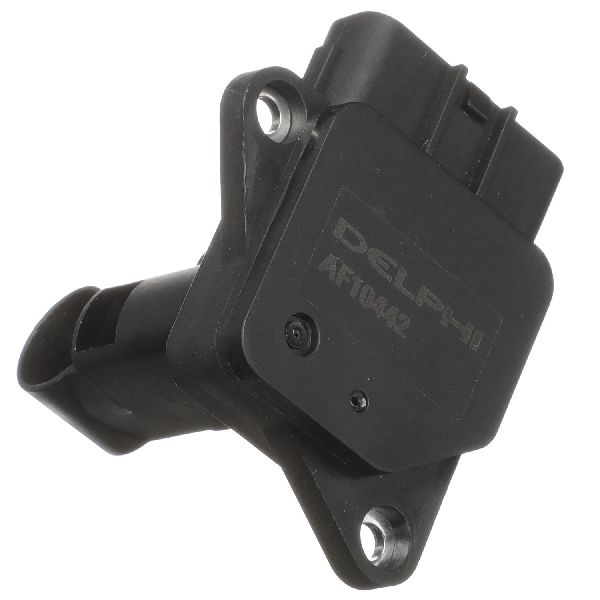
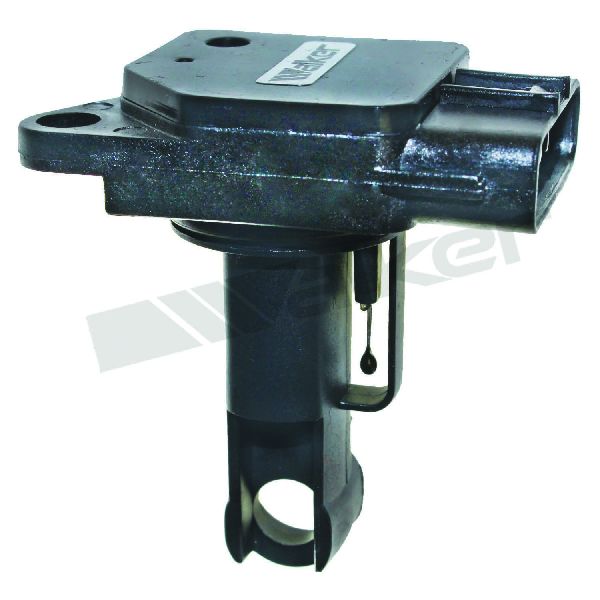
- Mass Air Flow (MAF) Sensor
(OEM #22680AA310)— This sensor is the most common point of failure, either by contamination or electronic failure, directly causing the P0102 code. This OEM part number is confirmed for the 2002-2007 WRX.
Trusted brands: Subaru (OEM), Denso (Often the OEM manufacturer)
OEM price range: $200-$280
Aftermarket price range: $70-$150 - Turbo Inlet Hose
(OEM #14459AA510)— This hose is a known weak point on the EJ205 engine. It can crack due to age and heat, causing a major vacuum leak that triggers the P0102 code.
Trusted brands: Subaru (OEM), Perrin, Mishimoto, COBB
OEM price range: $100-$150
Aftermarket price range: $80-$250 - MAF Sensor Cleaner — Often, the sensor is just dirty from oil or debris, and a simple cleaning is the only fix required. This is the cheapest and easiest first step.
Trusted brands: CRC, Liqui Moly
Aftermarket price range: $10-$15
Related Codes That Often Appear With This One
- P0172 — System Too Rich. The ECM sees low airflow from the P0102 fault and injects what it thinks is the right amount of fuel. However, if the low reading is due to a faulty sensor (and not actually low air), the fuel mixture becomes too rich.
- P0113 — Intake Air Temperature (IAT) Sensor Circuit High. On this vehicle, the IAT sensor is integrated into the MAF sensor assembly. A failure of the MAF sensor or its wiring can often trigger a fault for the IAT as well.
- P0300 — Random/Multiple Cylinder Misfire. An incorrect air-fuel mixture caused by a bad MAF reading or vacuum leak can lead to instability and misfires.
Technical Service Bulletins (TSBs) & Recalls
- No specific Technical Service Bulletins (TSBs) from Subaru or Saab directly addressing the P0102 code on this platform were identified during the research. Diagnosis relies on standard workshop manual procedures.
Platform-Specific Known Issues
- The plastic turbo inlet hose located under the intake manifold is a very common failure point. It becomes brittle and cracks, causing a significant post-MAF vacuum leak. The tear is often found on the underside of the hose where it connects to the turbo, making it difficult to see without removal.
- Owners using aftermarket oiled-gauze air filters frequently cause this code by over-oiling the filter, which then contaminates the MAF sensor element.
Mechanic-Grade Diagnostic Values
- MAF Sensor Signal Voltage at Idle (Warm Engine) — expected: 1.2V - 1.4V. Failure: A reading significantly outside this range, or one that is stuck and doesn't change with RPM, indicates a problem. A reading of 0V suggests a circuit or power issue. A reading over 3V at idle is way too high.
- MAF Sensor Power Supply Voltage (Key On, Engine Off) — expected: 10V - 13V (Battery Voltage). Failure: No voltage or low voltage indicates a problem with the power supply wire from the main relay or a blown fuse.
- MAF Sensor Ground Circuit — expected: Near 0Ω resistance to chassis ground.. Failure: High resistance indicates a poor ground connection, which can cause erratic sensor readings.
- MAF Sensor Airflow Reading at Idle — expected: 2 - 4 g/s. Failure: Reading is stuck at 0 g/s or does not increase smoothly with engine RPM.
Scan Tool Commands That Help
- Subaru Select Monitor (or equivalent like Cobb Accessport): Live Data Monitoring (MAF Voltage, MAF g/s) — This is the primary method for diagnosing the MAF sensor. It allows you to see the sensor's output in real-time to check if it responds correctly to changes in engine speed and load.
- Subaru Select Monitor (or equivalent): Clear Memory / Reset ECU — After replacing the MAF sensor or repairing a wiring issue, the ECU should be reset. This can be done with the scan tool or by disconnecting the negative battery terminal and pressing the brake pedal for several seconds to drain residual power. This forces the ECU to relearn air/fuel trims with the new/corrected sensor input.
Wiring & Ground Locations
- MAF Sensor Connector (B136) — At the MAF sensor, located on the air intake tract right after the air filter box on the right side of the engine compartment.. This is the primary connection point for the sensor. The pins for power, ground, and signal must be clean and making good contact. The signal wire for the MAF is at pin 1 of the B136 connector at the ECU.
- Engine Control Module (ECM) — Located behind the right side of the dashboard, below the glove box.. All MAF sensor wiring terminates here. A poor connection at the ECU connector (B136) can cause a P0102 code.
- Engine Ground (GE-1, GE-2) — GE-1 is on the top left side of the engine; GE-2 is on the top right. A key ground strap also connects from the cylinder head to the chassis.. A poor engine ground can cause electrical noise and voltage drops, affecting the readings of sensitive components like the MAF sensor. Ensuring these grounds are clean and tight is a critical step.
- MAF Connector Pinout (2002-2005 WRX/EJ205) — On the 5-pin MAF sensor connector.. Knowing the pin functions is essential for testing. Pin 1: 12V Power (Yellow wire). Pins 2 & 3: IAT Sensor. Pin 4: MAF Signal (Shielded wire). Pin 5: Signal Ground.
Real Owner Repair Stories
- YouTube user video on a 2005 Subaru STI (2005 Subaru STI (similar EJ engine and wiring)) — P0102 code, stalling issues, noise on the signal line.
❌ Tried (didn't work) Dealer recommended replacing the entire wiring harness.
✅ What actually fixed it The previous owner had clipped the ground wire near the MAF sensor connector. The user repaired the broken ground wire by splicing in a new section of wire and shielding it with foil tape to prevent signal interference. This resolved the P0102 code. - Reddit user on r/subaru (2006 Forester XS (Non-turbo, but similar diagnostic principle)) — P0102 and P0113, stalling at low RPMs, especially when warm.
❌ Tried (didn't work) Cleaning the MAF sensor., Changing spark plugs., Changing valve cover gasket., Changing air filter., Disconnecting the MAF (made no difference).
✅ What actually fixed it A Subaru dealer technician commented that this pair of codes is exactly what you get when the MAF is unplugged or has a total wiring failure. The advice was to inspect the wiring harness leading to the sensor for damage before replacing the sensor itself, as cleaning had already failed.
"I Checked Everything" — The Actual Cause
- In some cases reported on forums, a smoke test may not reveal a leak if the crack in the turbo inlet hose only opens up under vacuum or when the engine torques, causing an intermittent P0102. The leak may also be in a less common location, such as a leaking oil filler cap seal, which can introduce unmetered air into the crankcase and eventually the intake system via the PCV, confusing the diagnosis.
Model Year Variations Within This Range
- 2005 vs 2006: The 2005 Saab 9-2X Aero used the 2.0L turbocharged EJ205 engine. The 2006 Saab 9-2X Aero switched to the 2.5L turbocharged EJ255 engine. While the P0102 code and general diagnostic principles are similar, some parts (like the MAF sensor itself, although the part number often cross-references) and specific engine characteristics may differ. This article specifically addresses the EJ205.
Diagnostic Flowchart
Used vs. New Parts: Buying Guide for This Vehicle
When a used part is the smart pick: A used part is a reasonable choice for the plastic engine covers or the airbox assembly if they are damaged. For the core components related to P0102, used parts are generally not recommended.
Donor-vehicle mileage cap: roughly under 75000 miles for the part to have meaningful remaining life.
What to inspect on the donor part:
- For a turbo inlet hose, inspect for any signs of cracking, brittleness, or oil saturation, especially at the ends.
- Verify the donor vehicle was not in a front-end collision that could have damaged wiring harnesses.
- Look for a vehicle that appears well-maintained, with a clean engine bay, as it's less likely to have had deferred maintenance issues.
OEM-only on this vehicle (don't cheap out):
- Mass Airflow (MAF) Sensor: Due to the sensitivity of the sensor and the specific calibration for the Subaru ECU, it is highly recommended to use a genuine Subaru/Denso OEM part. Many aftermarket MAF sensors are known to be poorly calibrated, causing persistent performance issues even if they clear the code temporarily.
Aftermarket brands forum-validated for this vehicle:
- Turbo Inlet Hose: Perrin, Mishimoto, and COBB Tuning all make high-quality silicone replacement hoses that are considered an upgrade over the failure-prone OEM plastic part.
Brands owners have reported issues with on this vehicle:
- Unnamed/generic 'eBay special' MAF sensors. Forum consensus is overwhelmingly against using cheap, unbranded electronic sensors on these vehicles.
Real Owner Stories
Aggregated from forums and TSBs cited above. Mileages and costs reflect what owners reported in those sources.
2005 Saab 9-2X Aero
Symptoms: Engine shudders when accelerating from idle in first gear and at wide-open-throttle around 4,000 RPM. Also feels down on power at the high end of the RPM range. Codes P0102, P0113, and P0303 were present.
What fixed it: The owner was still troubleshooting. Cleaning the MAF sensor stopped a lot of the shuddering but introduced a new shudder between 6,000-7,000 RPM.
Source hint: Reddit r/subaru
2006 Saab 9-5
Symptoms: Rough idle accompanied by fault codes P0102 and P0300.
What fixed it: Replacing the MAF sensor resolved all issues and cleared the codes.
Source hint: Reddit r/saab - 06 Saab 95 rough idle
2001 Saab 9-3 2.2TID
Symptoms: Check Engine Light with trouble code P0102.
What fixed it: The problem was not the MAF sensor itself, but a bent pin in a connector and a separate cracked vacuum hose.
Source hint: Saabclub.fi - 2001 9-3 2.2TID and trouble code P0102
Subaru Impreza WRX
Symptoms: P0102 code present.
What fixed it: A broken wire was found directly at the MAF sensor's electrical plug; repairing the wire fixed the issue.
Source hint: common_causes section, under 'Damaged Wiring or Loose Connector'
Related OBD-II Codes
Frequently Asked Questions
Why are Subaru forums like NASIOC recommended for my Saab 9-2X?
What is the most common part that fails and causes a P0102 code on this car?
I use an aftermarket oiled air filter. Could that be related to my P0102 code?
I cleaned the MAF sensor but the code came back. What should I check next?
My engine runs better when I unplug the MAF sensor. Does this confirm it's faulty?
Are there any official recalls or Technical Service Bulletins (TSBs) for the P0102 code on the 9-2X?
Helpful Videos

We Have This Part in Stock


The information in this article is provided for general reference and educational purposes only. Vehicle specifications, procedures, and part compatibility can vary by production date, trim level, and region. Always consult your vehicle's factory service manual and verify part numbers before purchasing or performing repairs. Safety-critical components such as airbags, seat belts, and braking systems should be installed by a qualified professional.
- Saab 9-2X:
- 🧭 Diagnostic Flowchart
- 🎬 Helpful Videos
- 🛍️ Shop This Part
- What's Unique About the 2005-2006 Saab 9-2X
- Symptoms You May Notice
- Most Likely Causes
- Rare But Worth Checking
- Diagnosis Steps
- Parts You'll Likely Need
- Related Codes That Often Appear With This One
- Technical Service Bulletins (TSBs) & Recalls
- Platform-Specific Known Issues
- Mechanic-Grade Diagnostic Values
- Scan Tool Commands That Help
- Wiring & Ground Locations
- Real Owner Repair Stories
- "I Checked Everything" — The Actual Cause
- Model Year Variations Within This Range
- Used vs. New Parts: Buying Guide for This Vehicle
- Real Owner Stories
- 2005 Saab 9-2X Aero
- 2006 Saab 9-5
- 2001 Saab 9-3 2.2TID
- Subaru Impreza WRX
- Related OBD-II Codes
- Frequently Asked Questions
- 🎟️ Get 5% Off