

OBD-II Code P0103: Mass Air Flow (MAF) Sensor Circuit High Input
What P0103 means, why it triggers, and how to fix it
- A dirty Mass Air Flow (MAF) sensor causes 70% of P0103 codes and costs just $15 to fix with a dedicated aerosol cleaner.
- Test the sensor's wiring harness for a 5V or 12V short-to-power before spending $150+ on a replacement MAF sensor.
- Expect a 10-20% drop in fuel economy, black exhaust smoke, and rough idling due to the engine running an overly rich fuel mixture.
- Driving with an active P0103 code for more than a month overheats and destroys the catalytic converter, turning a minor repair into a $2,500+ replacement.
What Does P0103 Mean?

The Powertrain Control Module (PCM) is receiving a voltage signal from the Mass Air Flow (MAF) sensor that exceeds the maximum limit (typically over 4.5-4.9 volts). The MAF sensor measures air entering the engine to calculate fuel delivery. A 'high input' code tricks the computer into thinking a massive amount of air is entering, forcing it to dump excess fuel and causing a rich running condition.
Technical definition: The official SAE/OBD-II definition for code P0103 is "Mass or Volume Air Flow 'A' Circuit High Input". The PCM sets this code when the MAF sensor's signal voltage or frequency remains above the maximum calibrated threshold (usually 4.5V to 4.9V) for more than 2 seconds.
Can I Drive With P0103?

Yes, But With Caution. You can drive, but expect poor performance like rough idling, stalling, and a 10-20% drop in gas mileage. The engine enters a 'limp mode' with reduced power. Fix this immediately; driving with a rich fuel condition overheats and destroys the catalytic converter, a repair costing between $900 and $2,500.
Common Causes

- Dirty or Contaminated MAF Sensor (Very Common) — Oil, dirt, or dust coats the sensor's hot wire, insulating it and causing false high voltage readings. Over-oiled aftermarket air filters are the primary culprit.
- Wiring Short to Power (Common) — A frayed wire in the MAF harness touching a 5V or 12V power source sends a constant high voltage signal to the PCM, regardless of actual airflow.
- Internally Shorted MAF Sensor (Common) — The electronic circuitry inside the sensor fails and shorts internally, pegging the output signal at maximum voltage.
- Bad Ground Connection (Less Common) — A corroded ground wire on the MAF circuit causes the signal voltage to float high. A ground circuit with over 0.1V of resistance triggers this code.
- Clogged Engine Air Filter (Rare) — A severely restricted air filter disrupts intake airflow dynamics, occasionally skewing the sensor's calibration high.
Symptoms

- Check Engine Light is On — The PCM logs the fault and illuminates the dashboard warning light immediately.
- Rough Idle and Stalling — The engine idles erratically, shakes, and stalls when coming to a stop due to the severely rich air-fuel mixture.
- Black Smoke from Exhaust — Excess unburned fuel exits the tailpipe as black smoke because the PCM is injecting too much gasoline based on the false high airflow reading.
- Decreased Fuel Economy — Gas mileage drops by 10-20% as the engine runs continuously in a rich, inefficient state.
- Sluggish Acceleration — The vehicle hesitates and lacks power because the PCM enters a protective 'limp mode' to prevent engine damage.
Diagnostic Flowchart
Tap your situation to follow the diagnostic path that matches what you're seeing on this code.
Common Fixes & Costs
- Clean the MAF Sensor — Parts: $10-$15, Labor: $0-$100, ~0.5 hr book time (DIY)
- Replace the MAF Sensor
— Parts: $100-$300, Labor: $50-$150, ~0.7 hr book time
(Intermediate)
Volkswagen (Jetta/Golf 1.9L TDI, 1999-2006): OEM 038906461B (Alt: {'Bosch': '0281002531 ($90-$140)', 'Walker': 'N/A'})
Ford (F-150 5.4L, 2004-2010): OEM 3L3Z-12B579-BA (Motorcraft AFLS131) (Alt: {'Denso': 'N/A', 'Walker': '245-1108 ($50-$80)', 'Cardone': '74-9549 (Reman, $60-$90)'})
Chevrolet/GMC (Silverado/Sierra 5.3L, 1999-2013): OEM 15865791 (ACDelco 213-4222) (Alt: {'Denso': '197-6038 ($60-$90)', 'Walker': '245-1110 ($50-$80)'}) - Repair Wiring or Connector — Parts: $20-$50, Labor: $150-$300, ~2 hr book time (Professional)
- Replace Clogged Engine Air Filter — Parts: $15-$30, Labor: $0-$20, ~0.2 hr book time (DIY)
DIY vs Professional
- Clean the MAF Sensor — Beginner: Yes
Tools: MAF sensor cleaner spray, screwdriver/Torx driver. - Replace the MAF Sensor — Beginner: Yes
Tools: Screwdriver, socket set. - Repair Wiring or Connector — Beginner: No
Tools: Multimeter, wire strippers, soldering iron, heat shrink tubing. - Replace Clogged Engine Air Filter — Beginner: Yes
Tools: Screwdriver or bare hands.
Used vs. New Parts: Buying Guide
When a used part is worth it: For vehicles over 10 years old, a used OEM MAF sensor from a low-mileage wrecked vehicle is superior to a cheap, inaccurate aftermarket sensor.
Donor-vehicle mileage cap: roughly under 80000 miles for the part to have meaningful remaining life.
Donor quality checklist:
- Verify the donor vehicle was not scrapped due to engine fire or flood.
- Match the OEM part number exactly.
- Ensure the seller offers a 30-day warranty.
Decision logic:
- If Vehicle is less than 8 years old or under 100K miles → Buy a new OEM or OEM-supplier (e.g., Bosch, Denso) part.
- If Vehicle is over 10 years old AND budget is tight → Buy a used OEM part from a reputable salvage yard.
- If A cheap $30 aftermarket sensor is the only option → Avoid it. Failure rates are high and readings are inaccurate out of the box.
Warranty tradeoff: Used parts offer a 30-day warranty. New aftermarket parts offer 1-year warranties. New OEM parts carry a 1-year manufacturer warranty.
Worst-case if a used part fails: $200-$500 if a cheap aftermarket part fails, requiring repeat diagnostics and a second replacement.
What Happens If You Wait — Timeline
- 0-1 month: Check Engine Light illuminates. Fuel economy drops 5-10%. The engine exhibits a slightly rough idle and minor hesitation. (MPG impact: 5-10%% · Added cost: $50-$100 (wasted fuel))
- 1-3 months: Engine performance degrades. Stalling at stops and sluggish acceleration become frequent. Black smoke is visible from the exhaust. (MPG impact: 10-20%% · Added cost: $100-$250 (wasted fuel))
- 3-6 months: The constant rich exhaust overheats the catalytic converter (over 2000°F), melting its internal ceramic honeycomb. A rotten egg smell develops. (MPG impact: 15-25%% · Added cost: $900-$2,500 (catalytic converter replacement required))
- 6+ months: The catalytic converter clogs completely, creating massive exhaust backpressure. The vehicle cannot accelerate over 30 mph, risking burnt exhaust valves. (MPG impact: 30-50%+% · Added cost: $3,000-$7,000+ (catalytic converter and engine repairs))
Cost of Not Fixing It
- 0-1 Month: Fuel economy drops by 10-20%, causing rough engine operation and stalling. The primary cost is wasted fuel. (Added cost: $50-$100)
- 1-6 Months: The persistent rich fuel mixture overheats the catalytic converter, melting its internal honeycomb structure and causing severe power loss. (Added cost: $1200-$2800)
- 6+ Months: A clogged catalytic converter creates extreme exhaust backpressure, burning exhaust valves and requiring a complete engine overhaul. (Added cost: $3000-$7000+)
Diagnosis Steps
- Visual Inspection
Verify the MAF sensor connector is plugged in securely. Inspect the wiring harness for cracks, melting, or chafing against metal brackets.
Tools: Flashlight (Beginner) - Clean the MAF Sensor
Remove the MAF sensor. Spray the wire elements with dedicated MAF sensor cleaner. Do NOT touch the elements. Let it air dry completely before reinstalling.
Tools: Screwdriver or Torx driver, MAF sensor cleaner spray (Beginner) - Check Live Data with a Scan Tool
Connect an OBD-II scanner and view MAF live data (g/s). At a warm idle, a 4-cylinder should read 2-4 g/s; a V6/V8 should read 4-7 g/s. If the reading is stuck above 150 g/s and ignores RPM changes, you have a hard electrical short.
Tools: OBD-II Scan Tool with Live Data (Intermediate) - [PRO TIP] Test for Short to Voltage
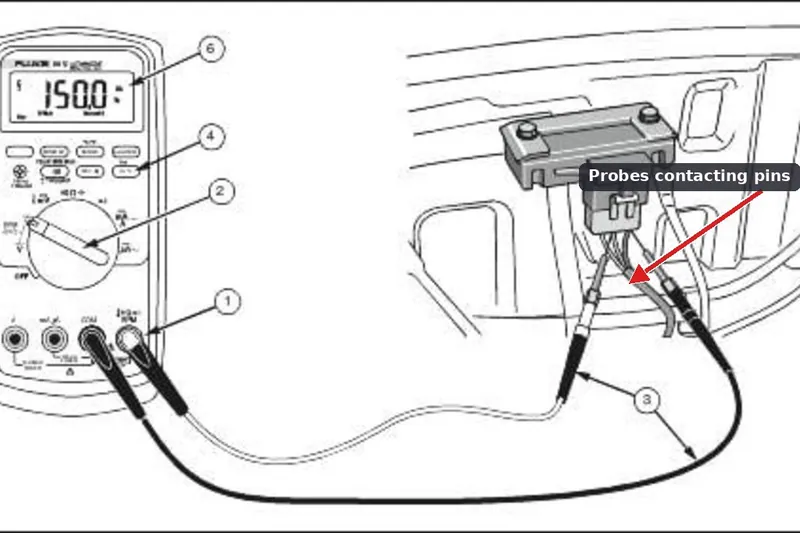
Disconnect the MAF sensor. Turn the ignition ON (engine off). Measure the voltage on the MAF SIGNAL wire terminal in the harness connector. It must be 0V. If you read 5V or 12V, the wire is shorted to power in the harness. Stop here and repair the wiring.
Tools: Multimeter (Advanced) - [PRO TIP] Test Circuit Power and Ground
With the MAF disconnected and ignition ON, test the remaining harness terminals. You must find 12V (battery power), 5V (PCM reference), and a solid ground (< 0.1V). Missing voltages indicate a blown fuse or PCM issue.
Tools: Multimeter (Advanced) - [PRO TIP] Test MAF Sensor Voltage Output
Reconnect the sensor. Backprobe the signal wire with the engine idling; voltage should be 0.5V to 1.0V. Slowly increase RPM. Voltage must rise smoothly to ~4.5V at wide-open throttle. A reading stuck above 4.8V confirms a failed sensor.
Tools: Multimeter, backprobe pins (Intermediate)
When This Code Triggers (Freeze-Frame Conditions)
- Engine Coolant Temp: 180-200°F (The engine is at full operating temperature when the fault registers.)
- RPM: 1500-3000 RPM (The code sets during steady-state cruising or light acceleration, not at idle unless the sensor is hard-shorted.)
- Engine Load: 30-60% (The fault occurs under moderate engine load when the PCM expects a specific airflow reading that contradicts the erroneously high signal.)
- Vehicle Speed: 40-65 mph (Corresponds to city or highway cruising speeds where engine operation is stable, making the high MAF signal mathematically irrational.)
Related Codes
- P0101 — Indicates the MAF signal is irrational compared to RPM and throttle position. A condition causing P0103 often sets P0101 simultaneously.
- P0102 — The direct opposite of P0103, indicating the MAF circuit input is too low (e.g., below 0.5V). Seeing both codes intermittently suggests a frayed wire shorting to both ground and power.
- P0172 / P0175 — These 'System Too Rich' codes are symptoms of P0103. The PCM injects excess fuel based on the false high airflow signal. Always diagnose the MAF code first.
Climate & Environmental Factors
- High Humidity / Moisture: Water ingestion rapidly cools the sensor's hot wire, causing a false, momentary high airflow signal. Moisture also corrodes connector pins.
- Extreme Cold: Repeated temperature cycling degrades the sensor's internal circuitry and plastic housing, leading to premature failure.
How to Talk to a Mechanic About This Code
Say this: "I have a P0103 code. I've cleaned the MAF sensor and checked for obvious wiring damage. Please test the MAF circuit for a short to voltage and check the live data before recommending a new sensor."
Signals you've done research and steers the mechanic towards proper electrical diagnosis rather than just replacing the most likely part.
Avoid saying:
- 'Just fix whatever's wrong'
- 'My check engine light is on, can you look at it?'
- 'Whatever you recommend'
Questions to ask before authorizing the repair:
- What was the MAF sensor's voltage reading at idle and at 2500 RPM?
- Did you test the signal wire for a short to voltage with the sensor disconnected?
- Can you show me the damaged wiring or explain the test results that condemn the sensor?
- What is your warranty on this repair and the replacement part?
Where to Take It: Dealer vs Independent vs Chain
- Dealer:
Best for: Vehicles under powertrain or emissions warranty, Known TSBs apply (e.g., Honda, Jeep), Complex wiring issues on newer cars
Downsides: 1.5-2x labor rate vs independent shops, Replaces entire harnesses instead of repairing wires (Typical cost: +50% vs. baseline) - Independent Shop:
Best fit for most scenarios. A competent independent shop easily diagnoses and repairs P0103, including cleaning, wiring checks, and sensor replacement.
Best for: Out-of-warranty vehicles, Standard diagnosis and sensor replacement
Downsides: Quality varies — vet via reviews and ASE certification, Lacks manufacturer-specific software updates (Typical cost: +0% vs. baseline) - Chain Shop:
Acceptable for a confirmed-bad sensor replacement, but AVOID for initial diagnosis requiring electrical testing.
Best for: Simple part swaps like an air filter replacement
Downsides: High pressure to upsell, Technicians lack deep electrical diagnostic skills (Typical cost: -10% vs. baseline)
When to Walk Away From the Repair
If the estimated repair cost exceeds 50% of the car's private-party value (check KBB or Edmunds), seriously consider selling it.
- Car worth $4000, fix is $2200: Walk away — the repair cost is over 50% of the car's value due to catalytic converter damage.
- Car worth $12000, fix is $450: Fix it — this is a standard repair cost for a MAF sensor replacement.
- Car worth $2500, fix is $1500: Walk away — the repair cost is 60% of the vehicle's value.
What Scan Tool You Need for This Code
Minimum: An OBD-II reader that displays Live Data, specifically the MAF sensor reading in grams/second (g/s).
A basic $20 reader only shows the code 'P0103'. It won't show the live data needed to determine if the sensor reading is stuck high.
Budget: BlueDriver Pro or Ancel BD310 (~$60-100) — Connects to your smartphone via Bluetooth to graph live MAF sensor data (g/s), revealing if the reading is stuck high or ignoring RPM changes.
Mid-range: Foxwell NT301 or Innova 5610 (~$150-350) — Provides a dedicated handheld unit with a screen for viewing live data. The Innova 5610 offers bidirectional controls and detailed diagnostic suggestions.
Professional: Autel MaxiCOM MK808S (~$500-700) — Offers full-system diagnostics on a tablet. Provides fast, detailed live data graphing to handle complex wiring diagnostics.
Rent vs buy: If this is a one-time diagnosis, auto parts stores like AutoZone offer a free loaner tool program. Buy only if you perform your own diagnostics regularly.
How to Clear the Code After You Fix It
- Use an OBD-II scan tool to clear the P0103 code.
- Perform a complete OBD-II drive cycle to allow readiness monitors to run.
- Rescan the vehicle to confirm the code has not returned.
Drive cycle (~30 minutes): A general drive cycle includes: 1. Cold start after sitting 8+ hours. 2. Idle for 3 minutes. 3. Drive city speeds (25-45 mph) with stops. 4. Accelerate to highway speed (55-60 mph) and hold steady for 5 minutes. 5. Coast to a stop without braking.
Readiness monitors affected: Catalyst (CAT) Monitor, Oxygen (O2) Sensor Monitor, Evaporative (EVAP) System Monitor
Before emissions retest: drive at least 100 miles to fully set monitors.
Watch out for:
- Disconnecting the battery clears the code but resets all readiness monitors, causing an immediate emissions test failure.
- The code returns instantly if a wiring short to power was ignored.
- Failing to complete a full drive cycle results in a 'Not Ready' emissions failure.
Will This Fail Emissions / State Inspection?
Yes — this code typically fails an OBD-II emissions inspection.
- California: An active P0103 code triggers an automatic smog check failure. A full drive cycle must be completed post-repair to set readiness monitors.
- New York: The NYS DMV inspection includes an OBD-II scan. An illuminated Check Engine Light for P0103 is an automatic failure.
- Texas: In the 17 counties requiring emissions testing, P0103 causes an automatic annual inspection failure.
Most Commonly Affected Vehicles
- Volkswagen Golf, Passat, Jetta (1999-2006) — Extremely common on 1.9L TDI diesel engines. The sensor degrades and fails, causing severe power loss. Replacement costs $250-$450.
- Ford F-150, Focus, Ranger (2004-2010) — Frequently caused by oiled aftermarket air filters contaminating the MAF sensor. Replacement on an F-150 costs $200-$350.
- Chevrolet / GMC Silverado, Sierra (1999-2013) — Triggered by a dirty or failed MAF sensor. A typical repair cost for a Silverado MAF replacement is $220-$400.
- Honda Civic (1.5L Turbo), CR-V (2016-2024) — TSB 24-005 provides a PCM software update to address false P0103 codes. A short to power in the wiring harness is also a primary cause.
- Jeep Grand Cherokee (2018-2024) — Prone to wiring harness chafing and shorting to power on the 3.6L V6. TSB 25-002-24 provides a wiring protection kit.
- Nissan Sentra, Altima (2013-2019) — Caused by a failing MAF sensor sending a voltage signal above 4.9V. Often appears alongside P0101.
- Subaru WRX, Forester (2002-2014) — Damaged wiring near the sensor is a common cause. Aftermarket cold air intakes without a proper engine tune trigger this code during hard acceleration.
Manufacturer-Specific Notes
- Volkswagen/Audi: On early 2000s TDI diesels, the MAF sensor gradually loses performance rather than failing instantly, causing a slow loss of power before triggering P0103.
- Ford: Using an aftermarket oiled air filter is the leading cause of MAF sensor contamination and P0103 codes on Ford trucks.
- Honda: TSB 24-005 recommends a PCM software update for 2016-2024 Civics to correct overly sensitive P0103 fault logic.
- Jeep: TSB 25-002-24 provides a wiring harness protection kit for 2018-2024 Grand Cherokees, as the factory harness chafes and shorts to power.
Real Owner Stories
2015 Honda Fit with ~100k miles
Check Engine Light illuminated with P0103. The car ran rough at idle. The owner replaced the MAF sensor and checked the ACG fuse, but the code remained.
What they tried:
- Replaced MAF sensor.
- Replaced ACG fuse.
- Checked spark plugs.
Outcome: Tracing the wiring harness revealed a section deep in the engine bay chewed by a mouse. Repairing the damaged wires permanently resolved the P0103 code.
Lesson: If a new sensor doesn't fix the code, a wiring short is the culprit. Visually inspect the entire harness before buying parts.
Subaru WRX in heavy rain
During hard acceleration in heavy rain, the car lost power, threw a P0103 code, and the cruise control light blinked.
What they tried:
- Pulled over, turned off the engine, and let the car sit.
- Restarted the vehicle.
Outcome: Water ingested into the intake splashed the hot MAF sensor element, causing a momentary high-reading spike. After drying, the sensor functioned normally and the code cleared.
Lesson: Heavy rain or deep puddles cause false P0103 codes, especially with aftermarket intakes. Let the sensor dry before attempting repairs.
Mazda Miata after DIY intake install
Immediately after installing an aftermarket cold air intake, the car threw a P0103 code.
What they tried:
- Checked MAF sensor connection.
- Viewed live data showing maxed-out airflow readings.
Outcome: The aftermarket intake altered airflow dynamics, causing the sensor to read incorrectly. The owner required an ECU tune to remap the sensor's expected values.
Lesson: Installing an aftermarket intake without an ECU tune alters airflow geometry and triggers P0103. Revert to the stock airbox to verify.
How to Prevent This Code From Triggering
- Avoid Oiled Aftermarket Air Filters (Always) — Excess oil aerosolizes and coats the delicate MAF sensor wire, insulating it and causing false high readings. Use high-quality dry paper filters.
- Clean the MAF Sensor Periodically (Every 50,000 miles.) — Removes accumulated fine dust and oil vapors, restoring sensor accuracy and preventing P0103 codes.
- Replace Engine Air Filter on Schedule (Every 15,000-30,000 miles.) — Ensures proper airflow dynamics and prevents debris from striking the MAF sensor element.
Frequently Asked Questions
What are the most common mistakes when diagnosing P0103?
The most common mistake is immediately replacing the MAF sensor without testing the wiring. Technicians often miss a short to voltage in the harness. Always test the circuit with a multimeter before condemning the sensor.
Can a bad ground cause P0103?
Yes. The MAF sensor requires a stable ground reference to output correct voltage. A corroded ground wire causes the signal voltage to float high, triggering the code.
Will cleaning the MAF sensor definitely fix a P0103 code?
Cleaning fixes the code if the sensor element is insulated by dirt or oil. It will not fix an internally shorted sensor or a damaged wiring harness.
How much does it cost to fix P0103?
A DIY cleaning costs $15 for an aerosol spray. Professional sensor replacement ranges from $150 to $450, while wiring repairs cost $120 to $350.
What's the difference between P0103 and P0102?
P0103 means the MAF signal voltage is stuck too high, indicating a short to power. P0102 means the signal is too low, indicating an open circuit or short to ground.
Will a P0103 code clear itself?
No. The PCM stores the code in its memory until the underlying short or contamination is fixed. You must clear it manually with an OBD-II scanner after repairs.
Can I pass an emissions test with a P0103 code?
No. An active P0103 illuminates the Check Engine Light, resulting in an automatic emissions failure. The resulting rich fuel mixture also causes tailpipe sniffer test failures.
Key Takeaways
- A dirty Mass Air Flow (MAF) sensor causes 70% of P0103 codes and costs just $15 to fix with a dedicated aerosol cleaner.
- Test the sensor's wiring harness for a 5V or 12V short-to-power before spending $150+ on a replacement MAF sensor.
- Expect a 10-20% drop in fuel economy, black exhaust smoke, and rough idling due to the engine running an overly rich fuel mixture.
- Driving with an active P0103 code for more than a month overheats and destroys the catalytic converter, turning a minor repair into a $2,500+ replacement.
Shop the Parts Behind P0103
Below are the parts most often responsible for code P0103, ranked by how frequently each one is the actual culprit (per the diagnosis above). Tap any to see what we have for your vehicle.




The information in this article is provided for general reference and educational purposes only. Vehicle specifications, procedures, and part compatibility can vary by production date, trim level, and region. Always consult your vehicle's factory service manual and verify part numbers before purchasing or performing repairs. Safety-critical components such as airbags, seat belts, and braking systems should be installed by a qualified professional.
- 🧭 Diagnostic Flowchart
- 🛍️ Shop This Part
- What Does P0103 Mean?
- Can I Drive With P0103?
- Common Causes
- Symptoms
- Common Fixes & Costs
- DIY vs Professional
- Used vs. New Parts: Buying Guide
- What Happens If You Wait — Timeline
- Cost of Not Fixing It
- Diagnosis Steps
- When This Code Triggers (Freeze-Frame Conditions)
- Related Codes
- Climate & Environmental Factors
- How to Talk to a Mechanic About This Code
- Where to Take It: Dealer vs Independent vs Chain
- When to Walk Away From the Repair
- What Scan Tool You Need for This Code
- How to Clear the Code After You Fix It
- Will This Fail Emissions / State Inspection?
- Most Commonly Affected Vehicles
- Manufacturer-Specific Notes
- Real Owner Stories
- 2015 Honda Fit with ~100k miles
- Subaru WRX in heavy rain
- Mazda Miata after DIY intake install
- How to Prevent This Code From Triggering
- Frequently Asked Questions
- What are the most common mistakes when diagnosing P0103?
- Can a bad ground cause P0103?
- Will cleaning the MAF sensor definitely fix a P0103 code?
- How much does it cost to fix P0103?
- What's the difference between P0103 and P0102?
- Will a P0103 code clear itself?
- Can I pass an emissions test with a P0103 code?
- Key Takeaways
- 🎟️ Get 5% Off