

P0103 on 2011-2018 Ford Focus 2.0L: MAF Circuit High Causes and Fixes
P0103 on a 2011-2018 Ford Focus most often means the Mass Airflow (MAF) sensor has failed or its wiring is damaged. The code indicates the sensor's output voltage is stuck high, which the computer interprets as maximum airflow. A replacement MAF sensor (Motorcraft part CP9Z-12B579-B) is the most common fix. Expect to pay around $70-$150 for an aftermarket part and $150+ for an OEM Motorcraft sensor. It is a simple DIY replacement held by two T20 Torx screws.
- P0103 on your Focus means the MAF sensor circuit is sending a signal that's too high.
- The most likely cause is a failed MAF sensor, which is a simple, 10-minute DIY replacement with a T20 Torx driver.
- Before replacing, inspect the sensor's wiring and connector for damage, as this is a possible and cheaper fix.
- Cleaning the sensor with dedicated MAF cleaner is worth trying, but often a 'circuit high' code indicates an internal electrical failure that cleaning won't fix.
- Always use the correct MAF sensor cleaner; other chemicals can damage the sensor.
What's Unique About the 2011-2018 Ford Focus
On the third-generation Ford Focus (2011-2018) with the 2.0L GDI engine, the MAF sensor is a common failure point located conveniently on the air filter housing. The P0103 code is frequently caused by an internally shorted sensor, which is a common failure mode for this part. The Intake Air Temperature (IAT) sensor is integrated into the MAF sensor assembly, so a failure will almost always trigger the related IAT high circuit code P0113 simultaneously. For 2012-2014 models, it's also critical to check for wiring harness chafing against the intake manifold, as outlined in Ford TSB 18-2062, which can cause this and other electrical codes.
Symptoms You May Notice
- Check Engine Light is on
- Engine runs rough or idles erratically
- Hesitation or stumbling during acceleration
- Reduced engine power or 'limp mode'
- Decreased fuel economy
- Black smoke from the exhaust
- Hard starting or stalling
- Engine backfiring or bogging down on throttle
- Replacing the oxygen (O2) sensors, as poor running conditions can sometimes be mistaken for an O2 sensor issue.
- Replacing spark plugs or ignition coils without first diagnosing the MAF circuit.
- Assuming a vacuum leak is the cause. While vacuum leaks can cause MAF-related codes, they more commonly trigger 'lean' codes (P0171/P0174) or MAF 'range/performance' codes (P0101) rather than a 'circuit high' code.
Most Likely Causes
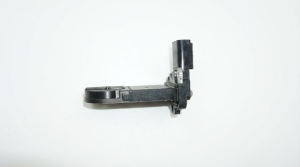
- Failed Mass Airflow (MAF) Sensor 🔴 High Probability → Shop Fuel Injection Air Flow Meter The sensor can fail internally, causing a short circuit that sends a constant high voltage signal to the PCM. This is the most reported fix in owner forums for a P0103, especially when paired with P0113.
How to confirm: With a scan tool, observe the MAF sensor reading (in grams/second) and IAT temperature. If the MAF reading is stuck at a very high number (e.g., 1023 g/s) and the IAT reads -40°F/C regardless of engine RPM, the sensor has failed. Unplugging the sensor should cause the engine to run better in its default 'limp' mode, confirming the sensor was providing bad data.
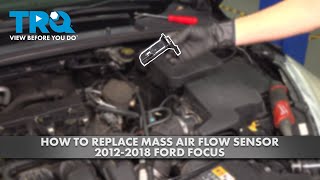
Typical fix: Replace the MAF sensor. It is held in by two T20 Torx screws. 🎬 Watch: How to replace the MAF sensor on your Focus
Est. part cost: $70-$180 - Wiring or Connector Issue 🟡 Medium Probability Ford TSB 18-2062 specifically calls out a tendency for the engine wiring harness to chafe against the intake manifold on 2012-2014 models, which can short the MAF signal wire. Rodent damage has also been a reported cause.
How to confirm: Visually inspect the wiring harness leading to the MAF sensor, paying close attention to where it might rub against the intake manifold or other components. Check for a secure connection at the plug and look for corrosion or pushed-out pins. Use a multimeter to check for 12V power, good ground, and the signal wire voltage at the connector.
Typical fix: Repair the damaged section of the wiring harness with solder and heat shrink. Reroute the harness or add protective conduit to prevent future chafing.
Est. part cost: $5-$50 - Dirty MAF Sensor ⚪ Low Probability → Shop Fuel Injection Air Flow Meter While more likely to cause a 'range/performance' code (P0101), excessive contamination from dirt or oil (especially from an over-oiled aftermarket air filter) can sometimes cause erratic high readings. However, for a hard 'circuit high' fault, this is less likely than an electrical failure.
How to confirm: Remove the sensor and inspect the small wires or sensing elements. If they are coated in dirt or oil, this is a possible culprit.
Typical fix: Clean the sensor elements carefully using only dedicated MAF sensor cleaner spray. Do not touch the elements. Let it dry completely before reinstalling.
Est. part cost: $10-$15
Rare But Worth Checking
- Faulty Powertrain Control Module (PCM): This is extremely rare. The PCM should only be considered after all other possibilities, including the sensor and its entire circuit, have been exhaustively tested and ruled out. A PCM failure is more likely if multiple, unrelated sensor circuit codes are present.
- Clogged Air Filter: → Shop Air Cleaner Assembly A severely clogged air filter can restrict airflow, but it is highly unlikely to cause a 'circuit high' code. It is more associated with performance issues or other MAF codes like P0101.
Diagnosis Steps
- Read the fault codes with an OBD-II scanner. Confirm P0103 is present and note if P0113 is also stored, which is highly likely.
- Using the scanner's live data function, monitor 'MAF (g/s)' and 'IAT (°F/°C)'. With Key On, Engine Off (KOEO), MAF should be 0 g/s. At idle, it should be around 2-4 g/s. A P0103 fault will likely show a reading pegged at its maximum value (e.g., 1023 g/s) and the IAT at -40°.
- Visually inspect the air filter to ensure it is not excessively clogged.
- Inspect the MAF sensor's electrical connector for a tight fit, corrosion, or pushed-out pins. Trace the wiring harness back from the connector, looking for any visible damage, especially where it might rub against the intake manifold per TSB 18-2062.
- Unplug the MAF sensor. Clear the codes. Start the engine. If it starts and runs more smoothly (in limp mode), this strongly suggests the sensor itself is faulty and was providing erroneous data.
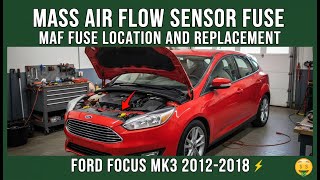
- If you have a multimeter, test the connector (sensor unplugged, KOEO). You should find a 12V power wire, a ground wire (check for continuity to chassis ground), and a 5V reference wire. A short to power on the signal wire will cause P0103. 🎬 See how to check and swap a blown MAF fuse
- If wiring and connections appear good, and the live data readings were clearly illogical, replace the MAF sensor. This is the most probable fix.
- After replacement, clear the codes and perform a test drive to ensure the issue is resolved.
Parts You'll Likely Need
- Mass Airflow Sensor
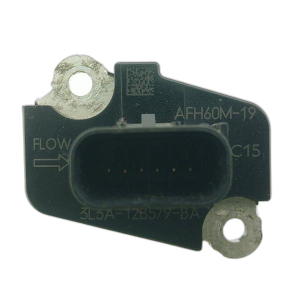
(OEM #CP9Z-12B579-B (Motorcraft AFLS191))— This is the most common cause of a P0103 code, as the sensor fails internally and sends an incorrect high voltage signal. The IAT sensor is integrated, so this single part fixes both P0103 and the commonly associated P0113.
Trusted brands: Motorcraft, Bosch, Delphi, Hitachi, NTK
OEM price range: $150-$200
Aftermarket price range: $70-$150
Related Codes That Often Appear With This One
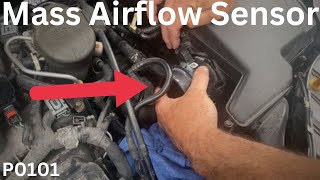
- P0113 — Intake Air Temperature Sensor 1 Circuit High. The IAT sensor is integrated into the MAF sensor assembly on the Ford Focus. A wiring problem or internal failure affecting the MAF will almost certainly affect the IAT circuit, making these two codes appear together. 🎬 Watch: Diagnosing and fixing P0103 and P0113 codes
- P0102 — Mass Air Flow (MAF) Circuit Low. Seeing both high and low codes can point to an intermittent wiring problem or a sensor that is failing erratically.
Technical Service Bulletins (TSBs) & Recalls
- TSB 18-2062: Details a known issue on 2012-2014 Focus 2.0L GDI models where the engine wiring harness can chafe against the intake manifold, leading to various DTCs including those related to MAF, TPS, and other sensors.
Platform-Specific Known Issues
- TSB 18-2062: For 2012-2014 models, the engine wiring harness can chafe against the intake manifold, causing shorts or opens in various sensor circuits, including the MAF sensor. This should be inspected before replacing parts.
- Recall 18S32 / 19S22 (NHTSA 18V735): Related to a faulty canister purge valve (CPV) that can cause drivability issues and fuel system problems. While not a direct cause of P0103, it's a critical issue on this platform and the PCM software update associated with it can affect overall fuel system monitoring.
Mechanic-Grade Diagnostic Values
- MAF Sensor Live Data (g/s) at idle — expected: Approximately 2.0 g/s. A general rule is that g/s should roughly match engine displacement in liters at idle.. Failure: A reading that is stuck at a very high number (e.g., over 150 g/s) or does not change with RPM. A P0103 fault will often show a value pegged at the sensor's maximum output.
- MAF Sensor Live Data (g/s) at 2500 RPM — expected: Should rise smoothly to between 15 to 25 g/s.. Failure: Reading does not increase with RPM, increases erratically, or remains pegged high.
- MAF Sensor Signal Voltage — expected: A variable DC voltage that is proportional to airflow, typically around 0.5-1.5V at idle and rising with throttle.. Failure: Voltage remains higher than 4.5V - 4.9V for more than a few seconds.
- MAF Sensor Connector - Power Supply (KOEO) — expected: One wire should have battery voltage (~12V).. Failure: No voltage or significantly low voltage indicates a wiring or fuse issue.
- MAF Sensor Connector - Ground Circuit (KOEO) — expected: Less than 0.1V when testing voltage, or near 0 Ohms resistance to chassis ground.. Failure: Voltage reading higher than 0.1V or high resistance indicates a poor ground connection.
Scan Tool Commands That Help
- Professional Scan Tool (e.g., Ford IDS, Autel, Snap-on): Live Data Graphing - MAF PID — This is the primary method to visually confirm sensor functionality. The MAF reading (g/s) should rise and fall smoothly, tracking with RPM and Throttle Position (TPS). A flat-lined, erratic, or pegged graph indicates a faulty sensor or circuit.
- Ford IDS: KOER (Key On, Engine Running) Self-Test — This is a standard Ford diagnostic routine that commands the PCM to check all sensor inputs against expected ranges under operating conditions. It will flag a P0103 if the MAF reading is out of the calibrated range during the test.
- Any OBD-II Scanner: Clear Codes / Reset KAM (Keep Alive Memory) — After replacing the MAF sensor, clearing the codes and resetting the KAM (if available) will force the ECU to immediately start using the new sensor's data. While the system will self-adapt over a few drive cycles, this provides a quicker reset.
Wiring & Ground Locations
- MAF Sensor Connector (C103) — On the MAF sensor, which is mounted on the air filter housing outlet pipe.. This is the primary connection point for the sensor. A loose connection, corrosion on pins, or damage to the connector lock can cause a P0103. The typical 4-pin layout is Pin 1: IAT Signal, Pin 2: Ground, Pin 3: Power (12V), Pin 4: MAF Signal. A short between Pin 3 and Pin 4 would cause a P0103.
- Main Engine-to-Chassis Ground — Bolted to the chassis frame underneath the airbox, in front of the battery.. A poor main ground connection can cause a floating ground, leading to incorrect voltage readings for multiple sensors, including the MAF. Cleaning this connection point is a critical step in diagnosing any electrical fault.
- TCM Ground Points — Two bolts on the transmission case, below the airbox area, are often used as ground points for the Transmission Control Module.. While primarily for the TCM, these grounds are part of the overall engine grounding scheme. On the Focus, poor grounds in this area are a known issue and can contribute to widespread electrical noise and erratic sensor behavior. Ensuring these are clean and tight is good practice.
OEM Part Supersession History
7M51-12B579-BB→CP9Z-12B579-B (Motorcraft AFLS191)— Standard part number evolution and potential minor revisions.
Heads up: The part appears physically consistent across the 2011-2018 model years for the 2.0L engine. Aftermarket parts may have different housings or number of pins, so verifying fitment is crucial.
Model Year Variations Within This Range
- 2012-2014: These model years are specifically called out in TSB 18-2062 for a wiring harness that is prone to chafing against the intake manifold. While the issue can occur on any year, these are the most documented.
Diagnostic Flowchart
Other Known Issues on This Vehicle
Issues unrelated to this code that are worth knowing about as an owner of this generation:
- DPS6 PowerShift Dual-Clutch Transmission Failure 🔴 High — Extremely common on 2012-2016 models. Symptoms include shuddering, hesitation, jerky shifts, and complete loss of engagement. (Ref: Multiple class-action lawsuits and warranty extensions (e.g., 14M01) were issued. Ford replaced clutches and Transmission Control Modules (TCMs) for many owners.)
- Electronic Power Steering (EPAS) Failure 🔴 High — Common across the generation, especially early models (2012-2014). Can cause a sudden loss of power steering assist, making the wheel very difficult to turn. (Ref: Ford issued TSBs to reprogram the EPAS module, but often a full steering rack replacement is required.)
- Canister Purge Valve (CPV) Failure 🟠 Medium — Very common. The valve sticks open, causing rough idle after refueling, engine stalling, and potential fuel tank deformation due to excessive vacuum. (Ref: NHTSA Recalls 18V735 (18S32) and 19V515000 (19S22) were issued to reprogram the PCM and replace the CPV if necessary.)
- Passenger-Side Engine Mount Collapse 🟠 Medium — The hydraulic passenger-side engine mount frequently fails prematurely (typically 50k-80k miles), leading to excessive vibration in the cabin at idle and while driving.
- Engine Wiring Harness Chafing 🟠 Medium — A known issue on 2012-2014 models where the harness rubs against the intake manifold, causing various electrical faults and sensor codes. (Ref: TSB 18-2062 provides a diagnostic and repair procedure.)
Used vs. New Parts: Buying Guide for This Vehicle
When a used part is the smart pick: A used OEM MAF sensor from a low-mileage donor vehicle can be a cost-effective option, as OEM sensors are generally more reliable than aftermarket alternatives. Given the electronic nature of the part, it's a calculated risk.
Donor-vehicle mileage cap: roughly under 60000 miles for the part to have meaningful remaining life.
What to inspect on the donor part:
- Check for physical damage to the connector and housing.
- Ensure the sensing element area is visibly clean and free of oil or debris.
- Verify the part number on the used sensor matches the OEM number for your vehicle.
- Ask the seller for the mileage of the donor vehicle if possible.
OEM-only on this vehicle (don't cheap out):
- Mass Airflow Sensor
Aftermarket brands forum-validated for this vehicle:
- Hitachi (often an OE supplier for Ford)
- Delphi
- Bosch
- NTK/NGK (WVE)
Brands owners have reported issues with on this vehicle:
- Unknown 'white box' or no-name brands from online marketplaces.
- Store brands like Duralast and Spectra Premium have received mixed reviews in forums, with some users reporting immediate drivability issues after installation.
Real Owner Stories
Aggregated from forums and TSBs cited above. Mileages and costs reflect what owners reported in those sources.
2012 Ford Focus 2.0L GDI
Symptoms: The car was experiencing classic symptoms including bogging down, stalling, and backfiring.
What fixed it: Unplugging the sensor allowed the car to run in limp mode, confirming the sensor was the issue; the MAF sensor was replaced.
Source hint: Reddit r/FordFocus - Multiple MAF related codes and rough performance even after replacing MAF sensor.
2011-2018 Ford Focus 2.0L I4
Symptoms: P0103 and P0113 codes appeared with rough running immediately after a starter replacement.
What fixed it: The issue was attributed to a disturbed wiring harness or connector during the starter repair.
Source hint: Reddit r/FordFocus - P0103 and P0113 code after starter replacement
Related OBD-II Codes
Frequently Asked Questions
Does TSB 18-2062 apply to my 2013 Ford Focus with a P0103 code?
I'm seeing P0103 and P0113 together on my Focus; does this mean I have two broken sensors?
Can I just clean the MAF sensor on my 2.0L GDI engine to fix this?
Will unplugging the MAF sensor help diagnose the problem on my Ford Focus?
Is the P0103 code related to the Ford Focus transmission or purge valve recalls?
Helpful Videos

We Have This Part in Stock

The information in this article is provided for general reference and educational purposes only. Vehicle specifications, procedures, and part compatibility can vary by production date, trim level, and region. Always consult your vehicle's factory service manual and verify part numbers before purchasing or performing repairs. Safety-critical components such as airbags, seat belts, and braking systems should be installed by a qualified professional.
- Ford Focus:
- 🧭 Diagnostic Flowchart
- 🎬 Helpful Videos
- 🛍️ Shop This Part
- What's Unique About the 2011-2018 Ford Focus
- Symptoms You May Notice
- Most Likely Causes
- Rare But Worth Checking
- Diagnosis Steps
- Parts You'll Likely Need
- Related Codes That Often Appear With This One
- Technical Service Bulletins (TSBs) & Recalls
- Platform-Specific Known Issues
- Mechanic-Grade Diagnostic Values
- Scan Tool Commands That Help
- Wiring & Ground Locations
- OEM Part Supersession History
- Model Year Variations Within This Range
- Other Known Issues on This Vehicle
- Used vs. New Parts: Buying Guide for This Vehicle
- Real Owner Stories
- 2012 Ford Focus 2.0L GDI
- 2011-2018 Ford Focus 2.0L I4
- Related OBD-II Codes
- Frequently Asked Questions
- 🎟️ Get 5% Off