

P0103 on 2010-2012 Saab 9-5: MAF Circuit High Input Causes and Fixes
P0103 on a 2010-2012 Saab 9-5 means the Mass Air Flow (MAF) sensor is sending an abnormally high signal. The most common fix is to clean the sensor with dedicated MAF cleaner. If that fails, replacing the MAF sensor, typically a Bosch unit, is the next step. Expect to pay $100-$250 for a new sensor. Also, inspect the wiring and connector for damage, as this is a known potential cause.
- P0103 means the MAF sensor signal is too high, usually causing a rich fuel condition and poor performance.
- Always start by cleaning the MAF sensor with a dedicated cleaner; this is a cheap and very common fix.
- The 2010-2012 Saab 9-5 uses GM-based engines; the 2.0T and 2.8T use different MAF sensors. Ensure you buy the correct part for your engine.
- Using a quality OEM brand sensor (like Bosch or ACDelco) is highly recommended, as these cars can be sensitive to sensor calibration.
What's Unique About the 2010-2012 Saab 9-5
The 2010-2012 Saab 9-5 (known as the NG9-5 or YS3G) is built on a General Motors (GM) Epsilon II platform, which it shares with the Buick LaCrosse/Regal and Opel Insignia. This is important because many engine components, including the MAF sensor and its electronics, are GM-sourced parts, often manufactured by Bosch. These platforms can be sensitive to MAF sensor calibration, so using a cheap, non-OEM sensor can sometimes fail to fix the issue or cause other performance problems. The Saab Workshop Information System (WIS) specifically notes to check for contamination from a ruptured hydrocarbon (HC) absorber in the air cleaner assembly, which can leak charcoal and foul the sensor element.
Symptoms You May Notice
- Check Engine Light is on
- Rough or unstable idle
- Hesitation or stumbling during acceleration
- Noticeable loss of engine power
- Black smoke from the exhaust during acceleration
- Decreased fuel economy
- Engine speed drops slower than normal when releasing the accelerator
- Engine stalling, especially at idle
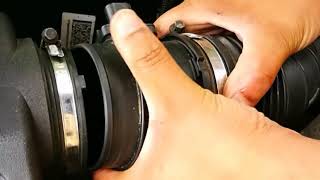
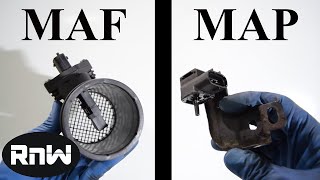
- Replacing oxygen (O2) sensors. While a rich condition can affect O2 sensor readings, the P0103 code points specifically to a problem in the MAF circuit itself. 🎬 See this breakdown of P0103 causes and common fixes.
Most Likely Causes
- Dirty or Contaminated MAF Sensor 🔴 High Probability → Shop Fuel Injection Air Flow Meter Oil from aftermarket air filters or fine debris bypassing a worn air filter can coat the sensor's delicate hot wire, insulating it and causing incorrect readings. The Saab WIS also points to the possibility of a ruptured hydrocarbon absorber in the air cleaner leaking charcoal onto the sensor.
How to confirm: Visually inspect the MAF sensor's wire or film element. If it appears dirty, oily, or has debris on it, it needs cleaning.
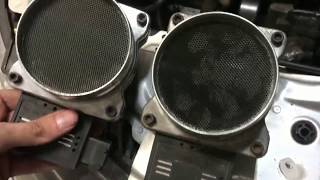
Typical fix: Carefully remove the sensor and spray the sensing element thoroughly with a dedicated Mass Air Flow sensor cleaner. Do not use brake or carb cleaner, as they can damage the sensor. Do not touch the element. Let it air dry completely before reinstalling. 🎬 Watch: How to replace your air filter and clean the sensor.
Est. part cost: $10-$15 for cleaner - Failed MAF Sensor 🟡 Medium Probability → Shop Fuel Injection Air Flow Meter The Saab Workshop Information System (WIS) notes that this trouble code can indicate an internal fault in the sensor itself. Electronics can fail over time, leading to a permanent high-voltage or high-frequency signal.
How to confirm: If cleaning the sensor and checking the wiring doesn't resolve the code, the sensor is the likely culprit. A scan tool can monitor the MAF signal; a fixed, high reading that doesn't change with RPM points to a bad sensor.
Typical fix: Replace the MAF sensor. It is highly recommended to use an OEM-quality part from a brand like Bosch or an official GM/ACDelco part.
Est. part cost: $100-$250 - MAF Sensor Wiring or Connector Issue ⚪ Low Probability → Shop Fuel Injection Air Flow Meter The WIS suggests inspecting the harness to ensure it's not routed too close to high-voltage components like ignition coils or solenoids, which can induce a high-frequency signal. Corrosion in the connector, pushed-out pins, or a frayed wire shorting to a power source can also cause this code.
How to confirm: Inspect the MAF sensor connector for corrosion, moisture, or pushed-out pins. Trace the wiring harness for any signs of damage, melting, or improper routing. Use a multimeter to check for a short to voltage on the signal wire.
Typical fix: Repair the damaged section of the wiring harness or clean/replace the connector pigtail.
Est. part cost: $5-$50
Rare But Worth Checking
- Clogged Engine Air Filter: → Shop Air Cleaner Assembly A severely clogged air filter can cause turbulent or restricted airflow across the MAF sensor, which might lead to erratic or high readings. It's a simple and inexpensive item to check first.
- Vacuum Leaks: While typically causing lean codes, a significant vacuum leak in the intake system after the MAF sensor can, in some scenarios, cause turbulent air that results in an incorrect high reading.
- Engine Control Module (ECM) Fault: In very rare cases, the fault can be within the ECM's internal circuitry that processes the MAF signal. This should only be considered after all other possibilities, including wiring and the sensor itself, have been exhaustively ruled out.
Diagnosis Steps
- Read all fault codes using an OBD-II scanner. Note any other codes that are present.
- Visually inspect the air intake system between the air filter and the throttle body for any obvious cracks, loose clamps, or disconnected hoses.
- Inspect the engine air filter. If it is dirty or clogged, replace it.
- Unplug and inspect the MAF sensor electrical connector for corrosion, moisture, or damaged pins. Ensure it is fully seated.
- Inspect the wiring harness leading to the MAF sensor for any signs of damage, fraying, or melting. Ensure it is not routed near ignition coils or the alternator.
- Remove the MAF sensor and inspect the sensing element. If dirty, clean it using only dedicated MAF sensor cleaner spray. Allow it to dry completely.
- Reinstall the sensor, clear the codes, and perform a test drive to see if the P0103 code returns.
- If the code returns, use a scan tool with live data capability to monitor the MAF sensor reading (in Hz or g/s). A reading that is stuck at a very high value (approaching or exceeding 15,152 Hz for this car) and does not change with engine RPM strongly suggests a failed sensor or a wiring short to power.
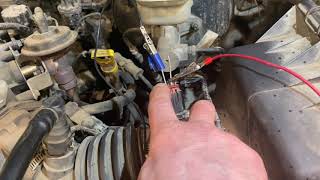
- If live data is inconclusive, use a multimeter to test the MAF sensor circuit. Check for proper power (12V), ground (less than 5 ohms to chassis ground), and signal voltage at the connector according to the vehicle's service manual.
- If wiring and connections are confirmed to be good and cleaning did not work, replace the MAF sensor, preferably with a genuine OEM part.
Parts You'll Likely Need
- Mass Air Flow Sensor (2.0L Turbo L4)
(OEM #12671624)— This is the most common part to fail if cleaning the original sensor does not resolve the code. The 2.0T engine is a GM-family engine (LHU Ecotec). This part number supersedes 13432262 and 13505433.
Trusted brands: ACDelco / GM Genuine Parts, Bosch
OEM price range: $120-$180
Aftermarket price range: $70-$130 - Mass Air Flow Sensor (2.8T Turbo V6)
(OEM #93185455)— This is the most common part to fail if cleaning the original sensor does not resolve the code. The 2.8T V6 uses a different sensor from the 2.0T. This is a Bosch sensor also used by Opel.
Trusted brands: Bosch, OES, Delphi
OEM price range: $180-$250
Aftermarket price range: $100-$160 - Mass Air Flow Sensor Cleaner — Often, the sensor is just dirty and does not need to be replaced. This is the first and most cost-effective repair attempt.
Trusted brands: CRC, Liqui Moly
Aftermarket price range: $10-$15
Related Codes That Often Appear With This One
- P0101 — P0101 indicates a MAF 'Range/Performance' issue. A sensor that is reading too high (P0103) is also, by definition, out of its expected performance range, so these codes often appear together.
- P0172 / P0175 — These codes indicate 'System Too Rich' for Bank 1 and Bank 2. A false high airflow reading from the MAF sensor causes the ECM to inject too much fuel, leading to a rich condition.
Technical Service Bulletins (TSBs) & Recalls
- While no TSBs directly address P0103, Saab TSB 248-2748 (referenced in general TSB lists) discusses diagnosing intermittent electrical faults, which could be relevant for a wiring-related cause of P0103.
Mechanic-Grade Diagnostic Values
- MAF Sensor Signal Frequency (Fault Trigger) — expected: < 15,152 Hz. Failure: A reading greater than 15,152 Hz will set DTC P0103.
- MAF Sensor Ground Circuit Resistance — expected: < 5 Ω between the ground circuit terminal 2 and chassis ground.. Failure: Resistance greater than 5 Ω indicates an open or high resistance in the ground circuit, which can cause a high signal reading.
- MAF Sensor Ignition Circuit Voltage — expected: A test lamp should illuminate between the ignition circuit (terminal 4) and ground with the key ON.. Failure: If the test lamp does not illuminate, there is a short to ground or an open/high resistance in the power supply to the sensor.
- MAF Sensor 5V Reference Circuit — expected: 4.8-5.2 V between the signal circuit (terminal 5) and the ground circuit (terminal 2) with the key ON.. Failure: Voltage below this range suggests an open/high resistance or short to ground in the signal circuit. Voltage above this range indicates a short to voltage.
- Live Data - MAF Reading at Idle (2.0T LHU) — expected: Approximately 2-7 g/s (grams per second) at a stable, warm idle.. Failure: A reading that is stuck at a maximum value or does not respond to changes in RPM indicates a sensor or wiring fault.
Scan Tool Commands That Help
- Tech2 / GDS2: Live Data > MAF Sensor (Hz) — This is the primary function to diagnose P0103. Monitor the frequency reading at idle and while revving the engine. A value that is stuck high (near or above 15,152 Hz) or doesn't change with RPM points to a failed sensor or a wiring short to power.
- J 38522 Variable Signal Generator: ECM Input Simulation — This is an advanced, mechanic-grade test. After disconnecting the MAF, this tool is used to send a known frequency signal to the ECM. If the scan tool shows the expected frequency (e.g., 5,000 Hz), but the code was setting with the sensor connected, it proves the ECM is processing the signal correctly and the fault is in the sensor or its wiring.
Wiring & Ground Locations
- B75 MAF Sensor Connector (2.0T L4) — In the air intake duct, between the air filter housing and the turbocharger inlet pipe.. This is the main connection point. Corrosion, pushed-out pins, or a loose connection here will directly cause MAF codes. Pin 2 is Ground, Pin 4 is Ignition Voltage, and Pin 5 is the Signal circuit.
- B75 MAF Sensor Connector (2.8T V6) — In the air intake duct, between the air filter housing and the turbocharger inlet pipe.. This is the main connection point. The 2.8T uses a 4-pin connector. Pin 1: IAT Signal, Pin 2: Ground, Pin 3: Ignition Voltage, Pin 4: MAF Signal. A fault on pin 2, 3, or 4 can cause P0103.
- G107 / G108 — In the engine compartment, on the left and right frame rails/strut towers.. These are major chassis and engine bay ground points. The ECM and its sensors rely on a clean ground path. Corrosion or looseness at these points can introduce electrical noise and voltage offsets, potentially causing erratic sensor readings that could be misinterpreted by the ECM.
- G7 — On the side of the intake manifold for the 4-cylinder engine.. This is a primary engine sensor ground point. A poor connection here can cause unstable readings from multiple sensors, including the MAF, as they may share a common ground reference path back to the ECM.
Real Owner Repair Stories
- Reddit user on r/saab (2006 Saab 9-5 (Older generation, but diagnostic principle is identical)) — Check Engine Light with P0101 (Range/Performance), sluggish acceleration.
❌ Tried (didn't work) Initially planned to just clean the sensor.
✅ What actually fixed it The user discovered the hose clamp securing the MAF sensor to the intake pipe was completely loose. After cleaning the sensor and properly tightening the clamp, the acceleration issue was resolved. This indicates unmetered air was likely causing the fault, not a bad sensor.
OEM Part Supersession History
Bosch 0280218254 (GM 55562426)→Bosch 0280218268, Bosch 0280218429, GM 12671624— Product revision, consolidation, and updates by the manufacturer.
Heads up: While these parts are listed as supersessions, Saab forums strongly recommend using the exact original Bosch part number if possible. Some owners report that aftermarket versions or even later OEM revisions can cause subtle calibration issues, leading to persistent performance problems that are difficult to diagnose.
Diagnostic Flowchart
Other Known Issues on This Vehicle
Issues unrelated to this code that are worth knowing about as an owner of this generation:
- Rear Trunk LED Light Bar Failure 🟠 Medium — Extremely common. The original design has poor moisture sealing and circuit board design, leading to partial or complete failure. Gaskets were reportedly wrong size from the factory. (Ref: No official recall, but numerous aftermarket repair kits and services exist due to the high failure rate.)
- Timing Chain Wear/Failure (2.0T & 2.8T) 🔴 High — A known issue on the GM 2.0T (LHU) and 2.8T (LP9) engines, especially on vehicles with higher mileage or inconsistent oil change histories. Symptoms include rattling noises on startup. (Ref: No specific recall, but it is a widely discussed problem in owner forums.)
- Haldex (XWD) All-Wheel-Drive System Maintenance 🟠 Medium — The XWD system requires periodic fluid and filter changes for the coupling and eLSD (if equipped). Neglect can lead to pump failure or loss of AWD function. (Ref: No recall, but it's a critical maintenance item. Control modules can also fail and are becoming scarce.)
- Automatic Transmission Problems (Diesel Models) 🔴 High — While less common in North America, the 2.0 TTiD diesel models were known to have issues with the automatic transmission valve body and, in some cases, complete gearbox failure at higher mileage (around 110,000+ km).
Used vs. New Parts: Buying Guide for This Vehicle
When a used part is the smart pick: A used MAF sensor is generally NOT recommended for this vehicle. The sensor's calibration is critical, and its performance degrades over time. A used sensor may be just as faulty as the one being replaced, or it may have been contaminated by the donor car's issues (like an oiled air filter or ruptured HC absorber). It's only a smart choice if it's extremely low-cost ($10-20) and you're using it purely for a quick diagnostic swap to see if the code changes, not as a permanent fix.
Donor-vehicle mileage cap: roughly under 40000 miles for the part to have meaningful remaining life.
What to inspect on the donor part:
- Ensure the donor vehicle did not use an aftermarket oiled air filter (e.g., K&N). Ask to see the airbox.
- Inspect the sensor's mesh screen for any physical damage or debris.
- Look at the sensing element itself; if it looks oily, black, or coated, it's a poor candidate.
- Check the donor vehicle's VIN to ensure it's the exact same engine and model year to avoid calibration mismatches.
OEM-only on this vehicle (don't cheap out):
- Mass Air Flow Sensor
Aftermarket brands forum-validated for this vehicle:
- Bosch (The Original Equipment Manufacturer)
- ACDelco / GM Genuine Parts
Brands owners have reported issues with on this vehicle:
- Unbranded, 'no-name' sensors from online marketplaces. Forum users consistently report that cheap aftermarket MAF sensors are poorly calibrated for the Saab/GM engine management system and often fail to fix the code or introduce new driveability problems.
Related OBD-II Codes
Frequently Asked Questions
My Saab 9-5 has a P0103 code. What brand of MAF sensor should I buy if I need to replace it?
Could my aftermarket oiled air filter be the reason for the P0103 code on my 2011 9-5?
The Saab service manual (WIS) mentions a 'hydrocarbon absorber'. How does that relate to a MAF sensor failure?
Is there a specific known issue with the MAF sensor wiring harness on the 2010-2012 Saab 9-5?
Are there any official TSBs from Saab that directly address the P0103 code?
I have a P0103 code and also hear a rattling noise when I start my 2.0T engine. Are these problems related?
I'm looking at a used 2011 Saab 9-5. What other common electronic issues should I check for besides engine codes?
Helpful Videos
We Have This Part in Stock

The information in this article is provided for general reference and educational purposes only. Vehicle specifications, procedures, and part compatibility can vary by production date, trim level, and region. Always consult your vehicle's factory service manual and verify part numbers before purchasing or performing repairs. Safety-critical components such as airbags, seat belts, and braking systems should be installed by a qualified professional.
- Saab 9-5:
- 🧭 Diagnostic Flowchart
- 🎬 Helpful Videos
- 🛍️ Shop This Part
- What's Unique About the 2010-2012 Saab 9-5
- Symptoms You May Notice
- Most Likely Causes
- Rare But Worth Checking
- Diagnosis Steps
- Parts You'll Likely Need
- Related Codes That Often Appear With This One
- Technical Service Bulletins (TSBs) & Recalls
- Mechanic-Grade Diagnostic Values
- Scan Tool Commands That Help
- Wiring & Ground Locations
- Real Owner Repair Stories
- OEM Part Supersession History
- Other Known Issues on This Vehicle
- Used vs. New Parts: Buying Guide for This Vehicle
- Related OBD-II Codes
- Frequently Asked Questions
- 🎟️ Get 5% Off