

P0106 on 2016-2017 Buick Envision: MAP Sensor & Vacuum Leak Guide
P0106 on a 2016-2017 Buick Envision most often points to a faulty Manifold Absolute Pressure (MAP) sensor or a vacuum leak in the intake system. However, a GM Technical Service Bulletin (PIP5529B) reveals a very common cause for this specific platform is loose intake manifold bolts. Before replacing parts, check the torque on these bolts. If loose, tightening them often resolves the issue.
- P0106 on your Envision means the MAP sensor's reading is out of sync with what the engine computer expects.
- The most likely cause is a faulty MAP sensor, which is a relatively inexpensive and easy part to replace yourself.
- Before replacing the sensor, always check for vacuum leaks from cracked hoses or bad gaskets, as this is another common cause.
- Symptoms to watch for include a rough idle, poor acceleration, and lower gas mileage.
- If multiple other engine codes are present along with P0106, a more complex issue may be present, as noted in GM's technical service bulletins.
What's Unique About the 2016-2017 Buick ENVISION
For the 2016-2017 Buick Envision, which uses either a 2.5L LCV or a 2.0L Turbo LTG engine, the P0106 code has a very specific and well-documented quirk. While a faulty MAP sensor is a possibility, GM issued Technical Service Bulletin PIP5529B which explicitly identifies loose intake manifold bolts as a frequent cause for P0106, often accompanied by other codes. This creates a small vacuum leak that the ECM interprets as a sensor performance problem. This issue is shared across numerous GM vehicles using the same engines, like the Chevy Malibu and Cadillac ATS. Therefore, a primary diagnostic step for this vehicle, unlike many others, is to physically check the torque of the intake manifold bolts before assuming a sensor has failed.
Diagnostic Flowchart
Tap your situation to follow the diagnostic path that matches what you're seeing on this vehicle.
Symptoms You May Notice
- Check Engine Light is on
- Rough or unstable idle
- Hesitation or lack of power during acceleration
- Decreased fuel economy
- Engine stalling, especially when coming to a stop
- Black smoke from the exhaust
- Hard starting
- Replacing the MAP sensor when the root cause is loose intake manifold bolts.
- Replacing the throttle body when the issue is a simple vacuum leak.
- Replacing oxygen sensors when the rich or lean condition is caused by incorrect MAP sensor readings.
Most Likely Causes
- Loose Intake Manifold Bolts 🔴 High Probability → Shop Engine Intake Manifold As identified in GM TSB PIP5529B, the intake manifold bolts on the 2.5L LCV and 2.0L LTG engines can loosen over time, creating a vacuum leak that triggers a P0106 code.
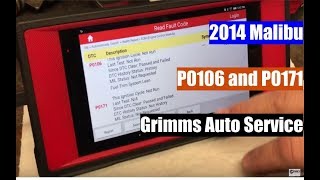
How to confirm: With the engine cool, use a torque wrench to check the intake manifold bolts. If they are noticeably loose, this is very likely the cause. The issue is often found on platform mates like the Chevy Malibu. 🎬 Watch this video to see how loose bolts cause these codes.
Typical fix: Per TSB PIP5529B, remove one bolt at a time, apply medium strength threadlocker, reinstall, and torque all bolts in sequence to 89 lb-in (10 Nm). The TSB advises against replacing the gasket unless a leak is confirmed after torquing.
Est. part cost: $5-$15 (for threadlocker) - Faulty Manifold Absolute Pressure (MAP) Sensor 🟡 Medium Probability → Shop Manifold Absolute Pressure Sensor The MAP sensor is exposed to constant heat and vibration in the engine bay, leading to eventual failure from normal wear and tear, typically after 100,000 miles.
How to confirm: Check the MAP sensor's voltage reading with a scan tool. With the key on and engine off, it should read near barometric pressure (around 4.5-5.0 volts). At idle, it should drop to 1-2 volts and respond instantly to throttle changes. If the reading is stuck, slow, or erratic, the sensor is likely bad.
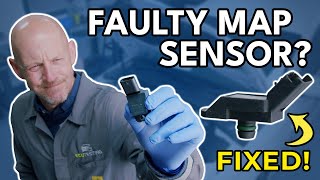
Typical fix: Replace the MAP sensor. It is typically mounted directly on the intake manifold 🎬 Watch this quick guide to help you find the sensor location. with a single bolt.
Est. part cost: $30-$90 - Vacuum Leak (other than intake manifold) 🟡 Medium Probability Vacuum hoses (especially PCV lines) and intake components can become brittle and crack over time due to heat and age, allowing unmetered air to enter the engine.
How to confirm: Visually inspect all vacuum hoses connected to the intake manifold for cracks or disconnections. Listen for a hissing sound with the engine running. For a definitive diagnosis, perform a smoke test to see where smoke escapes from the intake system.
Typical fix: Replace the cracked hose or leaking gasket. Common leak points include the PCV hoses and the air intake tube between the air filter and throttle body.
Est. part cost: $10-$200 - Wiring or Connector Issue ⚪ Low Probability The wiring harness or connector for the MAP sensor can become damaged from engine vibration or heat, causing a poor connection. Rodent damage is also a possibility.
How to confirm: Inspect the MAP sensor's electrical connector and wiring for any signs of damage, corrosion, or loose pins. Wiggle the connector with the engine running to see if it affects the idle.
Typical fix: Repair the damaged wiring or replace the connector pigtail.
Est. part cost: $15-$50
Rare But Worth Checking
- TMAP Sensor Icing in Cold Climates: → Shop Manifold Absolute Pressure Sensor In freezing temperatures, GM has noted in a service bulletin (20-NA-043) that ice can form on the TMAP (Temperature/Manifold Absolute Pressure) sensor during long drives, causing a P0106 code. The issue may resolve itself after the engine warms up and the ice melts. The bulletin suggests installing a winter grille cover to prevent recurrence and advises against cleaning the sensor with chemicals or compressed air.
- Clogged Catalytic Converter: A clogged exhaust can create excessive backpressure, which can affect the intake manifold pressure and trigger a P0106 code. This is usually accompanied by other codes and a severe loss of power. One owner of a platform-mate vehicle reported this as the ultimate fix after many other parts were replaced.
- Internal Engine Mechanical Issue: Extremely rare, but a mechanical problem like a stuck or burnt intake valve can disrupt manifold pressure and cause a P0106 that won't go away even with a new sensor. This is because the pressure reading is genuinely erratic due to the mechanical fault.
- Faulty Powertrain Control Module (PCM): This is extremely rare, but the PCM can fail and misinterpret sensor data. This should only be considered after all other possibilities have been exhaustively ruled out.
Diagnosis Steps
- Scan for any other stored trouble codes. The presence of codes like P0171 or P0068 strongly suggests an air leak, as noted in TSB PIP5529B.
- CRITICAL STEP FOR THIS VEHICLE: With the engine cool, check the torque on the intake manifold bolts. Per TSB PIP5529B, loose bolts are a very common cause. If loose, remove one at a time, apply medium-strength threadlocker, and torque to 89 lb-in (10 Nm). Clear codes and test drive before proceeding.
- If bolts were tight, proceed with standard diagnosis. With the engine running, listen for any audible hissing noises that would indicate a vacuum leak.
- Visually inspect all vacuum lines (especially PCV hoses) and the air intake tube for cracks, loose connections, or damage.
- Inspect the MAP sensor's electrical connector and wiring for any signs of damage or corrosion.
- Using a scan tool with live data, monitor the MAP sensor reading. With the Key On, Engine Off (KOEO), the reading should be close to barometric pressure (around 4.5-5.0 volts).
- Start the engine. At idle, the MAP sensor reading should drop significantly (to around 1-2 volts).
- Briefly snap the throttle open. The MAP sensor reading should respond instantly. If it's slow, stuck, or doesn't change, the sensor is likely faulty.
- If the sensor appears to respond correctly but the code persists, perform a smoke test on the intake system to find any hard-to-see vacuum leaks.
- Check the engine air filter to ensure it is not clogged.
Parts You'll Likely Need
- Manifold Absolute Pressure (MAP) Sensor
(OEM #12711681 (replaces 12644228), 55573248)— This is a common component to fail, but should only be replaced after checking for loose intake bolts. Part number can vary, so confirm with VIN.
Trusted brands: ACDelco, Bosch, Delphi
OEM price range: $40-$90
Aftermarket price range: $25-$60 - Medium Strength Threadlocker — Required for the TSB-specified fix of re-securing loose intake manifold bolts to prevent them from backing out again.
Trusted brands: Loctite, Permatex
OEM price range: $5-$15
Aftermarket price range: $5-$15 - Intake Manifold Gasket — Only needed if a leak is confirmed after tightening the intake manifold bolts. The TSB specifically advises not to replace this part otherwise.
Trusted brands: ACDelco, Fel-Pro
OEM price range: $40-$70
Aftermarket price range: $20-$40
Related Codes That Often Appear With This One
- P0171 — Indicates the system is running too lean. A vacuum leak from loose intake bolts is a common cause for both P0171 and P0106, and they are listed together in TSB PIP5529B.
- P0068 — Indicates a conflict between the MAP sensor, throttle position sensor, and MAF sensor readings. The TSBs for the Envision list these codes together, suggesting a common underlying cause like a major air leak.
- P0107 — Indicates MAP sensor circuit voltage is too low, often pointing directly to a failed sensor or wiring short.
- P0108 — Indicates MAP sensor circuit voltage is too high, also pointing to a failed sensor or wiring issue.
Technical Service Bulletins (TSBs) & Recalls
- PIP5529B: Mentions P0106 in a list of multiple DTCs that can be set together. Crucially, it identifies loose intake manifold bolts as a primary cause and details the repair procedure involving threadlocker and re-torquing.
- PIP5529A: An earlier version of the same bulletin with similar information regarding multiple DTCs including P0106.
- 20-NA-214: While not specific to the Envision, this GM bulletin describes a condition where P0106 can be set due to ice forming on the TMAP sensor in very cold weather, a relevant possibility for this vehicle.
Platform-Specific Known Issues
- TSB #PIP5529B: Loose Intake Manifold Bolts: → Shop Engine Intake Manifold This is the most significant vehicle-specific issue. GM identified that P0106 (often with P0068, P0171, and others) is frequently caused by intake manifold bolts that have loosened over time. The official fix is not to replace the gasket, but to remove each bolt, apply threadlocker, and re-torque to 89 lb-in (10 Nm). This simple procedure often resolves the code without any parts replacement.
- TSB #20-NA-043: TMAP Sensor Icing: → Shop Manifold Absolute Pressure Sensor In cold climates (below 24°F / -5°C), ice can form on the TMAP sensor during extended drives, causing P0106. The issue often resolves itself once the engine heat melts the ice. GM recommends installing a winter grille cover to prevent this. The bulletin explicitly states not to clean the sensor with chemicals or compressed air if this is suspected.
Mechanic-Grade Diagnostic Values
- MAP Sensor 5V Reference Voltage — expected: Approximately 5.0 Volts DC with Key On, Engine Off (KOEO).. Failure: Voltage significantly lower or higher than 5.0V points to a problem with the ECM or the wiring.
- MAP Sensor Signal Voltage (KOEO) — expected: 4.5 - 5.0 Volts, corresponding to atmospheric pressure.. Failure: A voltage significantly outside this range suggests a faulty sensor or a wiring issue.
- MAP Sensor Signal Voltage (Engine at Idle) — expected: 1.0 - 2.0 Volts (can range from 0.75-2.0V depending on altitude).. Failure: Voltage that is too high (closer to KOEO voltage) or does not drop when the engine starts indicates a major vacuum leak or a faulty sensor.
- MAP Sensor Ground Circuit Voltage Drop — expected: Less than 0.1 Volts (100 mV).. Failure: Voltage higher than 0.1V indicates high resistance in the ground circuit, which can skew sensor readings.
- MAP Sensor Pressure (Scan Tool, Idle) — expected: 20-52 kPa, depending on altitude.. Failure: Pressure reading that is close to BARO at idle suggests a massive vacuum leak or a sensor that is not reading vacuum.
Scan Tool Commands That Help
- GDS2 (GM Dealer Tool): MAP Performance Test parameter — The GM diagnostic strategy for P0106 uses model-based diagnostics. The scan tool displays parameters like 'MAP Performance Test 1' and 'MAP Performance Test 2', which compare the actual MAP sensor reading to an ECM-calculated estimate based on MAF and throttle position. A large discrepancy here confirms that the MAP reading is irrational, helping to isolate the fault.
Wiring & Ground Locations
- MAP Sensor Connector — On the MAP sensor, which is mounted directly to the intake manifold.. The connector is a common failure point due to heat and vibration. A 3-pin connector is typical. Pin A is often Sensor Ground (Black/White), Pin B is the MAP Signal (Yellow), and Pin C is the +5V Reference (Orange). Verifying 5V power and a good ground at this connector is a key diagnostic step.
- Engine Wiring Harness Chafe Point (Related TSB) — On platform-mate Chevrolet Malibus (2016-2017), TSB 17-NA-181 notes the engine harness can chafe against a coolant hose clamp (heater inlet, air bleed, or upper radiator hose).. While not specific to the Envision, this is a known issue on a vehicle sharing the same platform and engines. Damage to the harness can affect the MAP sensor circuit wires, causing intermittent P0106, P0107, or P0641 codes. This is a valuable check if direct sensor/vacuum issues are not found.
Real Owner Repair Stories
- Reddit user in r/MechanicAdvice (General vehicle, not Envision specific, but relevant to P0106 behavior.) — P0106 code appeared immediately after the battery died and was replaced. The engine was idling incredibly hard and stalling.
❌ Tried (didn't work) Replacing the MAP sensor did not fix the code.
✅ What actually fixed it The user was advised that disconnecting the battery can cause the computer to lose its idle position calibration. The recommended fix was to thoroughly clean the throttle body, reconnect the battery, and then let the vehicle idle for 10 minutes without touching the accelerator to allow the computer to relearn the idle position. This procedure often resolves a P0106 that appears after a power loss event.
OEM Part Supersession History
12644228→12711681— Standard part evolution for improved reliability or manufacturing changes. A GM service update (N212332660) for other models with erratic MAP signals specifically calls for replacing older sensors with 12711681.12591290→12644228— Older part number that was updated to 12644228 for many GM applications.
Heads up: While 12591290 may be listed for some GM vehicles, 12644228 (and its successor 12711681) is the more current and reliable part for this engine family.
Helpful Videos




We Have This Part in Stock




The information in this article is provided for general reference and educational purposes only. Vehicle specifications, procedures, and part compatibility can vary by production date, trim level, and region. Always consult your vehicle's factory service manual and verify part numbers before purchasing or performing repairs. Safety-critical components such as airbags, seat belts, and braking systems should be installed by a qualified professional.
- Buick ENVISION:
- 🧭 Diagnostic Flowchart
- 🎬 Helpful Videos
- 🛍️ Shop This Part
- What's Unique About the 2016-2017 Buick ENVISION
- Symptoms You May Notice
- Most Likely Causes
- Rare But Worth Checking
- Diagnosis Steps
- Parts You'll Likely Need
- Related Codes That Often Appear With This One
- Technical Service Bulletins (TSBs) & Recalls
- Platform-Specific Known Issues
- Mechanic-Grade Diagnostic Values
- Scan Tool Commands That Help
- Wiring & Ground Locations
- Real Owner Repair Stories
- OEM Part Supersession History
- 🎟️ Get 5% Off