

P0106 on 2007-2014 Chevrolet Silverado 3500: MAP Sensor and Engine Fault Guide
On a 2007-2014 Silverado 3500, code P0106 most often points to a faulty or contaminated Manifold Absolute Pressure (MAP) sensor. Cleaning the sensor port or replacing the sensor is the most common fix, with parts costing between $25 and $70. However, this code can also be a critical warning for a broken valve spring, especially if accompanied by code P0506, making a thorough diagnosis essential.
- P0106 on a 2007-2014 Silverado most commonly points to a faulty MAP sensor or a blocked sensor port in the intake manifold.
- Before replacing any parts, always remove the MAP sensor and clean both the sensor tip and its port in the intake manifold.
- Check for vacuum leaks from cracked hoses, as this is a frequent and inexpensive fix.
- Be aware of the TSBs for this truck: the code can be caused by ice buildup in the intake or, more seriously, a broken valve spring.
- Do not confuse the MAP sensor with the MAF sensor; P0106 is specific to the Manifold Absolute Pressure sensor.
What's Unique About the 2007-2014 Chevrolet SILVERADO 3500
On this generation of Silverado, P0106 has specific, well-documented causes beyond a simple bad sensor. GM issued a technical service bulletin (TSB #PI1257) acknowledging that the MAP sensor's location could lead to ice or moisture buildup, causing this code in cold weather. Another TSB for Duramax diesel models (#PIP4307H) describes a similar icing issue and provides instructions for a sensor modification. More critically, TSB #PIP5423 warns that P0106, especially when seen with code P0506, can be a symptom of a more serious mechanical problem: a broken valve spring. While the MAP sensor is the most likely culprit, these known issues make a thorough diagnosis crucial to avoid misdiagnosis and potential engine damage.
Diagnostic Flowchart
Tap your situation to follow the diagnostic path that matches what you're seeing on this vehicle.
Generation note: The 2007-2014 year range primarily covers the second generation (GMT900) of the Silverado HD, which was introduced in 2007. The previous generation (GMT800) was also sold in 2007 as the 'Classic' model. This guide focuses on the GMT900 platform, but the causes are highly relevant to other GM trucks of the era.
Symptoms You May Notice
- Check Engine Light is on
- Rough or erratic idle
- Poor acceleration or hesitation
- Reduced fuel economy
- Engine stalling
- Black smoke from the exhaust
- Engine misfires or a ticking/tapping noise
- Replacing the Mass Airflow (MAF) sensor. P0106 is a MAP sensor code, not a MAF sensor code.
- Replacing the throttle body when it only needs cleaning.
- Replacing the MAP sensor repeatedly when the underlying cause is a vacuum leak or mechanical fault like a broken valve spring.
Most Likely Causes
- Faulty or Dirty MAP Sensor 🔴 High Probability → Shop Manifold Absolute Pressure Sensor A GM TSB (#N212330660) directly advises dealers to replace the MAP sensor for this code. The sensor can also become contaminated with oil or carbon from the PCV system, insulating it from accurate pressure readings, or it can fail electronically.
How to confirm: With a scan tool, monitor the MAP sensor voltage. At KOEO (Key On, Engine Off), it should read ~4.5-5.0 Volts, matching the BARO reading. At idle, it should drop to 1.0-2.0 Volts. If the reading is stuck, erratic, or doesn't change smoothly with throttle input, the sensor is likely bad.
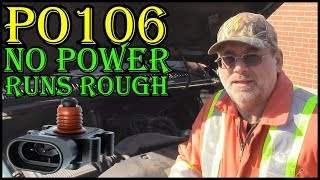
Typical fix: Replace the MAP sensor. It is located on top of the intake manifold, often behind the throttle body, and held by a single bolt. 🎬 Watch: Step-by-step guide to replacing your MAP sensor.
Est. part cost: $25 - $70 - Contaminated/Iced MAP Sensor Port 🔴 High Probability → Shop Manifold Absolute Pressure Sensor TSB #PI1257 specifically addresses this issue on gas engines, where moisture can freeze in the intake manifold port for the MAP sensor, blocking it and causing incorrect readings. A similar issue affects Duramax diesels per TSB #PIP4307H. A redesigned intake manifold was released to solve the gas engine issue.
How to confirm: Remove the MAP sensor and visually inspect the port in the intake manifold for ice, water, oil, or carbon buildup.
Typical fix: Thoroughly clean the port with a small pick and appropriate cleaner, being careful not to damage the sensor itself with harsh chemicals. If the problem persists in cold weather, the updated intake manifold (for gas engines) or sensor modification (for diesel) may be required.
Est. part cost: $0 (for cleaning) - Vacuum Leaks 🟡 Medium Probability Hoses for the PCV system, brake booster, and other vacuum-operated accessories can crack and leak over time. The intake manifold gaskets on the V8 engines are also a known failure point that can cause lean codes (P0171/P0174) alongside P0106.
How to confirm: Visually inspect all vacuum hoses connected to the intake manifold for cracks or disconnections. Listen for a hissing sound at idle. A smoke test is the most effective way to find hard-to-see leaks, especially from the brake booster or intake gaskets.
Typical fix: Replace the cracked or leaking vacuum hose(s) or gaskets. The brake booster vacuum hose 🎬 See this easy trick to find hidden vacuum leaks. is a common failure point.
Est. part cost: $10 - $50 - Broken Valve Spring ⚪ Low Probability → Shop Engine Valve Spring TSB #PIP5423 specifically links codes P0106 and P0506 to a potential broken valve spring on V8 engines. This causes a loss of compression and allows exhaust gases to push back into the intake (reversion), which disrupts manifold pressure and confuses the MAP sensor.
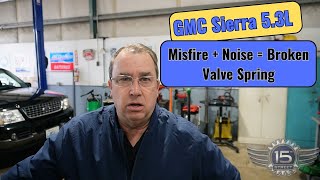
How to confirm: This is a serious mechanical issue. A rhythmic ticking or misfire at idle is a key symptom. A compression test will show low or zero compression in the affected cylinder. Visual inspection requires removing the valve cover to look for a physically broken spring. In severe cases, this can cause the intake manifold runner to melt. 🎬 Watch: How to identify a broken valve spring by sound.
Typical fix: Requires professional diagnosis and replacement of the broken spring and any related damaged components (valve seals, keepers). If the valve dropped, more significant engine repair is needed.
Est. part cost: $20 - $100 for the spring, but labor is significant.
Rare But Worth Checking
- Dirty Throttle Body: → Shop Fuel Injection Throttle Body On drive-by-wire systems, heavy carbon buildup can restrict airflow at idle, forcing the ECM to hold the throttle plate at an abnormal angle. This mismatch between the expected and actual airflow can sometimes falsely trigger a P0106 code. Cleaning the throttle body is a worthwhile step before replacing more expensive parts.
- Clogged Catalytic Converter: A severely restricted exhaust creates backpressure that affects intake manifold pressure, potentially leading to a P0106 code. This is usually accompanied by a significant loss of power, especially at higher RPMs, and possibly other exhaust-related codes.
Diagnosis Steps
- Read all stored DTCs with a scan tool to check for other related codes, paying close attention to P0506 or any P030x misfire codes.
- Visually inspect the MAP sensor, its electrical connector, and nearby wiring for damage, corrosion, or looseness.
- Inspect all vacuum lines connected to the intake manifold for obvious cracks, brittleness, or disconnections, especially the PCV and brake booster lines.
- Using a scan tool's live data, observe the MAP sensor reading (usually in kPa or Volts) with the Key On and Engine Off (KOEO). The reading should be ~4.5-5.0V and correspond to the barometric pressure for your altitude.
- Start the engine. At idle, the reading should drop significantly to 1.0-2.0V (indicating vacuum). Rev the engine; the reading should respond instantly and smoothly.
- If the reading is stuck, slow to respond, or erratic, remove the MAP sensor.
- Inspect the sensor's port in the intake manifold for any blockage like ice, water, oil, or carbon. Clean the port thoroughly.
- If the port is clear and the sensor's behavior on the scan tool was incorrect, the MAP sensor is the most likely failure point and should be replaced.
- If the engine runs very poorly with a rhythmic misfire and codes P0506/P030x are present, suspect a mechanical issue. Remove the valve covers to inspect for a broken valve spring and perform a compression test on the affected cylinder.
Parts You'll Likely Need
- Manifold Absolute Pressure (MAP) Sensor
(OEM #12644228, 213-4658)— This sensor is the most frequent cause of P0106, either due to electronic failure or contamination. Multiple TSBs point to its replacement as the primary
Related Codes That Often Appear With This One
- P0108 — This code for 'MAP/BARO Circuit High Input' is often seen with P0106, as they both relate to implausible signals from the same sensor. TSB #N212330660 mentions both codes occurring together.
- P0506 — This code for 'Idle Air Control System RPM Lower Than Expected' can appear with P0106 when there is a serious mechanical issue, such as the broken valve spring mentioned in TSB #PIP5423. This combination is a strong indicator of a mechanical fault rather than a simple sensor issue.
- P0300-P0308 — A misfire code (e.g., P0300 for random misfire) can be caused by the incorrect air/fuel mixture from a bad MAP sensor, or it can be the result of the same mechanical failure causing the P0106, like a broken valve spring.
- P2002, P2463, P2459 — On Duramax diesel models, P0106 can appear alongside a host of codes related to the Diesel Particulate Filter (DPF) system, as noted in TSB #21-NA-214. This indicates the MAP reading issue may be related to exhaust backpressure problems from a clogged DPF.
Technical Service Bulletins (TSBs) & Recalls
- N212330660: Recommends replacing the MAP sensor for P0106/P0108 codes.
- 21-NA-214: Lists P0106 among many other codes related to DPF and transmission issues on Duramax models.
- PIP5423 / PIP5423B: Links P0106 and P0506 to a possible broken valve spring on V8 engines.
- PI1257: Details issue of ice buildup in the MAP sensor port on gas engines and the fix involving a redesigned intake manifold.
- PIP4307H: Describes MAP sensor icing on 6.6L Duramax engines and provides a modification procedure as a fix.
Platform-Specific Known Issues
- TSB #PI1257 documents an issue where ice can build up in the MAP sensor port on gas engines, causing code P0106. The fix involves installing a redesigned upper intake manifold.
- TSB #PIP4307H describes a similar icing issue on 6.6L Duramax engines in cold climates and details a procedure to fabricate and install an extension to move the sensor's inlet.
- TSB #PIP5423B warns that codes P0106 and P0506 appearing together strongly point to a broken valve spring on V8 engines, which requires removing the valve cover for inspection and replacement.
- TSB #N212330660 for a similar model year range explicitly states that for a P0106 or P0108 code, dealers are to replace the MAP sensor.
Mechanic-Grade Diagnostic Values
- MAP Sensor 5V Reference Wire Voltage — expected: ~5.0 Volts DC with Key On, Engine Off. Failure: Voltage significantly below 5.0V or 0V indicates a wiring issue, a short on the reference circuit, or a faulty ECM.
- MAP Sensor Ground Wire Voltage — expected: Less than 0.1 Volts (100mV). Failure: Higher voltage indicates a poor ground connection, which can skew sensor readings.
- MAP Sensor Signal Wire Voltage (KOEO) — expected: ~4.5 - 5.0 Volts DC (should match BARO reading). Failure: Voltage is low, stuck, or does not match barometric pressure at your altitude.
- MAP Sensor Signal Wire Voltage (at idle) — expected: 1.0 - 2.0 Volts DC. Failure: Voltage is high (closer to KOEO reading), stuck, or erratic, indicating a vacuum leak, blocked port, or faulty sensor.
- MAP Sensor Signal (tested with hand vacuum pump) — expected: At 5 in. Hg of vacuum, voltage should be 3.9-4.1V. At 10 in. Hg, voltage should be 2.8-3.0V.. Failure: Voltage does not drop smoothly and predictably as vacuum is applied.
- Alternator AC Ripple Voltage — expected: Less than 0.09 Volts (90mV) AC with engine running. Failure: AC voltage significantly higher than 90mV indicates a failing alternator diode, which can create electrical noise and cause erratic sensor behavior.
Scan Tool Commands That Help
- GM GDS2 / Professional Bidirectional Scanner: Active Test / Bidirectional Control — To diagnose if the MAP sensor reading is being affected by other systems, a technician can command vacuum solenoids (like for the EGR or EVAP purge valve) to open or close while watching the live MAP data. If the MAP reading does not change when it should, it helps isolate the problem to the sensor/circuit rather than a commanded vacuum change. This confirms the sensor's ability to respond to real pressure changes.
Wiring & Ground Locations
- MAP Sensor Connector — On the MAP sensor itself, located on the top of the intake manifold.. Knowing the pinout is essential for testing. For many GM V8s: Pin A is the 5V reference (Gray wire), Pin B is the signal (Light Green wire), and Pin C is the low reference/ground (Orange/Black wire). These exact colors can vary, but the function of the 5V, signal, and ground pins is consistent.
- 5V Reference Circuit 1 — This is a wiring circuit, not a single physical part. On many 2008+ models, it provides power to multiple sensors.. On an '08 Silverado, the MAP sensor shares its 5V reference circuit with the Fuel Tank Pressure sensor, A/C High-Pressure sensor, Oil Pressure sensor, and Camshaft Position sensor. A short in any of these components or their wiring can pull the voltage down for the entire circuit, causing a P0106 code even if the MAP sensor itself is good.
Real Owner Repair Stories
- Clore Automotive blog, comment by user 'Rick' (2008 Chevrolet Silverado) — Intermittent limp mode and a P0641 (5-Volt Reference 'A' Circuit) code, which often accompanies or causes sensor performance codes like P0106.
❌ Tried (didn't work) Disconnecting sensors on the shared 5V reference circuit one-by-one (MAP, A/C, etc.) did not immediately reveal the fault., Gently wiggling harnesses did not consistently reproduce the fault.
✅ What actually fixed it The fault was an intermittent short in the wiring for the Fuel Pressure sensor, which is located on top of the fuel sending unit. While touching the hard-to-reach connector for this sensor, the 5V reference voltage returned to normal, pinpointing the location of the short. This highlights how a fault in a seemingly unrelated sensor on the same circuit can trigger a MAP sensor code.
"I Checked Everything" — The Actual Cause
- A common scenario is for a smoke test to show no vacuum leaks, yet the P0106 code persists. This often happens when the root cause is electrical, not mechanical. A failing alternator diode can introduce AC ripple voltage (electrical noise) into the DC system, causing the MAP sensor to send erratic signals that the ECM flags as a performance fault. Another example is an intermittent short-to-ground in another sensor that shares the same 5-volt reference circuit, like the fuel tank pressure sensor, which pulls down the voltage for the MAP sensor.
When the Usual Fixes Don't Work
- While replacing the MAP sensor is the most common fix, many owners have replaced the sensor multiple times without resolving the P0106 code. In these cases, the fault often lies in the shared 5-volt reference circuit. A short-to-ground in the wiring for a completely different sensor, such as the fuel pressure sensor on the fuel tank or the A/C pressure sensor, can pull down the reference voltage for the entire circuit. This causes the ECM to see an incorrect signal from the MAP sensor and set a P0106, even though the MAP sensor itself is functioning perfectly. Before replacing the MAP sensor a second time, it is critical to test the 5V reference wire for correct voltage.
OEM Part Supersession History
12644228→12711681— Standard part number update by the manufacturer for design revision or supplier change.
Heads up: The new part number (12711681) is the direct replacement for the original and should be fully compatible.
Model Year Variations Within This Range
- 2007-2013 (GMT900 Gas Engines): These models were specifically prone to MAP sensor port icing in cold weather, as addressed by TSB #PI1257, which recommended a redesigned intake manifold.
- 2008+: Models from around 2008 and newer often group multiple sensors onto a shared 5-volt reference circuit. For example, the MAP, fuel tank pressure, A/C pressure, and oil pressure sensors may all be on the same circuit, making electrical diagnosis more complex.
Helpful Videos



The information in this article is provided for general reference and educational purposes only. Vehicle specifications, procedures, and part compatibility can vary by production date, trim level, and region. Always consult your vehicle's factory service manual and verify part numbers before purchasing or performing repairs. Safety-critical components such as airbags, seat belts, and braking systems should be installed by a qualified professional.
- Chevrolet SILVERADO 3500:
- 🧭 Diagnostic Flowchart
- 🎬 Helpful Videos
- What's Unique About the 2007-2014 Chevrolet SILVERADO 3500
- Symptoms You May Notice
- Most Likely Causes
- Rare But Worth Checking
- Diagnosis Steps
- Parts You'll Likely Need
- Related Codes That Often Appear With This One
- Technical Service Bulletins (TSBs) & Recalls
- Platform-Specific Known Issues
- Mechanic-Grade Diagnostic Values
- Scan Tool Commands That Help
- Wiring & Ground Locations
- Real Owner Repair Stories
- "I Checked Everything" — The Actual Cause
- When the Usual Fixes Don't Work
- OEM Part Supersession History
- Model Year Variations Within This Range
- 🎟️ Get 5% Off