

P0106 on 2006-2010 Ford Explorer 4.6L V8: MAP Sensor Performance Causes and Fixes
On a 2006-2010 Explorer with the 4.6L V8, code P0106 is almost always caused by a faulty Manifold Absolute Pressure (MAP) sensor that is integrated into the EGR valve assembly or a cracked vacuum line leading to it. The integrated design is a major point of confusion. Expect to pay $150-$250 for a genuine Motorcraft replacement part, with a DIY difficulty of 3/5 due to tight access at the rear of the engine.
- For code P0106 on this Explorer, do not look for a standalone MAP sensor; it is part of the EGR valve assembly at the back of the engine.
- Before replacing the expensive EGR/MAP assembly, always inspect the small plastic vacuum lines connected to it for cracks or breaks, as this is a common and much cheaper fix.
- Do not waste money replacing the Mass Airflow (MAF) sensor; it is unrelated to this specific trouble code.
- Symptoms like a rough idle, stalling, and poor acceleration are strongly linked to this code.
- If replacing the assembly, using a high-quality OEM (Motorcraft) part is recommended to ensure compatibility and avoid future issues.
What's Unique About the 2006-2010 Ford Explorer
The most critical thing to know about the 4.6L 3V V8 in this generation of Explorer is that it does not have a standalone MAP sensor that you can easily spot on the intake manifold. Instead, the MAP sensor's function is integrated into the Exhaust Gas Recirculation (EGR) valve assembly, which is located on the back of the engine near the firewall, making access tight. This design is a major source of confusion, leading many owners and even some mechanics to waste time searching for a part that doesn't exist or misdiagnosing the issue as a problem with the Mass Airflow (MAF) sensor.
Symptoms You May Notice
- Rough, surging, or low idle, sometimes stalling when coming to a stop.
- Hesitation, sluggish acceleration, or general lack of power.
- Significantly decreased fuel economy.
- Check Engine Light is on.
- Black smoke from the exhaust in some cases, indicating a rich fuel mixture.
- Replacing the Mass Airflow (MAF) sensor. The P0106 code is specific to the MAP sensor circuit and is not related to the MAF sensor on this vehicle.
- Searching for a standalone MAP sensor on the intake manifold. On the 4.6L 3V V8, it is integrated into the EGR valve assembly at the rear of the engine.
Most Likely Causes
- Faulty EGR Valve Assembly (Integrated MAP Sensor) 🔴 High Probability → Shop Exhaust Gas Recirculation (EGR) Valve The MAP sensor is integrated into the EGR valve, a component subjected to extreme heat and carbon buildup. Failure of the internal MAP sensor electronics requires replacing the entire assembly. Using non-OEM (aftermarket) parts is widely reported on forums to cause the P0106 code to persist or return immediately.
How to confirm: After ruling out vacuum leaks and wiring issues, the component itself is the most likely culprit. A scan tool can monitor MAP sensor voltage. With Key On, Engine Off (KOEO), voltage should be ~4.5-5.0V. At idle, it should drop to 1.0-1.5V. A reading stuck high at idle (e.g., above 2.5V) points to a bad sensor.
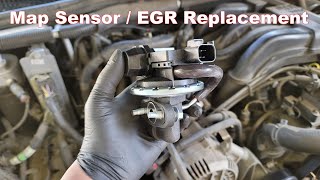
Typical fix: Replace the entire EGR valve assembly with a genuine Motorcraft part. It is located at the rear of the intake manifold and is typically held on by two 10mm bolts. 🎬 Watch this step-by-step guide to replacing the EGR and MAP assembly.
Est. part cost: $150-$250 - Vacuum Leak 🟡 Medium Probability The small, hard plastic vacuum lines connected to the EGR/MAP assembly become brittle from constant heat cycles and can easily crack or break. A YouTube video specifically for a 2010 Explorer showed a broken black vacuum line right at the EGR/MAP assembly as the cause of a P0106 code. NHTSA ODI #10967364 describes a similar failure where plastic tubing disintegrated in the vicinity of the part, triggering both P0106 and P0401 codes.
How to confirm: Visually inspect all vacuum hoses connected to the intake manifold and the EGR valve assembly for cracks, breaks, or loose connections. The lines running to the EGR/MAP are a common failure point. A smoke test is the most effective way to find hard-to-see leaks.
Typical fix: Replace the cracked or broken vacuum hose section. In some cases, a small piece of rubber hose can be used to splice the broken hard line. Entire pre-formed hose assemblies are also available.
Est. part cost: $5-$50 - Damaged Wiring or Connector ⚪ Low Probability
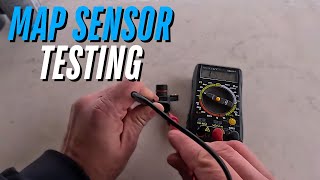
How to confirm: Visually inspect the electrical connector and wiring harness going to the EGR valve assembly for any signs of damage, corrosion, or loose pins. Use a multimeter to check for the correct 5V reference, ground, and a changing signal voltage by back-probing the connector. 🎬 See how to test a MAP sensor using a multimeter.
Typical fix: Repair the damaged section of the wiring harness or clean/replace the connector.
Est. part cost: $10-$100
Rare But Worth Checking
- Clogged Catalytic Converter: A severely restricted exhaust can cause abnormal pressure in the intake manifold, which can sometimes trigger a P0106 code. This is usually accompanied by a severe lack of engine power and potentially other exhaust-related codes.
- Faulty Powertrain Control Module (PCM): This is extremely rare. The PCM should only be considered after all other possibilities, including the sensor, wiring, and vacuum leaks, have been exhaustively ruled out by a professional.
Diagnosis Steps
- Check for any other stored trouble codes that could provide more clues.
- Perform a thorough visual inspection of all vacuum lines connected to the intake manifold and the EGR/MAP assembly. Pay close attention to the hard plastic lines for any cracks or breaks, especially right at the connector to the EGR/MAP unit.
- Inspect the electrical connector and wiring harness at the EGR/MAP assembly for damage, corrosion, or loose connections.
- Using a scan tool, monitor the live data for the MAP sensor PID. With the Key On, Engine Off (KOEO), the MAP reading should be close to the Barometric Pressure (BARO) reading (approx. 14.7 psi / 29.9 inHg at sea level) and the voltage should be around 4.5-5.0V.
- Start the engine. At a stable idle, the MAP voltage should drop significantly to 1.0-1.5V (indicating high vacuum). If the voltage is stuck high (e.g., 2.6V or more), the sensor is likely bad or there is a massive vacuum leak.
- Briefly snap the throttle open; the MAP voltage should jump up towards the KOEO reading (~4.5V).
- If vacuum lines and wiring are intact but the MAP sensor readings are erratic or do not change correctly with engine load, the EGR/MAP assembly is faulty. It is highly recommended to replace it with an OEM Motorcraft part.
- If a vacuum leak is suspected but not visible, perform a smoke test to pinpoint the source of the leak.
Parts You'll Likely Need
- EGR Valve with Integrated MAP Sensor
(OEM #Motorcraft CX-2102 (Ford Base No. 5L2Z-9D475-A, which supersedes 4L2Z-9D475-A and 4L2Z-9D475-HA))— This is the most common cause of failure. The internal MAP sensor fails, requiring the replacement of the entire assembly. Using the OEM Motorcraft part is strongly recommended as aftermarket versions are known to cause persistent issues.
Trusted brands: Motorcraft
OEM price range: $200-$250
Aftermarket price range: $80-$150 - Vacuum Hoses/Connectors — The plastic vacuum lines, especially the black one connected to the EGR/MAP assembly, become brittle with age and are a frequent source of leaks that trigger this code.
Trusted brands: Dorman, Motorcraft
OEM price range: $20-$50
Aftermarket price range: $5-$30
Related Codes That Often Appear With This One
- P0171 — System Too Lean (Bank 1) - Often caused by a vacuum leak that is also affecting the MAP sensor reading.
- P0174 — System Too Lean (Bank 2) - Often caused by a vacuum leak that is also affecting the MAP sensor reading.
- P0401 — EGR Flow Insufficient Detected - Since the MAP sensor is part of the EGR valve assembly, a fault in the assembly can trigger codes for both systems.
- P0172 — System Too Rich (Bank 1) - A faulty MAP sensor can incorrectly tell the PCM the engine is under high load, causing an overly rich fuel mixture.
- P0175 — System Too Rich (Bank 2) - A faulty MAP sensor can incorrectly tell the PCM the engine is under high load, causing an overly rich fuel mixture.
Technical Service Bulletins (TSBs) & Recalls
- TSB Bulletin #SSM 50156 and TSB Bulletin #SSM 49446 note that some Ford vehicles may exhibit an illuminated MIL with DTC P0106 stored in the PCM after transportation to higher altitudes or while in transport mode.
- NHTSA ODI #10787972 references Ford TSB #13-9-8 and TSB-13-5-29, noting that vehicles experiencing P0106 may suffer from hesitation, loss of idle RPM, difficulty starting, and a lack of power.
Platform-Specific Known Issues
- A user on Ford Truck Enthusiasts forum with a 2006 F-150 4.6L (same engine family) reported chasing a P0106 for a long time. After replacing the EGR valve and cleaning the MAF with no success, the issue persisted, highlighting the diagnostic challenge.
- A Reddit user with a 2007 F-150 4.6L got a P0106 code immediately after replacing the intake manifold with a non-OEM EGR/MAP assembly. Swapping to the OEM Motorcraft part resolved the P0106 code, demonstrating the sensitivity to part quality.
- A YouTube video by 'The G Automotive' on a 2010 Explorer with a P0106 code found the cause to be a broken black vacuum line right where it connects to the EGR/MAP assembly. A simple repair with a piece of rubber hose fixed the problem without replacing the expensive assembly. 🎬 Watch a mechanic perform this EGR and MAP sensor swap.
Mechanic-Grade Diagnostic Values
- MAP Sensor Output Frequency (KOEO) — expected: 152-155 Hz at sea level. Failure: A reading significantly outside this range indicates a sensor or wiring issue.
- MAP Sensor Output Frequency (Engine at Idle) — expected: 93-98 Hz. Failure: No change from the KOEO reading, or a reading that doesn't drop into this range, points to a bad sensor or a vacuum leak.
- MAP Sensor Signal Voltage (Engine at Idle) — expected: 0.8 - 1.5 Volts DC. Failure: Voltage stuck high (e.g., above 2.5V) or not responding to throttle changes.
- Sensor 5V Reference Voltage — expected: ~5.0 Volts DC. Failure: No voltage or low voltage indicates a wiring problem or a PCM fault.
Hidden / Shadow Codes Worth Checking
- Mode $06, Test ID $81: On many Ford CAN-bus systems, this test ID relates to MAP sensor rationality and performance checks. It can reveal intermittent sensor issues that haven't yet set a hard P0106 code. (see via A professional scan tool or advanced DIY software (like FORScan) with Mode $06 capabilities.)
Scan Tool Commands That Help
- Ford IDS, FORScan: Reset All Adaptations / Clear KAM (Keep Alive Memory) — This should be performed after replacing the EGR/MAP assembly or fixing a significant vacuum leak. It forces the PCM to relearn fuel trims and sensor baseline values with the new, correct inputs, preventing the code from returning due to old adaptive strategies.
- Ford IDS, FORScan: Datalogger - MAP (PID), BARO, RPM, TP — Use this to graph the MAP sensor's voltage or pressure reading against RPM and Throttle Position (TP). This allows you to visually confirm if the MAP sensor is responding correctly to engine load changes or if it is lagging, sticking, or providing erratic data.
Wiring & Ground Locations
- Engine Control and Ground Distribution Diagrams — Available in vehicle service manuals and online resources for the 2006-2010 Ford Explorer.. The integrated EGR/MAP sensor relies on a clean 5V reference, a solid ground, and an intact signal wire back to the PCM. A corroded ground point or chafed wire in the engine harness can cause the P0106 code. These diagrams are essential for tracing the MAP sensor circuit (VREF, Signal, Ground) and locating primary engine-to-chassis ground points to check for corrosion or looseness.
- EGR/MAP Connector Pins — The electrical connector on the EGR valve assembly at the rear of the engine.. Knowing the pinout is required for testing with a multimeter. You must identify the 5V reference, ground, and signal wires to check for proper voltages without guessing, which could damage the PCM.
OEM Part Supersession History
4L2Z-9D475-A, 4L2Z-9D475-HA→5L2Z-9D475-A— Standard part revision and consolidation by the manufacturer.
Heads up: The service part number for 5L2Z-9D475-A is Motorcraft CX-2102. While no incompatibilities are noted for the official supersession, many aftermarket versions of this part are reported by owners to be faulty out of the box or fail quickly, causing the P0106 code to return. Sticking to the OEM Motorcraft part is highly advised.
Model Year Variations Within This Range
- 2006-2010: The 4.6L 3V V8 in the Explorer uses a cast iron engine block, whereas the same engine family in the 2005+ Mustang GT used an aluminum block. The horsepower difference between the Explorer and Mustang versions is primarily due to a more restrictive exhaust and different PCM tuning for torque, not major internal differences like cams. This does not significantly affect the diagnosis of P0106 within this generation.
Diagnostic Flowchart
Other Known Issues on This Vehicle
Issues unrelated to this code that are worth knowing about as an owner of this generation:
- 5R55S Transmission Failure 🔴 High — Common after 50,000 miles. Symptoms include harsh/delayed shifts (especially into reverse), shift flares between 2-3 and 3-5, and flashing O/D light. (Ref: No recall, but a widely known issue. The primary cause is wear in the servo bores within the aluminum transmission case, leading to pressure loss. Rebuilding the solenoid pack or replacing the valve body are common repair attempts.)
- Timing Chain Tensioner Seal Failure 🟠 Medium — Can occur at any mileage, but more common over 100,000 miles. Presents as a 3-5 second rattle on startup. (Ref: No recall. The plastic tensioners have seals that are prone to blowing out, causing a loss of oil pressure to the tensioner on startup until the pump builds pressure. Ignoring it can lead to chain slap and eventual timing failure.)
- Cracked Plastic Thermostat Housing 🟠 Medium — Common failure item leading to coolant leaks. Often leaks at the seam between the upper and lower housing pieces.
- Cracked Exhaust Manifolds 🟡 Low — A ticking noise, especially when the engine is cold, often indicates a cracked exhaust manifold.
- Leaking Intake Manifold Gaskets 🟡 Low → Shop Engine Intake Manifold — The gaskets between the plastic intake manifold and the cylinder heads can harden and fail, causing vacuum leaks that lead to a rough idle, stalling, and misfires.
Used vs. New Parts: Buying Guide for This Vehicle
When a used part is the smart pick: For this specific repair, sourcing a used EGR/MAP assembly from a junkyard is generally NOT recommended. The high failure rate and sensitivity of the integrated electronics make it a risky purchase. A used part should only be considered if it is a verified OEM Motorcraft part from a very low-mileage, recently wrecked donor vehicle, and if the price offers substantial savings over a new OEM part.
Donor-vehicle mileage cap: roughly under 50000 miles for the part to have meaningful remaining life.
What to inspect on the donor part:
- Verify the part is a genuine 'Motorcraft' or 'FoMoCo' branded part. Avoid any unbranded or aftermarket-branded used parts.
- Inspect the electrical connector pins for any signs of corrosion, bending, or damage.
- Check the vacuum port for any blockages or heavy carbon buildup.
- Ask for the VIN of the donor vehicle to verify its low mileage and year.
- Ensure there is a return policy in case the part is dead on arrival.
OEM-only on this vehicle (don't cheap out):
- EGR Valve with Integrated MAP Sensor (Motorcraft CX-2102)
Aftermarket brands forum-validated for this vehicle:
- None consistently reported. Forum consensus strongly advises against non-OEM parts for this specific component due to high rates of immediate or premature failure.
Brands owners have reported issues with on this vehicle:
- All non-Motorcraft brands for the EGR/MAP assembly carry a high risk of causing the P0106 code to persist or return.
Real Owner Stories
Aggregated from forums and TSBs cited above. Mileages and costs reflect what owners reported in those sources.
2010 Ford Explorer 4.6L V8
Symptoms: Check engine light with code P0106.
What fixed it: Repaired a broken black vacuum line right at the connection to the EGR/MAP assembly using a small piece of rubber hose.
Source hint: YouTube video by 'The G Automotive' on a 2010 Explorer
2007 Ford F-150 4.6L 3V V8
Symptoms: P0106 code appeared immediately after replacing the intake manifold with a non-OEM EGR/MAP assembly.
What fixed it: Swapping the non-OEM part for a genuine Motorcraft EGR/MAP assembly.
Source hint: Reddit r/AskMechanics - '2007 Ford F-150 4.6 with MAP/BARO code (P0106)'
2006 Ford F-150 4.6L V8
Symptoms: Persistent P0106 error code; owner attempted to clean the MAF and replace the EGR valve without initial success.
What fixed it: Detailed diagnostic path involving checking specific voltage values (4.5-5.0V KOEO and 1.0-1.5V at idle) to confirm sensor/wiring integrity.
Source hint: Ford Truck Enthusiasts - '2006 F150 P0106 error'
Ford Owner Report
Symptoms: An owner reported their check engine light came on with codes P0106 and P0401. They discovered plastic tubing had failed by disintegrating in the vicinity of the EGR/MAP assembly.
Source hint: NHTSA ODI #10967364
Related OBD-II Codes
Frequently Asked Questions
Can I use an aftermarket EGR valve assembly to fix the P0106 code on my 2006-2010 Ford Explorer?
Where is the MAP sensor located on the Explorer 4.6L V8 engine?
What should the MAP sensor voltage read at idle on my 2010 Explorer?
Is there a common vacuum line failure point for the P0106 code on this vehicle?
Why do I have to replace the whole EGR valve if only the MAP sensor is bad?
Could my Explorer's rough idle and stalling at stops be related to P0106?
Helpful Videos

We Have This Part in Stock


The information in this article is provided for general reference and educational purposes only. Vehicle specifications, procedures, and part compatibility can vary by production date, trim level, and region. Always consult your vehicle's factory service manual and verify part numbers before purchasing or performing repairs. Safety-critical components such as airbags, seat belts, and braking systems should be installed by a qualified professional.
- Ford Explorer:
- 🧭 Diagnostic Flowchart
- 🎬 Helpful Videos
- 🛍️ Shop This Part
- What's Unique About the 2006-2010 Ford Explorer
- Symptoms You May Notice
- Most Likely Causes
- Rare But Worth Checking
- Diagnosis Steps
- Parts You'll Likely Need
- Related Codes That Often Appear With This One
- Technical Service Bulletins (TSBs) & Recalls
- Platform-Specific Known Issues
- Mechanic-Grade Diagnostic Values
- Hidden / Shadow Codes Worth Checking
- Scan Tool Commands That Help
- Wiring & Ground Locations
- OEM Part Supersession History
- Model Year Variations Within This Range
- Other Known Issues on This Vehicle
- Used vs. New Parts: Buying Guide for This Vehicle
- Real Owner Stories
- 2010 Ford Explorer 4.6L V8
- 2007 Ford F-150 4.6L 3V V8
- 2006 Ford F-150 4.6L V8
- Ford Owner Report
- Related OBD-II Codes
- Frequently Asked Questions
- 🎟️ Get 5% Off