

P0106 on 2006-2013 Holden Commodore V8: MAP Sensor Causes and Fixes
On a 2006-2013 V8 Commodore, code P0106 is most often caused by a faulty Manifold Absolute Pressure (MAP) sensor. This triggers symptoms like severe rough idle, hesitation, and poor fuel economy. A replacement sensor is relatively inexpensive (around $50-$100 for an aftermarket part) and easy to replace for a DIYer, located on the front of the intake manifold.
- P0106 on your V8 Commodore almost always points to a problem with the MAP sensor circuit.
- The most likely cause is a failed MAP sensor, followed by a vacuum leak from a cracked PCV hose.
- Before buying parts, check all vacuum hoses for cracks and inspect the sensor's wiring and connector.
- Be aware that two different MAP sensors were used on the VE Commodore; verify the correct part for your car before purchasing by checking the connector shape.
- This is a very common and straightforward DIY repair that can be completed with basic tools.
What's Unique About the 2006-2013 Holden Commodore
The Holden VE Commodore uses the robust GM Gen IV V8 (L98/L77), a platform where the MAP sensor is a common and well-understood failure point. While the code itself is standard, owner forums frequently point to the sensor itself failing with age, leading to sudden and severe rough running. It's also worth noting there was a MAP sensor design change around mid-2008, so verifying the correct part for your specific vehicle's VIN is crucial. The early sensor (GM P/N 16212460) has an oval connector, while the later sensor (GM P/N 12591290) has a rectangular one.
Symptoms You May Notice
- Check Engine Light is on
- Engine runs rough, especially at idle
- Hesitation or stumbling during acceleration
- Noticeable decrease in fuel economy
- Difficulty starting the engine, or extended cranking
- Black smoke from the exhaust under load
- Engine stalling at stops or low speeds
- Engine backfiring (in severe cases)
- Replacing the Mass Air Flow (MAF) sensor. While both sensors measure air intake, P0106 is specific to the MAP sensor circuit. Owners sometimes replace the MAF sensor hoping to solve a general performance issue without properly diagnosing the specific code.
- Replacing the Throttle Position Sensor (TPS). A faulty TPS can cause similar hesitation symptoms, but it will typically set its own specific codes (e.g., P0121, P0221).
Most Likely Causes
- Faulty MAP Sensor 🔴 High Probability → Shop Manifold Absolute Pressure Sensor The sensor is a known failure point on this platform due to age and heat cycles in the engine bay. Forum discussions frequently cite outright sensor failure as the fix. Oil contamination from the PCV system can also coat the sensor element, impairing its function.
How to confirm: Use a scan tool to monitor MAP sensor voltage/kPa. With Key On, Engine Off, it should read close to atmospheric pressure (approx. 100 kPa at sea level). At a warm, stable idle, it should be low (e.g., 30-40 kPa). Voltage should sweep smoothly from ~1.0-1.5V at idle to ~4.5V at wide-open throttle. Erratic readings, no change, or being stuck at a high value indicates a bad sensor.
Typical fix: Replace the MAP sensor. It is located on the front of the intake manifold, near the throttle body, and is held in by a single bolt. Ensure you purchase the correct sensor for your model year (pre or post mid-2008).
Est. part cost: $50-$170 - Vacuum Leak 🟡 Medium Probability With age, rubber and plastic vacuum hoses can become brittle and crack. Common failure points on the VE Commodore include the PCV hoses that connect to the valve covers and intake manifold, the brake booster hose, and the small plastic barb fittings on the intake manifold itself which can degrade and leak.
How to confirm: Visually inspect all vacuum hoses connected to the intake manifold for cracks or disconnections. Listen for a hissing sound at idle. A professional smoke test is the most effective way to find small, hidden leaks. You can also carefully spray brake cleaner around suspected leak areas; a change in engine RPM indicates a leak.
Typical fix: Replace the cracked hose or leaking gasket. Some owners on forums recommend replacing the plastic intake manifold barb fittings with more durable brass equivalents.
Est. part cost: $10-$200 - Damaged Wiring or Connector ⚪ Low Probability The wiring harness in the engine bay is exposed to heat and vibration, which can cause wires to break or the connector pins to lose tension over time. On the related Pontiac G8 platform, owners have reported P0106 being caused by broken wires in the harness near the sensor.
How to confirm: Visually inspect the MAP sensor connector and its wiring for any signs of damage, corrosion, or loose pins. Wiggle the connector with the engine running to see if it affects the idle. With the key on, use a multimeter to check for a 5V reference signal, a good ground, and a signal wire at the connector.
Typical fix: Repair the damaged wire or replace the connector pigtail.
Est. part cost: $15-$50
Rare But Worth Checking
- Clogged Catalytic Converter: A severely clogged catalytic converter can create excessive backpressure in the exhaust, which affects manifold pressure and can indirectly trigger a P0106 code. This is usually accompanied by other codes and a significant loss of high-RPM power.
- Incorrect Camshaft Timing: → Shop Engine Camshaft If the engine's timing chain has jumped a tooth or a tensioner has failed, it will drastically alter engine vacuum and can cause a P0106 code. This would be accompanied by very poor running conditions, a rattling noise from the front of the engine, and likely other timing-related trouble codes (e.g., P0008, P0017).
- Faulty Engine Control Module (ECM): This is extremely rare. The ECM itself can fail, but all other possibilities, including wiring and other sensors, should be exhaustively tested before considering ECM replacement.
Diagnosis Steps
- Connect an OBD-II scanner and confirm P0106 is the primary code. Note any other codes present and review freeze frame data to see the conditions when the code was set.
- With the scanner, observe the MAP sensor reading (in kPa) with the Key On, Engine Off. The reading should be close to the Barometric Pressure (BARO) reading, typically around 100 kPa at sea level. A significant difference points to a sensor issue.
- Start the engine. Observe the MAP reading at idle. It should drop to a low value (e.g., 30-45 kPa). Rev the engine; the reading should increase and then drop back down smoothly.
- Visually inspect all vacuum lines connected to the intake manifold, especially the PCV lines to the valve covers and the brake booster hose, for any cracks, loose fittings, or obvious damage.
- Inspect the MAP sensor's electrical connector for corrosion, damage, or loose pins. Ensure it is seated firmly. Wiggle the harness while monitoring MAP data on the scan tool to check for intermittent connection issues.
- If a vacuum leak is suspected but not visible, perform a smoke test. This is the most reliable method to pinpoint the source of small, hard-to-find leaks.
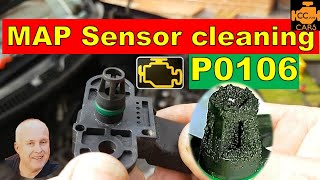
- Remove the MAP sensor (a single bolt) and inspect it and its port for oil contamination from the PCV system or carbon buildup. A heavily oiled sensor is a strong indicator of a problem.
- If no vacuum leaks or wiring issues are found, and the sensor is clean but still provides illogical readings, the MAP sensor itself is the most likely culprit and should be replaced.
Parts You'll Likely Need
- Manifold Absolute Pressure (MAP) Sensor
(OEM #12591290 (Late VE, MY08.5+) / 16212460 (Early VE, 2006-MY08.5))— This is the most common failure item for a P0106 code on this platform. There are two distinct sensors used during the VE production run that are not interchangeable.
Trusted brands: ACDelco, Bosch, Delphi
OEM price range: $120-$170
Aftermarket price range: $50-$100 - Intake Manifold Gaskets — If a vacuum leak is traced to the intake manifold, these gaskets will need to be replaced. This is less common than a hose leak but can happen on higher mileage vehicles.
Trusted brands: ACDelco, Fel-Pro
OEM price range: $50-$80
Aftermarket price range: $30-$60 - PCV Hose — The rubber hoses for the Positive Crankcase Ventilation (PCV) system are a frequent source of vacuum leaks as they become brittle with age and heat exposure.
Trusted brands: GM, Gates
OEM price range: $20-$40
Aftermarket price range: $10-$25
Related Codes That Often Appear With This One
- P3400: On L77 engines with Active Fuel Management (AFM), a P0106 code can sometimes appear alongside a P3400 (Cylinder Deactivation System) code. A Reddit user with a Pontiac G8 (a platform mate) experienced this, suggesting a potential link where the ECU's expected MAP reading during cylinder deactivation doesn't match the actual reading, possibly due to a failing lifter or the MAP sensor issue itself.
Platform-Specific Known Issues
- There are two different MAP sensors used during the VE Commodore's production. Early models (approx. 2006-mid 2008) use a sensor with an oval connector, GM part number 16212460. Later models (approx. mid-2008/MY08.5 to 2013) use a different sensor with a rectangular connector, GM part number 12591290. They are not interchangeable. Always verify the correct part using your vehicle's VIN or by visually inspecting the existing sensor's connector.
- On L77 engines (Sept 2010-2013), the Active Fuel Management (AFM) system can cause issues that may be related. While P0106 is not a direct AFM code, issues with AFM lifters can cause slight variations in engine vacuum that the ECU may flag as a MAP performance issue, especially if the sensor is already marginal.
Mechanic-Grade Diagnostic Values
- MAP Sensor Voltage (Key On, Engine Off) — expected: ~4.5-5.0V (at sea level, should correspond to ~100 kPa). Failure: Voltage significantly lower than expected, or 0V.
- MAP Sensor Voltage (Engine at warm idle) — expected: 1.0 - 1.5 Volts (corresponds to high vacuum, ~30-45 kPa). Failure: Voltage stuck high (e.g., >2.5V), erratic, or not responding to throttle changes.
- MAP Sensor Voltage (Wide Open Throttle) — expected: ~4.5 Volts (corresponds to near-zero vacuum). Failure: Voltage does not increase smoothly with throttle application.
- 5V Reference Voltage at Connector — expected: 5.0 Volts on the Orange wire (Pin C). Failure: No voltage or low voltage indicates a wiring or ECM issue.
- Ground Circuit at Connector — expected: Near 0 Ohms resistance to chassis ground on the Black/White wire (Pin A). Failure: High resistance indicates a bad ground connection.
Scan Tool Commands That Help
- Tech2 / GDS2: MAP vs. BARO Comparison — With Key On, Engine Off, the MAP sensor reading should be nearly identical to the BARO (Barometric Pressure) sensor reading. A significant deviation points to a faulty MAP sensor. This is the first check a dealer technician would perform.
Wiring & Ground Locations
- MAP Sensor Connector (Both Early and Late) — On the front of the intake manifold, near the throttle body.. This is the primary connection point. The 3 pins are: Pin A - Sensor Ground (Black/White wire), Pin B - MAP Signal (Yellow wire), Pin C - 5V Reference (Orange wire). Checking for 5V, ground, and signal integrity here is a core diagnostic step.
- G102 / G103 — These are the main engine block ground points, typically located on the cylinder heads or front of the engine block.. A poor engine ground can cause floating or incorrect readings from various sensors, including the MAP sensor, as it can disrupt the sensor's ground reference.
- ECM/PCM Location — Located in the engine bay, typically under the main fuse box assembly.. All sensor wiring terminates here. In rare cases of persistent wiring faults, checking for continuity back to the ECM connector pins is necessary. A loose ECM mount has also been reported to cause intermittent electrical issues on this platform.
Real Owner Repair Stories
- ScannerDanner YouTube Channel (2005 Chevrolet Trailblazer (Similar GM electronic throttle control logic)) — Check Engine Light with code P0106, no major drivability complaints.
❌ Tried (didn't work) Initial diagnosis pointed towards a bad MAP sensor based on the code alone.
✅ What actually fixed it The throttle body was excessively dirty with carbon buildup. This forced the ECM to command a higher-than-normal throttle angle at idle to maintain target RPM. The ECM saw the high throttle angle but a low MAP sensor reading (high vacuum), which it interpreted as a MAP sensor performance fault. Cleaning the electronic throttle body and plate resolved the code. - Just Commodores Forum (VF Commodore SS (6.2L LS3, similar architecture)) — Sudden, extremely rough idle and vibration on startup, difficulty starting, P0106 code logged.
❌ Tried (didn't work) Initial suggestions included checking the MAF sensor.
✅ What actually fixed it The user was advised that the most direct and likely fix, especially given the sudden and severe symptoms, was to replace the MAP sensor itself. The community confirmed the MAP sensor is a very common failure point for this code.
"I Checked Everything" — The Actual Cause
- A dirty electronic throttle body can cause a P0106 code even with no vacuum leaks. The Engine Control Module (ECM) detects a mismatch between the throttle position (which is opened wider to compensate for the restriction) and the expected manifold pressure. The ECM flags the MAP sensor as irrational, even though the sensor and the vacuum integrity of the manifold are fine. The root cause is the restricted airflow at the throttle plate.
OEM Part Supersession History
16212460 (ACDelco)→12614970, 19418807 (GM)— The original part number was discontinued and replaced by updated versions.
Heads up: These part numbers are for the early VE Commodore (2006-mid 2008) with the oval connector. They are not compatible with the later rectangular connector sensor (12591290).
Model Year Variations Within This Range
- 2006 - Early 2008: Uses MAP sensor with an oval connector, part number 16212460. The VIN cutoff for this part is approximately 8L100907.
- Mid 2008 - 2013: Uses MAP sensor with a rectangular connector, part number 12591290. This sensor is a 1-bar sensor for naturally aspirated applications.
- Sept 2010 - 2013: These models use the L77 engine with Active Fuel Management (AFM). While the P0106 diagnosis is the same, be aware of potential underlying issues with AFM lifters causing vacuum fluctuations that could indirectly trigger this code.
Diagnostic Flowchart
Other Known Issues on This Vehicle
Issues unrelated to this code that are worth knowing about as an owner of this generation:
- AFM/DOD Lifter Failure (L77 Engine) 🔴 High — Common on L77 engines (2010-2013), especially if oil changes are neglected. Can occur from 80,000 km onwards. A ticking or squeaking noise on startup is a key symptom. (Ref: No official recall, but updated lifter and Lifter Oil Manifold Assembly (LOMA/VLOM) parts were released by GM to address the issue.)
- Timing Chain Tensioner Wear/Failure 🟠 Medium — More prevalent on the V6 models, but the V8s are not immune. A plastic timing chain tensioner can fail, causing chain slack, a rattling noise, and potential timing correlation codes. Proper oil maintenance is key to longevity.
- Starter Motor Heat Soak 🟡 Low — Common issue where the starter motor, located close to the hot exhaust manifold/headers, gets too hot and struggles to crank the engine when the vehicle is at operating temperature. The engine starts fine when cold. (Ref: No TSB, but common fixes include installing a starter motor heat shield/blanket or a relay kit to ensure full voltage.)
- Cracked Radiator End Tanks 🟠 Medium — The plastic end tanks on the factory radiator can become brittle over time from repeated heat cycles and eventually crack, causing coolant leaks. This is a common failure on many vehicles of this era.
- Oil Pressure Sensor Failure/Leak 🟡 Low — The oil pressure sensor, located in a difficult-to-access position behind the intake manifold, is known to fail or develop leaks. Failure can cause an incorrect or zero reading on the oil pressure gauge.
Used vs. New Parts: Buying Guide for This Vehicle
When a used part is the smart pick: A used MAP sensor is generally not recommended. It is an inexpensive electronic component that fails with age and heat cycles. The cost savings of a used part are minimal compared to the risk of receiving a part that is already failing or has a short remaining lifespan. It is only a viable option if you are in an emergency situation and need to get the vehicle running immediately.
Donor-vehicle mileage cap: roughly under 60000 miles for the part to have meaningful remaining life.
What to inspect on the donor part:
- Ensure the donor vehicle was not in a front-end collision.
- Visually inspect the connector on the used sensor for any cracks, brittleness, or corrosion on the pins.
- Check the O-ring seal to ensure it is pliable and not flattened or cracked.
- If possible, ask for the donor vehicle's mileage; lower is always better.
Aftermarket brands forum-validated for this vehicle:
- ACDelco (OEM supplier)
- Bosch (OEM supplier)
- Delphi
Brands owners have reported issues with on this vehicle:
- Unnamed, no-brand sensors from online marketplaces are a significant gamble. Owners frequently report premature failure or out-of-box incorrect readings with ultra-cheap parts.
Real Owner Stories
Aggregated from forums and TSBs cited above. Mileages and costs reflect what owners reported in those sources.
2006-2013 Holden Commodore V8
Symptoms: The engine was running very rough and the owner experienced a sudden, severe vibration and a rough start.
What fixed it: Replacing the MAP sensor resolved the P0106 code and the rough running condition.
Source hint: Just Commodores (forums.justcommodores.com.au)
2008-2009 Pontiac G8 GT (6.0L L76 V8)
Symptoms: Repeated P0106 codes despite the engine being modified.
What fixed it: The issue was caused by broken wires in the wiring harness near the sensor rather than the sensor itself.
Source hint: GRRRR8.net (Pontiac G8 Forum)
2006 Chevrolet Corvette Z06 (LS7 Engine)
Symptoms: P0106 code present; owner confirmed the early style MAP sensor was required.
What fixed it: Identification and replacement of the early style MAP sensor (Part #16212460).
Source hint: CorvetteForum (corvetteforum.com)
Related OBD-II Codes
Frequently Asked Questions
I have a 2008 VE Commodore; which MAP sensor part number do I need to fix P0106?
Can the AFM system on my L77 engine cause a P0106 code?
Are there specific vacuum lines on the VE Commodore I should check for leaks?
Is it true that oil can ruin the MAP sensor on the 6.0L V8?
I've replaced the sensor but the P0106 code persists on my Pontiac G8 (VE platform mate). What else should I check?
Can I use a sensor from a 2006 Z06 Corvette to fix my early VE Commodore?
Helpful Videos



The information in this article is provided for general reference and educational purposes only. Vehicle specifications, procedures, and part compatibility can vary by production date, trim level, and region. Always consult your vehicle's factory service manual and verify part numbers before purchasing or performing repairs. Safety-critical components such as airbags, seat belts, and braking systems should be installed by a qualified professional.
- Holden Commodore:
- 🧭 Diagnostic Flowchart
- 🎬 Helpful Videos
- What's Unique About the 2006-2013 Holden Commodore
- Symptoms You May Notice
- Most Likely Causes
- Rare But Worth Checking
- Diagnosis Steps
- Parts You'll Likely Need
- Related Codes That Often Appear With This One
- Platform-Specific Known Issues
- Mechanic-Grade Diagnostic Values
- Scan Tool Commands That Help
- Wiring & Ground Locations
- Real Owner Repair Stories
- "I Checked Everything" — The Actual Cause
- OEM Part Supersession History
- Model Year Variations Within This Range
- Other Known Issues on This Vehicle
- Used vs. New Parts: Buying Guide for This Vehicle
- Real Owner Stories
- 2006-2013 Holden Commodore V8
- 2008-2009 Pontiac G8 GT (6.0L L76 V8)
- 2006 Chevrolet Corvette Z06 (LS7 Engine)
- Related OBD-II Codes
- Frequently Asked Questions
- 🎟️ Get 5% Off