

P0106 on 2017-2024 Mazda CX-5 2.2L Diesel: MAP Sensor & Carbon Buildup Fixes
On the SKYACTIV-D 2.2L engine, P0106 is most often caused by either a soot-contaminated Manifold Absolute Pressure (MAP) sensor or severe carbon buildup in the intake manifold clogging the sensor's port. Replacing the sensor is a common, DIY-friendly fix (~$60-$180), but a full intake cleaning may be required for a permanent solution. This fault code will prevent DPF regeneration, risking a much more expensive repair if not addressed promptly.
- P0106 on this engine is a strong warning sign for either a failed MAP sensor or, more seriously, a heavily carbon-clogged intake system.
- Do not ignore this code. Continued driving can prevent the DPF from cleaning itself, risking a multi-thousand dollar repair.
- Before replacing expensive parts, inspect the MAP sensor and its port for heavy soot. This will tell you if you have the deeper carbon buildup problem.
- If replacing the MAP sensor, use a high-quality OEM or equivalent brand like Bosch or Denso to avoid compatibility issues.
- If significant carbon is present, a simple sensor replacement will not be a permanent fix. The entire intake system requires a thorough, professional cleaning.
What's Unique About the 2017-2024 Mazda CX-5
The Mazda SKYACTIV-D 2.2L engine is a direct-injection diesel well-known for generating significant amounts of soot and carbon, which can overwhelm the intake system. Unlike many other engines where P0106 might just be a bad sensor, on this platform, the code is a strong indicator of the engine's systemic issue with carbon buildup. This buildup not only fouls the MAP sensor directly but can also clog the EGR system and intake runners, making a simple sensor replacement only a temporary fix if the underlying carbon issue isn't addressed. At an average mileage of 70k, there can be as much as 2kg of carbon to be removed from the system.
Symptoms You May Notice
- Check Engine Light is on
- Reduced engine power or 'limp mode'
- Hesitation during acceleration
- Poor fuel economy
- Rough or unstable idle
- Black smoke from the exhaust
- Other warning lights, such as SCBS (Smart City Brake Support) or traction control, may illuminate as the vehicle enters limp mode
- Replacing the turbocharger. While turbo failure can occur on these engines, a P0106 code is more often related to the sensors that measure the turbo's output, not the turbo itself.
- Using an incorrect MAP sensor. Some aftermarket sensors, like those intended for Ford Transit diesels, may physically fit but have different electronic calibrations, which will immediately trigger a P0106 code.
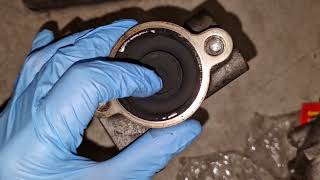
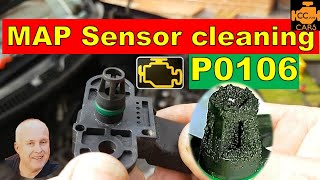
- Cleaning only the MAP sensor. 🎬 Watch: How to clean a dirty MAP sensor and boost sensor If the intake manifold port is clogged with carbon, a new or clean sensor will still not read the pressure correctly, and the code will return quickly.
Most Likely Causes
- Severe Intake System Carbon Buildup 🔴 High Probability The SKYACTIV-D 2.2L engine's design, combining direct injection and EGR, leads to heavy soot and oil vapor deposits in the intake manifold, a widely documented issue. Short-trip driving habits accelerate this buildup as the engine doesn't get hot enough to burn off deposits.
How to confirm: Visually inspect the inside of the intake manifold and the port for the MAP sensor. If it is heavily coated in thick, black soot, this is the likely cause. This often requires removing the throttle body or MAP sensor for a clear view. The EGR valve and cooler will also be heavily clogged.
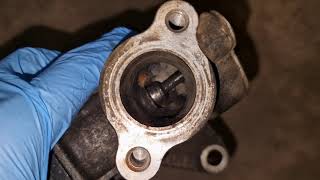
Typical fix: A labor-intensive cleaning of the intake manifold, EGR valve, EGR cooler, and intake ports on the cylinder head. This is often done via walnut shell blasting for best results. 🎬 See a deep clean of the EGR and intake plenum Some specialists report this service costs around £855 ($1000+) due to the labor involved. Simply removing the manifold can break carbon loose, which can be ingested by the engine, so a full system clean is essential.
Est. part cost: $30-$80 for new gaskets - Faulty Manifold Absolute Pressure (MAP) Sensor 🔴 High Probability → Shop Manifold Absolute Pressure Sensor The sensor's sensing element becomes contaminated with the same soot and oil that coats the intake manifold, causing it to fail or send inaccurate readings. It is a known failure item on these engines.
How to confirm: With the Key On, Engine Off, use a scan tool to compare the MAP sensor reading to the BARO reading. They should be nearly identical (e.g., around 14.5 PSI at sea level). If they differ significantly, or if the sensor's voltage is stuck when tested with a multimeter, the sensor is likely faulty.
Typical fix: Replace the MAP sensor. It is typically held in by a single 8mm bolt and is easily accessible on top of the intake manifold.
Est. part cost: $60-$180 - Damaged Wiring or Connector ⚪ Low Probability
How to confirm: Visually inspect the MAP sensor's electrical connector and harness for cracks, corrosion, or loose pins. Use a multimeter to verify a 5-volt reference signal and a good ground at the connector with the key on. On this 4-pin sensor, typically three wires are used, and you should find two 5V reference signals and one ground.
Typical fix: Repair the damaged section of the wiring harness or replace the connector pigtail.
Est. part cost: $15-$50
Rare But Worth Checking
- Leaking Vacuum Hoses or Faulty Vacuum Pump: → Shop Vacuum Hose The turbocharger's wastegate and other components are vacuum-controlled. A leak in the vacuum system or a failing vacuum pump can cause erratic boost levels, which may trigger a P0106 if the PCM sees manifold pressure that doesn't align with its commands.
- Faulty Powertrain Control Module (PCM): This is extremely rare. The PCM should only be considered a possibility after all other potential causes, including sensors, wiring, and mechanical issues, have been thoroughly ruled out.
Diagnosis Steps
- Scan for Codes: Use an OBD-II scanner to confirm P0106 and check for any other related codes (e.g., P0401, P0107, P0299). Note any Freeze Frame Data.
- Inspect Sensor and Connector: Locate the MAP sensor on top of the intake manifold. Inspect its electrical connector and wiring for any visible damage, corrosion, or loose connections.
- Check Sensor with Scan Tool (KOEO): With the Key On, Engine Off, use your scanner's live data function. Compare the 'MAP' pressure reading to the 'BARO' (Barometric) pressure reading. They should be within a few kPa of each other. A faulty sensor may read excessively high, such as 36 PSI when the expected value is 14.5 PSI. If they are significantly different, the MAP sensor is likely faulty.
- Test Wiring: If the sensor reading is suspect, disconnect the sensor and test the harness connector. Use a multimeter to confirm you have two 5-volt reference wires (reading approx. 4.6V - 5.0V) and one good ground wire (reading approx. 0.01V). If voltages are incorrect, the problem lies in the wiring or PCM.
- Inspect for Carbon Buildup: Remove the MAP sensor (typically one 8mm bolt). Shine a light into the sensor port and the intake manifold. If you see a thick layer of black, oily soot, severe carbon buildup is your primary problem.
- Clean or Replace Sensor: If the sensor itself is just dirty, you can try cleaning it with electrical contact cleaner. However, given the high failure rate and relatively low cost, replacement is often the more reliable solution.
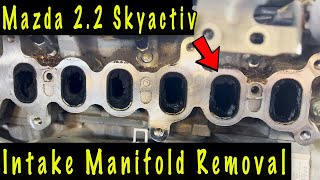
- Address Carbon Buildup: If significant carbon is found, the only long-term fix is to have the intake manifold and associated components removed and professionally cleaned, often with walnut blasting. This is a multi-hour job. 🎬 Watch: Step-by-step intake manifold removal for carbon cleaning
- Clear Codes and Test Drive: After any repairs, clear the codes and perform an extended test drive to ensure the issue is resolved and to allow the DPF system to regenerate if needed.
Parts You'll Likely Need
- Manifold Absolute Pressure (MAP) Sensor
(OEM #SH01-18-211)— This sensor is the most common part to fail, either from internal failure or contamination from soot. It is often the first part to be replaced when diagnosing P0106.
Trusted brands: Bosch, Denso, Mazda OE
OEM price range: $120-$180
Aftermarket price range: $60-$110 - Intake Manifold Gasket Kit — If the intake manifold must be removed for carbon cleaning, all associated gaskets must be replaced to prevent vacuum leaks upon reassembly.
Trusted brands: Mazda OE, Victor Reinz
OEM price range: $50-$80
Aftermarket price range: $30-$50
Related Codes That Often Appear With This One
- P0401 — Stands for 'EGR Flow Insufficient'. This code is almost always caused by the same severe carbon buildup that clogs the MAP sensor port and intake manifold.
- P0107 — Stands for 'MAP Sensor Circuit Low Input'. This indicates an electrical fault (low voltage) in the same sensor circuit, often caused by a failed sensor or wiring issue.
- P0299 — Stands for 'Turbocharger Underboost'. This can be caused by a faulty MAP sensor providing incorrect pressure readings, or by related issues like vacuum leaks or a clogged intake restricting airflow.
Technical Service Bulletins (TSBs) & Recalls
- TSB R073/15: While not for P0106 directly, this TSB addresses camshaft wear, a severe issue on these engines that is often discovered during repairs for carbon-related codes like P0401 and P0106.
Platform-Specific Known Issues
- The SKYACTIV-D 2.2L engine is notorious for severe carbon buildup in the intake manifold, which is the root cause of many sensor and EGR-related fault codes, including P0106 and P0401.
- Short-distance driving significantly accelerates carbon accumulation, as the engine and emissions systems do not reach optimal temperatures to burn off soot.
Mechanic-Grade Diagnostic Values
- MAP Sensor Harness Voltage (KOEO) — expected: Two pins at ~5V (e.g., 4.67V, 4.98V) and one pin at ~0V (e.g., 0.01V).. Failure: Voltages that are significantly lower or higher, or missing entirely, indicate a wiring or PCM issue.
- Scan Tool Live Data: MAP Reading (KOEO) — expected: Should match barometric pressure, approx. 14.5 PSI or 100 kPa at sea level.. Failure: A reading that is wildly incorrect, such as 36 PSI, points to a faulty sensor.
- MAP Sensor Signal Voltage (Engine Idling) — expected: Should drop to between 1 and 2 volts once the engine is started and idling.. Failure: Voltage does not drop or is erratic, indicating the sensor is not responding to engine vacuum.
Scan Tool Commands That Help
- Mazda IDS or equivalent advanced scanner: DPF Learned Values Reset — This is critical after replacing exhaust system components like the DPF or related pressure sensors. While not for the MAP sensor directly, a P0106 code prevents DPF regeneration, and after fixing the P0106 cause, this reset may be necessary to restore normal DPF function.
- N/A - Manual Procedure: Idle Relearn Procedure — After disconnecting the battery or cleaning the throttle body, the ECU can lose its idle calibration, sometimes triggering a P0106. The relearn procedure involves starting the vehicle and letting it idle without any throttle input for about 10 minutes to allow the computer to relearn the idle position.
Wiring & Ground Locations
- MAP Sensor Connector — On top of the intake manifold, connected to the MAP sensor.. This is a 4-pin connector, but typically only three wires are used for the SKYACTIV-D 2.2L engine. It is the primary point for voltage and signal testing.
- G03 — Typically located on the left front of the engine compartment.. This is a major engine bay ground point. A poor connection here could cause erratic voltage readings for multiple sensors, including the MAP sensor.
- G09 — Typically located behind the instrument cluster.. This is an interior ground point that could be relevant if the MAP sensor circuit ground path routes through the cabin harness.
Real Owner Repair Stories
- Reddit user post in r/MechanicAdvice, citing a forum solution (General, not specific to Mazda but applicable principle) — P0106 code appeared immediately after the vehicle's battery died and was replaced. Car had a very rough idle initially which then resolved, but the code remained.
❌ Tried (didn't work) Replacing the MAP sensor., Clearing the code with a scanner (it returned immediately).
✅ What actually fixed it The issue was a lost idle position calibration from the battery disconnect. The fix was to disconnect the battery again, thoroughly clean the throttle body, reconnect the battery, and then perform an idle relearn procedure by letting the car idle for 10 minutes without touching the accelerator.
OEM Part Supersession History
SH01-18-211→SH01-18-211 (current)— No supersession found. This appears to be the consistent part number.
Heads up: The OEM Bosch equivalent is part number 0261230319. While no revisions to the Mazda part were found, it is critical to use a sensor with the correct calibration. Using a sensor intended for another vehicle (e.g., Ford Transit) can cause this code to set immediately, even if it physically fits.
Diagnostic Flowchart
Other Known Issues on This Vehicle
Issues unrelated to this code that are worth knowing about as an owner of this generation:
- Leaking Fuel Injector Seals (Washers) 🔴 High — Very common, especially on pre-2018 models with original copper seals. Failure allows combustion gas to contaminate engine oil, leading to sludge, oil starvation, and catastrophic engine failure. (Ref: Mazda issued TSBs (e.g., R073/15) and revised the part from copper to steel to address this.)
- Premature Turbocharger Failure 🔴 High → Shop Turbocharger — Common. Can be caused by oil starvation from clogged oil pickup (due to failed injector seals) or mechanical failure of the wastegate valve on the small, low-pressure turbo.
- Oil Dilution from DPF Regeneration 🟠 Medium — Common, especially for vehicles used primarily for short trips. Incomplete DPF regeneration cycles cause diesel fuel to mix with the engine oil, raising the oil level and reducing its lubricating properties.
- Exhaust Camshaft Lobe Wear 🔴 High → Shop Engine Camshaft — A known issue, often linked to oil starvation/contamination. Worn lobes can lead to engine failure. The camshaft has undergone several part revisions. (Ref: Mentioned in various TSBs related to engine repair and oil pressure issues.)
Used vs. New Parts: Buying Guide for This Vehicle
When a used part is the smart pick: A used part is generally not recommended for the MAP sensor itself due to the high likelihood of contamination and wear. However, if a larger component like the intake manifold is cracked and needs replacement, a used manifold from a low-mileage donor vehicle can be a cost-effective option, provided it is thoroughly cleaned of all carbon before installation.
Donor-vehicle mileage cap: roughly under 50000 miles for the part to have meaningful remaining life.
What to inspect on the donor part:
- For an intake manifold, check for any cracks or damage, especially around mounting points.
- Visually inspect the inside of the manifold's runners; the less carbon, the better.
- Ensure all threaded holes for sensors and bolts are intact and not stripped.
OEM-only on this vehicle (don't cheap out):
- Manifold Absolute Pressure (MAP) Sensor: Due to the sensitivity of the calibration, an OEM (Mazda) or OEM-supplier (Bosch, Denso) part is strongly recommended to avoid immediate range/performance codes.
Aftermarket brands forum-validated for this vehicle:
- Bosch (often the original OEM supplier)
- Denso
Brands owners have reported issues with on this vehicle:
- Unbranded, generic sensors from online marketplaces.
- Sensors specified for other diesel engines (e.g., Ford Transit) that may physically fit but have incorrect electronic calibration.
Real Owner Stories
Aggregated from forums and TSBs cited above. Mileages and costs reflect what owners reported in those sources.
2016 Mazda CX-5 2.2L AWD Diesel — 111846 miles
Symptoms: The vehicle repeatedly enters emergency mode (limp mode) accompanied by acoustic warning signals.
What fixed it: The owner report indicates the issue is related to the intake system and carbon accumulation common in high-mileage units.
Source hint: cx5-forum.de
Related OBD-II Codes
Frequently Asked Questions
Does TSB R073/15 apply to my 2.2L SKYACTIV-D if I have a P0106 code?
Why is my CX-5 showing SCBS and Traction Control warning lights along with P0106?
Can I just clean the MAP sensor to fix the P0106 error?
How much does it cost to fix the carbon buildup causing this code?
Does my driving habit affect how often P0106 occurs on the 2.2L diesel?
Is the P0106 issue common to other Mazda models with the same engine?
Helpful Videos

We Have This Part in Stock

The information in this article is provided for general reference and educational purposes only. Vehicle specifications, procedures, and part compatibility can vary by production date, trim level, and region. Always consult your vehicle's factory service manual and verify part numbers before purchasing or performing repairs. Safety-critical components such as airbags, seat belts, and braking systems should be installed by a qualified professional.
- Mazda CX-5:
- 🧭 Diagnostic Flowchart
- 🎬 Helpful Videos
- 🛍️ Shop This Part
- What's Unique About the 2017-2024 Mazda CX-5
- Symptoms You May Notice
- Most Likely Causes
- Rare But Worth Checking
- Diagnosis Steps
- Parts You'll Likely Need
- Related Codes That Often Appear With This One
- Technical Service Bulletins (TSBs) & Recalls
- Platform-Specific Known Issues
- Mechanic-Grade Diagnostic Values
- Scan Tool Commands That Help
- Wiring & Ground Locations
- Real Owner Repair Stories
- OEM Part Supersession History
- Other Known Issues on This Vehicle
- Used vs. New Parts: Buying Guide for This Vehicle
- Real Owner Stories
- 2016 Mazda CX-5 2.2L AWD Diesel — 111846 miles
- Related OBD-II Codes
- Frequently Asked Questions
- 🎟️ Get 5% Off