

P0106 on 1994-1998 Subaru Legacy 2.2L: MAP Sensor and Vacuum Leak Guide
On a 1994-1998 Subaru Legacy with the 2.2L engine, code P0106 is most often caused by a cracked, disconnected, or internally clogged vacuum hose between the intake manifold and the MAP sensor. Before replacing the sensor, thoroughly inspect all vacuum lines, paying close attention to the ends for hairline cracks and the inside for blockages. A new hose costs less than $15, while a new MAP sensor can range from $50 to over $200.
- Always check for vacuum leaks first. A cracked, disconnected, or clogged hose is the most probable cause for P0106 on a 94-98 Legacy.
- The MAP sensor is located on the passenger side strut tower, not directly on the engine's intake manifold.
- Do not immediately buy a new MAP sensor. A thorough diagnosis starting with the cheapest and most likely cause (vacuum hoses) will save you time and money.
- The original MAP sensor part number is 22012AA070, which has been superseded by other numbers like 22098AA000.
What's Unique About the 1994-1998 Subaru Legacy
For the second-generation Subaru Legacy with the naturally aspirated EJ22 engine, the MAP sensor is not mounted directly on the intake manifold. Instead, it's located on the passenger-side strut tower, near the firewall, and connected to the manifold via a small vacuum hose. This design makes the vacuum hose itself the most common point of failure; over time, the rubber becomes brittle from engine heat cycles, developing hairline cracks right at the connection points, or becoming disconnected. This creates a vacuum leak that is the most frequent trigger for a P0106 code on this specific vehicle. Owners often mistakenly replace the MAP sensor when the actual fault is a simple, inexpensive vacuum hose.
🎬 Watch: See how a cracked vacuum hose causes rough idling.Symptoms You May Notice
- Check Engine Light is on
- Rough, unstable, or fluctuating idle.
- Engine stalling, especially when coming to a stop or at idle.
- Hesitation or lack of power during acceleration.
- Noticeably reduced fuel economy.
- Difficulty starting the engine.
- A faint hissing sound from the engine bay at idle.
- Black smoke from the exhaust, indicating a rich fuel condition.
- Replacing the MAP sensor before checking for vacuum leaks. The vacuum hose is a much more common and cheaper failure point on this vehicle.
- Overlooking a tiny, hairline crack in the vacuum hose. The crack may only be visible when the hose is removed and flexed.
Most Likely Causes
- Cracked, disconnected, or leaking vacuum hose 🔴 High Probability → Shop Vacuum Hose The MAP sensor is remotely mounted via a rubber hose that is exposed to constant engine heat and vibration. This causes the rubber to become hard and brittle over time, leading to cracks, especially at the connection nipples on the manifold and sensor.
How to confirm: With the engine running, listen for a hissing sound near the passenger side strut tower and along the intake manifold. Carefully spray short bursts of brake cleaner or an unlit propane torch around the vacuum lines; a change in engine idle (smoothing out or revving up) indicates you've found the leak. The most definitive test is to remove the hose and physically flex it in your hands; hairline cracks that are invisible in place will often open up under stress.
Typical fix: Replace the damaged vacuum hose with a new one of the correct inner diameter (typically 3.5mm or 4mm). Ensure it is routed away from direct contact with hot engine parts.
Est. part cost: $5-$15 - Faulty Manifold Absolute Pressure (MAP) Sensor 🟡 Medium Probability → Shop Manifold Absolute Pressure Sensor
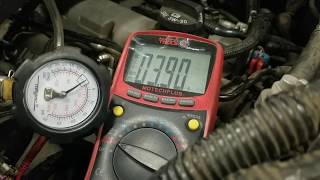
How to confirm: If no vacuum leaks are found and the wiring is intact, the sensor is the next likely culprit. You can test it with a multimeter and a hand vacuum pump to see if the voltage signal changes smoothly with applied vacuum 🎬 Watch: A step-by-step guide to testing your MAP sensor., or swap it with a known-good part. With the key on, engine off, the sensor should read atmospheric pressure (around 4.5-5.0 volts at sea level).
Typical fix: Replace the MAP sensor.
Est. part cost: $50-$250 - Clogged orifice in MAP sensor vacuum line ⚪ Low Probability → Shop Manifold Absolute Pressure Sensor Over many years, oil vapor from the PCV system can be drawn into the MAP sensor line and bake into a blockage, especially if there is a small restrictor orifice inside the hose. This prevents the sensor from seeing rapid changes in manifold pressure.
How to confirm: After removing the vacuum hose for inspection, attempt to blow through it. If there is significant resistance or it's completely blocked, it needs to be cleared or replaced. Use a small wire or pipe cleaner to gently clear the orifice if one is present.
Typical fix: Clean the orifice with a small tool or replace the entire hose.
Est. part cost: $0-$15 - Dirty or contaminated MAP sensor electrical connector ⚪ Low Probability → Shop Manifold Absolute Pressure Sensor
How to confirm: Unplug the MAP sensor connector and inspect the terminals for corrosion, dirt, or moisture. A poor connection can disrupt the signal.
Typical fix: Clean the connector terminals with electrical contact cleaner and ensure it is securely reconnected. Applying a small amount of dielectric grease can prevent future corrosion.
Est. part cost: $5-$10
Rare But Worth Checking
- Dirty Throttle Body: → Shop Fuel Injection Throttle Body A significant buildup of carbon in the throttle body can affect airflow at idle. This is sometimes seen after a battery has been disconnected, as the ECU loses its learned idle values and struggles to compensate 🎬 Watch: How to perform a Subaru idle relearn procedure., which can trigger a P0106.
- Clogged Catalytic Converter: A severely restricted exhaust can cause abnormal pressure in the intake manifold, leading to an implausible MAP sensor reading. This is usually accompanied by other symptoms like a severe loss of power, especially at higher RPMs, and potentially a P0420 code.
- Faulty Engine Control Unit (ECU): In very rare cases, after all other possibilities have been exhausted, the ECU itself may be the source of the problem. One owner on the LegacyGT.com forums reported resolving a persistent P0106 that survived multiple sensor and hose replacements only by swapping the ECU.
Diagnosis Steps
- Verify the code with an OBD-II scanner.
- With the engine idling, listen carefully for any hissing sounds from the engine bay, particularly around the intake manifold and the passenger-side strut tower where the MAP sensor is located.
- Thoroughly inspect the vacuum hose leading to the MAP sensor. Pay special attention to the ends connected to the intake manifold and the sensor itself.
- Remove the hose entirely and flex it while inspecting for tiny, hairline cracks. Attempt to blow through the hose to check for any internal blockages or a clogged orifice.
- If a leak is suspected but not visible, perform a leak test using propane or brake cleaner. Carefully introduce it near suspected leak points and listen for a change in engine idle.
- If no vacuum leaks or blockages are found, inspect the MAP sensor's electrical connector for corrosion or damage. Clean with electrical contact cleaner if necessary.
- Inspect the air filter and the throttle body for excessive dirt or blockages. Clean the throttle body if significant carbon buildup is present.
- If the above steps do not resolve the issue, the MAP sensor itself is likely faulty and should be tested with a multimeter and vacuum pump or replaced.
Parts You'll Likely Need
- Vacuum Hose — This is the most common failure point for a P0106 code on this specific vehicle due to the remote mounting of the MAP sensor. A generic 3.5mm or 4mm vacuum hose is usually sufficient.
Trusted brands: Generic vacuum hose
OEM price range: $5-$15
Aftermarket price range: $5-$10 - Manifold Absolute Pressure (MAP) Sensor
(OEM #22012AA070)— If vacuum lines and wiring are confirmed to be good, the sensor itself is the next logical part to replace.
Trusted brands: Denso (often the OEM manufacturer, e.g., Denso 100798-2831), Bosch, Beck/Arnley, Standard Motor Products
OEM price range: $200-$260
Aftermarket price range: $50-$180
Related Codes That Often Appear With This One
- P0420 (Catalyst System Efficiency Below Threshold) if the P0106 has caused a long-term rich running condition.
- P0325 (Knock Sensor 1 Circuit) can sometimes appear alongside various performance codes.
- P0441 (Evaporative Emission Control System Incorrect Purge Flow) can appear if vacuum lines are crossed or a purge solenoid has failed, which can also trigger P0106.
Platform-Specific Known Issues
- Real Owner Experience: The Hidden Crack: A common story on forums like ultimatesubaru.org involves owners replacing the MAP sensor, cleaning the throttle body, and checking wiring with no success. The final solution is often finding an almost invisible crack in the vacuum hose right where it pushes onto the intake manifold nipple. The heat from the engine block makes this specific spot extra brittle. The fix is always to replace the hose.
- Real Owner Experience: Persistent Code Resolved by ECU: In a thread on LegacyGT.com, an owner with a 1998 Legacy detailed replacing every related component (MAP, MAF, all hoses, solenoids) and cleaning all grounds to chase a P0106. The car ran poorly and the code persisted. The ultimate fix, after months of troubleshooting, was replacing the Engine Control Unit (ECU). This is an extremely rare but possible cause.
Mechanic-Grade Diagnostic Values
- MAP Sensor Signal Voltage (Key On, Engine Off) — expected: ~4.5 V. Failure: Significantly lower voltage suggests a sensor or wiring issue. This reading reflects atmospheric pressure.
- MAP Sensor Signal Voltage (Engine Idling, Warmed Up) — expected: 1.0 - 1.5 V. Failure: Voltage significantly higher than 1.5V at idle suggests a vacuum leak or a faulty sensor not responding to vacuum.
- Scan Tool: Intake Manifold Absolute Pressure (Engine Idling) — expected: 30 - 35 kPa. Failure: Pressure significantly higher than 35 kPa indicates a vacuum leak. Pressure that doesn't change with RPM indicates a clogged line or faulty sensor.
- MAP Sensor 5V Reference Circuit — expected: ~5.0 V (at sensor connector with KOEO). Failure: Low or no voltage indicates a wiring problem between the ECU and the sensor.
- MAP Sensor Ground Circuit — expected: < 100 mV (0.1 V) resistance to chassis ground. Failure: Higher voltage or resistance points to a bad ground connection, a common issue on older vehicles that can cause erratic sensor readings.
- P0107 (Low Input) Trigger Condition — expected: N/A. Failure: ECU stores a fault when signal is < 0.5V or pressure is < 13.3 kPa. This defines the lower bound of the P0106 'range' issue.
- P0108 (High Input) Trigger Condition — expected: N/A. Failure: ECU stores a fault when signal is > 4.4V or pressure is > 119.5 kPa. This defines the upper bound of the P0106 'range' issue.
Hidden / Shadow Codes Worth Checking
- Pending P0106: The ECU has detected a potential fault with the MAP sensor circuit on a single drive cycle, but has not yet illuminated the Check Engine Light. The CEL will typically illuminate and the code will become 'hard' or 'stored' if the fault is detected again on a second consecutive drive cycle. (see via Most standard OBD-II scanners can display 'Pending Codes'. This is a valuable early warning that a problem is developing.)
Scan Tool Commands That Help
- Subaru Select Monitor (or equivalent professional scanner): Live Data > 'Intake manifold absolute pressure signal (MANI. P.)' — This is the primary function used to diagnose a P0106. The technician should monitor the pressure reading (in kPa) at KOEO, idle, and while snapping the throttle to see if it responds logically and stays within the expected ranges.
Wiring & Ground Locations
- Primary ECU/Sensor Ground — A grounding point on the intake manifold, typically under or near the ignition coil pack.. The ECU and its sensors, including the MAP sensor, use this point as a reference. Corrosion or a loose connection here can cause voltage fluctuations and erratic signals, directly leading to a P0106 code even if the sensor and vacuum lines are good.
- MAP Sensor Connector — On the passenger side strut tower, connected to the MAP sensor.. This 3-pin connector provides the 5V reference, ground, and returns the signal to the ECU. The pins must be clean and the connector fully seated. A technician can use a multimeter here to verify power, ground, and signal integrity without a wiring diagram by testing for ~5V (reference), continuity to ground (ground), and a variable voltage (signal).
Real Owner Repair Stories
- LegacyGT.com user 'vicdeng' (1997 Subaru Legacy GT) — Check Engine Light with P0106 and P0441.
❌ Tried (didn't work) Initial inspection of vacuum lines.
✅ What actually fixed it The user discovered that the vacuum hose routing was complex, involving a 'Pressure Sources Switching Solenoid Valve'. Another user pointed out that the hoses were incorrectly routed to this solenoid, causing a constant vacuum draw from the charcoal canister and bypassing the solenoid entirely. The fix was to correct the vacuum hose routing according to the diagram under the hood, resolving the implausible pressure reading. - LegacyGT.com user 'vicdeng' (different thread) (Subaru Legacy (year not specified, but in 2nd gen forum)) — Persistent P0106 CEL.
❌ Tried (didn't work) Replacing the vacuum line filter, checking hoses.
✅ What actually fixed it The user swapped the MAP sensor and solenoid from his car with a known-good 1999 Outback. The CEL returned on his car, proving the original sensor and solenoid were not the issue. This diagnostic step correctly isolated the problem to the car's wiring, vacuum system integrity, or ECU, preventing unnecessary part replacement.
OEM Part Supersession History
22012AA070→22098AA000— Standard part update and consolidation by Subaru.
Heads up: The new part number is a direct replacement for the original.
Model Year Variations Within This Range
- 1997-1998: The EJ22E engine was updated for 1997. It features single-port exhaust heads (vs. dual-port on 1995-1996), a higher compression ratio (9.7:1 vs 9.5:1), lighter pistons, and valvetrain changes. While the P0106 diagnosis is similar, a mechanic must be aware of these differences when sourcing engine components like heads or pistons.
Diagnostic Flowchart
Other Known Issues on This Vehicle
Issues unrelated to this code that are worth knowing about as an owner of this generation:
- External Head Gasket Oil Leaks 🟠 Medium — Common over 100,000 miles. Unlike the EJ25 engine's catastrophic internal failures, the EJ22 is famous for developing external oil leaks from the head gaskets, dripping oil onto the exhaust manifold. It's often a slow leak that can be monitored.
- Rear Oil Separator Plate Leak 🔴 High — Very common. The original plastic plate on the back of the engine block becomes brittle and leaks oil, often mistaken for a rear main seal leak. The fix requires engine or transmission removal and replacement with an updated metal plate.
- Wheel Bearing Failure 🟠 Medium — Common failure item, especially front wheel bearings. Owners often report replacing them multiple times. Onset can be anytime over 80,000 miles, presenting as a roaring or grinding noise that changes with vehicle speed.
- 4EAT Automatic Transmission Torque Bind 🟠 Medium — Occurs on AWD models, especially with mismatched tires or neglected fluid changes. Causes a shuddering or hopping sensation during tight, low-speed turns. Can sometimes be resolved with multiple drain-and-fills of the correct ATF or by replacing the transfer clutch duty solenoid.
- Rear Quarter Panel / Subframe Rust 🔴 High — Extremely common in regions that use road salt. The rear wheel arches and the subframe components are highly susceptible to severe corrosion, which can become a structural safety issue.
Used vs. New Parts: Buying Guide for This Vehicle
When a used part is the smart pick: A used OEM MAP sensor (Denso) from a reputable salvage yard is a smart choice if the new OEM part is prohibitively expensive. The failure rate is much lower than the vacuum hoses, so a used sensor often has significant life left.
Donor-vehicle mileage cap: roughly under 150000 miles for the part to have meaningful remaining life.
What to inspect on the donor part:
- Inspect the donor vehicle for signs of a severe engine failure (e.g., thrown rod), which could have damaged electronics.
- Check the sensor's plastic housing for cracks or damage.
- Ensure the electrical connector pins are clean, straight, and free of corrosion.
- If possible, test the sensor's resistance or ask the seller if it's been tested.
OEM-only on this vehicle (don't cheap out):
- Engine Control Unit (ECU) - Aftermarket or incorrectly matched used ECUs are a common source of persistent, unfixable issues.
Aftermarket brands forum-validated for this vehicle:
- Denso (This is the original equipment manufacturer and is the best choice for a new part).
Brands owners have reported issues with on this vehicle:
- Unnamed, no-brand 'white box' sensors from online marketplaces. These often have poor quality control and may be out of calibration from the factory, causing the P0106 code to persist even after replacement.
Real Owner Stories
Aggregated from forums and TSBs cited above. Mileages and costs reflect what owners reported in those sources.
1998 Subaru Legacy
Symptoms: The car ran poorly and the P0106 code persisted despite replacing the MAP sensor, MAF sensor, all hoses, and solenoids, and cleaning all grounds.
What fixed it: Replacing the Engine Control Unit (ECU).
Source hint: LegacyGT.com: 'Persistent P0106 Code'
1994-1998 Subaru Legacy EJ22
Symptoms: Owners often replace the MAP sensor and clean the throttle body with no success while chasing the P0106 code.
What fixed it: Replacing the vacuum hose after finding an almost invisible crack right where it pushes onto the intake manifold nipple.
Source hint: vehicle_specific_issues: Real Owner Experience: The Hidden Crack
1998 Subaru Legacy
Symptoms: Lousy fuel economy, a pretty low/rough idle, and a P0106 code that will not go away.
What fixed it: The owner's troubleshooting process on LegacyGT.com eventually led to an ECU replacement.
Source hint: owner_reports: LegacyGT.com
Related OBD-II Codes
Frequently Asked Questions
Where is the MAP sensor located on my 1994-1998 Legacy EJ22?
Why does the vacuum hose on this specific Subaru model fail so often?
Can I use any vacuum hose to fix the P0106 code on my Legacy?
My Legacy has a rough idle and stalls at stops; could this be the MAP sensor?
I've replaced the MAP sensor and hoses but the P0106 code persists on my 1998 Legacy. What else could it be?
Is there a way to check for a blockage in the MAP system without buying parts?
Helpful Videos


We Have This Part in Stock


The information in this article is provided for general reference and educational purposes only. Vehicle specifications, procedures, and part compatibility can vary by production date, trim level, and region. Always consult your vehicle's factory service manual and verify part numbers before purchasing or performing repairs. Safety-critical components such as airbags, seat belts, and braking systems should be installed by a qualified professional.
- Subaru Legacy:
- 🧭 Diagnostic Flowchart
- 🎬 Helpful Videos
- 🛍️ Shop This Part
- What's Unique About the 1994-1998 Subaru Legacy
- Symptoms You May Notice
- Most Likely Causes
- Rare But Worth Checking
- Diagnosis Steps
- Parts You'll Likely Need
- Related Codes That Often Appear With This One
- Platform-Specific Known Issues
- Mechanic-Grade Diagnostic Values
- Hidden / Shadow Codes Worth Checking
- Scan Tool Commands That Help
- Wiring & Ground Locations
- Real Owner Repair Stories
- OEM Part Supersession History
- Model Year Variations Within This Range
- Other Known Issues on This Vehicle
- Used vs. New Parts: Buying Guide for This Vehicle
- Real Owner Stories
- 1998 Subaru Legacy
- 1994-1998 Subaru Legacy EJ22
- 1998 Subaru Legacy
- Related OBD-II Codes
- Frequently Asked Questions
- 🎟️ Get 5% Off