

P0106 on 2013-2017 Subaru Outback 2.5L: MAP Sensor Causes and Fixes
Code P0106 on a 2013-2017 Subaru Outback 2.5L typically points to a faulty Manifold Absolute Pressure (MAP) sensor, a vacuum leak, or a dirty throttle body. Replacing the MAP sensor or cleaning the throttle body are common, straightforward DIY fixes.
- P0106 on your Subaru Outback means the engine's computer is getting nonsensical readings from the Manifold Absolute Pressure (MAP) sensor.
- The most likely causes are a faulty MAP sensor, a dirty throttle body, or a vacuum leak in the intake system.
- Symptoms typically include a rough idle, poor acceleration, and decreased fuel mileage.
- Before replacing parts, clean the throttle body and check for cracked or disconnected vacuum hoses, as these are simple and cheap fixes.
- Replacing the MAP sensor is a DIY-friendly job that requires basic tools and can often solve the problem in under an hour.
What's Unique About the 2013-2017 Subaru Outback
The 2013-2017 Subaru Outback spans two generations (4th and 5th), but the 2.5L FB25 engine's fundamental design regarding the MAP sensor is similar. The MAP sensor is conveniently located on the throttle body, making it more accessible than on some other vehicles. While the code is often caused by a faulty sensor, a dirty throttle body is also a very common culprit on these models, which can alter airflow and cause illogical pressure readings at idle. Cleaning the throttle body and performing an idle relearn procedure often resolves the code without needing to replace the sensor.
Generation note: This range covers the end of the fourth generation (2013-2014) and the beginning of the fifth generation (2015-2017). The location and function of the 2.5L engine's MAP sensor are consistent across these models, so the diagnosis and repair process is very similar. Early models in this range are more prone to the excessive oil consumption issue which can, over time, contribute to problems like fouled sensors and catalytic converters.
Symptoms You May Notice
- Check Engine Light is on
- Rough or unstable idle
- Hesitation or lack of power during acceleration
- Reduced fuel economy
- Engine stalling, especially when coming to a stop
- Black smoke from the exhaust
- Difficulty starting the engine
- Replacing the throttle body when only the MAP sensor is faulty.
- Replacing oxygen sensors, as poor fuel economy and rough running can be symptoms of many different issues.
- Replacing the MAP sensor when the actual problem is a dirty throttle body, which is a very common issue on these cars.
Most Likely Causes
- Faulty Manifold Absolute Pressure (MAP) Sensor 🔴 High Probability → Shop Manifold Absolute Pressure Sensor Sensors can fail over time due to heat cycles and internal wear. It's the most frequently replaced part for this code.
How to confirm: Use an OBD-II scanner with live data to monitor the MAP sensor voltage. At idle, it should be around 1-1.5V, and at wide-open throttle (engine off, key on), it should be near 4.5V. If the readings are stuck or don't change with engine RPM, the sensor is likely bad.
Typical fix: Replace the MAP sensor. It is typically mounted to the throttle body with two screws.
Est. part cost: $50-$150 - Dirty Throttle Body 🔴 High Probability → Shop Fuel Injection Throttle Body Carbon buildup around the throttle plate can prevent it from closing properly, allowing excess air to enter at idle. This creates a pressure reading that the PCM considers illogical, triggering P0106. This is a well-documented cause for this specific vehicle range.
How to confirm: Visually inspect the throttle body bore and plate for black carbon deposits. If it's dirty, cleaning is recommended before replacing any parts.
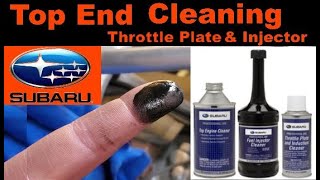
Typical fix: Remove the intake ducting, clean the throttle body bore and plate with a dedicated throttle body cleaner and a soft brush, and then perform 🎬 Watch: How to properly clean your Subaru throttle body plate an idle relearn procedure.
Est. part cost: $5-$15 (for a can of cleaner) - Vacuum Leak 🟡 Medium Probability Vacuum hoses, particularly the PCV hose, can become brittle and crack over time. Intake manifold gaskets can also fail, allowing unmetered air to enter the engine.
How to confirm: Perform a visual inspection of all vacuum lines connected to the intake manifold. A smoke test is the most effective way to find hard-to-see leaks. Pay close attention to the intake manifold gaskets and the PCV hose.
Typical fix: Replace the cracked hose or faulty gasket.
Est. part cost: $5-$50 - Wiring or Connector Issue ⚪ Low Probability
How to confirm: Visually inspect the MAP sensor's electrical connector and wiring for damage, corrosion, or looseness. Use a multimeter to check for a 5V reference signal and a good ground at the connector with the key on, engine off.
Typical fix: Repair the damaged wire or clean/replace the connector.
Est. part cost: $5-$25
Rare But Worth Checking
- Clogged Catalytic Converter: A clogged catalytic converter can create backpressure that affects manifold pressure readings. This is usually accompanied by other codes (like P0420) and a more significant loss of power, especially at high RPM.
- Faulty Powertrain Control Module (PCM): This is extremely rare. All other possibilities should be exhausted before considering the PCM as the cause.
Diagnosis Steps
- Connect an OBD-II scanner to confirm the P0106 code and check for any other related codes.
- Using the scanner's live data feature, monitor the MAP sensor voltage/pressure reading. Check the reading with the key on, engine off (should be close to barometric pressure) and at idle.
- Visually inspect the throttle body for carbon buildup. If dirty, clean it thoroughly with throttle body cleaner and a soft brush. Do not spray cleaner directly into the intake.
- After cleaning the throttle body, perform an idle relearn procedure. This often involves disconnecting the battery for a period, then letting the car idle for 10-15 minutes. 🎬 See this walkthrough of the Subaru idle relearn procedure
- If the code persists, visually inspect all vacuum hoses connected to the intake manifold for cracks, disconnection, or brittleness. Pay close attention to the PCV hose and brake booster hose.
- Inspect the MAP sensor's electrical connector for corrosion or damage. Ensure it is securely connected.
- If a vacuum leak is suspected but not visible, perform a smoke test to pinpoint the source of the leak.
- If no vacuum leaks or throttle body issues are found, test the MAP sensor's wiring. With the key on, engine off, unplug the sensor and check for a 5-volt reference, a good ground, and a signal wire at the connector.
- If wiring and vacuum systems are good, and the throttle body is clean, the MAP sensor itself is the most likely culprit. Replace the MAP sensor.
- After any repair, clear the code and perform a test drive to ensure the problem is resolved.
Parts You'll Likely Need
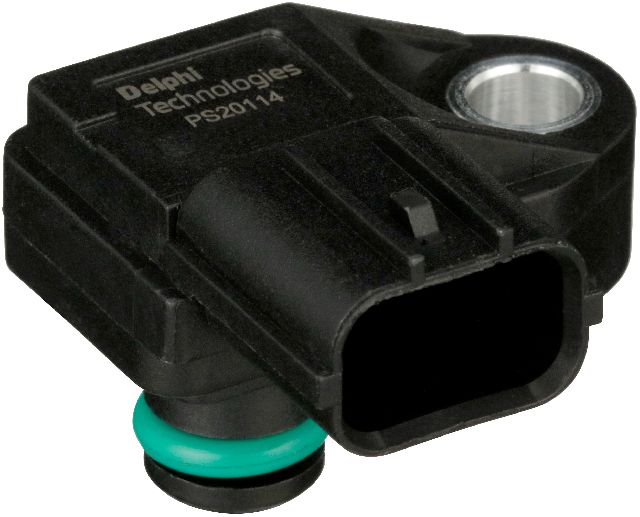
- Manifold Absolute Pressure (MAP) Sensor
(OEM #22627AA500)— This sensor is the most common failure point for code P0106. It directly measures the pressure the code references.
Trusted brands: Denso, Hitachi, Bosch, Subaru (Genuine)
OEM price range: $100-$180
Aftermarket price range: $50-$120
Related Codes That Often Appear With This One
- P0107 — Indicates MAP sensor circuit low input, pointing to a wiring issue or a failed sensor.
- P0108 — Indicates MAP sensor circuit high input, also pointing to a wiring issue or a failed sensor.
- P0300-P0304 — Random or specific cylinder misfire codes can be triggered by the incorrect air-fuel mixture caused by the faulty MAP sensor data.
- P0171 — System Too Lean. This can be triggered by a vacuum leak that is also causing the P0106 code.
Technical Service Bulletins (TSBs) & Recalls
- cause: TSB 02-157-14R: While not directly for P0106, this TSB addresses excessive oil consumption in early FB25 engines. This condition can lead to long-term issues like fouled sensors and catalytic converters, which can eventually trigger P0106.
Platform-Specific Known Issues
- A dirty throttle body is a very frequent cause of P0106 on this platform, often misdiagnosed as a bad MAP sensor. Owners report that cleaning the throttle body and performing an idle relearn procedure resolves the issue without replacing any parts.
Mechanic-Grade Diagnostic Values
- MAP Sensor Live Data (Scan Tool) — expected: 30-32 kPa at idle.. Failure: A reading of 13 kPa or below may trigger P0107; a reading of 99 kPa or above may trigger P0108.
- MAP Sensor Connector - 5V Reference — expected: ~5V DC with key on, engine off (KOEO).. Failure: No voltage or significantly lower voltage indicates a wiring or PCM issue.
- MAP Sensor Connector - Ground — expected: Good continuity to chassis ground (less than 1k ohms).. Failure: High resistance or an open circuit indicates a bad ground wire.
- MAP Sensor Connector - Signal Wire (KOEO) — expected: ~5V DC (on a pull-up resistor circuit).. Failure: Voltage significantly different from 5V suggests a wiring fault or a bad sensor.
- MAP Sensor Signal Voltage (Backprobed at Idle) — expected: 1V to 1.5V.. Failure: Voltage is stuck high or low and does not respond to changes in engine vacuum.
Scan Tool Commands That Help
- Generic OBD-II Scanner / Subaru Select Monitor (SSM): Idle Relearn / Throttle Body Adaptation Reset — This procedure is critical after cleaning the throttle body, replacing it, or disconnecting the vehicle's battery. The ECU stores learned values for the throttle plate position at idle, which are based on airflow through a slightly dirty throttle body. After cleaning, the airflow changes, and the old learned values can cause an unstable idle and trigger a P0106 code because the MAP reading no longer matches the expected value for the learned throttle angle. A relearn forces the ECU to establish a new baseline.
Wiring & Ground Locations
- MAP Sensor Connector — Plugged into the MAP sensor, which is mounted on the top of the throttle body on the 2.5L FB25 engine.. This is the primary point for electrical testing. It has three pins: a 5V reference, a ground, and a signal wire that returns a voltage to the PCM. A user on Reddit reported having two pins showing 5V, indicating a ground fault in the harness.
- MAP Sensor Pinout (Typical) — On the 3-pin connector for the MAP sensor.. Testing requires knowing which pin is which. While specific colors can vary, a typical Subaru pinout is: Pin 1 - Signal, Pin 2 - Ground, Pin 3 - 5V Reference. This must be verified with a multimeter. The 5V reference and ground must be present for the sensor to work.
Real Owner Repair Stories
- Reddit user on r/Subaru_Outback (2015 Subaru Outback 2.5L Premium) — Check engine light with codes P0107, P0102, P0113. Poor acceleration, lunging, and stalling at stop lights.
❌ Tried (didn't work) Cleaning the MAF sensor, Replacing the MAP sensor
✅ What actually fixed it The user diagnosed a wiring issue by testing the MAP sensor connector and finding 5 volts on two of the three pins, indicating a fault in the ground wire or a short in the harness. The final repair was fixing the wiring harness. - Forum user experience (General models with electronic throttle bodies) — P0106 code appeared immediately after disconnecting the battery for another repair.
❌ Tried (didn't work) Clearing the code with a scanner (it returned immediately)
✅ What actually fixed it Performing a specific idle relearn procedure. The ECU had lost its learned idle values when the battery was disconnected. The fix involved a sequence of key-on/key-off steps and letting the engine idle for a specific duration (e.g., 10 minutes) without touching the accelerator to allow the ECU to relearn the new baseline idle parameters.
"I Checked Everything" — The Actual Cause
- A cracked air intake duct between the mass airflow sensor and the throttle body can cause a P0106. This is unmetered air that enters after the MAF sensor but before the MAP sensor, causing a discrepancy in the readings the PCM expects. A smoke test might not always reveal a crack in the flexible ducting if it only opens under engine torque or vibration, making it a commonly missed cause.
OEM Part Supersession History
22627AA500→22627AA510— Standard part evolution and potential internal improvements.
Heads up: While the original part number 22627AA500 is associated with the 2.5L engine, it is also listed for diesel DPF applications in other markets, which can cause confusion. The superseding part 22627AA510 is the correct MAP sensor for many gasoline models in this range. Always verify the part number with a VIN.
Model Year Variations Within This Range
- 2013-2014: These model years are the facelift of the fourth generation (BR) and were the first to receive the 2.5L FB25 engine, replacing the previous EJ25. These early FB25 engines are more noted for potential oil consumption issues, which could indirectly lead to P0106 over time by fouling sensors.
- 2015-2017: These model years are the start of the fifth generation (BS). While they continue to use the FB25 engine, Subaru made refinements to address issues like oil consumption. The fundamental diagnosis for P0106 remains the same as the engine architecture around the intake and MAP sensor is very similar.
Diagnostic Flowchart
Other Known Issues on This Vehicle
Issues unrelated to this code that are worth knowing about as an owner of this generation:
- Excessive Oil Consumption 🔴 High — Common in early FB25 engines (2011-2014), leading to a class-action lawsuit. Consumption can be as high as 1 quart per 1200 miles. (Ref: TSB 02-157-14R outlines the oil consumption test procedure and conditions. Subaru extended the powertrain warranty to 8 years/100,000 miles for this issue on affected vehicles.)
- CVT (TR580) Valve Body Failure 🟠 Medium — A common failure point, typically occurring between 80,000 and 150,000 miles. Symptoms include shuddering, hesitation, and a flashing AT Temp light. (Ref: TSB 16-119-19 announces a redesigned valve body to prevent certain diagnostic codes.)
- Spontaneously Cracking Windshields 🟡 Low — Widespread enough to trigger multiple class-action lawsuits. Cracks can appear without an impact, often starting from the de-icer area at the bottom of the glass. (Ref: A settlement extended warranty coverage for windshield replacement on certain model years.)
- Catalytic Converter Failure 🟠 Medium — Premature failure of the catalytic converter can occur, often related to the excessive oil consumption which can contaminate the catalyst material. This typically triggers a P0420 code.
Used vs. New Parts: Buying Guide for This Vehicle
When a used part is the smart pick: A used throttle body assembly from a low-mileage donor vehicle can be a cost-effective option if the entire unit is suspected to be faulty, which is rare. For the MAP sensor itself, used is generally not recommended due to the low cost of a new aftermarket part and the sensitive nature of the electronics.
Donor-vehicle mileage cap: roughly under 60000 miles for the part to have meaningful remaining life.
What to inspect on the donor part:
- For a throttle body, check for a clean throttle plate and bore with minimal carbon buildup.
- Ensure the MAP sensor port is clean and free of oil.
- Verify the electrical connector pins on the sensor and throttle body are not corroded or bent.
Aftermarket brands forum-validated for this vehicle:
- Denso (often the OEM supplier)
- Bosch
- Hitachi
Brands owners have reported issues with on this vehicle:
- No-name, unbranded sensors from online marketplaces are frequently cited in forums as being dead-on-arrival or failing within a short period.
Real Owner Stories
Aggregated from forums and TSBs cited above. Mileages and costs reflect what owners reported in those sources.
2013 Subaru Outback 2.5L
Symptoms: Experienced P0106 along with P0107 and P0108 codes.
What fixed it: Replacing the MAP sensor.
Source hint: subaruoutback.org: P0106, P0107, P0108 - MAP Sensor
2013 Subaru Outback 2.5L
Symptoms: P0106 code appeared; owner attempted a cleaning that only worked temporarily before the code returned.
What fixed it: Cleaning the throttle body provided a temporary fix, but the final resolution was replacing the MAP sensor.
Source hint: subaruoutback.org: Help with P0106 code
2013-2017 Subaru Outback 2.5L
Symptoms: P0106 code triggered by illogical pressure readings at idle.
What fixed it: Cleaning the throttle body bore and plate and performing an idle relearn procedure.
Source hint: vehicle_specific_issues
Related OBD-II Codes
Frequently Asked Questions
Does TSB 02-157-14R apply to my 2013 Outback's P0106 code?
Is it true that a dirty throttle body is a common cause for P0106 on the 2013-2017 Outback?
What is the idle relearn procedure for a Subaru Outback after cleaning the throttle body?
Can I check the MAP sensor on my 2015 Outback with a multimeter?
Is the P0106 code related to the CVT transmission issues common in these years?
Could a PCV issue cause a P0106 on my Subaru?
Helpful Videos


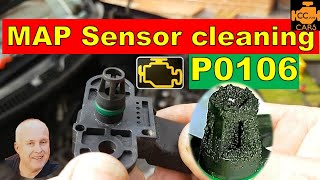
We Have This Part in Stock


The information in this article is provided for general reference and educational purposes only. Vehicle specifications, procedures, and part compatibility can vary by production date, trim level, and region. Always consult your vehicle's factory service manual and verify part numbers before purchasing or performing repairs. Safety-critical components such as airbags, seat belts, and braking systems should be installed by a qualified professional.
- Subaru Outback:
- 🧭 Diagnostic Flowchart
- 🎬 Helpful Videos
- 🛍️ Shop This Part
- What's Unique About the 2013-2017 Subaru Outback
- Symptoms You May Notice
- Most Likely Causes
- Rare But Worth Checking
- Diagnosis Steps
- Parts You'll Likely Need
- Related Codes That Often Appear With This One
- Technical Service Bulletins (TSBs) & Recalls
- Platform-Specific Known Issues
- Mechanic-Grade Diagnostic Values
- Scan Tool Commands That Help
- Wiring & Ground Locations
- Real Owner Repair Stories
- "I Checked Everything" — The Actual Cause
- OEM Part Supersession History
- Model Year Variations Within This Range
- Other Known Issues on This Vehicle
- Used vs. New Parts: Buying Guide for This Vehicle
- Real Owner Stories
- 2013 Subaru Outback 2.5L
- 2013 Subaru Outback 2.5L
- 2013-2017 Subaru Outback 2.5L
- Related OBD-II Codes
- Frequently Asked Questions
- 🎟️ Get 5% Off