

P0107 on 2009-2016 Audi A4 2.0L TFSI: MAP Sensor Circuit Low Causes and Fixes
P0107 on a B8 Audi A4 2.0T most often points to a faulty MAP sensor, a failed PCV valve creating a vacuum leak, or a wiring issue. Before replacing the sensor, check the PCV system for high vacuum by trying to remove the oil cap while the engine is running. A new Bosch MAP sensor costs around $30-$60.
- Before buying any parts for a P0107 code, test the PCV valve. With the engine idling, check for strong suction at the oil filler cap. This simple test can save you from misdiagnosing the problem.
- The most likely causes for P0107 on this car are, in order: a failed PCV valve, a faulty MAP sensor, or a vacuum leak.
- If you replace the MAP sensor, use a quality OEM brand like Bosch to ensure accurate readings. The part is relatively inexpensive and easy to access.
- This code indicates a problem that affects fuel economy and engine performance. It should be addressed promptly to avoid further issues.
What's Unique About the 2009-2016 Audi A4
On the 2.0L TFSI engine (engine codes like CAEB) from this era, the P0107 code is frequently linked to the platform's notoriously high failure rate of the Positive Crankcase Ventilation (PCV) valve, also known as the oil separator. A torn diaphragm in the PCV valve creates a significant internal vacuum leak. This excessive, unmetered vacuum in the crankcase causes the MAP sensor to send an abnormally low reading to the ECU. Owners often misdiagnose the issue as a bad MAP sensor when the root cause is the PCV system.
Symptoms You May Notice
- Check Engine Light is on
- Rough or unstable idle
- Sluggish acceleration and loss of power
- Increased fuel consumption
- Hesitation or stumbling when accelerating
- Engine stalling, especially at stops
- Black smoke from the exhaust in some cases
- A distinct whistling or 'honking' sound from the engine bay at idle, which may disappear when the oil cap is loosened. 🎬 Watch: Hear the distinct whistling sound of a failed PCV.
- Replacing the MAP sensor when the actual fault is a failed PCV valve. The symptoms are very similar, but the PCV is a more common failure point on this specific engine and should be checked first.
Most Likely Causes
- Failed PCV Valve / Oil Separator 🔴 High Probability The rubber diaphragm inside the PCV valve is a very common failure point on the 2.0L TFSI engine. It tears, creating a large, unmetered vacuum leak within the crankcase. This is a well-documented design flaw.
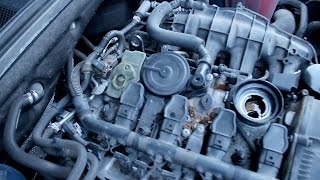
How to confirm: With the engine running at idle, try to remove the oil filler cap. If there is very strong suction holding the cap down, making it difficult to remove, the PCV valve has likely failed. 🎬 See how to diagnose and replace the PCV valve yourself. The engine may stumble or stall when you remove the cap. A whistling or honking sound from the PCV valve area that stops when the cap is loosened is another classic symptom. A Reddit user noted that oil visible in the intake manifold when the MAP sensor is removed is a clear sign of PCV failure.
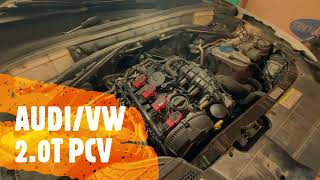
Typical fix: Replace the entire PCV valve assembly. It is located on top of the valve cover. 🎬 Watch this full assembly replacement walkthrough for B8 models. Always use the latest OEM part number revision available for your VIN, as Audi has updated the part multiple times.
Est. part cost: $140-$220 - Faulty Manifold Absolute Pressure (MAP) Sensor 🟡 Medium Probability → Shop Manifold Absolute Pressure Sensor The sensor can become contaminated with oil and carbon, especially if the PCV system is failing, or it can fail electronically over time. Its location on the charge pipe makes it susceptible to oil blow-by.
How to confirm: Check live data with a scan tool to see if the MAP reading is stuck low (e.g., below 0.5V). Test the sensor's voltage output at the connector; it should vary with engine RPM and load, typically between 1V and 4.5V. With the Key On, Engine Off (KOEO), the reading should reflect the current barometric pressure. If the reading is illogical or stuck, the sensor is suspect.
Typical fix: Replace the MAP sensor. It is located on the charge pipe near the throttle body and held by one or two T20/T30 Torx screws. Ensure the o-ring seal is in good condition to prevent a boost leak.
Est. part cost: $30-$70 - Vacuum Leak 🟡 Medium Probability Aside from the PCV valve, other plastic and rubber hoses in the engine bay become brittle over time due to heat cycles, leading to cracks and leaks. A failed rear main seal, sometimes caused by excessive vacuum from a bad PCV, can also be a major vacuum leak source.
How to confirm: Perform a smoke test on the intake system. This involves pumping smoke into the intake and looking for where it escapes, which will pinpoint the location of the leak. Visually inspect all vacuum lines connected to the intake manifold for obvious cracks or disconnections.
Typical fix: Replace the cracked or broken vacuum hose(s).
Est. part cost: $10-$50 - Wiring or Connector Issue ⚪ Low Probability
How to confirm: Inspect the MAP sensor's electrical connector and harness for damage, corrosion, or loose pins. Use a multimeter to check for 5V reference voltage and a good ground at the connector with the key on. A 'wiggle test' on the harness while monitoring live data can help identify intermittent connections. Check grounds on the valve cover, as loose grounds have been reported to cause sensor circuit codes.
Typical fix: Repair the damaged section of the wiring harness or clean/replace the connector.
Est. part cost: $5-$100
Rare But Worth Checking
- Faulty Engine Control Unit (ECU): This is extremely rare. The ECU should only be considered after all other possibilities (sensor, wiring, vacuum leaks) have been definitively ruled out.
Diagnosis Steps
- Read all fault codes with an OBD-II scanner. Note if other codes like P2279, P0171, or P0237 are present.
- With the engine running, carefully try to remove the oil filler cap. If extreme suction is present and/or a loud whistling is heard, the PCV valve is the likely culprit and should be replaced.
- If the PCV test is inconclusive, visually inspect the MAP sensor connector and wiring for any visible damage, oil contamination, or corrosion.
- Use a scan tool to monitor live data from the MAP sensor. Check the reading with the Key On, Engine Off (KOEO). It should be close to barometric pressure. Start the engine; the reading should drop at idle and change as you press the throttle.
- If the reading is stuck low (under 0.5V) or doesn't change, test the sensor's wiring. Confirm you have a 5-volt reference and a good ground at the connector.
- If wiring is good, the MAP sensor is likely faulty. Remove it and inspect for oil contamination. If oily, the PCV is also suspect. Replace the sensor.
- If the sensor and PCV seem okay, perform a smoke test to check the entire intake system for hidden vacuum leaks, paying attention to all hoses connected to the intake manifold.
Parts You'll Likely Need
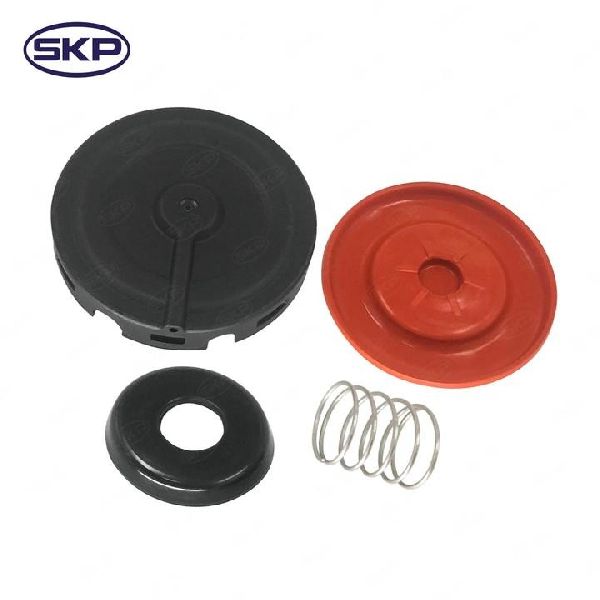
- PCV Valve / Oil Separator
(OEM #06H103495AH (for up to 2011/early 2012 models), 06H103495AK (for late 2012+ models). Always verify with VIN.)— This is the most common cause of vacuum leaks and pressure-related codes on the 2.0L TFSI engine.
Trusted brands: Audi (OEM), Hengst, Vaico
OEM price range: $150-$220
Aftermarket price range: $50-$120 - Manifold Absolute Pressure (MAP) Sensor
(OEM #038906051C / Bosch 0281002401 (Verify by VIN, as multiple sensors are used))— This is the sensor that directly reports the fault. It can fail electronically or become contaminated.
Trusted brands: Bosch (OEM supplier), Denso
OEM price range: $40-$70
Aftermarket price range: $25-$50
Related Codes That Often Appear With This One
- P0106 — This code indicates a MAP sensor performance/range issue. It often appears with P0107 as the sensor's readings are erratic or illogical, not just low.
- P2279 — This code means 'Intake Air System Leak'. It is commonly triggered by a failed PCV valve, which is a primary cause for P0107 on this engine.
- P0171 — This code means 'System Too Lean (Bank 1)'. A vacuum leak from a bad PCV valve or cracked hose allows unmetered air into the engine, causing a lean condition alongside the incorrect MAP sensor reading.
- P0237 — This code for 'Turbocharger Boost Sensor A Circuit Low' is often triggered alongside P0107 because on this engine, the MAP sensor and boost sensor are the same component.
Technical Service Bulletins (TSBs) & Recalls
- Audi TSB 2015505/10: This bulletin addresses conditions like whistling noises, oil leaks from the filler cap, and fault codes P2187 (Lean at Idle) and P2279 (Intake Air System Leak). It describes the failure mechanism of the crankcase ventilation valve (PCV), where a broken check valve pin leads to excessive crankcase vacuum or pressure, directly explaining the root cause of symptoms that can lead to a P0107 code.
Platform-Specific Known Issues
- The 2.0L TFSI engine in the B8 A4 is well-documented for PCV valve failures. The internal diaphragm tears, creating a significant vacuum leak that can trigger a P0107 code. Audi has released multiple revisions of this part to address the issue.
- A failed PCV valve can create enough vacuum to damage engine seals, most notably the rear main seal, leading to a much more expensive repair. Therefore, addressing PCV-related symptoms promptly is crucial.
Mechanic-Grade Diagnostic Values
- MAP Sensor Signal Voltage at ECU — expected: 1.0V - 4.5V (Varies with engine load, idle is ~1.0-1.7V).. Failure: Voltage is stuck below 0.5V, indicating a low circuit fault.
- MAP Sensor 5V Reference at Connector — expected: 5.0V with Key On, Engine Off (KOEO).. Failure: No voltage or significantly less than 5.0V points to a wiring or ECU issue, not a faulty sensor.
- MAP Sensor Ground Circuit Resistance — expected: Less than 10 Ohms to chassis ground.. Failure: Resistance above 10 Ohms indicates a poor ground path, which can cause a low voltage reading.
- VCDS Live Data - MAP Sensor Reading (KOEO) — expected: With Key On, Engine Off, the MAP sensor reading in VCDS should be very close to the Barometric Pressure reading (Atmospheric Pressure).. Failure: A significant deviation between the MAP sensor value and atmospheric pressure at KOEO indicates a faulty sensor.
Scan Tool Commands That Help
- VCDS (VAG-COM): Throttle Body Adaptation (TBA) — After cleaning or replacing the throttle body, or after disconnecting the battery. The ECU must relearn the throttle plate's position range. Go to [01-Engine] -> [Basic Settings - 04] -> Group 060 and activate. The process cycles the throttle and confirms adaptation.
- VCDS (VAG-COM): Monitor Measuring Blocks for MAP Sensor — To diagnose a suspected faulty MAP sensor. You can log the specified vs. actual boost pressure while driving to see if the sensor is responding correctly to changes in engine load. A sensor that is slow to respond or has a flat reading is faulty.
Wiring & Ground Locations
- MAP Sensor (G71) Connector Pins — On the charge pipe near the throttle body.. Knowing the pinout is critical for testing. Pin 1: 5V Reference (from ECU), Pin 2: Signal (to ECU), Pin 3: Ground. Verifying 5V and ground at the connector is the first step in diagnosing a circuit fault vs. a sensor fault.
- Engine Block to Firewall Ground — A strap connecting the engine block to the firewall, often designated as G105.. A corroded or loose main engine ground can cause floating voltages and intermittent sensor circuit faults, including P0107. This is a primary ground path for many engine sensors.
- Left Engine Bay Ground Point — Located on the chassis frame rail in the left (driver's side in LHD) engine bay, often designated G106.. This ground point serves multiple components in the engine bay. Verifying it is clean and tight is a key step when chasing electrical faults that don't have an obvious cause.
- ECU Connector T94 — The larger of the two main connectors at the Engine Control Unit (ECU), located in the plenum chamber box under the windshield.. The MAP sensor signal wire (Pin 2 on sensor) runs to pin T94/26 on the ECU. The 5V reference (Pin 1 on sensor) comes from T94/6. If voltage tests at the sensor fail, the next step is to check for continuity between the sensor connector and these specific ECU pins.
Real Owner Repair Stories
- Audizine Forum User (2011 Audi A4 2.0T) — Check engine light with codes P0107, P0171 (Lean), and P2279 (Intake Leak). Rough idle and hesitation.
❌ Tried (didn't work) Replaced MAP sensor (no change), Smoke tested the intake system (no leaks found)
✅ What actually fixed it The PCV valve was replaced. The user performed the 'oil cap test' and found extreme suction, confirming a torn diaphragm in the PCV. After replacement, all codes were cleared and did not return. - MHH Auto Forum User (Audi A4 B8 (engine not specified, but behavior is relevant)) — Non-starter with code P0651 (Sensor reference voltage B - Open Circuit), which is related to the 5V sensor supply.
❌ Tried (didn't work) Checking individual sensors on the 5V circuit.
✅ What actually fixed it A faulty turbo actuator was shorting the entire 5V reference circuit, pulling the voltage down to 0.99V for all sensors on that circuit, including what would affect the MAP sensor. Disconnecting the faulty actuator restored the 5V reference to other sensors. This demonstrates how an unrelated component can cause a sensor circuit code. - YouTube User Comment (2010 Audi A4 2.0T) — Persistent P0107 and lean codes, even after replacing PCV and MAP sensor.
❌ Tried (didn't work) Replaced MAP sensor, Replaced PCV valve
✅ What actually fixed it A hairline crack was found on the plastic intake manifold itself, on a seam near the throttle body. The crack would only open under certain temperature and vacuum conditions, making it very difficult to find with a smoke test on a cold engine. Replacing the intake manifold finally resolved the issue.
"I Checked Everything" — The Actual Cause
- A common scenario for this platform is a failed rear main seal causing a massive, unmetered air leak. The excessive crankcase vacuum created by a faulty PCV can pull air past the rear main seal. This is an 'intake leak' but will not show up on a traditional intake smoke test, as the leak is into the crankcase, not directly into the intake manifold. The symptom is a lean code (P0171) and sometimes P0107, but a smoke test of the intake and charge pipes comes back clean. The true test is to smoke test the crankcase itself via the oil filler neck.
OEM Part Supersession History
06H103495A / E / J→06H103495AH, then 06H103495AK, and later revisions.— The original PCV valve designs had diaphragms that were prone to tearing, leading to massive vacuum leaks. Audi released multiple revisions with improved materials and design to increase durability.
Heads up: While newer revisions may physically fit older cars, there was an ECU software update associated with the PCV change for the oil consumption fix. Using a later-style PCV on an early car without the corresponding ECU update can affect crankcase pressure regulation.
Model Year Variations Within This Range
- 2009-2012 (B8): These models were originally equipped with earlier, more failure-prone versions of the PCV valve (e.g., ending in A, E, J, AH). They were also the primary subjects of the oil consumption TSB which, if performed, included an updated PCV and an ECU reflash.
- 2013-2016 (B8.5): These facelift models came from the factory with an improved PCV design (typically 06H103495AK or later) and different ECU software to manage crankcase pressure. While still a failure point, they are generally more durable than the early B8 parts.
Diagnostic Flowchart
Other Known Issues on This Vehicle
Issues unrelated to this code that are worth knowing about as an owner of this generation:
- Excessive Oil Consumption 🔴 High — Very common, especially in 2009-2011 models with the CAEB engine. Often requires adding oil every 500-1000 miles. (Ref: Subject of class-action lawsuits (e.g., Gonzalez v. Volkswagen). Audi addressed this with a multi-stage repair process, often culminating in new pistons and rings.)
- Timing Chain Tensioner Failure 🔴 High — A critical issue primarily affecting pre-2013 models with a faulty tensioner design. Failure can occur without warning, often between 60,000 and 100,000 miles. (Ref: Subject of a class-action lawsuit (TimingChainLitigation.com). The fix involves replacing the original tensioner with an updated part (P/N 06K109467K).)
- Water Pump Failure 🟠 Medium — Common across all B8 model years. The plastic housing is prone to cracking and leaking coolant. Failure can occur as early as 25,000 miles, but is more typical around 60,000-80,000 miles. (Ref: No specific recall, but updated all-metal housing replacements are available.)
- Intake Manifold Carbon Buildup 🟠 Medium — As a direct-injection engine, carbon buildup on intake valves is inevitable and typically requires cleaning every 40,000-60,000 miles to prevent misfires and performance loss.
- Turbocharger Wastegate Rattle/Failure 🟠 Medium → Shop Turbocharger — The wastegate actuator rod can become loose on early B8 models, leading to rattling noises and underboost fault codes (like P0299).
Used vs. New Parts: Buying Guide for This Vehicle
When a used part is the smart pick: For this repair, buying used parts is generally not recommended. The primary failure items (PCV valve, MAP sensor) are wear-and-tear components with a finite lifespan. A used PCV valve is especially risky as the internal diaphragm's condition is unknown and it could fail shortly after installation.
Donor-vehicle mileage cap: roughly under 20000 miles for the part to have meaningful remaining life.
What to inspect on the donor part:
- Not applicable for PCV or MAP sensor. Do not buy used.
OEM-only on this vehicle (don't cheap out):
- PCV Valve / Oil Separator: While quality aftermarket options exist, the OEM part (from Audi or the OEM supplier, Hengst) has undergone the most revisions to fix the original design flaws. Using the latest genuine part is the safest bet to ensure compatibility and longevity.
Aftermarket brands forum-validated for this vehicle:
- PCV Valve: Hengst (OEM supplier), Vaico (often cited as a reliable alternative). Some owners report success with reinforced diaphragm kits from RKX-tech.
- MAP Sensor: Bosch (OEM supplier), Denso.
Brands owners have reported issues with on this vehicle:
- Unbranded, no-name PCV valves and MAP sensors from online marketplaces. These often have high failure rates, incorrect calibration, and can cause more issues than they solve.
Real Owner Stories
Aggregated from forums and TSBs cited above. Mileages and costs reflect what owners reported in those sources.
Audi A4 2.0L TFSI (High Mileage) — ~125000 miles
Symptoms: Owner reported P0107 and P0108 codes on a high-mileage engine.
What fixed it: The fix was a new PCV valve after a mechanic's diagnosis.
Source hint: Reddit (r/MechanicAdvice)
2009-2016 Audi A4 2.0L TFSI
Symptoms: Whistling noises, oil leaks from the filler cap, and fault codes related to intake air system leaks.
What fixed it: Replacement of the crankcase ventilation valve (PCV) due to a broken check valve pin.
Source hint: Audi TSB 2015505/10
Audi A4 (B8) 2.0T
Symptoms: Pressure and lean codes; owner found that replacing the MAP sensor did not resolve the issue.
What fixed it: Replacing the PCV valve after performing the 'oil cap suction test'.
Source hint: Audizine / AudiWorld
Related OBD-II Codes
Frequently Asked Questions
My 2009 Audi A4 is making a whistling sound at idle that stops when I open the oil cap. Is this related to P0107?
Does Audi TSB 2015505/10 apply to the P0107 code on my 2.0L TFSI?
I replaced the MAP sensor on my B8 A4 but the P0107 code came back. What should I check next?
Can a bad PCV valve cause other damage to my Audi A4 engine?
Where is the MAP sensor located on the 2.0L TFSI engine?
What part should I use to fix the PCV-related P0107 code?
Helpful Videos


We Have This Part in Stock

The information in this article is provided for general reference and educational purposes only. Vehicle specifications, procedures, and part compatibility can vary by production date, trim level, and region. Always consult your vehicle's factory service manual and verify part numbers before purchasing or performing repairs. Safety-critical components such as airbags, seat belts, and braking systems should be installed by a qualified professional.
- Audi A4:
- 🧭 Diagnostic Flowchart
- 🎬 Helpful Videos
- 🛍️ Shop This Part
- What's Unique About the 2009-2016 Audi A4
- Symptoms You May Notice
- Most Likely Causes
- Rare But Worth Checking
- Diagnosis Steps
- Parts You'll Likely Need
- Related Codes That Often Appear With This One
- Technical Service Bulletins (TSBs) & Recalls
- Platform-Specific Known Issues
- Mechanic-Grade Diagnostic Values
- Scan Tool Commands That Help
- Wiring & Ground Locations
- Real Owner Repair Stories
- "I Checked Everything" — The Actual Cause
- OEM Part Supersession History
- Model Year Variations Within This Range
- Other Known Issues on This Vehicle
- Used vs. New Parts: Buying Guide for This Vehicle
- Real Owner Stories
- Audi A4 2.0L TFSI (High Mileage) — ~125000 miles
- 2009-2016 Audi A4 2.0L TFSI
- Audi A4 (B8) 2.0T
- Related OBD-II Codes
- Frequently Asked Questions
- 🎟️ Get 5% Off