

P0107 on 2018-2019 Ford Flex 3.5L EcoBoost: Causes, TSB, and MAP Sensor Fix
On a 2018-2019 Ford Flex with the 3.5L EcoBoost, code P0107 is almost always caused by a faulty Manifold Absolute Pressure and Temperature (MAPT) sensor. This is a known issue covered by Ford TSB 19-2212. The fix is a simple DIY replacement of the sensor, costing around $100-$160 for the OEM part.
- For a 2018-2019 Flex 3.5L EcoBoost, P0107 almost certainly means the MAPT sensor has failed.
- This is a known issue covered by Ford TSB 19-2212.
- The repair is very simple: replace the sensor (Part # AA5Z-9F479-E) on top of the intake manifold.
- Do not ignore this code; it can cause a sudden and dangerous loss of engine power.
- Check for related codes P0108 and P0109, which further confirm a faulty MAPT sensor.
What's Unique About the 2018-2019 Ford Flex
For this specific vehicle and engine, P0107 is not a generic diagnostic puzzle. Ford issued Technical Service Bulletin (TSB) 19-2212 that directly addresses this code on the 2018-2019 Flex 3.5L EcoBoost. The TSB acknowledges a high failure rate for the Manifold Absolute Pressure and Temperature (MAPT) sensor, making it the primary and most probable cause. This turns the diagnosis from a broad search for wiring or vacuum issues into a highly specific, known component failure. The TSB was created because this issue was so prevalent across the entire 3.5L EcoBoost platform from this era.
Symptoms You May Notice
- Check Engine Light (MIL) illuminated
- Powertrain Malfunction (Wrench) light illuminated
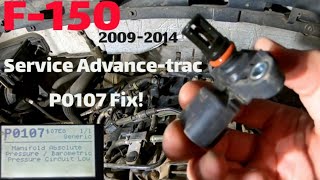
- "Service AdvanceTrac" message displayed
- "Hill Start Assist Not Available" message disp 🎬 See how a faulty sensor triggers these specific dashboard warnings.layed
- Significant lack of power or sluggish acceleration, often described as 'limp mode'
- Rough or unstable idle
- Poor fuel economy
- Vehicle may stall or hesitate
- Harsh or erratic transmission shifting
- Replacing the throttle body
- Searching for a vacuum leak (while a vacuum leak can cause similar symptoms, it's far less likely than the sensor failure on this specific platform and would typically present differently in the live data)
- Replacing the Mass Air Flow (MAF) sensor (The 3.5L EcoBoost uses MAP/TMAP sensors, not a traditional MAF sensor for primary load calculation)
Most Likely Causes
- Faulty Manifold Absolute Pressure and Temperature (MAPT) Sensor 🔴 High Probability → Shop Manifold Absolute Pressure Sensor This is a well-documented pattern failure acknowledged by Ford in TSB 19-2212 for this specific engine and year range. The sensor is exposed to significant heat and pressure changes within the intake manifold, leading to premature electronic failure.
How to confirm: With the Key On, Engine Off (KOEO), use a scan tool to compare the 'MAP (PRESS)' PID value to the 'BARO (PRESS)' PID value. TSB 19-2183 also suggests comparing it to 'TCBP (PRESS)' and 'TURBO INLET (PRESS)' PIDs if available. If the MAP reading differs from the others by more than 1.5 psi (10.35 kPa), the sensor is faulty.
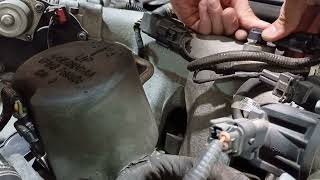
Typical fix: Replace the MAPT sensor located on top of the intake manifold, slightly to the passenger side. It is held in by a single T20 Torx screw. 🎬 Watch: Step-by-step MAP sensor replacement for the 3.5L EcoBoost. The engine cover must be popped off for access.
Est. part cost: $95-$165
Rare But Worth Checking
- Wiring Harness or Connector Issue: While less common than sensor failure on this platform, the wiring or connector pins at the MAPT sensor can become damaged from heat and vibration. Always perform a quick visual inspection and wiggle test of the connector before replacing the sensor. Check for pushed-out pins or corrosion inside the connector.
- Powertrain Control Module (PCM) Fault: → Shop Engine Control Module (ECM) This is extremely rare and should only be considered after the sensor and wiring have been definitively proven to be good. A PCM failure is a last resort diagnosis.
Diagnosis Steps
- Connect an OBD-II scanner to the vehicle and confirm P0107 is present. Check for other codes like P0108 or P0109, which strongly point to the same root cause.
- Turn the ignition to the 'Key On, Engine Off' (KOEO) position.
- Using the scanner's live data feature, view the Manifold Absolute Pressure (MAP) and Barometric Pressure (BARO) readings. If your scanner supports it, also view the Turbocharger Boost Pressure (TCBP) and Turbo Inlet Pressure PIDs.
- Compare the values. They should be nearly identical at your current altitude with the engine off. If the MAP reading is more than 1.5 psi (10.35 kPa) different from the BARO reading, the MAPT sensor is bad and must be replaced.
- If the values are close, visually inspect the MAPT sensor connector and its wiring for any signs of damage, corrosion, or looseness. The connector is on the top of the intake manifold.
- If the inspection reveals no issues and the sensor readings were plausible, the fault may be intermittent. However, given the high failure rate documented in TSB 19-2212, replacing the MAPT sensor is the most logical and time-effective next step.
Parts You'll Likely Need
- Manifold Absolute Pressure and Temperature (MAPT) Sensor
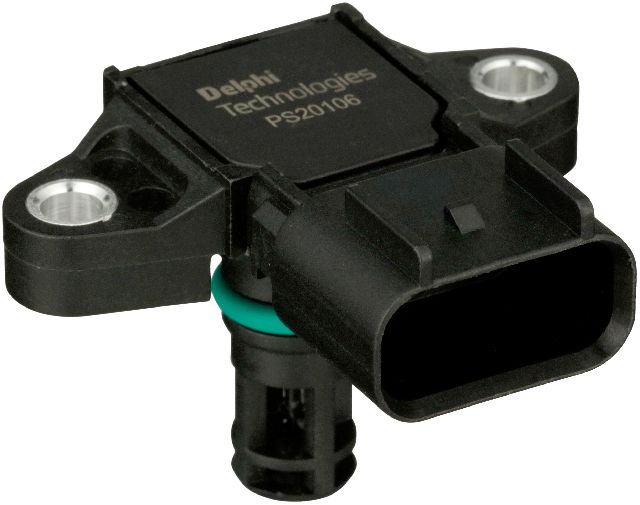
(OEM #AA5Z-9F479-E)— This is the specific part identified by Ford in TSB 19-2212 as the cause of the P0107 code on this vehicle. It is a 3-bar sensor designed for the turbocharged EcoBoost engine. Part number AA5Z-9F479-E supersedes previous versions like AA5Z-9F479-A.
Trusted brands: Motorcraft, Bosch
OEM price range: $97-$165
Aftermarket price range: $50-$110
Related Codes That Often Appear With This One
- P0108 — This code for 'MAP Circuit High Input' is also caused by the same failing MAPT sensor and is mentioned in TSB 19-2212.
- P0109 — This code for 'MAP Circuit Intermittent' is also caused by the same failing MAPT sensor and is mentioned in TSB 19-2212.
Technical Service Bulletins (TSBs) & Recalls
- TSB 19-2212: Supersedes TSB 19-2183. Addresses an illuminated MIL, wrench lamp, and lack of power with DTCs P0107, P0108, and/or P0109 due to a faulty MAPT sensor on 2018-2019 Flex, Explorer, Taurus, and MKT with the 3.5L EcoBoost engine. The primary update from the previous TSB was to the service procedure, simplifying it to a direct replacement without extensive diagnostics.
- TSB 19-2183: The original bulletin for this issue. It contained more detailed diagnostic steps, including comparing multiple pressure sensor PIDs, which are still useful for confirming the failure.
- Bulletin #TSB-2212: This manufacturer record notes that a faulty manifold absolute pressure and temperature (MAPT) sensor may cause a powertrain malfunction (wrench) lamp, Service AdvanceTrac message, Hill Start Assist Not Available message, and/or lack of power with DTCs P0107, P0108 and/or P0109 present.
Platform-Specific Known Issues
- Ford TSB 19-2212 was issued specifically for this problem. It notes that a faulty MAPT sensor can cause P0107, P0108, and/or P0109, along with a lack of power and multiple dashboard warning messages on 2018-2019 Flex, Explorer, Taurus, and MKT models with the 3.5L EcoBoost engine.
- Owner reports on forums for platform-mate vehicles like the Explorer Sport indicate this can be a recurring failure, with some owners replacing the sensor more than once.
Mechanic-Grade Diagnostic Values
- MAPT Sensor 5V Reference Wire Voltage — expected: Approx. 5.0V DC with key on, engine off.. Failure: No voltage or significantly low voltage points to a wiring issue or a problem with the PCM.
- MAPT Sensor Signal Wire Voltage (KOEO) — expected: Approx. 4.5V at sea level, should correspond to BARO reading.. Failure: Voltage below 0.5V for more than a few seconds will trigger P0107.
- MAPT Sensor Signal Wire Voltage (Engine Idling) — expected: 1.0V to 2.0V, depending on engine vacuum.. Failure: A reading that is stuck low (near 0V) or does not change with engine RPM.
- MAP vs. BARO PID Comparison (KOEO) — expected: Values should be within 1.5 psi (10.35 kPa) of each other.. Failure: A difference greater than 1.5 psi indicates a faulty MAPT sensor.
- Sensor Ground Wire to Chassis Ground Resistance — expected: Less than 0.5 Ohms.. Failure: A reading greater than 1 Ohm indicates a poor ground connection, which could be in the harness or internal to the PCM.
Scan Tool Commands That Help
- Ford IDS (or equivalent): No specific relearn or calibration function required. — After replacing the MAPT sensor for this TSB-related issue, no special procedure is needed. The PCM will adapt to the new sensor's readings automatically. Clearing the DTCs is sufficient.
Wiring & Ground Locations
- MAPT Sensor Connector — On top of the intake manifold, slightly to the passenger side of the engine, visible after removing the engine cover.. This is the primary connection point. Heat and vibration can damage the connector or the wires leading to it, causing an open or short that mimics a failed sensor.
- PCM Ground — The MAPT sensor is grounded through the Powertrain Control Module (PCM), not directly to the chassis or engine block.. If sensor voltage and reference tests are inconclusive, a fault in the PCM's ground circuit could be the cause, though this is rare. A bad main PCM ground could cause this and many other issues.
Real Owner Repair Stories
- YouTube video comment section (2014 Ford F-150 3.5L EcoBoost (Platform Mate)) — Truck started shuttering and displayed a 'Service AdvanceTrac' message, accompanied by a P0107 code.
✅ What actually fixed it Replaced the Manifold Absolute Pressure (MAP) sensor. After replacement and clearing the code, the wrench light went off and the issue was resolved on a test drive.
OEM Part Supersession History
2R3Z-9F479-AA→AA5Z-9F479-A— Standard part revision and update over time.AA5Z-9F479-A→AA5Z-9F479-C— Part revision. Note that the -C and -D versions are often listed for different applications (e.g., -C for naturally aspirated or in the intake manifold, -D for the boost pipe) and may not be interchangeable despite physical similarity.
Heads up: While physically similar, using the wrong revision can cause issues. The 3.5L EcoBoost uses multiple TMAP/MAP sensors in different locations; ensure the correct part is used for the manifold location.AA5Z-9F479-C→AA5Z-9F479-E— Latest revision specified in TSB 19-2212 for this specific fault.
Heads up: AA5Z-9F479-E is the correct, current part for this repair.
Diagnostic Flowchart
Real Owner Stories
Aggregated from forums and TSBs cited above. Mileages and costs reflect what owners reported in those sources.
Older Ford Diesel Truck
Symptoms: Experienced harsh and erratic transmission shifting alongside the P0107 code, leading to an incorrect fear that the Powertrain Control Module (PCM) was failing.
What fixed it: Diagnosed as a sensor issue; replacing the PCM was deemed incorrect and unnecessary.
Source hint: FordTruckEnthusiasts.com - 'P0107 - Replace PCM?'
2018-2019 Ford Explorer Sport 3.5L EcoBoost
Symptoms: Experienced a lack of power and dashboard warning messages. The issue presented as a recurring failure, happening more than once to the same vehicle.
What fixed it: Replaced the MAPT sensor (some owners reported having to replace it multiple times due to recurring failures).
Source hint: Go-Parts.com Articles for Taurus/MKT/Explorer / Platform-mate forums
Related OBD-II Codes
Frequently Asked Questions
Does Ford have a specific TSB for the P0107 code on my 2018-2019 Flex 3.5L EcoBoost?
Why is my Flex displaying 'Service AdvanceTrac' and 'Hill Start Assist Not Available' with this code?
How can I test if the MAPT sensor is actually bad on my 3.5L EcoBoost?
Where is the MAPT sensor located on the Flex, and can I replace it myself?
Is it possible my PCM is bad if I'm getting harsh shifting and a P0107 code?
Helpful Videos


We Have This Part in Stock



The information in this article is provided for general reference and educational purposes only. Vehicle specifications, procedures, and part compatibility can vary by production date, trim level, and region. Always consult your vehicle's factory service manual and verify part numbers before purchasing or performing repairs. Safety-critical components such as airbags, seat belts, and braking systems should be installed by a qualified professional.
- Ford Flex:
- 🧭 Diagnostic Flowchart
- 🎬 Helpful Videos
- 🛍️ Shop This Part
- What's Unique About the 2018-2019 Ford Flex
- Symptoms You May Notice
- Most Likely Causes
- Rare But Worth Checking
- Diagnosis Steps
- Parts You'll Likely Need
- Related Codes That Often Appear With This One
- Technical Service Bulletins (TSBs) & Recalls
- Platform-Specific Known Issues
- Mechanic-Grade Diagnostic Values
- Scan Tool Commands That Help
- Wiring & Ground Locations
- Real Owner Repair Stories
- OEM Part Supersession History
- Real Owner Stories
- Older Ford Diesel Truck
- 2018-2019 Ford Explorer Sport 3.5L EcoBoost
- Related OBD-II Codes
- Frequently Asked Questions
- 🎟️ Get 5% Off