

P0107 on 2008-2011 Ford Focus 2.0L: MAP Sensor Circuit Low Causes and Fixes
On a 2008-2011 Ford Focus, P0107 almost always points to a failed Manifold Absolute Pressure (MAP) sensor. It's a simple, beginner-friendly DIY fix, with a replacement sensor costing between $40 and $80. Before replacing, a quick visual inspection of the wiring and connector is wise, as harness damage is the second most likely cause.
- P0107 on your 2008-2011 Focus almost certainly points to a bad MAP sensor or its wiring.
- This is a beginner-friendly DIY repair that usually takes less than 30 minutes and requires only basic tools.
- Always check the wiring and connector for damage before buying a new sensor, especially on a high-mileage car or if the engine has excessive vibration.
What's Unique About the 2008-2011 Ford Focus
For the second-generation North American Ford Focus with the 2.0L Duratec engine (a Mazda MZR design), the P0107 code is very straightforward. Unlike some vehicles where this code could be triggered by a major vacuum leak, on this Focus it almost exclusively points to an electrical fault in the MAP sensor circuit. The sensor is mounted directly on the plastic intake manifold, making it very easy to access and replace, but also exposing it to engine heat and vibrations that can lead to its failure over time. A known issue with failing passenger-side engine mounts on this platform can cause excessive vibration, potentially accelerating the failure of the MAP sensor or its wiring.
Symptoms You May Notice
- Check Engine Light is on
- Rough or unstable idle
- Engine stalling, especially when coming to a stop
- Hesitation or sluggish acceleration
- Reduced engine power or 'limp mode'
- Poor fuel economy
- Black smoke from the exhaust (due to a rich fuel mixture)
- Difficulty starting the engine
- Engine may run rough and then smooth out after a few seconds, with the CEL turning off on its own (indicative of an intermittent connection or sensor issue, especially in cold weather)
- Replacing the Mass Air Flow (MAF) sensor. This vehicle uses a MAP sensor for its primary load calculations, and while it may also have a MAF sensor, P0107 specifically points to the MAP sensor circuit.
- Assuming a vacuum leak is the cause. While large vacuum leaks can cause performance issues, they typically trigger other codes like P0171 (System Too Lean). P0107 is an electrical circuit code, making a leak an unlikely direct cause on this platform.
Most Likely Causes
- Faulty Manifold Absolute Pressure (MAP) Sensor 🔴 High Probability → Shop Manifold Absolute Pressure Sensor The sensor is mounted directly to the intake manifold, where it is exposed to constant heat and engine vibration, leading to internal electrical failure over time. This is the most common cause for P0107 on this vehicle. The high rate of passenger-side motor mount failure on these cars can introduce excessive vibration, further stressing the sensor.
How to confirm: Use a scan tool to monitor MAP sensor voltage with the Key On, Engine Off (KOEO). The reading should be around 4.5-5.0 volts, corresponding to atmospheric pressure. At idle, it should drop to 1.0-1.5 volts. If the voltage is stuck below 0.5V in all states, the sensor has failed internally. You can also backprobe the sensor connector to verify these voltages with a multimeter.
Typical fix: Replace the MAP sensor. It is located on the intake manifold, often near the throttle body, and is held in by a single Torx or small hex bolt. Disconnect the electrical connector, remove the bolt, and pull the sensor out.
Est. part cost: $40-$125 - Wiring Harness or Connector Damage 🟡 Medium Probability The wiring harness leading to the MAP sensor can become brittle and chafe due to engine vibration and heat cycles, causing a short to ground or an open circuit. The connector pins can also corrode or become loose. A 'wiggle test' on the harness while monitoring live data can often reveal an intermittent connection issue.
How to confirm: Visually inspect the wiring and connector for any signs of damage, chafing, melting, or corrosion. With the key on, unplug the sensor and use a multimeter to verify a 5-volt reference and a good ground at the connector. If either is missing, the problem is upstream towards the PCM. If both are present, the issue is likely the sensor itself or the signal wire.
Typical fix: Repair the damaged section of wiring. If the connector itself is damaged, it will need to be replaced with a new pigtail connector. These are commonly available.
Est. part cost: $15-$30
Rare But Worth Checking
- Powertrain Control Module (PCM) Fault: → Shop Engine Control Module (ECM) This is extremely rare. A failure of the PCM's internal driver circuit for the MAP sensor can cause a P0107. The PCM should only be considered after the sensor and all wiring have been thoroughly tested and confirmed to be in good working order.
Diagnosis Steps
- Use an OBD-II scanner to confirm the P0107 code and check for any other pending or active codes. Record the freeze-frame data.
- Visually inspect the MAP sensor, its electrical connector, and the surrounding wiring for any obvious damage, such as cracks, corrosion, loose connections, or signs of melting.
- With a scan tool, observe the live data for the MAP sensor. With the Key On, Engine Off (KOEO), the voltage should be high (approx. 4.5-5.0V), corresponding to atmospheric pressure.
- Start the engine. At idle, the voltage should drop significantly (approx. 1.0-1.5V), indicating engine vacuum. If the voltage remains stuck low (under 0.5V) in both KOEO and idle states, the sensor or its circuit is faulty.
- If the data is stuck low, disconnect the sensor. With the key on, use a multimeter to test the connector's terminals. You should find a 5-volt reference wire, a ground wire, and a signal wire.
- If the 5-volt reference or ground is missing, there is a wiring issue between the connector and the PCM that must be traced and repaired.
- If the reference voltage and ground are present, the wiring is likely good, and the MAP sensor itself has almost certainly failed.
- Replace the MAP sensor, ensuring the O-ring seal is properly seated. Clear the code with the scanner and perform a test drive to ensure the repair is complete and the code does not return.
Parts You'll Likely Need
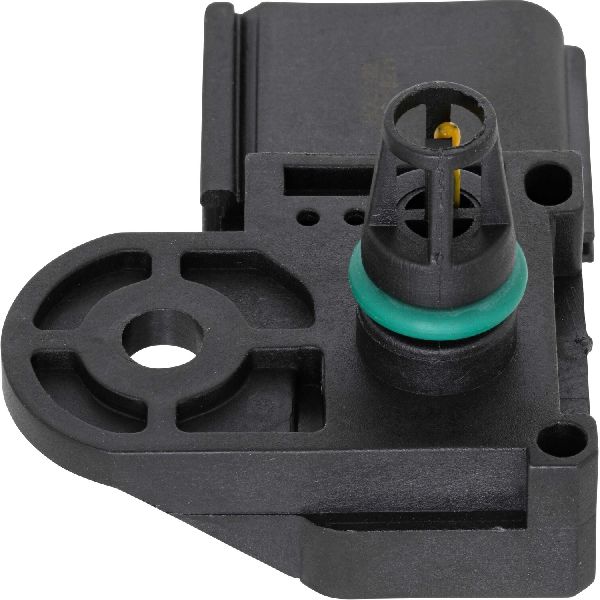
- Manifold Absolute Pressure (MAP) Sensor
(OEM #1S7A-9F479-AC)— This is the most common failure point for a P0107 code on this specific vehicle due to internal electrical failure from heat and vibration.
Trusted brands: Motorcraft (OEM), Bosch, Delphi, Standard Motor Products (SMP)
OEM price range: $75-$125
Aftermarket price range: $40-$80
Technical Service Bulletins (TSBs) & Recalls
- While not specific to the Focus, a manufacturer service bulletin for other Ford models, TSB Bulletin #TSB 19-2212, notes that a P0107 code may be accompanied by a wrench lamp, Service AdvanceTrac message, and a lack of power due to a faulty manifold absolute pressure and temperature (MAPT) sensor.
Platform-Specific Known Issues
- The high failure rate of the passenger-side hydraulic engine mount (Part # 5S4Z-6038-CB) is a well-documented issue. When this mount collapses, it leads to excessive engine vibration felt in the cabin, which can contribute to the premature failure of electrical components like the MAP sensor and its wiring.
Mechanic-Grade Diagnostic Values
- MAP Sensor 5V Reference Wire (KOEO) — expected: 4.8V to 5.2V DC. Failure: Voltage significantly below 4.8V or 0V indicates an open/short in the reference circuit from the PCM.
- MAP Sensor Signal Wire Voltage (KOEO) — expected: ~4.5V (at sea level, corresponds to BARO pressure). Failure: A reading below 0.5V indicates a circuit low fault (P0107).
- MAP Sensor Signal Wire Voltage (Engine Idling) — expected: 1.0V to 1.8V DC. Failure: Voltage stuck below 0.5V or not changing with engine RPM.
- MAP Sensor Ground Circuit Resistance — expected: Less than 1.0 ohm to chassis ground.. Failure: Resistance greater than 1.0 ohm indicates a poor ground connection, which can cause a poor ground connection, which can cause a low voltage reading.
- Wiring Harness Continuity — expected: Less than 0.5 ohms of resistance on a signal, reference, or ground wire from end to end.. Failure: A reading of O.L. (Over Limit) on a multimeter indicates an open circuit (broken wire).
Scan Tool Commands That Help
- Ford IDS / FORScan: KAM (Keep Alive Memory) Reset — After replacing the MAP sensor or repairing wiring, performing a KAM reset clears the PCM's learned adaptive fuel trims. This forces the module to relearn values immediately with the new, correct sensor data, preventing lingering performance issues.
Wiring & Ground Locations
- MAP Sensor Connector — On the MAP sensor, which is mounted directly on the intake manifold near the throttle body.. This is the primary connection point to test for 5V reference, ground, and signal voltage. Corrosion or loose pins here are a common cause of P0107.
- G101 — Typically located near the battery in the engine compartment.. This is a primary engine compartment ground point. A corroded or loose G101 can cause erratic sensor readings across the system, including the MAP sensor.
- G104 — Typically located at the right front of the engine compartment.. Another main engine ground point. Poor grounding at G104 can introduce electrical noise and voltage drops, potentially affecting the MAP sensor's low-voltage signal and triggering a P0107.
- PCM Fuse F5 (10A) — In the under-hood fuse box (Power Distribution Box).. This fuse provides Keep Alive Power (KAPWR) to the Powertrain Control Module (PCM). While not a direct cause of P0107 alone, issues with the PCM's power supply can cause a variety of sensor codes.
Real Owner Repair Stories
- YouTube video by 'Budget Mechanic' (Chevrolet Malibu (demonstrates a universal P0107 wiring issue)) — P0107 code present.
❌ Tried (didn't work) Initial diagnosis pointed to the MAP sensor itself.
✅ What actually fixed it A wiggle test on the harness revealed a voltage drop. The technician opened the wiring loom and found a wire that was broken internally, with the insulation still intact. Repairing this single broken wire by splicing in a new section with a butt connector and heat shrink resolved the code. - An owner reported in NHTSA ODI #11351923 that a P0107 fault occurred while pulling away from a red light without warning, resulting in a lack of power and a "Hill Start Assist Not Available" message, which disabled the vehicle in traffic.
OEM Part Supersession History
4S4Z-9F479-AA, 1S7A-9F479-AC, 1S7Z-9F479-AA→1S7Z-9F479-AD— Standard part revision and consolidation by Ford.
Heads up: The latest part number, 1S7Z-9F479-AD, is the correct service replacement for all previous versions and fits a wide range of Ford vehicles from 2001-2022.
Diagnostic Flowchart
Other Known Issues on This Vehicle
Issues unrelated to this code that are worth knowing about as an owner of this generation:
- Passenger-Side Engine Mount Failure 🔴 High — Extremely common, often failing every 50,000-80,000 miles. Causes significant vibration in the cabin at idle and during acceleration. (Ref: While no specific recall exists, Ford issued TSBs for earlier models (2000-2011) regarding vibration, and replacing this mount is the universally accepted fix. Many owners recommend using only the OEM Motorcraft part (5S4Z-6038-CB) as aftermarket mounts are often solid rubber and transmit more vibration.)
- Automatic Transmission (4F27E) Issues 🟠 Medium — Common on higher-mileage vehicles. Symptoms include harsh shifting, slipping, or failure to go into overdrive. This is distinct from the later, more infamous PowerShift DCT transmission problems. (Ref: Multiple TSBs exist for shift quality concerns. Problems often relate to shift solenoids or the valve body.)
- Suspension Component Wear 🟠 Medium — Common after 100,000 miles. Worn ball joints, tie rod ends, and sway bar links can cause clunking noises over bumps and poor handling. (Ref: TSB TB-21399 addresses premature tire wear and alignment issues.)
- Frozen or Sticking Door Latches 🟡 Low — A common annoyance, especially in colder or wet climates. Moisture can get into the latch mechanism, causing it to stick or freeze.
- Warped Front Brake Rotors 🟡 Low — Frequently reported issue causing steering wheel shake or pulsation when braking. Often requires premature replacement of rotors.
Used vs. New Parts: Buying Guide for This Vehicle
When a used part is the smart pick: A used OEM MAP sensor from a reputable salvage yard is a reasonable choice for this repair. The part is not a major wear item, but an electronic component that typically fails from heat and vibration rather than mileage alone. Given the low cost of new aftermarket parts, a used part is most sensible if it comes from a very low-mileage donor vehicle or is significantly cheaper than a new aftermarket option.
Donor-vehicle mileage cap: roughly under 80000 miles for the part to have meaningful remaining life.
What to inspect on the donor part:
- Check for a clean donor vehicle with no signs of front-end damage or engine fire.
- Inspect the sensor's plastic housing for any cracks, melting, or physical damage.
- Ensure the electrical connector pins are clean, straight, and free of corrosion.
- Verify the O-ring is present and pliable, though replacing it with a new one is always recommended.
Aftermarket brands forum-validated for this vehicle:
- Bosch
- Delphi
- Standard Motor Products (SMP)
- NTK
Brands owners have reported issues with on this vehicle:
- No-name, unbranded sensors from online marketplaces should be avoided, as their calibration and longevity can be questionable, potentially causing persistent performance issues even if they clear the code initially.
Real Owner Stories
Aggregated from forums and TSBs cited above. Mileages and costs reflect what owners reported in those sources.
2008 Ford Focus 2.0L I4 — 200000 miles
Symptoms: P0107 code present on a well-maintained vehicle.
What fixed it: The owner was advised to check the wiring harness for faults as replacing the sensor alone did not always resolve the persistent code.
Source hint: reddit.com/r/FordFocus
2008-2011 Ford Focus 2.0L I4
Symptoms: P0107 code appears only on cold starts and then clears itself.
What fixed it: Indicative of a sensor failing intermittently or a connection sensitive to temperature.
Source hint: Kappa Performance Forum: P0107 intermittent on cold starts
Related OBD-II Codes
Frequently Asked Questions
Is there a specific engine mount I should use to prevent vibration-related MAP sensor failure on my 2008-2011 Focus?
Why does my Focus run rough in cold weather and then smooth out once the CEL turns off?
Where is the MAP sensor located on the 2.0L Duratec engine?
Can a collapsed engine mount really cause a P0107 code?
My 2008 Focus has a P0107 code that won't go away even after replacing the sensor. What else should I check?
Is the P0107 code related to the PowerShift transmission issues found in other Focus models?
Helpful Videos


We Have This Part in Stock


The information in this article is provided for general reference and educational purposes only. Vehicle specifications, procedures, and part compatibility can vary by production date, trim level, and region. Always consult your vehicle's factory service manual and verify part numbers before purchasing or performing repairs. Safety-critical components such as airbags, seat belts, and braking systems should be installed by a qualified professional.
- Ford Focus:
- 🧭 Diagnostic Flowchart
- 🎬 Helpful Videos
- 🛍️ Shop This Part
- What's Unique About the 2008-2011 Ford Focus
- Symptoms You May Notice
- Most Likely Causes
- Rare But Worth Checking
- Diagnosis Steps
- Parts You'll Likely Need
- Technical Service Bulletins (TSBs) & Recalls
- Platform-Specific Known Issues
- Mechanic-Grade Diagnostic Values
- Scan Tool Commands That Help
- Wiring & Ground Locations
- Real Owner Repair Stories
- OEM Part Supersession History
- Other Known Issues on This Vehicle
- Used vs. New Parts: Buying Guide for This Vehicle
- Real Owner Stories
- 2008 Ford Focus 2.0L I4 — 200000 miles
- 2008-2011 Ford Focus 2.0L I4
- Related OBD-II Codes
- Frequently Asked Questions
- 🎟️ Get 5% Off