

P0107 on 2012-2018 Ford Focus 1.0L EcoBoost: MAP Sensor Circuit Low Causes and Fixes
For a Ford Focus with the 1.0L EcoBoost engine, code P0107 almost always indicates a failed Manifold Absolute Pressure (MAP) sensor. This is a DIY-friendly fix, with an aftermarket sensor costing between $40-$80 and an OEM Motorcraft part costing $90-$150. Before replacing, it's crucial to confirm the sensor is the issue by testing for 5V reference and ground at the connector.
- P0107 on a 1.0L EcoBoost Focus points directly to an electrical problem in the MAP sensor circuit, not a dirty sensor.
- The most likely fix is replacing the MAP sensor located on the intake manifold, which is a simple, quick, and affordable DIY job.
- Before replacing the sensor, always perform a quick check of the connector for 5-volt power and ground to rule out a simple wiring issue.
- Do not drive the vehicle for an extended period with this code, as it can cause poor drivability and potentially damage the catalytic converter.
What's Unique About the 2012-2018 Ford Focus
The 1.0L EcoBoost engine, found in 2015-2018 Focus models in North America, uses two pressure sensors: one on the charge pipe (a T-MAP or boost sensor) and one on the intake manifold itself. The P0107 code specifically refers to the sensor on the intake manifold. While these direct-injection turbo engines are known for oil vapor from the PCV system contaminating sensors, P0107 points to a hard electrical failure (like an internal short or open circuit) rather than just a dirty sensor that can be cleaned.
Symptoms You May Notice
- Check Engine Light is on
- Significantly reduced engine power and sluggish acceleration
- Rough or erratic idle
- Engine stalling, especially when coming to a stop
- Poor fuel economy
- Black smoke from the exhaust
- Hesitation when accelerating
- Difficulty starting the engine
- Cleaning the MAP sensor. P0107 is an electrical circuit code, not a performance or range code. If the sensor has failed internally and is shorted, cleaning will not resolve the issue.
- Replacing the wrong sensor. The 1.0L EcoBoost has a second pressure sensor (T-MAP) on the turbocharger piping. P0107 refers to the sensor on the intake manifold.
Most Likely Causes
- Faulty Manifold Absolute Pressure (MAP) Sensor 🔴 High Probability → Shop Manifold Absolute Pressure Sensor The sensor is a common failure item due to internal electronics failing from heat and vibration, causing a short to ground or an open circuit. While oil contamination from the PCV system is common on this engine, P0107 specifically points to an electrical failure that cleaning cannot fix.
How to confirm: After confirming the sensor's connector has a 5-volt reference and good ground with a multimeter, if the signal wire shows less than 0.5 volts with the key on, the sensor has failed internally. You can also jump the 5V reference wire to the signal wire; if the scan tool reading jumps to 5V, the wiring is good and the sensor is bad.
Typical fix: Replace the MAP sensor located on the top of the intake manifold. It is typically secured by a single T25 or 8mm screw.
Est. part cost: $40-$150 - Wiring Harness or Connector Issue 🟡 Medium Probability The engine wiring harness is exposed to heat and vibration, which can cause wires to chafe, break, or corrode over time. A frayed ground wire or damaged connector pins can also cause this code. A user on FordOwnersClub.com with a 1.0L EcoBoost reported a P0107 code that a dealer diagnosed as needing a new wiring loom.
How to confirm: Visually inspect the wiring going to the MAP sensor for any signs of melting, chafing, or breaks. Use a multimeter to test for 5V reference power and a good ground at the connector with the key on. A 'wiggle test' on the harness while monitoring voltage can help identify intermittent breaks.
Typical fix: Repair the damaged section of wiring using heat-shrink butt connectors. If the connector itself is damaged, replace it with a new pigtail connector.
Est. part cost: $15-$40
Rare But Worth Checking
- Powertrain Control Module (PCM) Fault: → Shop Engine Control Module (ECM) This is extremely rare. Before considering PCM replacement, all other possibilities, including the sensor and the entire wiring circuit between the sensor and the PCM, must be exhaustively tested and ruled out. A user on the FordOwnersClub forum reported a P0107 code alongside PCM microprocessor error codes (P060A47, P060C49), indicating this is a possibility, however remote.
Technical Service Bulletins (TSBs) & Recalls
- While not specific to the Focus, manufacturer TSB Bulletin #TSB 19-2212 notes that a faulty manifold absolute pressure and temperature (MAPT) sensor can cause a lack of power and a wrench lamp with DTC P0107 present.
- There are no specific recalls for code P0107 on this vehicle. However, Ford did issue recall 23S64 (NHTSA 23V-905) for the oil pump drive belt and tensioner on 2016-2018 models. While unrelated to the MAP sensor circuit, an oil pressure loss from this issue can cause widespread engine problems.
Diagnosis Steps
- Confirm the P0107 code is present using an OBD-II scanner.
- Using the scanner's live data function, check the MAP sensor voltage with the Key On, Engine Off (KOEO). A reading below 0.5 volts (often as low as 0.25V) points towards the fault.
- Locate the MAP sensor on the top of the intake manifold.
- Visually inspect the sensor's electrical connector and the nearby wiring for any signs of damage, corrosion, or looseness.
- Disconnect the sensor. With the key on, use a multimeter to test the electrical connector's terminals. Verify you have a 5-volt reference on one pin and a good ground (near 0 volts) on another.
- If the 5V reference or ground is missing, there is a fault in the wiring harness that needs to be traced and repaired.
- If the reference voltage and ground are present, the MAP sensor is almost certainly the cause of the fault.
- As a final confirmation, you can jump the 5V reference pin to the signal pin on the connector with a paperclip. The MAP reading on your scan tool should jump to ~5.0V. If it does, the wiring to the PCM is good and the sensor has failed.
- Replace the MAP sensor, ensuring the new O-ring is properly seated to prevent a vacuum leak.
- Clear the trouble code with the scanner and perform a test drive to confirm the repair.
Parts You'll Likely Need
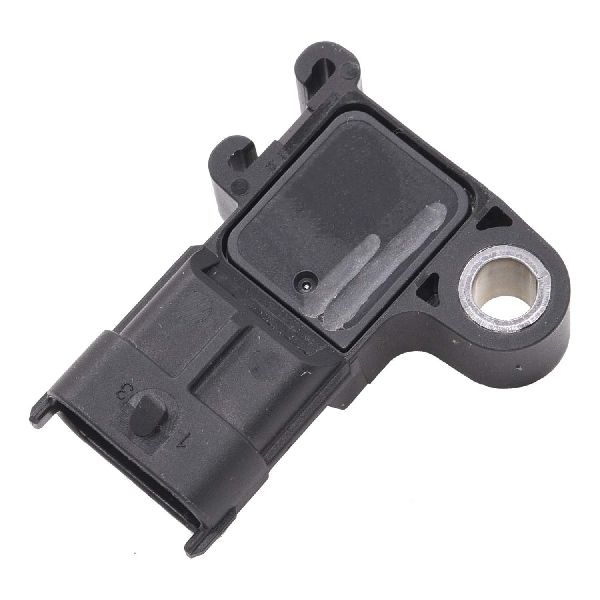
- Manifold Absolute Pressure (MAP) Sensor
(OEM #CM5Z-9F479-A (Motorcraft CX-2391))— This is the most common cause for a P0107 code on this engine, as the sensor's internal electronics fail and cause a low voltage signal. The original part number AG91-9F479-AB has been superseded. The base part number for Ford MAP sensors is often 9F479.
Trusted brands: Motorcraft, Bosch, NTK, Delphi
OEM price range: $90-$150
Aftermarket price range: $40-$80
Related Codes That Often Appear With This One
- P0108 — Manifold Absolute Pressure/Barometric Pressure Circuit High. If there is an intermittent fault or short in the wiring or sensor, the voltage may fluctuate wildly, causing the PCM to log both high and low voltage codes.
- P0106 — Manifold Absolute Pressure/Barometric Pressure Circuit Range/Performance. This code can appear alongside P0107 if the sensor is failing intermittently or if there's a wiring issue causing erratic signals.
Platform-Specific Known Issues
- There are no specific recalls for code P0107 on this vehicle. However, Ford did issue recall 23S64 (NHTSA 23V-905) for the oil pump drive belt and tensioner on 2016-2018 models. While unrelated to the MAP sensor circuit, an oil pressure loss from this issue can cause widespread engine problems.
Mechanic-Grade Diagnostic Values
- PCM Fault Threshold for P0107 — expected: Voltage must be above 0.19V.. Failure: The PCM will set code P0107 if the MAP sensor signal voltage is less than 0.19 volts.
- MAP Sensor 5V Reference Wire (KOEO) — expected: 4.8V to 5.2V. Failure: Voltage below 4.8V or above 5.2V points to a wiring or PCM issue.
- MAP Sensor Signal Wire (KOEO) — expected: ~4.5V (at sea level, should correspond to barometric pressure). Failure: A reading below 0.5V confirms the P0107 fault condition.
- MAP Sensor Signal Wire (Engine Idling, warm) — expected: 1.0V to 1.5V. Failure: Voltage remaining near 0V or not responding to throttle changes indicates a failed sensor or circuit.
- MAP Sensor Ground Circuit Resistance — expected: < 0.5 Ohms to chassis ground. Failure: Resistance greater than 1.0 Ohm indicates a poor ground connection, which can cause incorrect sensor readings.
Wiring & Ground Locations
- MAP Sensor Connector — On the MAP sensor, which is located on the top of the intake manifold.. This 3-pin connector is where all electrical testing for the sensor circuit begins. The typical pinout is Pin 1: +5V Reference, Pin 2: Signal Out, Pin 3: Signal Return (Ground). Verifying power, ground, and signal here is the primary diagnostic step.
- Engine Harness Ground (e.g., G102/G104) — Bolted to the chassis on the left front side of the engine compartment, underneath the air filter box assembly.. This is a primary ground point for the engine harness. A loose or corroded connection here can cause erratic voltage and intermittent codes for multiple sensors, including the MAP sensor.
OEM Part Supersession History
AG91-9F479-AB→CM5Z-9F479-A, CV2Z-9F479-A— Part revision and consolidation across multiple vehicle platforms.
Heads up: The base part number for Ford MAP sensors is typically '9F479'. While prefixes (like 'AG91' or 'CM5Z') indicate the vehicle line and revision, sensors with the same base number are often physically and electrically compatible. However, always verify fitment with the vehicle's VIN.
Diagnostic Flowchart
Other Known Issues on This Vehicle
Issues unrelated to this code that are worth knowing about as an owner of this generation:
- Timing Belt / Oil Pump Belt Degradation ('Wet Belt') 🔴 High — Widespread. Failures can occur as early as 60,000-80,000 miles, well before the original 150,000-mile service interval. Using incorrect oil accelerates degradation. (Ref: Recall 23S64 / NHTSA 23V-905 was issued for the oil pump drive belt and tensioner on 2016-2018 models due to risk of fracture and oil pressure loss.)
- DPS6 'PowerShift' Automatic Transmission Failure 🔴 High — Extremely common on 2012-2016 Focus models, though more associated with the 2.0L engine, it was a major platform-level failure. Symptoms include shuddering, hesitation, and outright failure. (Ref: Subject of a major class-action lawsuit (Vargas v. Ford) resulting in extended warranties, cash payments, and vehicle buybacks.)
- Cooling System Failures & Overheating 🔴 High — Common on earlier 1.0L EcoBoost engines (approx. 2012-2014). Brittle plastic coolant pipes (degas hose) and other components could fail, leading to rapid coolant loss and overheating, potentially cracking the cylinder head. (Ref: Ford issued a recall for the degas hose on some earlier European models and has faced lawsuits regarding engine damage from overheating.)
- Carbon Build-up on Intake Valves 🟠 Medium — A common issue for all direct-injection engines, including the 1.0L EcoBoost. Becomes noticeable around 60,000-80,000 miles, causing rough idle, hesitation, and reduced power.
Used vs. New Parts: Buying Guide for This Vehicle
When a used part is the smart pick: A used wiring harness pigtail from a junkyard is a smart choice if only the connector is damaged. It provides OEM-quality wire and terminals for a robust repair. A used MAP sensor is generally not recommended due to the low cost of new aftermarket parts and the high probability of internal electronic failure on a used unit.
Donor-vehicle mileage cap: roughly under 80000 miles for the part to have meaningful remaining life.
What to inspect on the donor part:
- For a wiring pigtail, ensure the locking tab is intact and not brittle.
- Check for at least 6 inches of clean, un-corroded wire attached.
- Avoid connectors from vehicles with obvious signs of engine fire or flood damage.
Aftermarket brands forum-validated for this vehicle:
- Bosch
- NTK
- Delphi
- Standard Motor Products (SMP)
Brands owners have reported issues with on this vehicle:
- Unbranded sensors from online marketplaces (e.g., Amazon, eBay) are a gamble and often have high failure rates.
Real Owner Stories
Aggregated from forums and TSBs cited above. Mileages and costs reflect what owners reported in those sources.
2015 Ford Fiesta 1.0L EcoBoost
Symptoms: Car broke down, would not run, and had a long list of fault codes including P0107 and P0106.
What fixed it: A Ford dealer diagnosed and replaced a faulty wiring loom.
Source hint: FordOwnersClub.com - '2015 Fiesta 1.0 Ecoboost Broken down twice on the same day 1 year later'
2013 Fiesta MK7 1.0 EcoBoost
Symptoms: The engine just cut out while driving and wouldn't restart; oil light came on as it happened.
What fixed it: The root cause was identified as a P0107 Manifold Absolute Pressure/Barometric Pressure Sensor Circuit Low fault.
Source hint: Reddit r/Ford
Ford Focus (High-Mileage) — ~150000 miles
Symptoms: Persistent P0107 code that stayed on even after the owner replaced the MAP sensor.
What fixed it: The community advised testing for a wiring circuit problem rather than replacing more parts.
Source hint: Reddit r/FordFocus - 'P0107 Code stays on'
Ford Owner Report
Symptoms: An owner reported a lack of power accompanied by a "Service AdvanceTrac" and "Hill Start Assist Not Available" message with DTC P0107 (MAP faulty).
What fixed it: The failure occurred while pulling away from a red light without warning, disabling the vehicle in the middle of an intersection (NHTSA ODI #11351923).
Related OBD-II Codes
Frequently Asked Questions
Can I just clean the MAP sensor on my 1.0L EcoBoost to fix the P0107 code?
Is there a recall for the MAP sensor or P0107 on the 2012-2018 Ford Focus?
Where is the MAP sensor located on the Focus 1.0L EcoBoost engine?
I replaced the MAP sensor but the P0107 code is still active. What should I check next?
Does the 'wet belt' issue on the 1.0L EcoBoost cause P0107?
Are there other Ford models with the 1.0L engine that have this same MAP sensor problem?
Helpful Videos
We Have This Part in Stock


The information in this article is provided for general reference and educational purposes only. Vehicle specifications, procedures, and part compatibility can vary by production date, trim level, and region. Always consult your vehicle's factory service manual and verify part numbers before purchasing or performing repairs. Safety-critical components such as airbags, seat belts, and braking systems should be installed by a qualified professional.
- Ford Focus:
- 🧭 Diagnostic Flowchart
- 🎬 Helpful Videos
- 🛍️ Shop This Part
- What's Unique About the 2012-2018 Ford Focus
- Symptoms You May Notice
- Most Likely Causes
- Rare But Worth Checking
- Technical Service Bulletins (TSBs) & Recalls
- Diagnosis Steps
- Parts You'll Likely Need
- Related Codes That Often Appear With This One
- Platform-Specific Known Issues
- Mechanic-Grade Diagnostic Values
- Wiring & Ground Locations
- OEM Part Supersession History
- Other Known Issues on This Vehicle
- Used vs. New Parts: Buying Guide for This Vehicle
- Real Owner Stories
- 2015 Ford Fiesta 1.0L EcoBoost
- 2013 Fiesta MK7 1.0 EcoBoost
- Ford Focus (High-Mileage) — ~150000 miles
- Ford Owner Report
- Related OBD-II Codes
- Frequently Asked Questions
- 🎟️ Get 5% Off