

P0107 on 2018-2019 Ford Taurus 3.5L EcoBoost: Causes, Symptoms, and Fixes for MAP Sensor Low Input
On a 2018-2019 Taurus with the 3.5L EcoBoost, code P0107 is almost always caused by a faulty Manifold Absolute Pressure (MAP) sensor. This is a known issue covered by Ford TSB 19-2212. The fix is a simple DIY replacement of the sensor, costing around $50-$120 for the part.
- P0107 on a 2018-2019 Taurus 3.5L EcoBoost is almost certainly a failed MAPT sensor.
- Look for a combination of the Check Engine light, wrench light, and messages about 'AdvanceTrac' and 'Hill Start Assist'.
- This is a known issue covered by Ford TSB 19-2212, which also applies to the Explorer, Flex, and Lincoln MKT with the same engine.
- The fix is a very simple, 10-minute DIY replacement of the MAPT sensor (Part # AA5Z-9F479-E) on top of the intake manifold.
What's Unique About the 2018-2019 Ford Taurus
For this specific vehicle and engine, P0107 is the subject of a Ford Technical Service Bulletin (TSB 19-2212). This TSB acknowledges a high failure rate for the Manifold Absolute Pressure and Temperature (MAPT) sensor, making it the primary and most probable cause. Unlike on other vehicles where diagnosis might start with checking for vacuum leaks or complex wiring issues, the updated TSB 19-2212 streamlines the process, directing technicians to replace the sensor if the specific cluster of symptoms and codes are present, making the diagnosis unusually straightforward.
Symptoms You May Notice
- Check Engine Light (MIL) illuminated
- Powertrain Malfunction (Wrench) Light illuminated
- "Service AdvanceTrac" message on the dash
- "Hill Start Assist Not Available" message
- Significant lack of power or sluggish acceleration, especially from a stop
- Vehicle enters a reduced-power "limp mode"
- Rough or unstable idle
- Cruise control inoperative
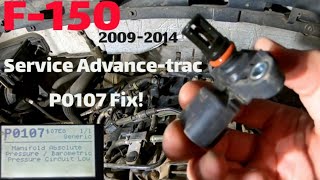
- Replacing the throttle body. Some symptoms like hesitation and the 'Service AdvanceTrac' message could be mistaken for a throttle body issue. A YouTuber with a 2012 F-150 3.5L EcoBoost initially suspected a bad throttle body 🎬 See how this owner fixed the AdvanceTrac warning light. before realizing the P0107 code pointed to the MAP sensor.
- Searching for a vacuum leak. While a massive vacuum leak could theoretically cause a low pressure reading, it is not the common cause for this code on this specific platform, and you would likely hear a loud hissing sound and potentially see lean codes like P0171 or P0174.
Most Likely Causes
- Faulty Manifold Absolute Pressure and Temperature (MAPT) Sensor 🔴 High Probability → Shop Manifold Absolute Pressure Sensor This is a well-documented failure for this engine and model year, as acknowledged by Ford in TSB 19-2212. The sensor's internal electronics can fail, causing it to send a voltage signal below the minimum threshold. An owner of a 2018 Explorer filed a complaint with the NHTSA (ODI #11351923) describing the vehicle stalling in an intersection due to this exact failure.
How to confirm: With the key on and engine off, use an OBD-II scanner to view live data. Compare the MAP sensor pressure reading to the Barometric Pressure (BARO) reading. If they differ by more than 1.5 psi (10.35 kPa), the sensor is faulty. Alternatively, back-probe the signal wire; a reading below 0.5V with the key on points to a bad sensor. 🎬 Watch: How to test and replace a faulty MAP sensor.
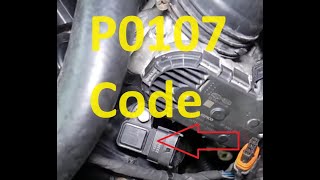
Typical fix: Replace the MAPT sensor. It is located on top of the intake manifold toward the rear, secured by a single T20 Torx screw.
Est. part cost: $50-$120
Rare But Worth Checking
- Wiring Harness or Connector Issue: While the sensor itself is the most common failure point, it's worth checking the wiring. Wires in the engine bay can become brittle from heat cycles, or pins in the connector can corrode. A quick visual inspection and a gentle 'wiggle test' on the wires at the connector can sometimes reveal a hidden break.
- Powertrain Control Module (PCM) Fault: → Shop Engine Control Module (ECM) This is extremely rare. The PCM's internal circuit for the MAP sensor could fail, but this should only be considered after the sensor and wiring have been definitively ruled out as the cause.
Diagnosis Steps
- Read the trouble codes with an OBD-II scanner to confirm P0107 and check for P0108 or P0109.
- Note any other warning messages on the instrument cluster, such as the wrench light or 'Service AdvanceTrac'.
- Per TSB 19-2212, if the specific combination of symptoms and codes (P0107/P0108/P0109) are present on an affected vehicle, the diagnostic is simplified: replace the MAPT sensor.
- For verification (as outlined in the older TSB 19-2183), turn the ignition to 'On' without starting the engine.
- Using the scanner's live data function, compare the Manifold Absolute Pressure (MAP) reading to the Barometric Pressure (BARO) reading. They should be nearly identical.
- If the pressure readings differ by more than 1.5 psi (10.35 kPa), the MAPT sensor is faulty and should be replaced.
- If the readings are similar, perform a visual inspection of the MAPT sensor connector and its wiring for any signs of damage, corrosion, or loose connections.
- To replace, remove the plastic engine cover (lift off oil cap, then pull cover up). The sensor is on top of the intake manifold, held by one T20 Torx screw. Disconnect the electrical connector, remove the screw, and pull the old sensor out. 🎬 Watch this step-by-step MAP sensor replacement walkthrough.
- Lubricate the O-ring on the new sensor with a small amount of engine oil and install it. Reconnect and clear codes.
- Perform a test drive to ensure the issue is resolved and all warning lights are off.
Parts You'll Likely Need
- Manifold Absolute Pressure and Temperature (MAPT) Sensor
(OEM #AA5Z-9F479-E)— This is the component identified by Ford's own Technical Service Bulletin (19-2212) as the direct cause for P0107 on this vehicle. It is also referred to by the Motorcraft service part number CX-2619.
Trusted brands: Motorcraft (OEM), Bosch, Delphi, Standard Motor Products (SMP)
OEM price range: $80-$120
Aftermarket price range: $50-$90
Related Codes That Often Appear With This One
- P0108 — This code for 'MAP/BARO Circuit High Input' is also listed in TSB 19-2212. A failing MAPT sensor can send erratic signals that are either too low (P0107) or too high (P0108).
- P0109 — This code for 'MAP/BARO Circuit Intermittent' is also cited in TSB 19-2212 as a common companion code caused by the same faulty MAPT sensor.
Technical Service Bulletins (TSBs) & Recalls
- TSB 19-2212: Supersedes 19-2183. This updated bulletin simplifies the service procedure, advising technicians to replace the MAPT sensor directly if the vehicle presents with the specified DTCs and symptoms, removing the previous diagnostic step of comparing PID values.
- TSB 19-2183: The original version of the bulletin. It identified the faulty MAPT sensor as the cause for DTCs P0107, P0108, and/or P0109 and provided the diagnostic criteria of comparing MAP and BARO PID values, which should not differ by more than 1.5 psi (10.35 kPa).
Platform-Specific Known Issues
- A Ford Technical Service Bulletin (TSB 19-2212, superseding 19-2183) was issued for 2018-2019 Taurus models with the 3.5L EcoBoost engine that exhibit P0107, P0108, and/or P0109. The bulletin states this is likely due to a faulty MAPT sensor and advises replacement.
- The 'Service AdvanceTrac' warning is a key secondary symptom because the stability control system depends on accurate engine torque calculations from the PCM. When the MAPT sensor provides a faulty low-pressure reading, the torque calculation is incorrect, forcing the system to disable itself as a precaution.
Mechanic-Grade Diagnostic Values
- 5V Reference Wire Voltage at Sensor Connector (KOEO) — expected: ~5.0 V. Failure: No voltage or significantly low voltage points to a wiring or PCM issue, not the sensor itself.
- Signal Wire Voltage at Sensor Connector (KOEO) — expected: ~4.5 V (at sea level, should correspond to BARO). Failure: A reading below 0.5V will trigger P0107.
- Signal Wire Voltage at Sensor Connector (Engine Idling) — expected: 1.0 - 2.0 V. Failure: Voltage remains below 0.5V or does not drop from the KOEO reading.
- Ground Wire Integrity at Sensor Connector — expected: < 0.5 Ω resistance to chassis ground. Failure: Resistance above 10 Ω indicates a poor ground path, which can cause incorrect readings.
- Jumping 5V Reference to Signal Wire (Sensor Unplugged) — expected: Scan tool MAP voltage reading should jump to ~5.0V.. Failure: If voltage does not jump to 5.0V, it indicates an open or short in the signal wire back to the PCM.
Scan Tool Commands That Help
- Advanced Scan Tool (e.g., FORScan, Autel): Live Data Graphing — Use this to monitor the MAP sensor voltage in real-time. If there are sudden drops, spikes, or flat lines when revving the engine, it indicates an intermittent or failing sensor, even if the static voltage checks seem okay.
- Advanced Scan Tool (e.g., FORScan, Autel): Compare MAP PID vs. BARO PID — With the Key On, Engine Off (KOEO), the Manifold Absolute Pressure (MAP) and Barometric Pressure (BARO) PIDs should read nearly identically. A difference greater than 1.5 PSI (10.35 kPa) confirms a faulty sensor as per Ford's diagnostic criteria.
Wiring & Ground Locations
- G104 / G105 — G104 is typically on the right fender apron behind the battery; G105 is on the left front corner of the engine compartment, near the fender apron or frame.. These are major engine and chassis ground points. A loose or corroded ground at these locations can create a floating ground, causing incorrect voltage readings for multiple sensors, including the MAP sensor, potentially triggering a P0107 even with a good sensor and harness.
- MAPT Sensor Connector — On top of the intake manifold, toward the rear of the engine.. This 3 or 4-pin connector provides the 5V reference, ground, and signal return to the PCM. The wires are typically: Pin A - Ground, Pin B - MAP Signal, Pin C - 5V Supply. Heat and vibration can cause wires to break internally near the connector or pins to lose tension.
- PCM Connector — Typically located in the engine bay, often near the firewall or battery.. This is the termination point for the MAP sensor circuit. If voltage checks at the sensor are bad, you must check for the 5V reference and signal continuity at the PCM connector pins to determine if the fault is in the wiring harness or the PCM itself.
OEM Part Supersession History
AA5Z-9F479-A→AA5Z-9F479-E— The original part number was prone to premature failure, leading to the issuance of TSB 19-2183 and its successor.
Heads up: The superseded part AA5Z-9F479-A should not be used; always install the latest revision, AA5Z-9F479-E, to ensure the fix is permanent.AA5Z-9F479-E (Intake Manifold)→N/A— N/A
Heads up: Do not confuse with part AA5Z-9F479-C. Part AA5Z-9F479-C is also a MAP sensor but is specified for different applications, such as the intake manifold on the *naturally aspirated* 3.5L F-150, not the EcoBoost Taurus. Using the wrong sensor will result in incorrect pressure readings.
Diagnostic Flowchart
Real Owner Stories
Aggregated from forums and TSBs cited above. Mileages and costs reflect what owners reported in those sources.
2018 Ford Explorer 3.5L EcoBoost V6
Symptoms: Vehicle stalled in an intersection due to the MAPT sensor's internal electronics failing and sending a voltage signal below the minimum threshold.
What fixed it: Replacing the faulty MAPT sensor.
Source hint: NHTSA Complaint ODI #11351923
2012 Ford F-150 3.5L EcoBoost V6
Symptoms: Triggered code P0107 and a 'Service Advance-trac' message on the dash. The owner initially suspected a bad throttle body.
What fixed it: Replacing the MAP sensor located on the intake manifold.
Source hint: YouTube video titled 'F-150 Service Advance-trac fix!'
2011 Ford F-150 3.5L EcoBoost V6
Symptoms: Experienced confusion over diagnosing a P0107 code due to the presence of multiple MAP sensors on the EcoBoost engine.
What fixed it: Identifying and replacing the correct MAP sensor located on top of the intake manifold.
Source hint: Reddit r/f150ecoboost thread titled 'MAP Sensors'
Related OBD-II Codes
Frequently Asked Questions
Does TSB 19-2212 apply to my 2018 Ford Taurus 3.5L EcoBoost?
Why is my Taurus displaying a 'Service AdvanceTrac' message alongside the P0107 code?
How can I test the MAPT sensor on my 3.5L EcoBoost before replacing it?
Where is the MAPT sensor located on the 2018-2019 Taurus 3.5L EcoBoost?
My Taurus went into 'limp mode' and stalled. Is this normal for a P0107 code?
Do I need to compare MAP and BARO readings if I have the exact symptoms listed in TSB 19-2212?
Helpful Videos


We Have This Part in Stock



The information in this article is provided for general reference and educational purposes only. Vehicle specifications, procedures, and part compatibility can vary by production date, trim level, and region. Always consult your vehicle's factory service manual and verify part numbers before purchasing or performing repairs. Safety-critical components such as airbags, seat belts, and braking systems should be installed by a qualified professional.
- Ford Taurus:
- 🧭 Diagnostic Flowchart
- 🎬 Helpful Videos
- 🛍️ Shop This Part
- What's Unique About the 2018-2019 Ford Taurus
- Symptoms You May Notice
- Most Likely Causes
- Rare But Worth Checking
- Diagnosis Steps
- Parts You'll Likely Need
- Related Codes That Often Appear With This One
- Technical Service Bulletins (TSBs) & Recalls
- Platform-Specific Known Issues
- Mechanic-Grade Diagnostic Values
- Scan Tool Commands That Help
- Wiring & Ground Locations
- OEM Part Supersession History
- Real Owner Stories
- 2018 Ford Explorer 3.5L EcoBoost V6
- 2012 Ford F-150 3.5L EcoBoost V6
- 2011 Ford F-150 3.5L EcoBoost V6
- Related OBD-II Codes
- Frequently Asked Questions
- 🎟️ Get 5% Off