

P0107 on 2014-2018 Kia Forte: MAP Sensor Circuit Low Causes and Fixes
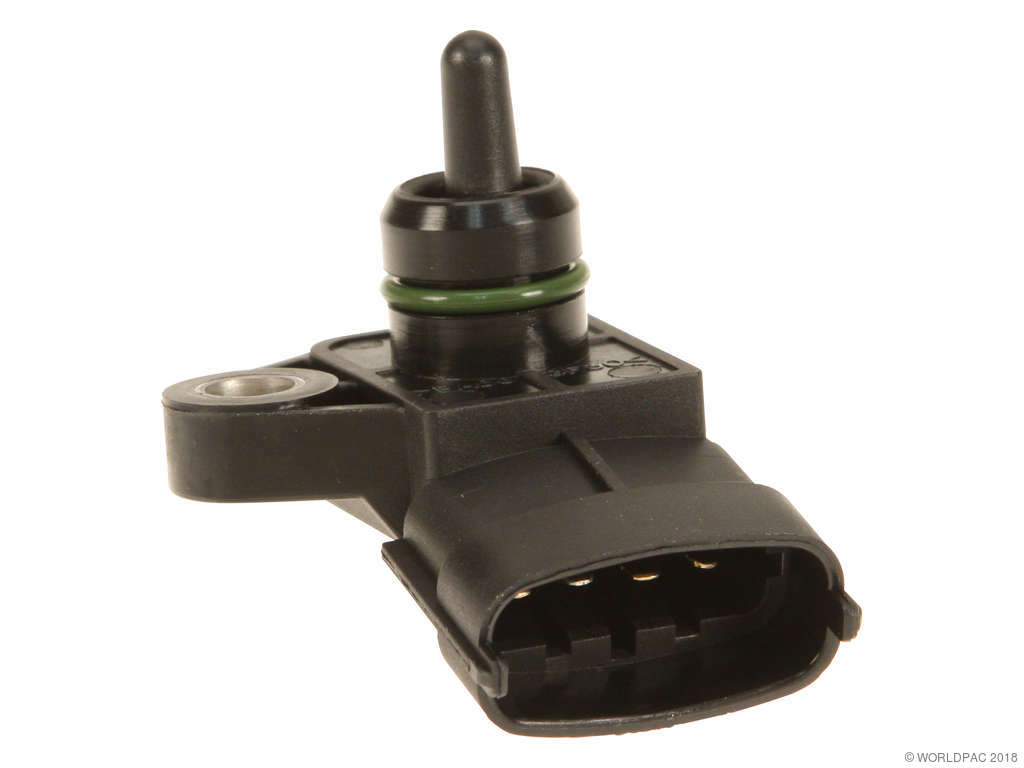
This code almost always indicates a faulty Manifold Absolute Pressure (MAP) sensor. It's an affordable part and a simple DIY replacement, typically costing between $30 and $90. Before replacing, quickly check the wiring connector for damage.
- P0107 on a 2014-2018 Kia Forte points to a low voltage signal from the MAP sensor, typically below 0.5V.
- The most probable cause is a failed MAP sensor itself, which is a simple and inexpensive part to replace.
- Symptoms include a rough idle, poor acceleration, stalling, and decreased fuel efficiency.
- Before replacing the sensor, always perform a quick visual check of the wiring and connector for damage and test for 5V reference and ground at the connector.
- This is a highly DIY-friendly repair that requires basic tools and can be completed in under 30 minutes.
- Be sure to verify the correct MAP sensor part number for your specific engine (1.8L or 2.0L) using your VIN.
What's Unique About the 2014-2018 Kia Forte
For the second-generation Kia Forte (2014-2018), the P0107 code is a common and straightforward issue with no major platform-specific complexities. The MAP sensor is generally easy to access on top of the intake manifold on both the 1.8L MPI and 2.0L GDI engines, making diagnosis and replacement a simple task for a DIY mechanic. Unlike some other vehicles, there are no widespread reports of complex wiring issues or frequent PCM failures associated with this code on this specific Forte generation; the sensor itself is the most common failure point.
Symptoms You May Notice
- Check Engine Light is on
- Rough or shaky idle
- Hesitation or stumbling during acceleration
- Reduced engine power
- Poor fuel economy
- Engine stalling, especially at stops
- Black smoke from the exhaust (due to a rich fuel mixture).
- Difficulty starting the engine
- Replacing spark plugs or ignition coils without diagnosing the MAP sensor circuit first.
- Replacing the throttle body when the issue is with the MAP sensor.
- Replacing the MAP sensor without first checking the wiring connector for 5V reference and good ground.
Most Likely Causes
- Faulty Manifold Absolute Pressure (MAP) Sensor 🔴 High Probability → Shop Manifold Absolute Pressure Sensor The sensor's internal electronics can fail over time due to constant heat cycles and engine vibration. This is the most common failure point for P0107 on this platform, as confirmed by numerous owner forums and repair guides.
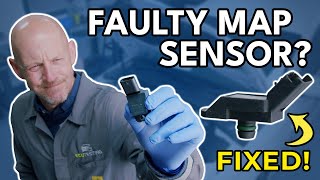
How to confirm: With the key on and engine off, back-probe the sensor's signal wire. The voltage should be around 4.5-5.0V. At a warm, stable idle, it should drop to 1.0-1.5V. A reading consistently below 0.5V, especially near 0V, strongly indicates a faulty sensor. You can also observe this using the live data function on an OBD-II scanner. 🎬 Watch: How to diagnose MAP sensor codes like P0107.
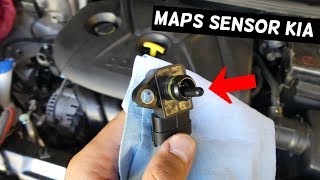
Typical fix: Replace the MAP sensor. It is located on the intake manifold and held by a single 10mm bolt, making for a 15-minute repair. 🎬 See this walkthrough for replacing the sensor on your Forte.
Est. part cost: $30-$90 - Wiring or Connector Issue 🟡 Medium Probability The wiring harness in the engine bay is exposed to heat and vibration, which can lead to cracked insulation, corrosion in the connector pins, or a loose connection. Rodent damage to wiring is also a possibility.
How to confirm: Visually inspect the MAP sensor connector and its wiring for any signs of damage, corrosion, or loose pins. Use a multimeter to check for a 5V reference signal and a good ground (less than 0.1V) at the connector harness with the key on. A user on kia-forums.com reported solving a persistent P0107 by tracing and fixing a bad ground connection after a sensor replacement didn't work.
Typical fix: Repair the damaged section of wiring or clean the connector terminals with electrical contact cleaner. If the connector itself is damaged, it may need to be replaced with a pigtail connector.
Est. part cost: $5-$50 - Vacuum Leak ⚪ Low Probability Vacuum hoses, particularly the PCV hose, can become brittle and crack with age, creating a leak in the intake manifold. While this can trigger MAP sensor codes, it more commonly sets a P0106 (Range/Performance) code but can occasionally cause a P0107 if the leak is severe.
How to confirm: Perform a smoke test to see if smoke escapes from any vacuum lines, gaskets, or seals. Alternatively, you can carefully spray carburetor cleaner around suspected areas while the engine is running and listen for a change in idle speed.
Typical fix: Replace the cracked or broken vacuum hose or faulty gasket.
Est. part cost: $10-$40
Rare But Worth Checking
- Faulty Powertrain Control Module (PCM): → Shop Engine Control Module (ECM) This is extremely rare and should only be considered after all other possibilities, including the sensor, wiring, and vacuum leaks, have been thoroughly ruled out. A PCM failure is unlikely without other accompanying codes or issues.
- Clogged Catalytic Converter: A severe exhaust restriction can alter the pressure in the intake manifold, potentially triggering a P0107 code. This is usually accompanied by other symptoms like a significant loss of power (especially at high RPMs), a sulfur smell from the exhaust, and potentially other exhaust-related codes.
Diagnosis Steps
- Plug an OBD-II scanner into the vehicle, confirm the P0107 code is present, and check for any other codes.
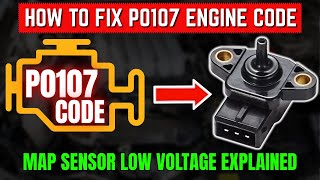
- Use the scanner's live data feature to monitor the MAP sensor voltage. With Key On, Engine Off (KOEO), it should read ~4.5V. At idle, it should be 1.0-1.5V. If it's stuck below 0.5V, the fault is active. 🎬 Watch: A simple explanation of MAP sensor low voltage codes.
- Visually inspect the MAP sensor, its electrical connector, and the surrounding wiring for any obvious damage, corrosion, or loose connections.
- Inspect all vacuum hoses connected to the intake manifold for cracks, splits, or disconnections.
- With the ignition on and engine off, disconnect the MAP sensor and test the harness-side connector with a multimeter. Verify a 5-volt reference wire (often Brown/Orange) and a good ground (often Black, should read <0.1V).
- If reference voltage or ground is missing, trace and repair the wiring. If both are present, the sensor is the primary suspect.
- If the sensor and wiring test good, check for a significant vacuum leak using a smoke machine, as this can sometimes cause the code.
- If no other cause is found, replace the MAP sensor.
- After replacement, clear the code with the scanner and perform a test drive to ensure the code does not return.
Parts You'll Likely Need
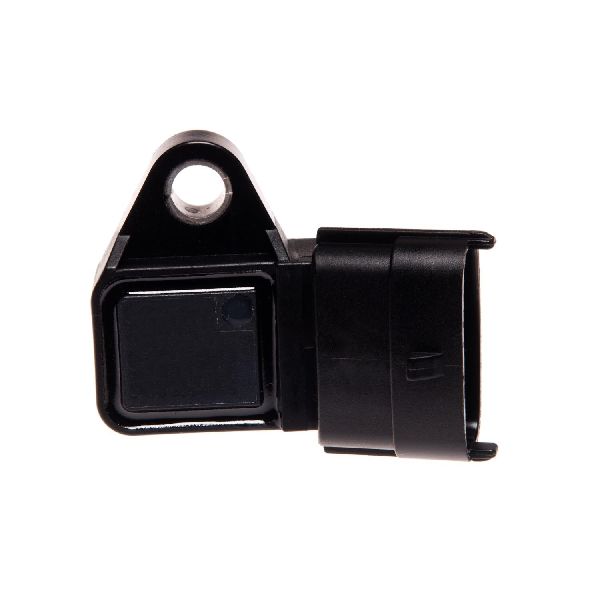
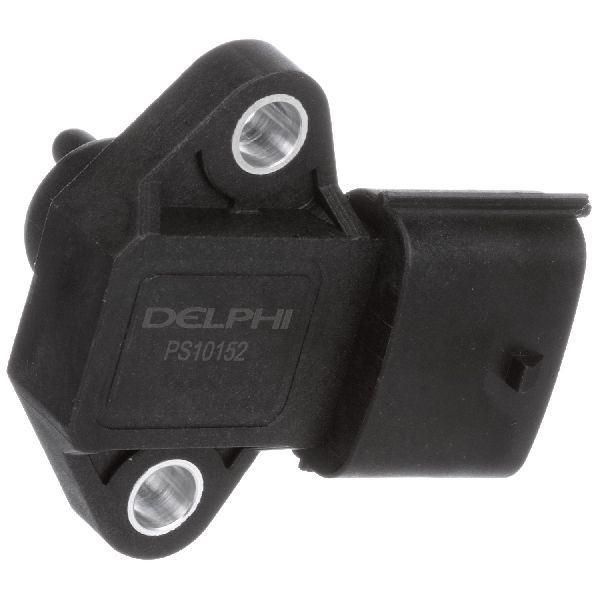
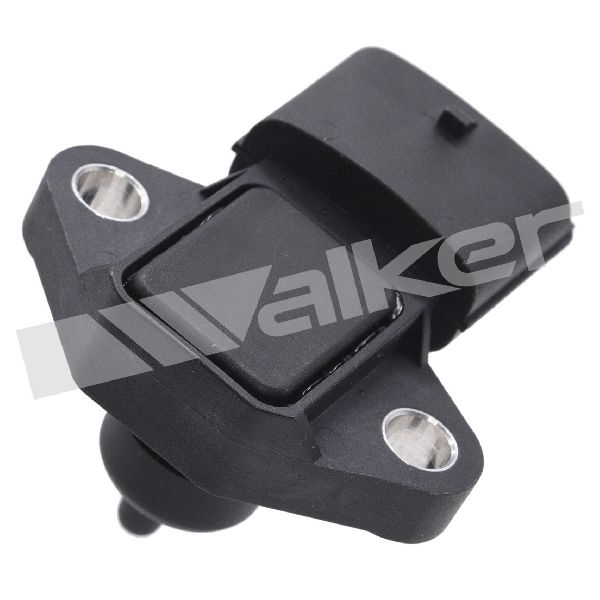
- Manifold Absolute Pressure (MAP) Sensor
(OEM #39300-2E600 (Typically for 2.0L Nu GDI) or 39300-2B000 (Typically for 1.8L Nu MPI))— This is the most common failure point for code P0107. The sensor's internal electronics fail, causing it to send a voltage signal below the minimum required specification. Always verify the part number with your vehicle's VIN.
Trusted brands: Kia (Genuine OEM), Delphi, Hella, Standard Motor Products (SMP), NGK, Bosch
OEM price range: $60-$90
Aftermarket price range: $28-$60
Related Codes That Often Appear With This One
- P0106 — This code indicates a MAP sensor performance/range issue. A failing sensor can sometimes trigger both a 'low circuit' and a 'performance' code as its signal becomes erratic before failing completely.
- P0113 — On some vehicles, the MAP and Intake Air Temperature (IAT) sensors are integrated into one unit. A failure of the combined sensor can trigger codes for both functions. A YOUCANIC video on a similar Kia showed P0107 and P0113 appearing together.
Technical Service Bulletins (TSBs) & Recalls
- TSB CHA 074: While not for P0107, this is a highly relevant TSB for the 2014 Forte concerning the replacement of the flexible steering coupler to fix a common clicking/knocking noise in the steering column.
Platform-Specific Known Issues
- Two Different Engines, Two Different Part Numbers: The 2014-2018 Forte used both a 1.8L MPI and a 2.0L GDI 'Nu' engine. While the P0107 diagnosis is the same, they may use different MAP sensors. Part number 39300-2B000 is commonly associated with the 1.8L and earlier 2.0L engines, while 39300-2E600 is often listed for the later 2.0L GDI. It is critical to verify the correct part for your specific vehicle using the VIN.
Mechanic-Grade Diagnostic Values
- MAP Sensor Signal Voltage (Key On, Engine Off) — expected: 4.5V - 5.0V. Failure: A reading below 4.5V suggests a circuit issue or faulty sensor.
- MAP Sensor Signal Voltage (Engine at Idle) — expected: 1.0V - 1.5V. Failure: A reading consistently below 0.5V, especially near 0V, indicates a hard fault and will trigger P0107.
- MAP Sensor Ground Wire Voltage (at connector) — expected: < 0.10V. Failure: Voltage significantly above 0.10V indicates a poor ground connection, which can skew the signal reading low.
- MAP Sensor 5V Reference Wire (at connector) — expected: ~5.0V. Failure: Missing or low voltage indicates a problem with the PCM or the wiring between the PCM and the sensor.
Scan Tool Commands That Help
- Kia GDS (Global Diagnostic System): Data Analysis / Live Data — To monitor the MAP sensor voltage in real-time (KOEO, idle, and while revving the engine) to see if it responds correctly or is stuck at a low value. This is the primary diagnostic step.
- Kia GDS (Global Diagnostic System): Actuation Test — While not directly for the MAP sensor (which is a passive sensor), actuation tests for components like the fuel pump relay or injectors can be used to rule out other system-wide issues if the P0107 diagnosis is not straightforward.
- Generic OBD-II Scanner: Clear/Erase Fault Codes — After replacing the MAP sensor or repairing a wiring issue, this function is used to clear the P0107 code from the PCM. A test drive is then required to confirm the fix. No special adaptation or relearn procedure is necessary for the MAP sensor on this vehicle.
Wiring & Ground Locations
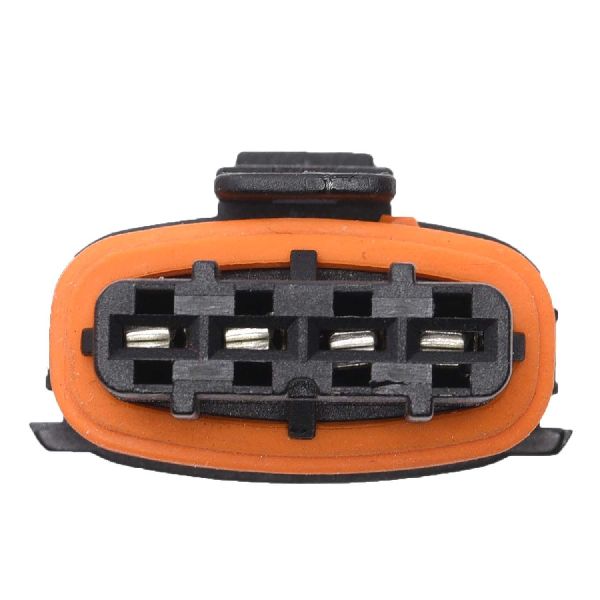
- MAP Sensor Connector — On the top/side of the plastic intake manifold, usually near the throttle body.. This is the primary point of failure for wiring issues. The connector or its pigtail can become corroded, damaged from heat, or have loose pins, causing the low voltage signal.
- MAP Sensor Circuit Ground — The ground for the MAP sensor is not a separate chassis ground point. It is integrated into the main engine wiring harness and grounds back through the Powertrain Control Module (PCM).. A high-resistance ground within the harness can cause the sensor's signal voltage to read artificially low, triggering P0107. Confirming a good ground (<0.1V) at the connector's ground pin is a critical diagnostic step.
Real Owner Repair Stories
- forteforums.com user (2014-2018 Kia Forte (generation specific)) — P0107 code, later followed by P0106.
❌ Tried (didn't work) Replacing the MAP sensor initially.
✅ What actually fixed it The user reported that after the new sensor didn't fix it, they traced the wiring and found an intermittent connection issue. Resolving the wiring problem finally cleared both codes. - kia-forums.com user (Kia Forte (model year not specified, but behavior is relevant)) — P0107 code, rough idle.
✅ What actually fixed it The user replaced the MAP sensor, which immediately resolved the rough idle and allowed them to clear the check engine light. This is the most common and successful repair path.
OEM Part Supersession History
39300-2B000→39300-2B100 (in some applications)— Standard part revision and supplier changes.
Heads up: 39300-2B000 is typically for the 1.8L MPI engine and some early 2.0L models. The 2.0L GDI engine often uses 39300-2E600. Using the wrong sensor can result in incorrect voltage scaling, leading to persistent codes even with a new part. Always verify by VIN.
Diagnostic Flowchart
Other Known Issues on This Vehicle
Issues unrelated to this code that are worth knowing about as an owner of this generation:
- Engine Failure (Nu 2.0L GDI) 🔴 High — Affects a significant number of 2014-2015 models, with failures often occurring around 75,000-90,000 miles. Problems include connecting rod bearing failure, piston scuffing, and excessive oil consumption, potentially leading to engine seizure. (Ref: Subject to class-action lawsuits and warranty extensions (up to 15 years/150,000 miles) for qualifying failures.)
- Steering Coupler Failure 🟠 Medium — Very common across this generation. Owners report a distinct clicking or knocking sound from the steering column when turning the wheel, especially when stationary. (Ref: Kia issued TSB CHA 074 to address this by replacing the flexible rubber coupler in the Motor Driven Power Steering (MDPS) unit.)
- Ignition Coil Failure 🟡 Low — Failures are commonly reported between 20,000 and 40,000 miles, leading to symptoms like engine misfiring, shaking, stalling, and hesitation. This is a relatively simple and inexpensive DIY repair.
Used vs. New Parts: Buying Guide for This Vehicle
When a used part is the smart pick: A used OEM MAP sensor from a low-mileage donor vehicle is a reasonable choice for this repair. The part is not a major wear item, and a genuine used part is often more reliable than a cheap, new aftermarket sensor. Given the low cost of new aftermarket parts, a used part is only logical if it's significantly cheaper or if you're sourcing it from a 'you-pull-it' yard for a few dollars.
Donor-vehicle mileage cap: roughly under 80000 miles for the part to have meaningful remaining life.
What to inspect on the donor part:
- Check the plastic housing for cracks or signs of extreme heat stress.
- Inspect the electrical connector pins to ensure they are straight and free of corrosion.
- Look at the O-ring to ensure it is pliable and not cracked or flattened.
- Avoid sensors from engines that show signs of heavy oil leaks or sludge, as oil can contaminate the sensor element.
Aftermarket brands forum-validated for this vehicle:
- Delphi
- Standard Motor Products (SMP)
- NTK (a division of NGK)
- Hella
- Bosch
Brands owners have reported issues with on this vehicle:
- Unbranded, 'white-box' sensors from online marketplaces should be avoided, as their calibration and durability are often questionable and can cause persistent issues.
Real Owner Stories
Aggregated from forums and TSBs cited above. Mileages and costs reflect what owners reported in those sources.
2014-2018 Kia Forte
Symptoms: Rough idle and the check engine light came on with code P0107.
What fixed it: Replacement of the MAP sensor.
Source hint: kia-forums.com thread titled 'Check engine light code p0107'
2014-2018 Kia Forte
Symptoms: The vehicle threw a P0107 code, and after the sensor was replaced, a P0106 code appeared.
What fixed it: The discussion suggests checking for intermittent wiring or connection issues when codes persist after sensor replacement.
Source hint: forteforums.com thread titled 'P0107 and now P0106'
2011-2016 Hyundai Elantra (1.8L Nu MPI)
Symptoms: Experienced P0107 circuit failures identical to the Forte platform.
What fixed it: Replacing the MAP sensor.
Source hint: youcanic.com: 'P0107 Fault Code Manifold Absolute Pressure Sensor - Kia | Hyundai'
2014-2018 Kia Forte
Symptoms: Persistent P0107 code that was not resolved by simply replacing the sensor.
What fixed it: Tracing and fixing a bad ground connection in the wiring harness.
Source hint: kia-forums.com report mentioned in Wiring or Connector Issue section
Related OBD-II Codes
Frequently Asked Questions
Does TSB CHA 074 address the P0107 code on my 2014 Kia Forte?
Which MAP sensor part number do I need for my 2014-2018 Forte?
Can a vacuum leak cause a P0107 on this vehicle?
Is the P0107 code related to the engine failure issues on the 2.0L GDI engine?
How long does it take to replace the MAP sensor on a Kia Forte?
What voltage should I see when testing the MAP sensor on my Forte?
Helpful Videos
We Have This Part in Stock


The information in this article is provided for general reference and educational purposes only. Vehicle specifications, procedures, and part compatibility can vary by production date, trim level, and region. Always consult your vehicle's factory service manual and verify part numbers before purchasing or performing repairs. Safety-critical components such as airbags, seat belts, and braking systems should be installed by a qualified professional.
- Kia Forte:
- 🧭 Diagnostic Flowchart
- 🎬 Helpful Videos
- 🛍️ Shop This Part
- What's Unique About the 2014-2018 Kia Forte
- Symptoms You May Notice
- Most Likely Causes
- Rare But Worth Checking
- Diagnosis Steps
- Parts You'll Likely Need
- Related Codes That Often Appear With This One
- Technical Service Bulletins (TSBs) & Recalls
- Platform-Specific Known Issues
- Mechanic-Grade Diagnostic Values
- Scan Tool Commands That Help
- Wiring & Ground Locations
- Real Owner Repair Stories
- OEM Part Supersession History
- Other Known Issues on This Vehicle
- Used vs. New Parts: Buying Guide for This Vehicle
- Real Owner Stories
- 2014-2018 Kia Forte
- 2014-2018 Kia Forte
- 2011-2016 Hyundai Elantra (1.8L Nu MPI)
- 2014-2018 Kia Forte
- Related OBD-II Codes
- Frequently Asked Questions
- 🎟️ Get 5% Off