

P0107 on 2011-2015 Kia Optima 2.0L Turbo: Causes and Fixes for MAP Sensor Low Input
On a 2011-2015 Kia Optima Turbo, code P0107 is almost always caused by a faulty Manifold Absolute Pressure (MAP) sensor or a break in its wiring harness. It's a simple DIY fix, with a new OEM sensor (Part No. 39300-84400) costing between $70 and $105. Before replacing, always check the wiring, as a broken wire at the connector is a common secondary cause.
- P0107 on your Optima Turbo almost always points to a bad MAP sensor or a broken wire at its connector.
- The repair is very simple, DIY-friendly, and requires only a 10mm socket, taking less than 15 minutes.
- Before buying a new sensor, always perform a quick visual inspection and 'tug test' on the wiring at the connector for any obvious damage.
- Driving with this code can lead to poor
What's Unique About the 2011-2015 Kia Optima
On the Kia Optima 2.0L Turbo (part of the Theta II engine family), the MAP sensor is sometimes called a Boost Pressure Sensor, as it's critical for managing the turbocharger's boost pressure. A failure can be more pronounced than on a naturally aspirated engine, leading to significant performance loss. While the sensor itself is a common failure item, the wiring harness is also a known weak point, susceptible to heat and vibration, which can cause breaks right at the connector. Additionally, oil contamination from the PCV system can foul the sensor, leading to incorrect readings.
Symptoms You May Notice
- Check Engine Light is on
- Rough or unstable idle
- Engine hesitation or stalling, especially when coming to a stop
- Poor acceleration and sluggish performance, may feel like 'limp mode'
- Increased fuel consumption
- Black smoke from the exhaust
- Surging while driving at steady speeds
- Replacing the throttle body or other intake components without first testing the MAP sensor circuit. The symptoms of a bad MAP sensor can mimic other issues, but P0107 points directly to the MAP circuit.
- Replacing the MAP sensor without checking the wiring first. A broken wire at the connector is a common issue that will cause the new sensor to not work.
Most Likely Causes
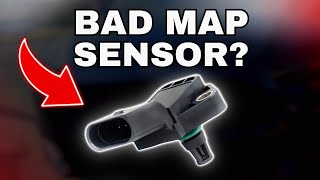
- Faulty Manifold Absolute Pressure (MAP) Sensor 🔴 High Probability → Shop Manifold Absolute Pressure Sensor The sensor is a known high-failure item across the Hyundai/Kia platform. It can fail electronically, causing its output voltage to drop below the 0.5V threshold, or become contaminated with oil from the PCV system, leading to incorrect readings.
How to confirm: With the key on and engine off, use a multimeter to test the signal wire at the sensor connector. A reading below 4.5V (at sea level) suggests a bad sensor. At idle, the voltage should be around 1.5V-2.5V for this turbo engine. If it's stuck below 0.5V, the sensor has failed. Visually inspect the sensor tip for oil contamination when removed.
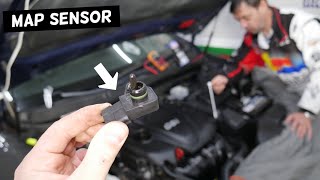
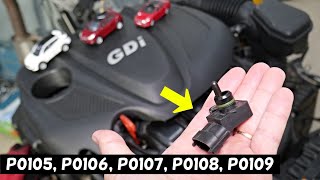
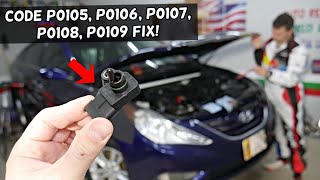
Typical fix: Replace the MAP sensor. It is held in by a single 10mm bolt and is easily accessible on the intake manifold.
Est. part cost: $25-$105 - Wiring Harness or Connector Issue 🟡 Medium Probability The engine bay is a harsh environment, and wires can become brittle and break, often right at the back of the MAP sensor connector. This specific failure is commonly reported in owner forums for the Optima and its platform mates.
How to confirm: Visually inspect the wiring leading to the MAP sensor for any breaks, melting, or corrosion. Unplug the connector and check for bent or corroded pins. Perform a 'tug test' on each of the three wires at the back of the connector to ensure they are secure. Check for 5V reference and good ground at the connector with a multimeter.
Typical fix: Repair the damaged section of wire or replace the connector pigtail. Pigtails are readily available online.
Est. part cost: $5-$30
Rare But Worth Checking
- Faulty Powertrain Control Module (PCM): → Shop Engine Control Module (ECM) This is extremely rare and should only be considered after the MAP sensor and its entire circuit have been thoroughly tested and proven to be good.
- Major Vacuum Leak: A massive vacuum leak could theoretically cause pressure readings to be abnormal, but it is much more likely to set a range/performance code (P0106) or other lean codes rather than a circuit low code.
- Clogged Catalytic Converter: A severely blocked catalytic converter can increase backpressure and affect intake manifold pressure, but this is an unlikely cause for P0107 and would typically be accompanied by other codes and more severe performance loss.
Diagnosis Steps
- Confirm the P0107 code is present using an OBD-II scanner. Note any other codes.
- Visually inspect the MAP sensor, which is located on the top of the intake manifold. Check for any obvious damage and ensure the connector is seated firmly.
- Inspect the wiring harness and connector for the MAP sensor. Look for loose connections, corrosion, or damaged wires. Perform a gentle 'tug test' on the wires at the back of the connector.
- With the ignition on but the engine off (KOEO), unplug the connector and use a multimeter to test the terminals. You should find a 5-volt reference wire, a ground wire (0 volts), and a signal wire.
- If 5V and ground are present, the wiring to the sensor is likely okay. Reconnect the sensor and back-probe the signal wire.
- With KOEO, the signal voltage should be around 4.5-5.0 volts (depending on altitude). If it's below 0.5V, the signal wire is likely shorted to ground or the sensor has failed internally.
- Start the engine. At idle, the voltage on the signal wire should drop to approximately 1.5-2.5 volts for this turbo engine. If the voltage does not change or remains low, this confirms a faulty sensor or circuit issue.
- If the sensor is removed, inspect the tip for any oil residue, which indicates possible contamination from the PCV system.
- If the wiring and voltages check out, the MAP sensor itself is the most likely culprit.
- Replace the MAP sensor.
- Clear the trouble code with the OBD-II scanner and perform a test drive to ensure the code does not return.
Parts You'll Likely Need
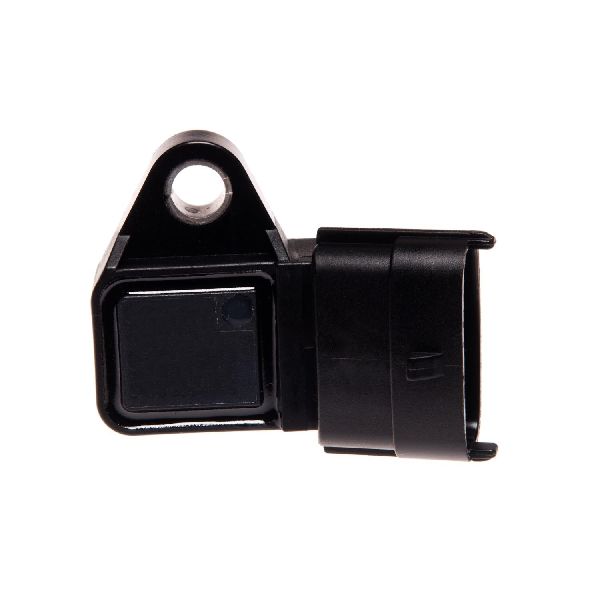
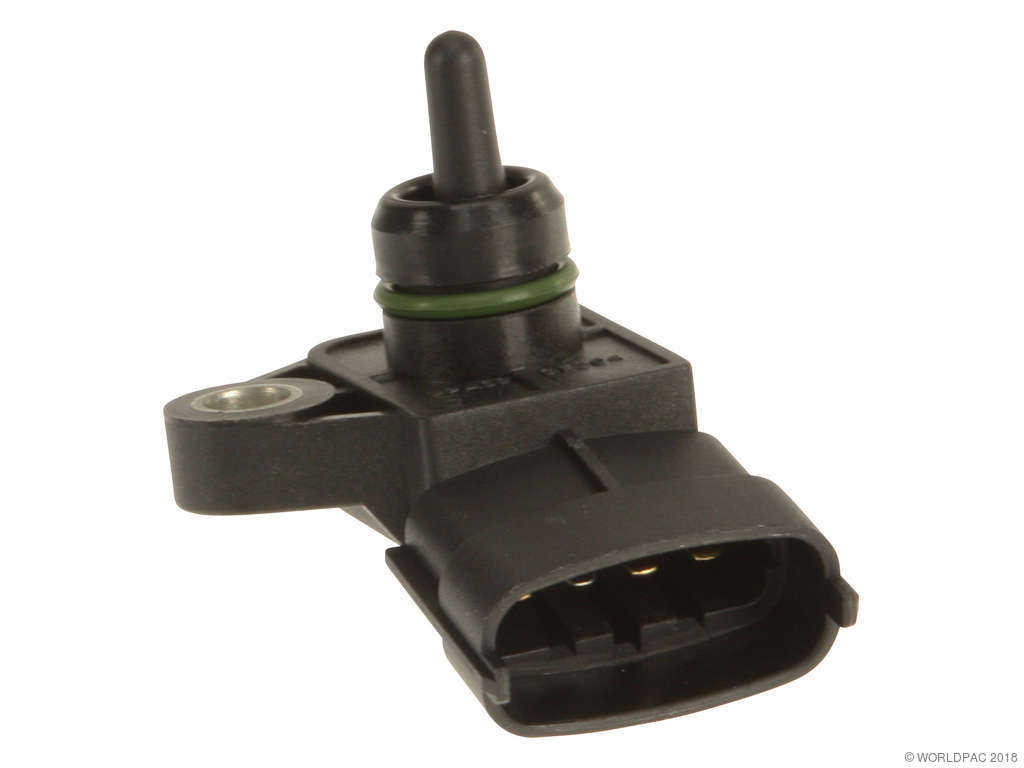
- Manifold Absolute Pressure (MAP) Sensor
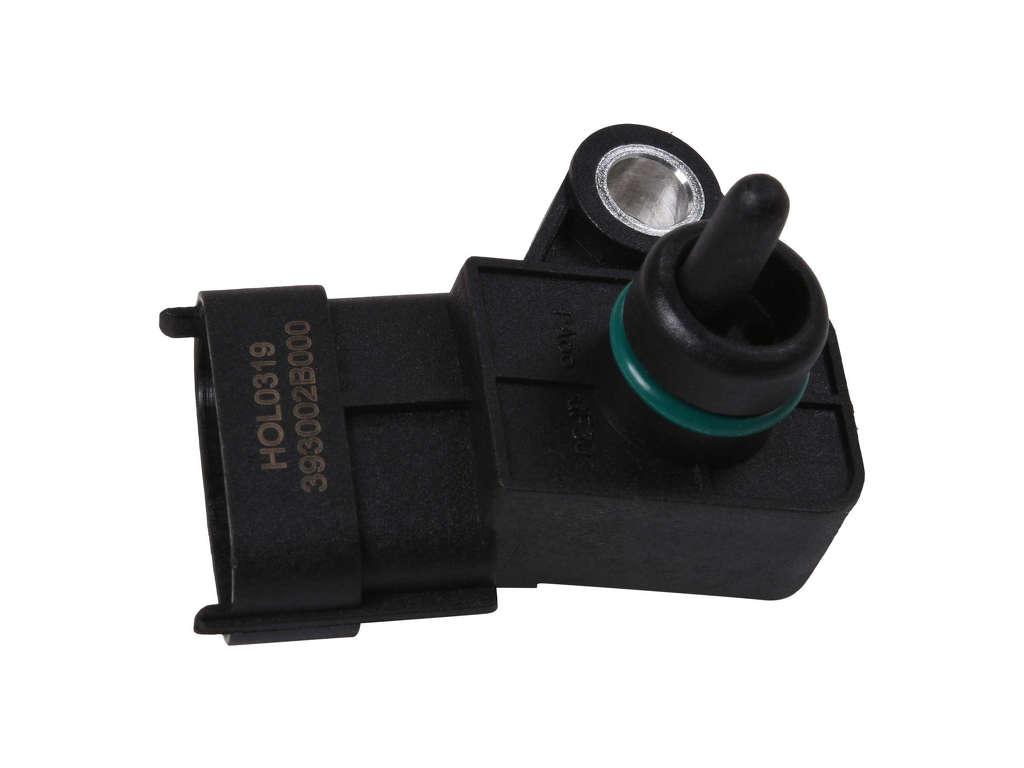
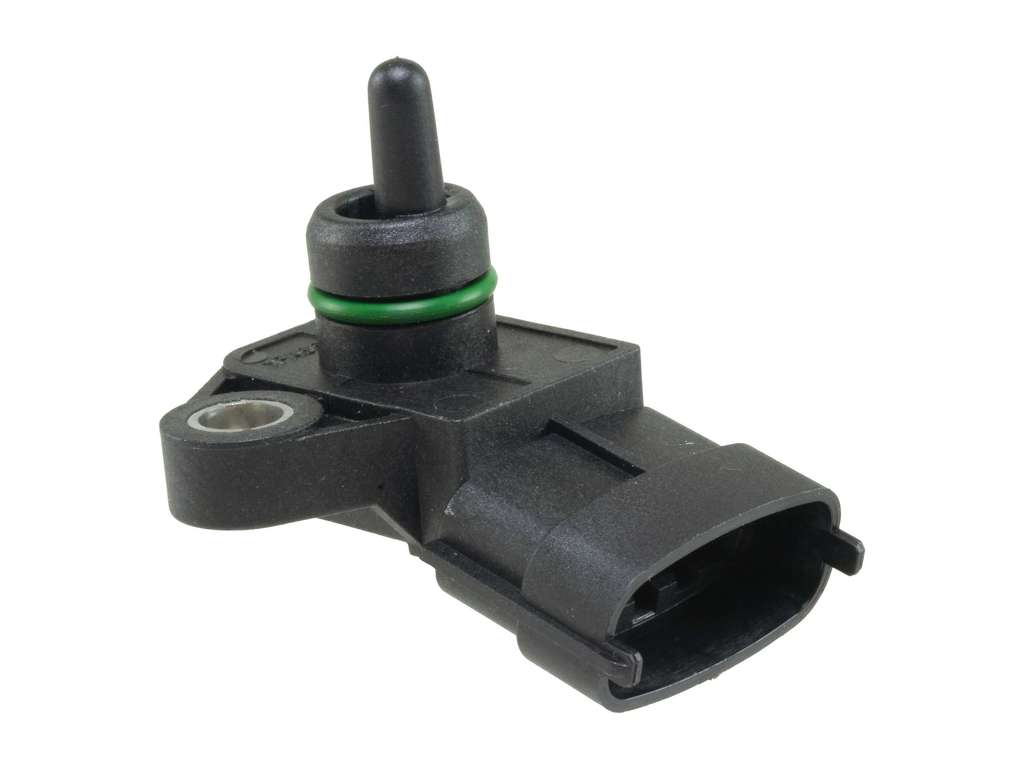
(OEM #39300-84400)— This is the most common cause of code P0107 on this vehicle. The sensor fails internally, sending a voltage signal that is too low for the PCM. This part number supersedes earlier versions like 39300-2G000 and 39300-2B000.
Trusted brands: Genuine Hyundai/Kia (OEM), Bosch, Delphi, NGK/NTK, Standard Motor Products (SMP)
OEM price range: $70-$105
Aftermarket price range: $25-$60
Related Codes That Often Appear With This One
- P0106 — If the MAP sensor is failing intermittently, is contaminated with oil, or providing erratic readings, a P0106 (MAP/Barometric Pressure Sensor Circuit Range/Performance) code may appear alongside P0107.
- P0108 — If there are intermittent wiring issues causing the signal wire to short to power, a P0108 (MAP/Barometric Pressure Circuit High Input) code could be stored along with the low input code.
- P0113 — On some models, the MAP and Intake Air Temperature (IAT) sensors are integrated or share wiring. A fault in the shared circuit can sometimes trigger codes for both sensors.
Platform-Specific Known Issues
- Owner on optimaforums.com reported P0107 and stalling. The fix was a simple replacement of the MAP sensor. Title: 'P0107 map sensor and stalling', URL: https://www.optimaforums.com/threads/p0107-map-sensor-and-stalling.169833/
- A Reddit user with a 2012 Optima (2.4L, but same sensor/issue) had both P0107 and P0106. After a new sensor didn't fix it, they found a broken wire in the harness, which was the true cause. Title: '2012 kia optima ex gdi 2.4 P0107 and P0106 MAP...', URL: https://www.reddit.com/r/MechanicAdvice/comments/dxtf2u/2012_kia_optima_ex_gdi_24_p0107_and_p0106_map/
- A user on kia-forums.com with a 2012 Optima SX (2.0T) fixed their P0107 and stalling issue by replacing the MAP sensor. Title: '2012 Optima SX MAP Sensor P0107', URL: https://www.kia-forums.com/threads/2012-optima-sx-map-sensor-p0107.342419/
Mechanic-Grade Diagnostic Values
- MAP Sensor Signal Wire (Key On, Engine Off) — expected: ~4.5V - 5.0V at sea level. Failure: A reading below 0.5V, which triggers the P0107 code.
- MAP Sensor Signal Wire (Engine Idling, Turbo Engine) — expected: ~1.5V - 2.5V. Failure: Voltage is stuck low (near KOEO reading) or does not respond to throttle changes.
- MAP Sensor Live Data (Key On, Engine Off) — expected: 11-307 kPa (Pressure should match local barometric pressure). Failure: Reading is significantly lower than barometric pressure, often near 11 kPa.
- MAP Sensor Ground Wire Voltage Drop — expected: Less than 100 millivolts (0.1V) DC when tested against battery negative terminal.. Failure: A reading higher than 0.1V indicates a poor ground connection, which can skew the sensor's signal.
Scan Tool Commands That Help
- Kia GDS (Global Diagnostic System): Trigger Module (Flight Record) — This function is used for diagnosing intermittent P0107 codes. It allows a technician to record sensor data during a test drive to capture the exact moment the fault occurs, which is invaluable for tracking down elusive wiring or connector issues.
Wiring & Ground Locations
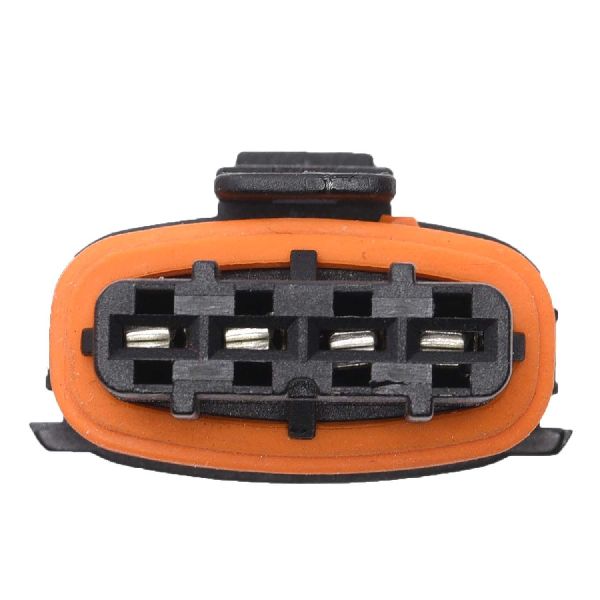
- MAP Sensor Connector Pin 1 (5V Reference) — At the MAP sensor connector on the intake manifold.. This pin supplies the 5-volt reference from the PCM. A loss of this voltage will cause the sensor to stop working, though it may set other codes as well.
- MAP Sensor Connector Pin 2 (Ground) — At the MAP sensor connector on the intake manifold.. This is the sensor's ground return. A bad ground connection here will cause incorrect voltage readings, potentially triggering P0107. The wire is often black or orange/black.
- MAP Sensor Connector Pin 3 (Signal) — At the MAP sensor connector on the intake manifold.. This is the signal wire that sends the pressure reading back to the PCM. A short to ground on this wire is a direct cause of P0107. The wire may be light green or blue.
- Engine/Chassis Ground — Main ground points are typically bolted to the engine block, cylinder head, or the inner fender in the engine bay.. The MAP sensor's circuit relies on a clean engine ground reference. A corroded or loose main ground strap can cause erratic voltage across multiple sensors, including the MAP sensor, leading to P0107.
OEM Part Supersession History
39300-2G000→39300-84400— Standard part revision and consolidation across multiple Hyundai/Kia platforms.
Heads up: The new part number 39300-84400 is a direct, backward-compatible replacement for 39300-2G000.39300-2B000→39300-84400— Part consolidation. While 39300-2B000 was used on many Kia/Hyundai engines, 39300-84400 is the current specified part for the 2.0L Turbo Optima.
Heads up: Using a sensor with a different calibration, even if it physically fits (e.g., a sensor for a 1.6L engine), can cause incorrect fuel mapping and trigger other codes like P0106 or P0108.
Diagnostic Flowchart
Other Known Issues on This Vehicle
Issues unrelated to this code that are worth knowing about as an owner of this generation:
- Catastrophic Engine Failure (Rod Bearing Wear) 🔴 High — Widespread issue affecting a large number of 2011-2015 models, often occurring between 60,000 and 120,000 miles. Caused by manufacturing debris. (Ref: NHTSA Campaign 17V224000 (Kia Recall SC147); led to class-action lawsuits and lifetime warranty extensions for many owners.)
- Worn Steering Column Flexible Coupler 🟠 Medium — Extremely common issue causing a distinct clicking or ticking noise from the steering column when turning the wheel. The rubber coupler (part # 56315-2K000-FFF) disintegrates over time. (Ref: Kia TSB CHA-072 and Customer Satisfaction Program CS1604 extended the warranty for this part.)
- Intake Valve Carbon Buildup 🟠 Medium — An inherent issue with all Gasoline Direct Injection (GDI) engines. Symptoms like rough idle, misfires, and hesitation typically appear after 60,000 miles and require professional cleaning (e.g., walnut blasting).
- Failing Electronic Wastegate Actuator (EWGA) 🟠 Medium → Shop Turbocharger — A common failure point on the 2.0L Turbo engine. The actuator drifts out of calibration or fails due to heat, causing turbo underboost (P0299) or overboost (P0234) codes and poor performance. (Ref: Multiple TSBs exist for recalibration procedures.)
Used vs. New Parts: Buying Guide for This Vehicle
When a used part is the smart pick: For a simple and relatively inexpensive electronic sensor like the MAP sensor, buying used is generally not recommended. The risk of getting a part that is already near the end of its life, or has an intermittent failure, outweighs the small cost savings over a new aftermarket part.
Donor-vehicle mileage cap: roughly under 60000 miles for the part to have meaningful remaining life.
What to inspect on the donor part:
- Ensure the connector is not cracked or damaged.
- Check that the O-ring is present and pliable, not flattened or brittle.
- Inspect the sensor tip for heavy oil or carbon buildup, which could indicate it came from a poorly maintained engine.
OEM-only on this vehicle (don't cheap out):
- While not strictly 'OEM-only', many forum users report that Hyundai/Kia GDI engines can be sensitive to the quality and calibration of aftermarket sensors. Using a Genuine Hyundai/Kia part (39300-84400) is the safest bet to ensure a one-time fix.
Aftermarket brands forum-validated for this vehicle:
- Bosch
- Delphi
- NGK/NTK
- Standard Motor Products (SMP)
Brands owners have reported issues with on this vehicle:
- No-name, unbranded sensors from online marketplaces are frequently cited as failing quickly or being dead-on-arrival.
Real Owner Stories
Aggregated from forums and TSBs cited above. Mileages and costs reflect what owners reported in those sources.
2012 Kia Optima SX 2.0T
Symptoms: Owner experienced a P0107 code and engine stalling.
What fixed it: Replacing the MAP sensor on the intake manifold resolved the issue.
Source hint: kia-forums.com thread titled '2012 Optima SX MAP Sensor P0107'
2012 Kia Optima EX GDI 2.4L
Symptoms: Vehicle had both P0107 and P0106 codes. A new sensor did not fix the problem.
What fixed it: Found a broken wire in the harness, which was the true cause.
Source hint: Reddit r/MechanicAdvice thread titled '2012 kia optima ex gdi 2.4 P0107 and P0106 MAP...'
2011-2015 Kia Optima 2.0T
Symptoms: P0107 with stalling at stops.
What fixed it: Replacement of the MAP sensor.
Source hint: optimaforums.com thread titled 'P0107 map sensor and stalling'
Related OBD-II Codes
Frequently Asked Questions
Is there a recall for the P0107 code on my 2011-2015 Kia Optima?
Where is the MAP sensor located on the 2.0L Turbo engine?
Can I use the same MAP sensor from a 2.4L Optima on my 2.0L Turbo?
Why does my Optima stall at stoplights when the P0107 code is active?
Is there a warranty extension for the steering noise I hear along with this engine code?
Could oil in my intake be causing the P0107 code?
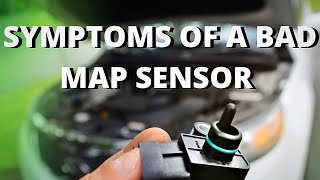
Helpful Videos

We Have This Part in Stock


The information in this article is provided for general reference and educational purposes only. Vehicle specifications, procedures, and part compatibility can vary by production date, trim level, and region. Always consult your vehicle's factory service manual and verify part numbers before purchasing or performing repairs. Safety-critical components such as airbags, seat belts, and braking systems should be installed by a qualified professional.
- Kia Optima:
- 🧭 Diagnostic Flowchart
- 🎬 Helpful Videos
- 🛍️ Shop This Part
- What's Unique About the 2011-2015 Kia Optima
- Symptoms You May Notice
- Most Likely Causes
- Rare But Worth Checking
- Diagnosis Steps
- Parts You'll Likely Need
- Related Codes That Often Appear With This One
- Platform-Specific Known Issues
- Mechanic-Grade Diagnostic Values
- Scan Tool Commands That Help
- Wiring & Ground Locations
- OEM Part Supersession History
- Other Known Issues on This Vehicle
- Used vs. New Parts: Buying Guide for This Vehicle
- Real Owner Stories
- 2012 Kia Optima SX 2.0T
- 2012 Kia Optima EX GDI 2.4L
- 2011-2015 Kia Optima 2.0T
- Related OBD-II Codes
- Frequently Asked Questions
- 🎟️ Get 5% Off