

P0107 on 2004-2012 Mitsubishi Galant: MAP Sensor Circuit Low Causes and Fixes
P0107 on a 2004-2012 Galant most often means the Manifold Absolute Pressure (MAP) sensor has failed. A replacement sensor is the most common fix. Expect to pay $80-$150 for an aftermarket part and around $230-$330 for OEM. It's an easy DIY replacement, typically located on the intake manifold.
- P0107 means the MAP sensor signal is too low, usually indicating a faulty sensor.
- Symptoms include rough idle, stalling, poor power, and bad gas mileage.
- The most likely fix is replacing the MAP sensor (OEM Part MN153281), which is an easy and accessible DIY job on the 2004-2012 Galant.
- Before replacing the sensor, always check its connector and wiring for damage, as this is a common and cheaper fix.
- Do not confuse the MAP sensor with the MAF (Mass Airflow) sensor; P0107 points specifically to the MAP circuit.
What's Unique About the 2004-2012 Mitsubishi Galant
For the ninth-generation Mitsubishi Galant (2004-2012), the P0107 code is a straightforward diagnostic issue without many platform-specific quirks. Unlike some turbocharged Mitsubishi engines where the MAP sensor port can get clogged with soot from the EGR system, the Galant's naturally aspirated engines (both the 2.4L 4G69 4-cylinder and 3.8L 6G75 V6) do not commonly suffer from this specific problem. The causes are typically a standard failure of the sensor itself or basic wiring issues. The sensor is generally easy to access on the intake manifold for both engines.
Symptoms You May Notice
- Check Engine Light is on
- Rough or uneven idle
- Engine stalling, especially when stopped or at low speeds
- Hesitation or lack of power during acceleration
- Poor fuel economy
- Black smoke from the exhaust (indicating a rich fuel mixture)
- Difficulty starting the engine, may require long cranking
- Engine surging
- Replacing the Mass Airflow (MAF) sensor. While a faulty MAF sensor can cause similar drivability issues, P0107 specifically points to the MAP sensor circuit. The Galant has both sensors, and it's important to diagnose the correct one.
Most Likely Causes
- Failed Manifold Absolute Pressure (MAP) Sensor 🔴 High Probability → Shop Manifold Absolute Pressure Sensor Sensors fail over time due to heat cycles and exposure within the engine bay. It is the most cited reason for this code across all vehicle makes and the most common fix reported by Galant owners.
How to confirm: With the ignition on and engine off, use a scan tool to check the MAP sensor reading; it should be close to atmospheric pressure (voltage around 1.2V to 1.8V at sea level). With the engine idling, the reading should be a low pressure (high vacuum), with voltage around 1.0V-1.5V. If the reading is stuck low (e.g., below 0.5V) regardless of engine state, the sensor is likely bad.
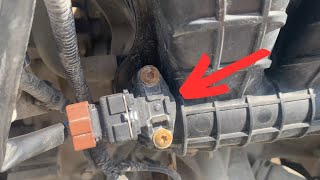
Typical fix: Replace the MAP sensor. It is typically mounted on the intake manifold with a single bolt and is easy to access. 🎬 See this step-by-step MAP sensor replacement walkthrough
Est. part cost: $80-$150 - Wiring Harness or Connector Issue 🟡 Medium Probability Engine vibration and heat can cause wires to break or insulation to crack over time. The connector itself can also become corroded, loose, or filled with debris, causing a poor connection. A short to ground on the signal wire is a common cause.
How to confirm: Visually inspect the wiring and connector for damage. Use a multimeter to check for a 5V reference signal (specifically 4.9-5.1V), a good ground, and the signal wire's integrity between the sensor and the ECM. Wiggling the harness while monitoring the voltage can reveal intermittent connection problems.
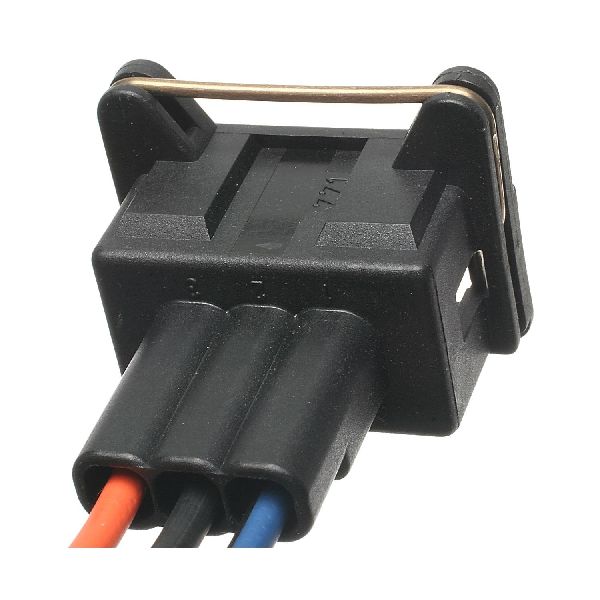
Typical fix: Repair the damaged wire or replace the connector pigtail.
Est. part cost: $5-$25 - Vacuum Leak ⚪ Low Probability Rubber vacuum hoses can crack and degrade with age. A leak in a hose connected to the intake manifold can alter pressure readings.
How to confirm: Inspect all vacuum hoses connected to the intake manifold for cracks, brittleness, or loose connections. A smoke test is the most effective way to find small leaks. A significant leak would be needed to cause a P0107, and it would likely be accompanied by other symptoms like a loud hissing sound and possibly other lean-condition codes.
Typical fix: Replace the cracked or broken vacuum hose.
Est. part cost: $5-$20
Rare But Worth Checking
- Failed Powertrain Control Module (ECM): → Shop Engine Control Module (ECM) This is extremely rare and should only be considered after all other possibilities (sensor, wiring, vacuum leaks) have been exhaustively ruled out. A Mitsubishi service document lists a failed ECM as a potential, though least likely, cause.
- Clogged Catalytic Converter: A severely restricted exhaust can cause abnormal pressure in the intake manifold, potentially triggering a P0107 code, though it would usually be accompanied by other codes like P0420 and severe performance loss.
Diagnosis Steps
- Read the code with an OBD-II scanner and record the freeze frame data.
- Visually inspect the MAP sensor, its electrical connector (B-117), and the surrounding wiring for any obvious damage, corrosion, or loose connections.
- Inspect the vacuum port on the intake manifold where the sensor sits for any blockage or carbon buildup.
- With the ignition on (engine off), use a scan tool (like Mitsubishi's M.U.T.-III) to view live data for the MAP sensor (Data List Item 8). The voltage should be between 1.2V and 1.8V at sea level. A reading below 0.2V indicates a circuit or sensor fault.
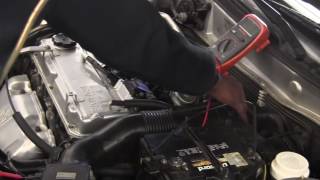
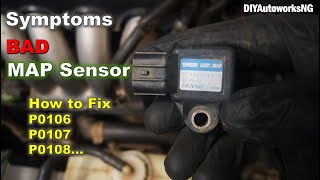
- Start the engine and observe the MAP sensor data at idle. The voltage should drop to around 1.0V - 1.5V. If the voltage remains stuck below 0.5V, the sensor or its circuit is faulty. 🎬 Watch: How to diagnose bad MAP sensor symptoms and codes
- If the data seems incorrect, test the sensor's wiring. Disconnect the sensor and check for a 4.9V - 5.1V reference voltage at connector B-117, pin 3, and a good ground at pin 2.
- If power and ground are good, check the signal wire (pin 1) for a short to ground between the sensor connector (B-117) and the ECM connector (B-108, terminal 45).
- If the wiring tests good, the MAP sensor itself is the most likely culprit and should be replaced.
Parts You'll Likely Need
- Manifold Absolute Pressure (MAP) Sensor
(OEM #MN153281, MD355556 (superseded), 1865A049 (for 4G69))— This is the most common component to fail and directly cause the P0107 code.
Trusted brands: Mitsubishi Genuine, Denso, Delphi (Part No. PS20070), Standard Motor Products (Part No. AS331)
OEM price range: $227-$336
Aftermarket price range: $75-$159
Related Codes That Often Appear With This One
- P0108 — P0108 is 'MAP Sensor Circuit High Input'. Seeing both codes intermittently could point to a wiring issue or a failing sensor that is fluctuating wildly.
- P0172 — P0172 is 'System Too Rich'. If the ECM sees a very low pressure (high vacuum) from a faulty MAP sensor, it may incorrectly enrich the fuel mixture, leading to this code.
- P0101 / P0102 — These codes relate to the Mass Airflow (MAF) sensor. In some cases, a failing MAP sensor can cause the engine to run in a way that masks a secondary problem with the MAF. After replacing the MAP sensor and fixing P0107, these MAF codes may appear as the engine returns to normal operating parameters.
Technical Service Bulletins (TSBs) & Recalls
- While no specific TSB is dedicated solely to P0107, Mitsubishi has internal troubleshooting documents that guide technicians. For example, one document outlines checking the harness between MAP sensor connector B-117 (terminal 3) and ECM connector B-108 (terminal 44) for an open circuit.
Platform-Specific Known Issues
- On the Mitsubishi Forums, a user with a P0107 code that appeared intermittently, especially during highway driving, described a frustrating scenario where the code would clear itself and then return. While the user did not post a final resolution, the behavior of the code appearing under steady-state cruising and after refueling events points towards a potential intermittent wiring connection or a sensor on the verge of complete failure.
Mechanic-Grade Diagnostic Values
- MAP Sensor Signal Voltage (Key On, Engine Off) — expected: 1.2V - 1.8V at sea level (0 ft); 1.1V - 1.7V at 600m (1,969 ft); 1.0V - 1.6V at 1,200m (3,937 ft). Failure: Voltage is less than 0.2V for 2 seconds.
- MAP Sensor Signal Voltage (Engine Idling) — expected: 1.0V - 1.5V. Failure: Voltage does not drop from KOEO reading, or is stuck below 0.5V.
- MAP Sensor 5V Reference Voltage (at connector B-117, Pin 3 to Ground) — expected: 4.9V - 5.1V. Failure: Voltage is near 0V or significantly lower than 4.9V, indicating an open or short in the supply circuit.
- MAP Sensor Ground Circuit Resistance (at connector B-117, Pin 2 to Chassis Ground) — expected: Less than 10 Ω. Failure: High or infinite resistance (OL) indicates a bad ground path.
Scan Tool Commands That Help
- Mitsubishi M.U.T.-III: Data List - Item 8: Manifold Absolute Pressure Sensor — This is the primary function used to monitor the live voltage and pressure readings from the MAP sensor to see if they are within the expected range during KOEO and idle states.
- Mitsubishi M.U.T.-III: ECU Reprogramming / Initialization — While not typically required for a simple MAP sensor replacement on this model, some Mitsubishi vehicles require a sensor or system initialization after replacement. This function would be used if directed by a service manual after replacing related components or the ECU itself.
Wiring & Ground Locations
- B-117 — The electrical connector on the MAP sensor itself, located on the intake manifold.. This is the primary point for testing the sensor's power, ground, and signal circuits directly.
- B-108 — One of the main harness connectors at the Engine Control Module (ECM).. This connector contains the pins for the MAP sensor circuit (44, 45, 46) and is the endpoint for checking harness continuity from the sensor.
- MAP Sensor Pin 1 (Signal) — Connects to Pin 45 on ECM connector B-108.. This is the signal wire. A short to ground on this wire will cause a P0107 code.
- MAP Sensor Pin 2 (Ground) — Connects to Pin 46 on ECM connector B-108.. This is the sensor ground provided by the ECM. A bad connection here will cause incorrect readings.
- MAP Sensor Pin 3 (Power) — Connects to Pin 44 on ECM connector B-108.. This wire supplies the 5V reference voltage. No voltage here means an open circuit or a faulty ECM.
- G10 / G11 — Main engine compartment ground points, typically on the front or left front of the engine compartment.. While the MAP sensor is grounded through the ECM, a poor main engine or ECM ground can cause floating voltages and erratic sensor behavior across multiple systems.
Real Owner Repair Stories
- YouTube Channel 'SuperAuto's' (Mitsubishi vehicle (similar platform/engine management)) — Check engine light for MAP sensor.
❌ Tried (didn't work) Initially, the mechanic only diagnosed the MAP sensor code.
✅ What actually fixed it Replacing the MAP sensor cleared the P0107 code, but the car would then stall. Further diagnosis revealed new codes for the Mass Airflow (MAF) sensor (P0101/P0102). The faulty MAP sensor was causing the ECU to run in a state that masked the underlying MAF sensor problem. The final fix was replacing both the MAP and MAF sensors.
OEM Part Supersession History
MD355556→MN153281 (for this Galant application)— Part consolidation and updates over model years.
Heads up: While a sensor with the old part number might physically fit the connector, its internal calibration may be intended for a different engine or ECU software. Using an incorrectly calibrated sensor can lead to persistent performance issues, poor fuel economy, or other codes even if it's a new part.
Diagnostic Flowchart
Other Known Issues on This Vehicle
Issues unrelated to this code that are worth knowing about as an owner of this generation:
- Premature Automatic Transmission Failure/Shift Flare 🔴 High — A widely reported issue, especially the '2-3 shift flair'. Can occur at various mileages but becomes more common as vehicles age. (Ref: A recall was issued for the 2010 model year for a corroding transmission cooler pipe that could leak fluid (NHTSA ID: 10V135000).)
- Clear Coat and Paint Failure 🟠 Medium — Very common, especially on dark-colored vehicles and those exposed to high UV/sunlight. Peeling and oxidation on horizontal surfaces (roof, trunk, hood) are frequently noted by owners.
- Cracked Dashboard 🟡 Low — Common in climates with high heat and sun exposure. The dashboard material can become brittle and crack over time.
- Faulty Crankshaft Position Sensor 🟠 Medium — A common cause for engine stalling or no-start conditions, often without warning.
- Power Window Failure 🟡 Low — Failures of the window regulators or motors are a frequently cited annoyance by owners.
Used vs. New Parts: Buying Guide for This Vehicle
When a used part is the smart pick: For a critical, relatively low-cost electronic sensor like the MAP, buying used is generally not recommended. The risk of acquiring a part that is already failing, out of calibration, or has a short remaining lifespan outweighs the small cost savings.
Donor-vehicle mileage cap: roughly under 50000 miles for the part to have meaningful remaining life.
What to inspect on the donor part:
- Ensure the connector pins are clean, straight, and free of corrosion.
- Check the plastic housing for cracks or signs of extreme heat exposure.
- Verify the part number (MN153281) matches exactly for the Galant application.
- Avoid parts from engines that show signs of oil sludge or water intrusion.
OEM-only on this vehicle (don't cheap out):
- No parts in this specific P0107 repair are strictly 'OEM-only'.
Aftermarket brands forum-validated for this vehicle:
- Denso
- Delphi
- Standard Motor Products (SMP)
Brands owners have reported issues with on this vehicle:
- Unbranded, no-name sensors from online marketplaces. These often lack proper calibration and can fail prematurely or cause performance issues out of the box.
Real Owner Stories
Aggregated from forums and TSBs cited above. Mileages and costs reflect what owners reported in those sources.
2008 Mitsubishi Galant
Symptoms: The P0107 error appeared intermittently, especially during highway driving and steady-state cruising. The code would occasionally clear itself and then return, sometimes after refueling events.
What fixed it: The behavior pointed toward an intermittent wiring connection or a sensor on the verge of complete failure, requiring inspection of the wiring harness and MAP sensor.
Source hint: mitsubishi-forums.com: 'P0107 error' - A thread from 2008
Related OBD-II Codes
Frequently Asked Questions
Is there a specific Mitsubishi TSB for the P0107 code on my Galant?
Where is the MAP sensor located on the 2004-2012 Galant for replacement?
What voltage should I see when testing the MAP sensor with a scan tool?
Could my Galant's transmission issues be related to the P0107 code?
I'm seeing black smoke and the engine is stalling; is this common for P0107?
What specific electrical connectors should I inspect for this code?
Helpful Videos
We Have This Part in Stock


The information in this article is provided for general reference and educational purposes only. Vehicle specifications, procedures, and part compatibility can vary by production date, trim level, and region. Always consult your vehicle's factory service manual and verify part numbers before purchasing or performing repairs. Safety-critical components such as airbags, seat belts, and braking systems should be installed by a qualified professional.
- Mitsubishi Galant:
- 🧭 Diagnostic Flowchart
- 🎬 Helpful Videos
- 🛍️ Shop This Part
- What's Unique About the 2004-2012 Mitsubishi Galant
- Symptoms You May Notice
- Most Likely Causes
- Rare But Worth Checking
- Diagnosis Steps
- Parts You'll Likely Need
- Related Codes That Often Appear With This One
- Technical Service Bulletins (TSBs) & Recalls
- Platform-Specific Known Issues
- Mechanic-Grade Diagnostic Values
- Scan Tool Commands That Help
- Wiring & Ground Locations
- Real Owner Repair Stories
- OEM Part Supersession History
- Other Known Issues on This Vehicle
- Used vs. New Parts: Buying Guide for This Vehicle
- Real Owner Stories
- 2008 Mitsubishi Galant
- Related OBD-II Codes
- Frequently Asked Questions
- 🎟️ Get 5% Off