

P0108 on 2012-2018 Ford C-Max Hybrid: MAP Sensor High Input Causes and Fixes
This code almost always points to a failed Manifold Absolute Pressure (MAP) sensor. On the C-Max Hybrid, the sensor is difficult to access, making replacement a more involved job than on other vehicles. Expect to pay $40-$80 for an OEM sensor and 1.5-2.5 hours of labor if done by a shop. The most common OEM part number is GV2Z-9F479-B, which supersedes several previous numbers.
- P0108 on a 2012-2018 C-Max Hybrid is most likely caused by a failed MAP sensor.
- Symptoms include rough idle, poor acceleration, and bad fuel mileage.
- The biggest challenge for this repair is the sensor's location, which is buried on the intake manifold and very difficult to access, making DIY repair a 4/5 difficulty.
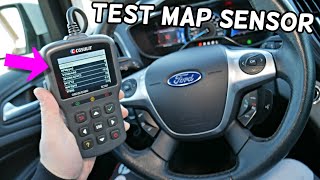
- Before replacing, verify the failure by checking live data with a scan tool.
- Always confirm the correct part number for your specific vehicle's VIN before purchasing a replacement sensor.
What's Unique About the 2012-2018 Ford C-Max
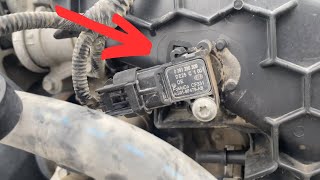
The 2.0L Hybrid engine, shared with the Ford Fusion Hybrid and Lincoln MKZ Hybrid, has a particularly challenging MAP sensor location. It is tucked deep on the intake manifold between the first and second cylinders, 🎬 See this video for the exact sensor location and replacement. underneath other components, making visual inspection and access extremely difficult without tools like an endoscope. While the sensor itself is a common failure point, its placement makes what is usually a simple 15-minute fix on other cars a much more labor-intensive job on the C-Max Hybrid, sometimes requiring removal of the intake manifold for access.
Symptoms You May Notice
- Check Engine Light is on
- Rough or unstable idle, engine speed may oscillate
- Hesitation, sluggish acceleration, or loss of power
- Reduced fuel economy
- Black smoke from the exhaust
- Engine may stall, especially when coming to a stop
- Engine may fail to start
- Replacing the Mass Airflow (MAF) sensor. The C-Max 2.0L Hybrid has both a MAF and a MAP sensor. P0108 specifically relates to the MAP sensor circuit, which measures pressure, not airflow.
Most Likely Causes
- Faulty Manifold Absolute Pressure (MAP) Sensor 🔴 High Probability → Shop Manifold Absolute Pressure Sensor On this specific platform, a bad MAP sensor is the most common culprit for P0108 and related codes. The sensor can fail internally from heat cycles and age, causing it to send a constant high voltage signal, sometimes getting stuck near 5 volts.
How to confirm: With the Key On, Engine Off (KOEO), use a scan tool to compare the MAP sensor reading to the Barometric Pressure (BARO) reading. They should be nearly identical. A difference of more than 0.5 volts is a strong indicator of a faulty sensor. You can also test the signal wire with a multimeter; it should read around 1.4-1.8 volts at idle and should not be stuck at or near 4.5-5 volts.
Typical fix: Replace the MAP sensor. Due to the difficult location on the 2.0L Hybrid engine, this may require removing the upper intake manifold for access. The sensor is held in by a single Torx bolt.
Est. part cost: $40-$80 - Wiring Harness or Connector Issue 🟡 Medium Probability The wiring harness in a crowded engine bay is susceptible to damage from heat, vibration, or during other maintenance procedures.
How to confirm: Visually inspect the wiring harness and connector going to the MAP sensor for any signs of damage, corrosion, melted plastic, or loose pins. Check for a short to power on the signal wire by testing for voltage with the sensor unplugged. Perform a wiggle test on the connector and wiring while monitoring live data on a scan tool to see if the reading fluctuates.
Typical fix: Repair the damaged section of the wiring harness or clean/replace the connector pigtail.
Est. part cost: $10-$60 - Dirty or Failing Throttle Body ⚪ Low Probability
How to confirm: A severely dirty throttle body can sometimes affect pressure readings and has been noted as a possible contributing factor on this platform. Inspect the throttle body for heavy carbon buildup around the throttle plate.
Typical fix: Clean the throttle body using a dedicated throttle body cleaner and a soft brush.
Est. part cost: $10-$15 - Intake Manifold Vacuum Leak ⚪ Low Probability
How to confirm: A significant vacuum leak from a cracked hose or bad intake gasket could theoretically alter pressure readings, though this more commonly causes lean codes. With the engine running, listen for hissing sounds around the intake manifold. You can also use a scan tool to check if idle vacuum is below the typical 15 in. Hg.
Typical fix: Identify and repair the source of the leak, which may involve replacing vacuum hoses or intake gaskets.
Est. part cost: $10-$200
Rare But Worth Checking
- Clogged Catalytic Converter: A severely restricted exhaust can cause excessive backpressure in the intake manifold, leading to an abnormally high MAP sensor reading. This would typically be accompanied by other symptoms like a severe loss of power, especially at high RPMs, and potentially a sulfur smell from the exhaust.
- Faulty Powertrain Control Module (PCM): → Shop Engine Control Module (ECM) This is extremely rare, but the PCM's internal circuitry for interpreting the MAP sensor signal can fail. This should only be considered after all other possibilities, including wiring and the sensor itself, have been exhaustively ruled out. A PCM replacement requires programming specific to the vehicle's VIN.
Diagnosis Steps
- Connect an OBD-II scanner and confirm P0108 is the primary code. Note any other codes present, especially P0106, P0107, or EVAP codes.
- Using the scanner's live data function, view the MAP sensor reading (usually in kPa or Volts) with the Key On and Engine Off (KOEO). The pressure reading should be close to the Barometric Pressure (BARO) reading. A significant difference points to a sensor or circuit fault.
- Start the engine. At idle, the MAP sensor voltage should drop to around 1.4-1.8 volts. As you open the throttle, the voltage reading should rise smoothly toward 4.5 volts. If the reading is stuck high (e.g., above 4.5V) and unresponsive, the sensor is likely bad or there is a short in the signal wire.
- If the sensor reading is suspect, turn off the vehicle and locate the MAP sensor on the intake manifold. It is difficult to access, located between cylinders 1 and 2. An endoscope camera can be very helpful for visual inspection.
- Inspect the sensor's electrical connector and wiring for any visible damage, corrosion, or loose connections. Perform a 'wiggle test' on the harness while watching live data to check for intermittent connections.
- If wiring appears okay, test the circuit. With the sensor unplugged and key on, verify you have a 5-volt reference and a good ground at the connector using a multimeter.
- If the circuit tests good, the most probable cause is a failed MAP sensor.
- To replace the sensor, you may need to remove the upper intake manifold for access. It is held in by a single Torx bolt.
- After replacing the sensor, clear the codes with the scanner and perform a test drive to ensure the issue is resolved and the code does not return.
Parts You'll Likely Need
- Manifold Absolute Pressure (MAP) Sensor
(OEM #GV2Z-9F479-B)— This is the most common cause of P0108. The sensor fails internally and sends an incorrect high-voltage signal to the PCM. The part number GV2Z-9F479-B is a common OEM replacement for the C-Max 2.0L Hybrid and supersedes older numbers. Always verify the part number with your vehicle's VIN before purchasing.
Trusted brands: Motorcraft, Bosch, NGK/NTK, Standard Motor Products
OEM price range: $65-$105
Aftermarket price range: $25-$70
Related Codes That Often Appear With This One
- P0106 — Indicates a MAP sensor performance/range issue. It can appear alongside P0108 if the sensor's readings are erratic or illogical, but not consistently high.
- P0107 — Indicates MAP sensor circuit low input. If the sensor or wiring is failing intermittently with shorts and opens, you could see both high (P0108) and low (P0107) codes stored.
- P144C — This is an EVAP system code often seen on these platforms. While not directly related to the MAP sensor circuit, issues in the intake or vacuum system can sometimes trigger multiple codes.
- P1450 — Indicates an inability to bleed up fuel tank vacuum, often caused by a stuck-closed canister purge valve. This is a very common issue on the 2.0L platform and its mates. While a separate issue, it involves the intake vacuum system and can occur concurrently.
Technical Service Bulletins (TSBs) & Recalls
- While no TSB was found specifically for P0108 on the C-Max Hybrid, Ford has issued TSBs for P0108 on other platforms like the 3.5L EcoBoost, where a faulty MAP sensor is the confirmed cause. This pattern of MAP sensor failure across Ford products adds confidence to the diagnosis.
Platform-Specific Known Issues
- The MAP sensor is in a very difficult location to access, significantly increasing labor time compared to most other vehicles. DIY replacement is challenging and may require removing the intake manifold.
- A YouTube video from 'Electrical Car Repair LIVE' specifically uses an endoscope to show the sensor's location on a C-Max, highlighting the access difficulty between cylinders 1 and 2 on the intake manifold.
Mechanic-Grade Diagnostic Values
- MAP Sensor Voltage (KOEO) — expected: ~4.5-4.7 Volts (should match BARO). Failure: A significant difference (>0.5V) between MAP and BARO readings indicates a fault.
- MAP Sensor Voltage (Engine Idling) — expected: 1.4 - 1.8 Volts. Failure: Voltage stuck high (near 4.5V) or unresponsive to throttle changes. A reading of 4.4V or higher will trigger P0108.
- MAP Sensor Voltage (Wide Open Throttle) — expected: Rises smoothly towards 4.5 Volts. Failure: Voltage does not increase with throttle application or is erratic.
- MAP Sensor Pressure (Engine Idling) — expected: Approx. 4.5 PSI or 31 kPa. Failure: Pressure reading is stuck high (near atmospheric, ~14.7 PSI) and does not drop when the engine is running.
- MAP Sensor Circuit 5V Reference — expected: 5.0 Volts. Failure: No voltage or significantly lower voltage indicates a PCM or wiring issue.
Scan Tool Commands That Help
- Ford IDS / FORScan / High-End Scanners: Keep Alive Memory (KAM) Reset — After replacing the MAP sensor or cleaning the throttle body, a KAM reset should be performed. This clears the adaptive learning tables in the PCM, forcing it to relearn fuel trims and sensor values immediately with the new/clean components, which can resolve persistent drivability issues.
- Ford IDS / FORScan / High-End Scanners: Graphing MAP vs. BARO PIDs — During diagnosis with Key On, Engine Off, graphing both the Manifold Absolute Pressure (MAP) and Barometric Pressure (BARO) PIDs allows for a quick visual confirmation. The lines on the graph should overlap perfectly. Any separation indicates a sensor or circuit fault.
Wiring & Ground Locations
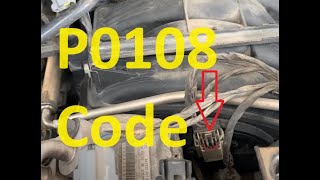
- MAP Sensor Connector — On the MAP sensor, located on the intake manifold between cylinders 1 and 2.. This 3-pin connector provides power, ground, and signal return for the sensor. Pin 1: VREF (5V Reference), Pin 2: MAP Signal, Pin 3: SIGRTN (Signal Return/Ground). Testing these specific pins is crucial for diagnosing a circuit fault vs. a sensor fault.
- G108 — Top of the transmission housing.. This is a primary engine and sensor ground point. A loose or corroded G108 can cause erratic readings and various sensor codes, including P0108, due to an unstable ground reference for the sensor circuit.
- G104 — Rear of the transmission.. Another key ground point for the powertrain. While G108 is more directly related, checking all major engine/transmission grounds is good practice when chasing electrical faults.
Real Owner Repair Stories
- Ford Fusion Hybrid Forum user (2014 Ford Fusion Hybrid (same 2.0L powertrain)) — Check engine light with code P0108, rough idle, and hesitation.
❌ Tried (didn't work) Initial diagnosis pointed to a possible vacuum leak, but none was found.
✅ What actually fixed it The MAP sensor was replaced. The owner confirmed the difficult location on the back of the intake manifold but stated that replacing the sensor resolved all symptoms and the P0108 code did not return.
OEM Part Supersession History
GV2Z-9F479-A→GV2Z-9F479-B— Standard part revision by the manufacturer, likely for improved reliability or minor design change.CX-2569→GV2Z-9F479-B— CX-2569 is the Motorcraft service part number which corresponds to the Ford engineering number GV2Z-9F479-B.
Model Year Variations Within This Range
- 2012-2018: There were no significant changes to the 2.0L Atkinson-cycle engine, intake manifold, or MAP sensor part number across the US model years for the C-Max Hybrid. The diagnostic and repair procedure is consistent for all years in this range.
Diagnostic Flowchart
Real Owner Stories
Aggregated from forums and TSBs cited above. Mileages and costs reflect what owners reported in those sources.
2013-2020 Ford Fusion Hybrid 2.0L I4
Symptoms: Experienced P010x series codes related to the MAP sensor.
What fixed it: Identified the MAP sensor as the common point of failure and replaced it.
Source hint: forfusionforum.com
Related OBD-II Codes
Frequently Asked Questions
Is there a specific TSB for the P0108 code on my 2012-2018 Ford C-Max Hybrid?
Where is the MAP sensor located on the 2.0L Hybrid engine, and can I replace it myself?
How can I visually inspect the MAP sensor without taking the intake manifold off?
What should the MAP sensor voltage read on my C-Max at idle?
Are other Ford hybrids prone to this same P0108 issue?
Helpful Videos


The information in this article is provided for general reference and educational purposes only. Vehicle specifications, procedures, and part compatibility can vary by production date, trim level, and region. Always consult your vehicle's factory service manual and verify part numbers before purchasing or performing repairs. Safety-critical components such as airbags, seat belts, and braking systems should be installed by a qualified professional.
- Ford C-Max:
- 🧭 Diagnostic Flowchart
- 🎬 Helpful Videos
- What's Unique About the 2012-2018 Ford C-Max
- Symptoms You May Notice
- Most Likely Causes
- Rare But Worth Checking
- Diagnosis Steps
- Parts You'll Likely Need
- Related Codes That Often Appear With This One
- Technical Service Bulletins (TSBs) & Recalls
- Platform-Specific Known Issues
- Mechanic-Grade Diagnostic Values
- Scan Tool Commands That Help
- Wiring & Ground Locations
- Real Owner Repair Stories
- OEM Part Supersession History
- Model Year Variations Within This Range
- Real Owner Stories
- 2013-2020 Ford Fusion Hybrid 2.0L I4
- Related OBD-II Codes
- Frequently Asked Questions
- 🎟️ Get 5% Off