

P0108 on 2018-2019 Ford Explorer 3.5L EcoBoost: Known MAP Sensor Failure (TSB 19-2212)
On a 2018-2019 Explorer with the 3.5L EcoBoost, code P0108 is almost always caused by a faulty Manifold Absolute Pressure and Temperature (MAPT) sensor, a well-documented issue covered by Ford TSB 19-2212. The fix is a simple DIY replacement of the sensor located on top of the intake manifold, costing about $90-$160 for the OEM part and taking less than 30 minutes.
- For a 2018-2019 Explorer 3.5L EcoBoost, P0108 almost certainly means you need a new MAPT sensor.
- This is a known issue confirmed by Ford in TSB 19-2212.
- Look for a cluster of symptoms: Check Engine light, Wrench light, 'Service AdvanceTrac' message, and a major loss of power.
- The repair is very easy for a DIYer, taking less than 30 minutes with a single T20 Torx driver.
- The correct OEM part number is AA5Z-9F479-E (Motorcraft CX-2619).
What's Unique About the 2018-2019 Ford Explorer
For this specific vehicle and engine, the P0108 code is a well-documented and known issue. Ford issued Technical Service Bulletins (TSB 19-2183, later updated to 19-2212) acknowledging that a faulty Manifold Absolute Pressure and Temperature (MAPT) sensor is the direct cause. This makes diagnosis much more straightforward than on other vehicles, where causes could range from wiring faults to vacuum leaks. The failure often triggers a cascade of other warning lights, like 'Service AdvanceTrac', because the stability control system relies on accurate engine torque data, which becomes unreliable due to the faulty sensor. The PCM then disables these dependent systems as a precaution.
Symptoms You May Notice
- Significant lack of power or sluggish acceleration, may feel like a transmission issue
- Check Engine Light (Malfunction Indicator Lamp) is on
- Powertrain Malfunction (Wrench) light is on 🎬 See how a faulty sensor triggers the wrench light and fix.
- "Service AdvanceTrac" message on the dashboard
- "Hill Start Assist Not Available" message
- Rough or unstable idle
- Poor fuel economy
- Hesitation or stalling, especially when accelerating from a stop
- Transmission problems. The severe hesitation and lack of power can be mistaken for a failing transmission, but it is a direct symptom of the faulty MAPT sensor providing incorrect data to the engine computer.
- Mass Airflow (MAF) Sensor issue. This engine platform uses MAP sensors, not a MAF sensor. Owners may confuse the two, but cleaning or replacing a non-existent MAF sensor will not fix the problem.
Most Likely Causes
- Faulty Manifold Absolute Pressure and Temperature (MAPT) Sensor 🔴 High Probability → Shop Manifold Absolute Pressure Sensor This is a known, widespread failure point documented by Ford in Technical Service Bulletins 19-2183 and 19-2212 for the 3.5L EcoBoost engine in this specific year range. The TSB was issued due to a high failure rate of this specific sensor.
How to confirm: Use a scan tool with the Key On, Engine Off. Per TSB 19-2183, compare the MAP (PRESS) PID to the BARO (PRESS) and TCBP (PRESS) PIDs. If the MAP reading differs by more than 10.35 kPa (1.5 psi), the sensor is faulty. A simpler check is to look for a MAP voltage reading at or above 4.5 volts with the key on and engine off.
Typical fix: Replace the MAPT sensor located on top of the intake manifold. It is held by a single T20 Torx screw. 🎬 Watch this quick walkthrough to see the sensor replacement process. The engine cover must be removed for access. A small amount of dielectric grease or motor oil on the new sensor's O-ring is recommended for easier installation.
Est. part cost: $90-$190
Rare But Worth Checking
- Wiring or Connector Issue: While possible, this is far less common than sensor failure on this platform. Before replacing the sensor, it is good practice to inspect the connector for visible damage, corrosion, or loose pins. If a new sensor does not resolve the issue, the wiring harness (checking for 5V reference, ground, and signal integrity) should be inspected.
Diagnosis Steps
- Scan for diagnostic trouble codes. Confirm P0108 is present, and check for P0107 or P0109, which point to the same root cause.
- Visually inspect the MAPT sensor connector and nearby wiring for any obvious signs of damage, corrosion, or looseness. The connector is on top of the intake manifold.
- Using a capable scan tool with the key on and engine off, compare the Manifold Absolute Pressure (MAP) reading to the Barometric Pressure (BARO) reading. Per Ford's TSB, if they differ by more than 1.5 PSI (10.35 kPa), the MAPT sensor is confirmed to be faulty.
- Alternatively, with a scan tool or multimeter, check the MAP sensor signal voltage with the key on, engine off. A reading at or near 5 volts indicates a failed sensor.
- If the diagnostic test confirms a faulty sensor, proceed with replacement. If the readings are within spec, a more thorough diagnosis of the wiring (checking for 5V reference, ground, and signal integrity) may be needed, but this is highly unlikely for this vehicle.
Parts You'll Likely Need
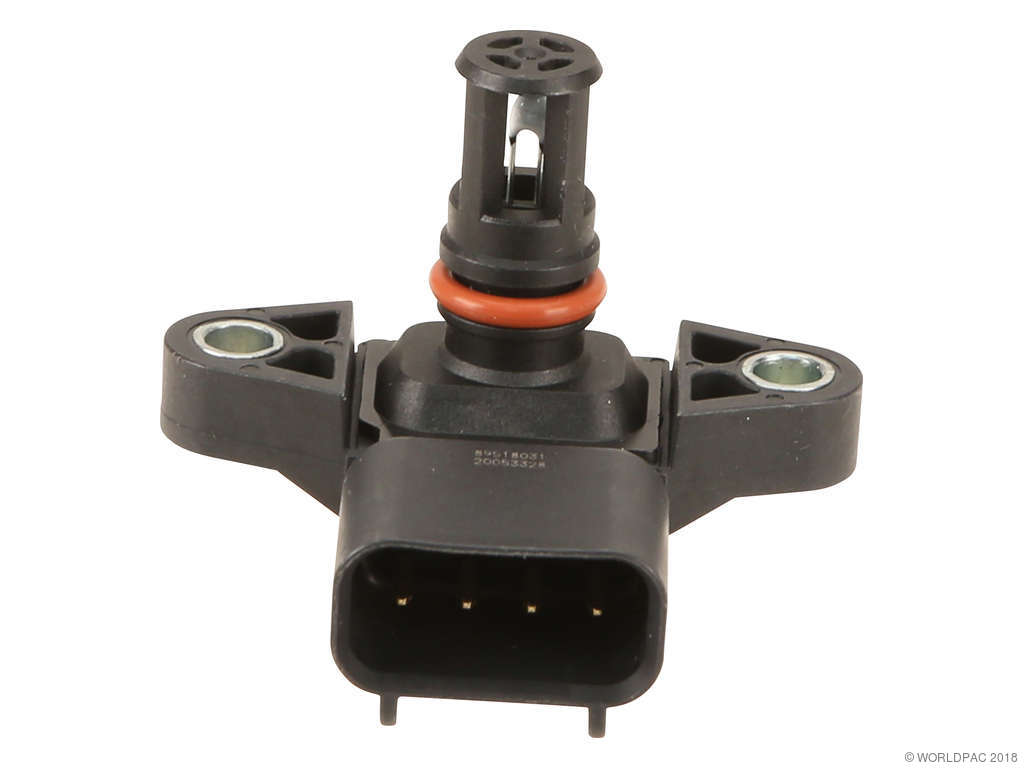
- Manifold Absolute Pressure and Temperature (MAPT) Sensor
(OEM #AA5Z-9F479-E)— This is the specific part identified by Ford in TSB 19-2212 as the cause of code P0108 on this vehicle. It is a combined pressure and temperature sensor.
Trusted brands: Motorcraft (CX-2619), Bosch, Delphi, Standard Motor Products
OEM price range: $90-$160
Aftermarket price range: $50-$120
Related Codes That Often Appear With This One
- P0107 — This code for 'MAP/BARO Circuit Low' is also caused by the same failing MAPT sensor. The sensor can fail by sending a signal that is either too high (P0108) or too low (P0107). Both are cited in the same Ford TSB.
- P0109 — This code for 'MAP/BARO Circuit Intermittent' is also listed in TSB 19-2212 as a common companion code caused by the same faulty MAPT sensor sending erratic signals.
Technical Service Bulletins (TSBs) & Recalls
- TSB 19-2212: Supersedes TSB 19-2183. Identifies a faulty MAPT sensor as the cause for DTCs P0107, P0108, and/or P0109, leading to a lack of power and various warning messages on 2018-2019 Explorer, Flex, Taurus, and Lincoln MKT with the 3.5L EcoBoost engine.
- TSB 19-2183: The earlier version of the bulletin with the same core information, providing a diagnostic step to compare MAP and BARO PID values.
Platform-Specific Known Issues
- A Ford Technical Service Bulletin (TSB 19-2212, superseding 19-2183) directly addresses this code on 2018-2019 Explorers with the 3.5L EcoBoost engine, identifying a faulty MAPT sensor as the cause.
- Owner Experience: An owner on YouTube documented the repair, describing the symptoms as "sluggishness from a stop" that could feel like a transmission issue. The video confirms the ease of replacement with a single T20 Torx screw after popping off the engine cover.
Mechanic-Grade Diagnostic Values
- MAP Sensor 5V Reference Wire Voltage — expected: 4.9V to 5.1V with key on, engine off.. Failure: Voltage is near 0V or significantly below 4.9V, indicating a wiring or PCM issue.
- MAP Sensor Ground Circuit Voltage/Resistance — expected: Less than 0.1V (100mV) drop when testing voltage, or less than 0.5 Ω resistance to a known good ground.. Failure: Voltage significantly higher than 0.1V or high resistance, indicating a poor ground connection.
- MAP Sensor Signal Voltage (KOEO) — expected: For turbo applications, between 2.0V and 3.0V, and should match the BARO sensor reading.. Failure: Voltage is > 4.96V, which will trigger the P0108 DTC.
- MAP Sensor Signal Voltage (Engine Idling) — expected: Approximately 1.0V to 2.0V.. Failure: Voltage remains high, near the KOEO reading, or does not drop when the engine starts.
Scan Tool Commands That Help
- Ford IDS / FORScan / Capable Scan Tool: Reset Keep Alive Memory (KAM) — After replacing the MAPT sensor or performing other related repairs, resetting the KAM clears the PCM's adaptive learning tables. This forces the module to relearn idle, fuel trims, and sensor strategies with the new, functioning part, preventing potential lingering driveability issues.
Wiring & Ground Locations
- MAP Sensor Connector (C134) — The MAPT sensor is on top of the intake manifold. Its connector is C134, a 20-pin connector located on the left front fender apron, which can be susceptible to water intrusion.. This is the primary connector for the MAPT sensor circuit. Damage, corrosion, or water intrusion at this specific connector can cause a P0108 code even if the sensor itself is good.
- Engine Harness Chafe Point — While a recall (19S32) was for 2020+ models, a known chafe point for Ford engine harnesses is near the A/C compressor pulley.. If the wiring harness rubs against the A/C pulley or another bracket, it can short the 5V reference or signal wire to power or ground, causing P0108 or related codes. A visual inspection of the harness routing near moving components is a valid, though unlikely, diagnostic step if a new sensor doesn't fix the issue.
- Sensor Ground (G104) — On some Ford engines, a common sensor ground point is G104, located at the center rear of the engine on the intake manifold.. A loose or corroded ground at this location can affect multiple sensors, including the MAP sensor, causing erratic or biased readings that could trigger a P0108 code.
OEM Part Supersession History
2R3Z-9F479-AA→AA5Z-9F479-A— Part revision or manufacturer change.AA5Z-9F479-A→AA5Z-9F479-E— This is the current, most updated part number specified in TSB 19-2212 to resolve the P0107/P0108/P0109 issues. It is also sold under the Motorcraft number CX-2619.
Heads up: While older parts may physically fit, using the latest 'E' revision is critical to ensure the fix is permanent, as it was released to address the high failure rate of previous versions.
Diagnostic Flowchart
Real Owner Stories
Aggregated from forums and TSBs cited above. Mileages and costs reflect what owners reported in those sources.
2018 Ford Explorer Sport 3.5L EcoBoost — 19500 miles
Symptoms: Traction control, hill decent, terrain management, abs, shifts hard, shuddering, stalling, check engine light. Codes P0106, P0107, P0108, P0109.
What fixed it: Replaced the PCM/ECU. The owner suspected a shorted PCM due to water intrusion after the vehicle sat at a dealer with no hood on it. Replacing the MAP sensor based on the TSB did not correct the issue.
Source hint: Ford Truck Enthusiasts Forums
2018 Ford Explorer 3.5L EcoBoost
Symptoms: Vehicle stalling in the middle of an intersection, 'Service AdvanceTrac' message, and code P0107 (grouped with P0108 in the TSB).
What fixed it: Replaced the MAPT sensor (Part No. AA5Z-9F479-E) as advised by Ford TSB 19-2212.
Source hint: Go-Parts / NHTSA ODI #11351923
2019 Ford Explorer Sport 3.5L EcoBoost — 20000 miles
Symptoms: Recurring MAPT sensor failure.
What fixed it: Replaced the MAPT sensor (this was the owner's second replacement at only 20k miles).
Source hint: Go-Parts / Reddit
Ford Explorer 3.5L EcoBoost
Symptoms: Sluggishness from a stop that felt like a transmission issue.
What fixed it: Replaced the MAPT sensor (AA5Z-9F479-E) by removing the engine cover and taking out a single T20 Torx screw.
Source hint: YouTube - Big Ben's Cars & Cycles
Related OBD-II Codes
Frequently Asked Questions
Is there a Technical Service Bulletin (TSB) for code P0108 on the 2018-2019 Ford Explorer 3.5L EcoBoost?
Why is my Explorer showing a 'Service AdvanceTrac' and 'Hill Start Assist Not Available' message along with code P0108?
How can I test if the MAPT sensor is bad on my 3.5L EcoBoost?
Where is the MAPT sensor located on the 2018-2019 Explorer 3.5L EcoBoost?
What is the correct part number to fix the P0108 code on this vehicle?
I replaced the MAPT sensor per the TSB, but I still have P0108, shuddering, and hard shifts. What else could it be?
Helpful Videos

We Have This Part in Stock



The information in this article is provided for general reference and educational purposes only. Vehicle specifications, procedures, and part compatibility can vary by production date, trim level, and region. Always consult your vehicle's factory service manual and verify part numbers before purchasing or performing repairs. Safety-critical components such as airbags, seat belts, and braking systems should be installed by a qualified professional.
- Ford Explorer:
- 🧭 Diagnostic Flowchart
- 🎬 Helpful Videos
- 🛍️ Shop This Part
- What's Unique About the 2018-2019 Ford Explorer
- Symptoms You May Notice
- Most Likely Causes
- Rare But Worth Checking
- Diagnosis Steps
- Parts You'll Likely Need
- Related Codes That Often Appear With This One
- Technical Service Bulletins (TSBs) & Recalls
- Platform-Specific Known Issues
- Mechanic-Grade Diagnostic Values
- Scan Tool Commands That Help
- Wiring & Ground Locations
- OEM Part Supersession History
- Real Owner Stories
- 2018 Ford Explorer Sport 3.5L EcoBoost — 19500 miles
- 2018 Ford Explorer 3.5L EcoBoost
- 2019 Ford Explorer Sport 3.5L EcoBoost — 20000 miles
- Ford Explorer 3.5L EcoBoost
- Related OBD-II Codes
- Frequently Asked Questions
- 🎟️ Get 5% Off