

P0108 on 2018-2019 Ford Taurus: Causes and Fixes for MAP Sensor Circuit High
On a 2018-2019 Ford Taurus, especially with the 3.5L EcoBoost engine, the P0108 code is almost always caused by a faulty Manifold Absolute Pressure and Temperature (MAPT) sensor, as documented in Ford Technical Service Bulletins 19-2183 and 19-2212. Replacing the sensor is a straightforward fix, with the part costing around $100-$160 for an OEM Motorcraft replacement.
- P0108 on a 2018-2019 Taurus is very likely a bad MAPT sensor, a known issue confirmed by Ford TSBs 19-2183 and 19-2212.
- Symptoms are more than just a check engine light; they include a wrench light, disabled traction control, and a noticeable lack of power.
- Diagnosis is straightforward: use a scan tool to compare MAP and BARO PIDs with the key on, engine off. A significant difference points to a bad sensor.
- The same issue affects other 2018-2019 Ford and Lincoln vehicles with the 3.5L EcoBoost, including the Explorer, Flex, and MKT.
- The fix is a simple, DIY-friendly replacement of the MAPT sensor (Part No. AA5Z-9F479-E) located on the intake manifold.
What's Unique About the 2018-2019 Ford TAURUS
For this specific generation of Ford Taurus with the 3.5L EcoBoost engine, the P0108 code is a known issue. Ford released Technical Service Bulletin (TSB) 19-2183, which was later superseded by TSB 19-2212, specifically addressing this code along with P0107 and P0109. The bulletins directly point to a faulty Manifold Absolute Pressure and Temperature (MAPT) sensor as the likely culprit for a cluster of symptoms including lack of power and various dash warnings. This makes diagnosis much more direct than on other vehicles where the cause might be more ambiguous.
Diagnostic Flowchart
Tap your situation to follow the diagnostic path that matches what you're seeing on this vehicle.
Symptoms You May Notice
- Illuminated Check Engine Light (Malfunction Indicator Lamp)
- Powertrain Malfunction (Wrench) Lamp illuminated.
- "Service AdvanceTrac" message on the dash.
- "Hill Start Assist Not Available" message.
- Significant lack of power or poor acceleration.
- Rough or unstable idle.
- Reduced fuel economy.
- Hesitation or engine stumbling.
- Black smoke from the exhaust.
- Hard starting or stalling.
- Replacing the throttle body. Owners sometimes replace the throttle body when experiencing limp mode and multiple warning lights, but if code P0108 is present, the MAPT sensor is the more likely culprit.
- Searching for a vacuum leak, which more commonly causes a P0106 (Range/Performance) or P0107 (Low Input) code, not a P0108 (High Input).
Most Likely Causes
- Faulty Manifold Absolute Pressure and Temperature (MAPT) Sensor 🔴 High Probability → Shop Manifold Absolute Pressure Sensor Ford issued TSB 19-2183 and TSB 19-2212 specifically identifying a faulty MAPT sensor as the cause for this code on this vehicle and engine combination.
How to confirm: With the key on and engine off (KOEO), use a Ford-specific scan tool to compare the MAP (PRESS) PID value to the Barometric Pressure (BARO), TCBP (PRESS), and TURBO INLET (PRESS) PIDs. If the MAP sensor's reading differs from the others by more than 10.35 kPa (1.5 psi), the sensor is faulty and should be replaced per the TSB.
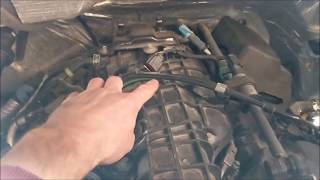
Typical fix: Replace the MAPT sensor. The sensor is located on top of the intake manifold and is typically held in by a single bolt, making for a quick replacement. 🎬 See this quick walkthrough on replacing a faulty MAP sensor.
Est. part cost: $100 - $161 - Wiring or Connector Issue 🟡 Medium Probability Vibrations and heat in the engine bay can cause wiring to fray or the connector to become loose or corroded over time. An owner of an F-150 with a similar issue found frayed wires at the connector to be the root cause.
How to confirm: Visually inspect the wiring harness and connector for the MAPT sensor for any signs of damage, corrosion, or looseness. Use a multimeter to check for a stable 5-volt reference, a good ground, and signal integrity at the sensor connector.
Typical fix: Repair the damaged section of the wiring harness or clean/replace the connector.
Est. part cost: $5 - $50
Rare But Worth Checking
- Clogged Catalytic Converter: A severely clogged catalytic converter can create excessive backpressure in the intake manifold, leading to an abnormally high MAP sensor reading. This would typically be accompanied by other exhaust-related codes and a more severe loss of power.
- Faulty Powertrain Control Module (PCM): → Shop Engine Control Module (ECM) In very rare cases, the PCM's internal circuit that processes the MAP sensor signal can fail. This should only be considered after the sensor and wiring have been proven to be good.
Diagnosis Steps
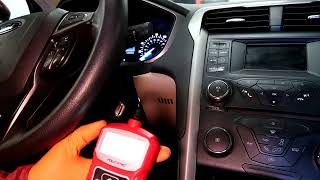
- Connect an OBD-II scanner to verify the P0108 code and check for any other related codes like P0107 or P0109.
- Check for applicable Technical Service Bulletins. For this vehicle, TSB 19-2183 and its successor TSB 19-2212 are highly relevant.
- Visually inspect the MAPT sensor, its electrical connector, and the surrounding wiring for any obvious damage, corrosion, or loose connections.
- Using a scan tool with live data capability, turn the key to the 'On' position without starting the engine (KOEO). Per TSB 19-2183, compare the 'MAP (PRESS)' PID value to the 'BARO' PID value. They should be nearly identical at the same altitude. If the values are off by more than 1.5 psi (10.35 kPa), the MAPT sensor is the likely cause and should be replaced.
- If the sensor readings seem plausible, start the engine and monitor the MAP sensor reading at idle and while applying throttle. The reading (voltage or frequency) should change smoothly with engine vacuum.
- If the sensor and its readings are suspect, test the wiring. Disconnect the sensor and check for a 5-volt reference signal, a proper ground, and continuity on the signal wire back to the PCM.
- If the wiring is confirmed to be good and the sensor's readings are incorrect, replace the MAPT sensor.
- After replacement, clear the codes with the scanner and perform a test drive to ensure the issue is resolved.
Parts You'll Likely Need
- Manifold Absolute Pressure and Temperature (MAPT) Sensor
(OEM #AA5Z-9F479-E)— This is the specific part identified as faulty in Ford's TSB 19-2183 for this exact issue. It is the most probable cause of the P0108 code on this vehicle.
Trusted brands: Motorcraft
OEM price range: $99-$161
Aftermarket price range: $35-$90
Related Codes That Often Appear With This One
- P0107 — This code for 'MAP Circuit Low Input' is also mentioned in TSB 19-2183 and 19-2212, indicating the faulty sensor can fail by sending either a high or low signal.
- P0109 — This code for 'MAP Circuit Intermittent' is also listed in TSB 19-2183 and 19-2212, as the failing sensor's signal can be erratic.
Technical Service Bulletins (TSBs) & Recalls
- TSB 19-2212: Supersedes TSB 19-2183. Addresses an illuminated MIL, wrench lamp, and various warning messages with DTCs P0107, P0108, and/or P0109, caused by a faulty MAPT sensor on 2018-2019 Taurus, Explorer, Flex, and MKT models with the 3.5L EcoBoost engine.
- TSB 19-2183: The original bulletin outlining the known MAPT sensor fault, symptoms, and diagnostic procedure.
Platform-Specific Known Issues
- TSB 19-2183 / 19-2212: Ford identified an issue on 2018-2019 Taurus, Explorer, Flex, and Lincoln MKT models with the 3.5L EcoBoost engine where a faulty MAPT sensor could cause a lack of power and trigger DTCs P0107, P0108, and/or P0109. The official fix is to diagnose and replace the sensor. 🎬 Watch: Step-by-step MAP sensor replacement for the 3.5L EcoBoost.
Mechanic-Grade Diagnostic Values
- MAP Sensor Signal Voltage at Idle — expected: 1.4V - 1.8V. Failure: A voltage reading at or above 4.4V - 4.5V will trigger P0108.
- MAP Sensor Signal Voltage (KOEO) — expected: Approximately 5V.. Failure: Voltage significantly lower than 5V may indicate a wiring issue.
- MAP Sensor Connector 5V Reference — expected: ~5V. Failure: No voltage indicates a problem with the PCM or the wiring between the PCM and the sensor.
- MAP Sensor Response to Vacuum (Bench Test) — expected: At 0 inHg of vacuum, voltage should be 3.9V - 4.7V. At 18-20 inHg of vacuum, voltage should drop to 0.8V - 1.5V.. Failure: Sensor voltage does not change smoothly or stay within these ranges when vacuum is applied and released.
- MAP Sensor Voltage During Catalyst Test (from 2000 RPM) — expected: At a steady 2000 RPM, voltage should be ~1.2V - 1.6V. When snapped to WOT, it should rise to ~3.8V - 4.2V and return to the idle value in less than 3 seconds.. Failure: If it takes longer than 3 seconds for the voltage to return to the idle value after snapping the throttle, the catalytic converter may be restricted.
Scan Tool Commands That Help
- Advanced OBD-II Scanner (e.g., Ford IDS, FORScan): Graph MAP Sensor PID vs. RPM — Used to visually confirm if the sensor is responding smoothly to throttle changes or if it is sticking, lagging, or providing erratic readings.
- Advanced OBD-II Scanner: Cranking Vacuum Test (Graph MAP PID) — With the engine in 'clear flood' mode (throttle fully depressed before cranking), crank the engine and graph the MAP sensor reading. A healthy engine should show a consistent drop in pressure (increase in vacuum) while cranking. This can be used to spot major sealing issues or incorrect cam/crank timing.
Wiring & Ground Locations
- Engine Harness Ground — There is a ground stud on the back side of the left (driver's side) cylinder head on the 3.5L EcoBoost engine.. A poor engine ground can cause floating or incorrect readings from various sensors, including the MAP sensor, that use the engine block as a ground reference.
- Main Chassis/Body Grounds — On related Ford platforms like the F-150, key factory ground points are located on the chassis next to the battery on the passenger side, and a body-to-chassis ground is located under the passenger front door area.. The PCM and its sensor circuits rely on solid chassis grounds. Corrosion or looseness at these points can introduce electrical noise and voltage offsets, potentially causing a P0108 code.
OEM Part Supersession History
2R3Z-9F479-AA→AA5Z-9F479-A, then AA5Z-9F479-E— Part has been revised and updated over time for improved reliability or to consolidate parts across different vehicle lines.
Heads up: Ford part numbers can be decoded. The core number '9F479' designates a MAP sensor. The prefix (e.g., 'AA5Z') indicates the vehicle line it was designed for ('A' for full-size car, 'A5' for Lincoln MKS) and year of design. It is common for a part designed for one vehicle (like a Lincoln MKS) to become the official service replacement for another (like a Taurus or Mustang) if it is functionally identical or superior. Do not be alarmed if a replacement OEM part has a different prefix than the original, as long as the dealership or parts catalog confirms it is the correct supersession.
Helpful Videos


The information in this article is provided for general reference and educational purposes only. Vehicle specifications, procedures, and part compatibility can vary by production date, trim level, and region. Always consult your vehicle's factory service manual and verify part numbers before purchasing or performing repairs. Safety-critical components such as airbags, seat belts, and braking systems should be installed by a qualified professional.
- Ford TAURUS:
- 🧭 Diagnostic Flowchart
- 🎬 Helpful Videos
- What's Unique About the 2018-2019 Ford TAURUS
- Symptoms You May Notice
- Most Likely Causes
- Rare But Worth Checking
- Diagnosis Steps
- Parts You'll Likely Need
- Related Codes That Often Appear With This One
- Technical Service Bulletins (TSBs) & Recalls
- Platform-Specific Known Issues
- Mechanic-Grade Diagnostic Values
- Scan Tool Commands That Help
- Wiring & Ground Locations
- OEM Part Supersession History
- 🎟️ Get 5% Off