

P0108 on 2015-2019 Ford Transit 3.5L EcoBoost: MAP Sensor Causes and Fixes
On a 2015-2019 Ford Transit with the 3.5L EcoBoost, code P0108 is most often caused by a faulty Manifold Absolute Pressure (MAP) sensor. Ford has acknowledged this issue in TSBs for other vehicles with the same engine. Replacing the sensor is a straightforward DIY job requiring a T20 Torx bit, with the part costing between $40 and $100.
- P0108 on a 3.5L EcoBoost Transit almost always points to a problem with the MAP sensor on the intake manifold, a failure acknowledged by Ford via TSBs for platform mates.
- Symptoms are significant and affect drivability, including sluggish performance, potential stalling, and dashboard warnings like the 'Wrench Light' and 'Service AdvanceTrac'.
- Diagnosis is straightforward using a scan tool to compare MAP pressure to other pressure PIDs with the key on, engine off.
- The repair is very DIY-friendly, requiring only basic tools (like a T20 Torx driver) and can be completed in under 30 minutes.
What's Unique About the 2015-2019 Ford Transit
The 3.5L EcoBoost engine is a twin-turbocharged, direct-injection engine that relies heavily on accurate pressure readings for performance and efficiency. Unlike naturally aspirated engines, the EcoBoost uses multiple pressure sensors: one on the intake manifold (the MAPT sensor relevant to P0108), one on the charge pipe (TCBP), and one at the turbo inlet. Due to the positive crankcase ventilation (PCV) system design, oil-laden vapor is routed into the turbocharger inlet under boost conditions. This oil vapor can travel through the intercooler and intake tract, eventually contaminating the MAPT sensor on the intake manifold, leading to faulty readings and eventual failure. This is a widely documented failure pattern on the EcoBoost platform.
Symptoms You May Notice
- Check Engine Light is on
- Powertrain Malfunction (Wrench) Light may be on
- Rough or unstable idle
- Poor engine performance and lack of power, especially sluggishness from a stop
- Hesitation during acceleration
- Reduced fuel economy
- Black smoke from the exhaust (due to rich fuel mixture)
- Engine stalling, especially when coming to a stop
- Service AdvanceTrac message on the dash
- Hill Start Assist Not Available message
- Replacing the Mass Airflow (MAF) sensor. The 3.5L EcoBoost uses MAP sensors for its primary load calculations, not a MAF sensor like many other engines. The symptoms can be similar, but the fault code P0108 points directly to the MAP sensor circuit.
Most Likely Causes
- Faulty Manifold Absolute Pressure (MAP) Sensor 🔴 High Probability → Shop Manifold Absolute Pressure Sensor The MAP sensor on the 3.5L EcoBoost is highly susceptible to contamination from oil and fuel vapors from the PCV system, which degrades the sensor over time. Ford issued TSB 19-2212 for this exact issue on platform mates, confirming a high failure rate.
How to confirm: With the key on and engine off, use a scan tool to compare the MAP (PRESS) PID value to the BARO (PRESS), TCBP (PRESS), and TURBO INLET (PRESS) PIDs. They should all be within 1.5 psi (10.35 kPa) of each other. If the MAP reading is significantly different, the sensor is faulty.
Typical fix: Replace the MAP sensor located on top of the intake manifold. It is held in by a single T20 Torx screw.
Est. part cost: $40-$100 - Wiring or Connector Issue 🟡 Medium Probability The wiring harness in the engine bay is exposed to heat and vibration, which can lead to chafing, breaks, or corrosion in the connector pins over time. A user on a forum suspected this after a mechanic had worked in the area.
How to confirm: Visually inspect the MAP sensor connector and wiring for any signs of damage, corrosion, or loose pins. With the connector unplugged and key on, use a multimeter to check for a 5-volt reference signal and a good ground at the connector. A technician in a YouTube video demonstrates this test on a 2016 Transit.
Typical fix: Repair the damaged section of wire or clean/replace the connector pigtail.
Est. part cost: $10-$30
Rare But Worth Checking
- Vacuum Leak or Cracked PCV Hose: A significant vacuum leak can cause the MAP sensor to read incorrectly. A user on the Ford Transit USA Forum with a 3.5L EcoBoost chased a similar rich condition code (P0172) and found the problem was a small, hard-to-see crack in the plastic PCV hose elbow where it connects to the intake manifold, after already replacing the MAP sensors without success.
- Clogged Catalytic Converter: A severely clogged catalytic converter can create excessive backpressure in the intake manifold, leading to an abnormally high MAP sensor reading. This is usually accompanied by other symptoms like a significant loss of power and potentially a sulfur-like smell from the exhaust.
- Faulty Powertrain Control Module (PCM): → Shop Engine Control Module (ECM) This is the least likely cause. The PCM is responsible for interpreting the sensor's signal. A failure within the PCM's internal circuitry could cause it to misread the data, but all other possibilities should be exhausted before considering PCM replacement.
Diagnosis Steps
- Connect an OBD-II scanner and confirm that P0108 is the primary code. Note any other codes present, such as P0107 or P0109.
- With the key on and engine off (KOEO), view live data on the scanner. Compare the 'MAP (PRESS)' PID to the 'BARO (PRESS)' and 'TCBP (PRESS)' PIDs. Per TSB 19-2183, they should be within 1.5 psi (10.35 kPa) of each other. If the MAP reading is high, the sensor is highly suspect.
- Visually inspect the MAP sensor, which is located on the top of the plastic intake manifold, driver's side. Check its electrical connector for corrosion, damage, or loose pins. Inspect the nearby wiring for any signs of fraying or damage.
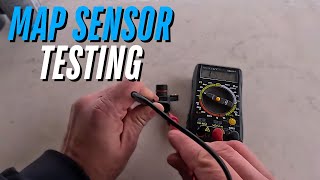
- If the wiring looks good, test the circuit. Disconnect the sensor. 🎬 Watch: How to test a MAP sensor with a multimeter or scanner. With the key on, use a multimeter to verify you have a 5-volt reference on one wire and a solid ground on another.
- If the reference voltage and ground are present, the sensor itself is the most likely cause of the problem.
- If reference voltage or ground is missing, the problem lies in the wiring between the sensor and the PCM, or a faulty PCM (which is rare). Check for continuity on the ground wire to a known good chassis ground.
- Before replacing the sensor, you can try cleaning it with a dedicated electronics or MAF sensor cleaner. Sometimes oil buildup is the sole cause. If cleaning doesn't resolve the issue, replacement is necessary.
- After replacement, clear the codes with the scan tool and perform a test drive to ensure the issue is resolved.
Parts You'll Likely Need
- Manifold Absolute Pressure and Temperature (MAPT) Sensor
(OEM #AA5Z-9F479-E)— This is the component that fails most frequently to cause a P0108 code on this engine, as documented in TSB 19-2212 for the same engine on other Ford platforms.
Trusted brands: Motorcraft, Bosch, Standard Motor Products
OEM price range: $60-$100
Aftermarket price range: $40-$75
Related Codes That Often Appear With This One
- P0107 — P0107 is 'MAP Sensor Circuit Low Input'. Seeing both P0107 and P0108 intermittently can indicate a failing sensor or a wiring issue causing the signal to fluctuate wildly between open and shorted conditions. TSB 19-2212 covers both codes.
- P0109 — P0109 is 'MAP Sensor Circuit Intermittent'. This code often appears alongside P0107 or P0108, pointing towards a sensor that is failing or has a poor electrical connection. TSB 19-2212 also covers this code.
Technical Service Bulletins (TSBs) & Recalls
- TSB 19-2212: Supersedes 19-2183. 3.5L EcoBoost - Various Warning Indicators/Lack Of Power - DTCs P0107, P0108 And/Or P0109.
- TSB 19-2183: 3.5L EcoBoost - Various Warning Indicators/Lack Of Power - DTCs P0107, P0108 And/Or P0109.
Platform-Specific Known Issues
- Ford issued Technical Service Bulletin (TSB) 19-2212, which supersedes TSB 19-2183. It applies to 2018-2019 Explorer, Flex, Taurus, and MKT models with the 3.5L EcoBoost engine for DTCs P0107, P0108, and P0109. It identifies a faulty MAPT sensor as the cause 🎬 See this breakdown of common causes and fixes for code P0108. and recommends replacement. While the Transit is not explicitly listed, the engine, sensor part number (AA5Z-9F479-E), and symptoms are identical, making this TSB highly relevant.
Mechanic-Grade Diagnostic Values
- MAP Sensor 5V Reference Voltage — expected: Approximately 5.0 Volts DC. Failure: No voltage or significantly lower voltage indicates a wiring or PCM issue.
- MAP Sensor Signal Voltage (KOEO - Key On, Engine Off) — expected: Approximately 4.5V to 5.0V (reading atmospheric pressure).. Failure: Voltage significantly lower than 4.5V or 0V suggests a sensor or wiring fault.
- MAP Sensor Signal Voltage (Engine Idling) — expected: 2.0V to 2.5V for turbocharged models.. Failure: A P0108 is set when voltage remains above the expected range, often over 4.4V-4.5V at idle.
- MAP Sensor Signal Frequency (Older Fords, KOEO) — expected: Approximately 158 Hz at sea level.. Failure: A reading that is significantly different or does not change with vacuum applied.
- Wiring Continuity Test — expected: Less than 0.5 Ohms. Failure: A reading of 'OL' (Open Loop) indicates a break in the wire. A reading higher than 0.5 Ohms indicates high resistance.
Scan Tool Commands That Help
- Ford IDS (Integrated Diagnostic System): Datalogger - PID comparison — To simultaneously monitor the MAP, BARO, and TCBP sensor values during KOEO and KOER tests to see if the MAP sensor reading is skewed compared to the others, which is a primary confirmation method per Ford TSBs.
Wiring & Ground Locations
- Main Engine/Chassis Ground — On the MK7/V363 platform, there is a primary ground strap from the gearbox to the inner wing below the under-hood fuse box.. A poor main engine ground can cause floating voltages and erratic sensor readings across the entire engine management system, including the MAP sensor. Ensuring this connection is clean and tight is a crucial preliminary step.
- B-Pillar Ground Point — A factory ground point is located on the B-Pillar, often near the D-ring.. While not directly for the MAP sensor, this is a known, reliable chassis ground point. When testing the MAP sensor's ground wire for continuity, this is a good reference point to use with a multimeter.
- MAP Sensor Connector Pins — At the sensor on top of the intake manifold.. Testing must be done at the correct pins. Pin assignments can vary, but generally consist of a 5V reference wire, a signal wire, and a ground wire. A wiring diagram is needed to confirm which pin is which for accurate testing.
Real Owner Repair Stories
- Ford F150 Forum (2011 Ford F-150 3.5L EcoBoost) — Uneven running at wide-open throttle, multiple MAP-related codes (P0098, P0106, P0108) appeared after replacing the top MAP sensor.
❌ Tried (didn't work) Replacing spark plugs and coil packs, Replacing the top MAP sensor (which triggered the codes), Reinstalling the old MAP sensor, Replacing the charge pipe MAP sensor
✅ What actually fixed it The owner found frayed wires on the Turbocharger Control Valve (TCV) connector. After repairing that connector, the issue was resolved. This highlights that wiring issues on nearby components can sometimes induce faults or symptoms that appear to be MAP sensor-related.
OEM Part Supersession History
2R3Z-9F479-AA→AA5Z-9F479-A— Part revision and update by Ford.AA5Z-9F479-A→AA5Z-9F479-E— This is the current, most updated part number recommended by Ford TSBs to resolve the P0108 issue. It is also sold under service part numbers CX-2228 and CX-1876.
Heads up: Using older, superseded part numbers may lead to a repeat failure, as the TSBs point to a flaw in the original sensor design that the newer revisions aim to correct.
Diagnostic Flowchart
Real Owner Stories
Aggregated from forums and TSBs cited above. Mileages and costs reflect what owners reported in those sources.
2017 Ford Transit — 100000 miles
Symptoms: Struggling to accelerate, has a hard time getting past 2000 rpm. Threw codes P0401 and P0108.
What fixed it: The user tried adding CataClean to the fuel tank, which made a noticeable difference but did not fix the acceleration issue. The final fix was not reported.
Source hint: Reddit r/MechanicAdvice thread titled 'Códigos P0365 & P0369 después de usar CataClean'
2016 Ford Transit
Symptoms: Check engine light on with code P0108.
What fixed it: Diagnosed the MAP sensor fault by disconnecting the sensor to test the circuit.
Source hint: Pine Hollow Auto Diagnostics YouTube comment/video
2016 Ford Transit 3.5L EcoBoost
Symptoms: Getting rich codes for both banks (P0172 and P0175).
What fixed it: Replaced the MAF and MAP sensors with no luck. The actual cause was discovered to be a cracked PCV hose at the intake manifold.
Source hint: FordTransitUSAForum.com thread titled 'P0172 and P0175 - Both Banks Rich'
Ford F-150 5.0L
Symptoms: P0108 and P0109 codes present. Replacing the MAP sensor didn't fix the issue.
What fixed it: Conducted extensive troubleshooting including checking wire continuity back to the PCM and investigating ground points on the firewall.
Source hint: F150forum.com thread titled 'P0108 P0109 ground troubleshooting'
Related OBD-II Codes
Frequently Asked Questions
Does TSB 19-2212 apply to my 2015-2019 Ford Transit 3.5L EcoBoost?
Why is my Transit blowing black smoke with code P0108?
Where is the MAP sensor located on the 3.5L EcoBoost Transit?
Why did my Transit display 'Service AdvanceTrac' and 'Hill Start Assist Not Available' messages along with P0108?
Can a PCV issue cause MAP sensor codes on my Transit?
How can I test if the MAP sensor is bad using a scan tool?
Helpful Videos
We Have This Part in Stock


The information in this article is provided for general reference and educational purposes only. Vehicle specifications, procedures, and part compatibility can vary by production date, trim level, and region. Always consult your vehicle's factory service manual and verify part numbers before purchasing or performing repairs. Safety-critical components such as airbags, seat belts, and braking systems should be installed by a qualified professional.
- Ford Transit:
- 🧭 Diagnostic Flowchart
- 🎬 Helpful Videos
- 🛍️ Shop This Part
- What's Unique About the 2015-2019 Ford Transit
- Symptoms You May Notice
- Most Likely Causes
- Rare But Worth Checking
- Diagnosis Steps
- Parts You'll Likely Need
- Related Codes That Often Appear With This One
- Technical Service Bulletins (TSBs) & Recalls
- Platform-Specific Known Issues
- Mechanic-Grade Diagnostic Values
- Scan Tool Commands That Help
- Wiring & Ground Locations
- Real Owner Repair Stories
- OEM Part Supersession History
- Real Owner Stories
- 2017 Ford Transit — 100000 miles
- 2016 Ford Transit
- 2016 Ford Transit 3.5L EcoBoost
- Ford F-150 5.0L
- Related OBD-II Codes
- Frequently Asked Questions
- 🎟️ Get 5% Off