

P0108 on 2011-2016 Honda CR-V: MAP Sensor Circuit High Voltage Causes and Fixes
For a 2011-2016 Honda CR-V, code P0108 almost always points to a failed Manifold Absolute Pressure (MAP) sensor. The ECU logs this code when the sensor's voltage signal exceeds the normal operating range, typically going above 4.5 volts. Replacement is very easy and typically costs between $30 for an aftermarket part and $100 for an OEM sensor. A critical distinction exists for 2015-2016 models which use a different 'Earth Dreams' direct-injection engine (K24W9), though the MAP sensor and diagno
- P0108 on a 2011-2016 CR-V means the MAP sensor circuit is sending a high voltage signal, typically over 4.5V.
- The most likely cause is a failed MAP sensor, which is an easy and affordable DIY replacement, often only requiring an 8mm socket.
- Symptoms include a rough idle, poor fuel economy, black exhaust smoke, and hesitation or stalling.
- Before replacing the sensor, quickly check its electrical connector for bent pins or corrosion and surrounding vacuum hoses for obvious issues.
- The repair is the same for both the 3rd gen (2011) and 4th gen (2012-2016) models covered in this range, as they use the same engine architecture and part number.
What's Unique About the 2011-2016 Honda CR-V
The 2011-2016 CR-V, equipped with the reliable K-series 2.4L engine, uses a MAP sensor-based engine management system. Unlike some vehicles that use a Mass Airflow (MAF) sensor, the CR-V relies heavily on the MAP sensor for load calculation. This makes the system very sensitive to the MAP sensor's signal quality. While the sensor itself is a common failure point across many Honda models sharing this engine architecture, its accessibility on the CR-V's intake manifold makes diagnosis and replacement a very straightforward DIY job, often requiring only an 8mm socket and 15-30 minutes. For 2015-2016 models with the K24W9 'Earth Dreams' engine, the MAP sensor remains the primary load sensor and the diagnostic principles are the same.
Generation note: The 2011-2016 range covers the end of the 3rd generation (2011) and the entire 4th generation (2012-2016). The 2011 model uses the K24Z6 engine, 2012-2014 models use the K24Z7, and the 2015-2016 models received a major update to the K24W9 'Earth Dreams' direct-injection engine. Despite these engine changes, the cause, diagnosis, and repair for P0108 are virtually identical as they all use the same MAP sensor part number (37830-RNA-A01) and diagnostic logic.
Symptoms You May Notice
- Check Engine Light is on
- Rough or unstable idle
- Poor engine performance and sluggish acceleration
- Reduced fuel economy
- Hesitation or stalling, especially at low speeds or when coming to a stop
- Black smoke from the exhaust, indicating a rich fuel condition
- Engine may be hard to start
- Vehicle may enter 'limp mode' and refuse to rev past a certain RPM (e.g., 3000 RPM)
- Replacing the throttle body when only the MAP sensor is at fault.
- Replacing oxygen sensors, as a rich or lean condition can be a symptom, not the root cause.
- Assuming an expensive intake manifold replacement is needed without first diagnosing the sensor and wiring.
Most Likely Causes
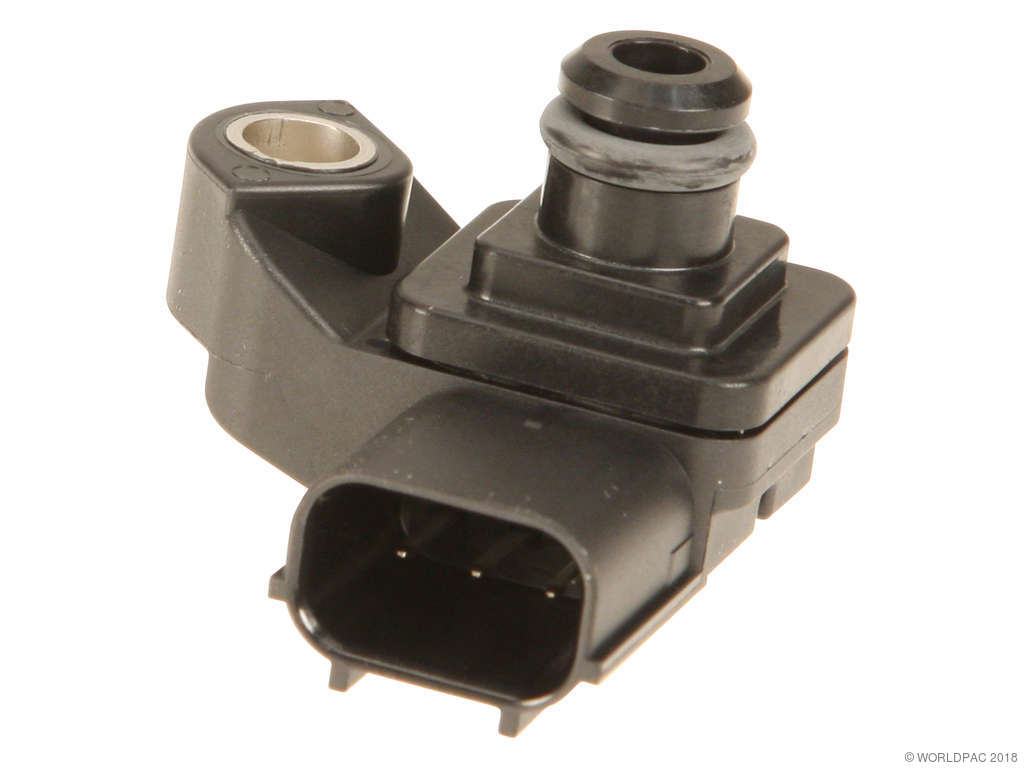
- Faulty MAP Sensor 🔴 High Probability → Shop Manifold Absolute Pressure Sensor The sensor is a common failure item due to age, heat cycles, and engine vibration. It's the most frequent cause for P0108 on this platform and many other Hondas.
How to confirm: With the key on and engine off, use a scan tool to check the MAP sensor voltage. It should be above the specified threshold, often 4.5V. A multimeter can also be used to back-probe the sensor connector. The reference voltage wire should have ~5V, the ground should have good continuity (<1 ohm) to the chassis, and the signal wire will show the high voltage reading. A healthy sensor should read around 1-1.5V at idle and increase smoothly with throttle, not be stuck high. 🎬 See how to test and replace your MAP sensor step-by-step.
Typical fix: Replace the MAP sensor. It is held in by a single 8mm bolt and is easily accessible on the intake manifold. Ensure the old O-ring is removed with the old sensor and the new one is seated correctly.
Est. part cost: $30-$100 - Wiring or Connector Issue 🟡 Medium Probability Vibration and heat can cause wires to break or the connector pins to become loose, bent, or corroded over time. Technicians often find issues with the connector pigtail itself.
How to confirm: Visually inspect the MAP sensor's 3-pin electrical connector and wiring harness for any signs of damage, corrosion, or loose/bent pins. A user on a forum reported finding a bent pin inside the connector was the root cause. Check for continuity on the signal and ground wires between the sensor connector and the PCM connector, and ensure the signal wire is not shorted to the 5V reference line.
Typical fix: Repair the damaged wiring or clean/replace the connector pigtail. Applying dielectric grease can help prevent future corrosion.
Est. part cost: $5-$25 - Vacuum Leak ⚪ Low Probability While less common for a 'high voltage' code (which indicates high pressure), a significant vacuum leak could in some cases cause erratic sensor readings that the PCM flags. More often, a vacuum leak would cause a P0106 (range/performance) code.
How to confirm: Inspect all vacuum hoses connected to the intake manifold for cracks, brittleness, or loose connections. A smoke test is the most effective way to find a hard-to-see leak. Another DIY method is to spray carburetor cleaner or a similar substance near suspected leak points with the engine running; a change in engine idle indicates a leak.
Typical fix: Replace the cracked or leaking vacuum hose.
Est. part cost: $5-$20
Rare But Worth Checking
- Clogged Catalytic Converter: A severely clogged catalytic converter can increase backpressure, which can affect intake manifold pressure and cause the MAP sensor to read higher than normal. This would typically be accompanied by other codes (like P0420) and severe performance loss, especially at higher RPMs.
- Faulty Powertrain Control Module (PCM): → Shop Engine Control Module (ECM) This is extremely rare. The PCM's internal circuit for the MAP sensor could fail, causing it to misinterpret the signal. This should only be considered after all other possibilities (sensor, wiring, connections) have been exhaustively ruled out through electrical testing at the PCM connector.
Diagnosis Steps
- Connect an OBD-II scanner to verify the P0108 code is present and check for any other stored trouble codes.
- With the ignition ON and engine OFF (KOEO), view the live data from the MAP sensor. The reading should be close to the barometric pressure (BARO) reading and the voltage should be high (often stuck >4.5V).
- Visually inspect the MAP sensor's electrical connector for loose pins, corrosion, or damage. Ensure it is plugged in securely.
- Inspect the wiring harness leading to the sensor for any visible signs of breaks, fraying, or heat damage.
- Test the circuit at the connector. With the key on, you should have a 5V reference, a good ground, and a high signal voltage.
- Inspect the vacuum hoses connected to the intake manifold for any obvious cracks or disconnections.
- If the wiring and connections look good, the next step is typically to replace the MAP sensor, as it is the most common failure point and relatively inexpensive.
- After replacement, clear the code using the scanner, perform the PCM idle learn procedure, and conduct a test drive to see if the code returns.
Parts You'll Likely Need
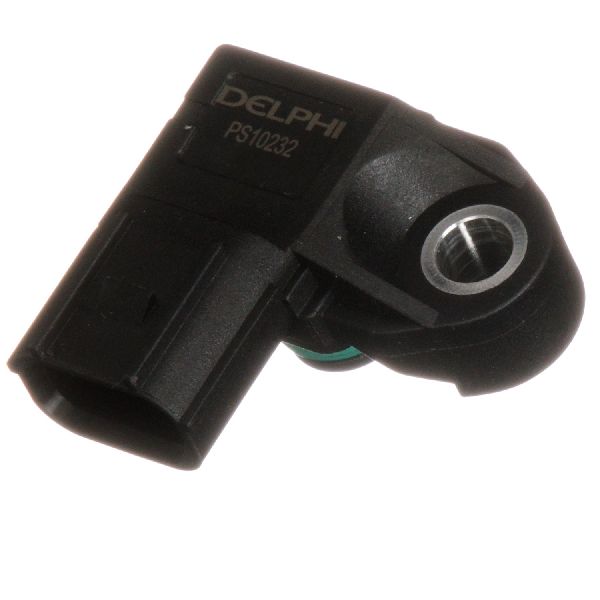
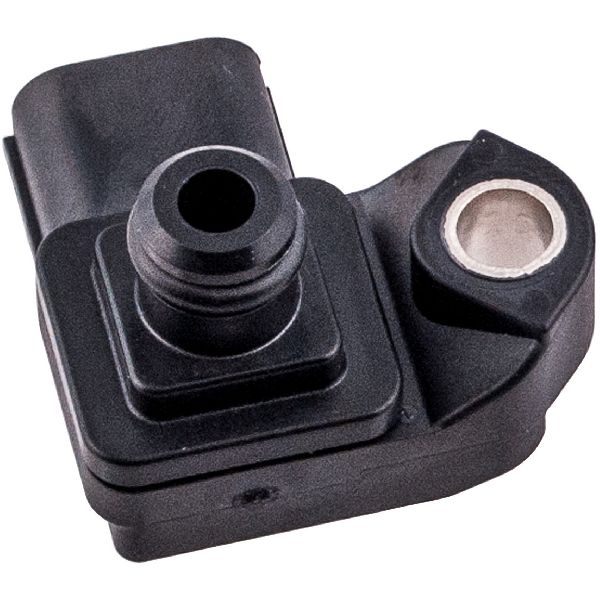
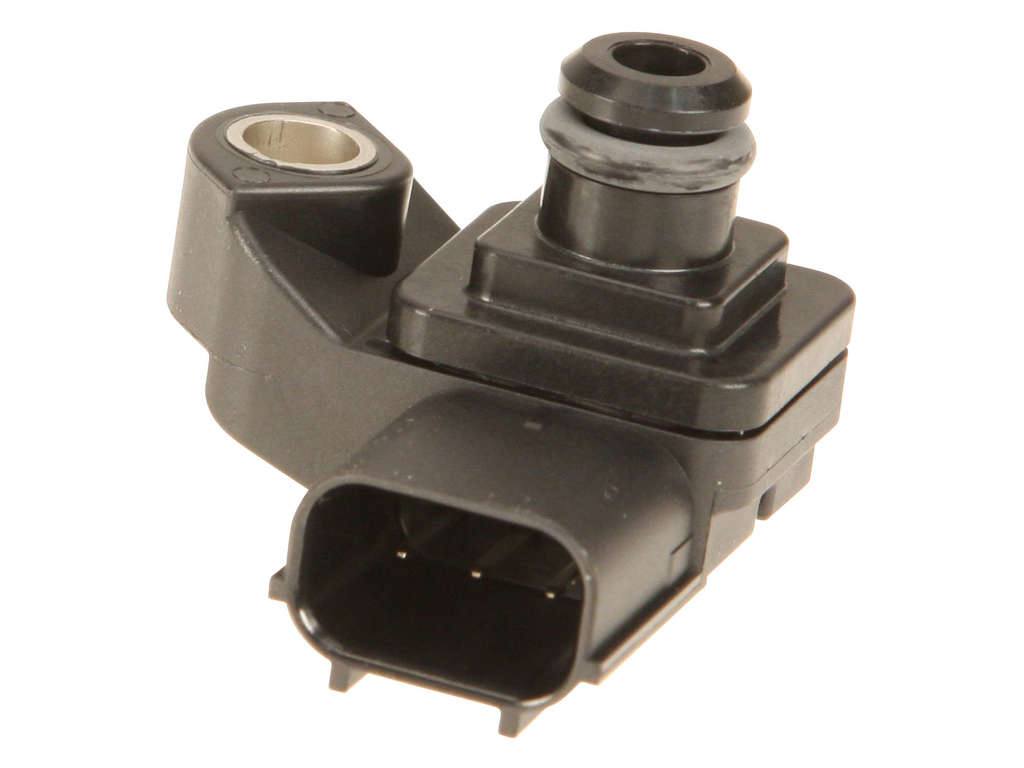
- Manifold Absolute Pressure (MAP) Sensor
(OEM #37830-RNA-A01)— This is the most common component to fail and trigger a P0108 code. 🎬 Watch: A complete diagnostic walkthrough for P0108 on this CR-V. It directly measures intake manifold pressure and sends the high voltage signal when it malfunctions. This part number is widely used across many Honda and Acura models.
Trusted brands: Honda (Genuine OEM), Denso (Often the OEM supplier), Bosch, NGK/NTK, Standard Motor Products (SMP)
OEM price range: $70-$120
Aftermarket price range: $20-$70
Related Codes That Often Appear With This One
- P0107 — This code is for 'MAP Sensor Circuit Low Voltage'. Seeing it alongside P0108 could indicate an intermittent wiring problem, a loose connection, or a failing sensor with erratic readings.
- P0106 — This code indicates 'MAP/Barometric Pressure Sensor Range/Performance Problem'. It can be triggered by a failing sensor that isn't completely shorted or open, or by an underlying vacuum leak.
Technical Service Bulletins (TSBs) & Recalls
- No specific TSBs were found directly addressing P0108 for this vehicle range. However, TSB 13-081 was issued for 2011 Odysseys for piston ring issues causing misfires, which can sometimes be related to pressure issues, but it is not a direct cause for P0108. It's always good practice to check for PCM software updates, as recommended in some Honda diagnostic procedures.
Mechanic-Grade Diagnostic Values
- MAP Sensor 5V Reference Wire Voltage — expected: ~5.0 Volts (with key on, engine off). Failure: 0 Volts indicates an open in the power wire from the PCM or a PCM fault. Significantly different voltage suggests a PCM issue.
- MAP Sensor Ground Wire Continuity — expected: < 1.0 Ohm to chassis ground. Failure: High resistance (> 5 ohms) indicates a poor ground connection, which can cause incorrect signal voltage. Some technicians look for less than 100 millivolts on the ground wire with the sensor connected and key on.
- MAP Sensor Signal Voltage (Key On, Engine Off) — expected: ~4.5 - 5.0 Volts (for a P0108 fault condition). Failure: A reading in this range with the engine off confirms the high voltage condition. A healthy sensor should read a voltage corresponding to atmospheric pressure, which varies by altitude.
- MAP Sensor Signal Voltage (Engine Idling) — expected: ~1.0 - 1.5 Volts (at sea level). Failure: Voltage remaining high (near 4.5V) at idle strongly suggests a faulty sensor or a short in the signal wire. Voltage should drop significantly from the KOEO reading due to engine vacuum.
- Live Data: MAP vs. BARO (Key On, Engine Off) — expected: MAP sensor pressure reading should be nearly identical to the Barometric (BARO) pressure reading.. Failure: A significant difference between the two readings points to a faulty MAP sensor.
Scan Tool Commands That Help
- Honda HDS (or equivalent professional scanner): Idle Learn Procedure / Reset ECM — Required after disconnecting the battery, replacing the PCM, or replacing/cleaning components that affect idle, such as the MAP sensor or throttle body. Failure to perform this can result in a rough or high idle. Some advanced scanners may also have a specific 'TPS calibration' function that can resolve stubborn idle issues after a repair.
Wiring & Ground Locations
- G101 — Typically located on the engine block or thermostat housing, on the left (driver's) side of the engine.. G101 serves as a primary ground termination point for the PCM and multiple sensors, including the MAP sensor circuit. A corroded or loose G101 ground can cause erratic voltage readings and is a known source of hard-to-diagnose electrical issues in Hondas.
- MAP Sensor Connector — A 3-pin connector plugged directly into the MAP sensor on the intake manifold.. This is the primary point for testing. Pin 1 is typically the 5V reference, Pin 3 is ground, and the center pin (Pin 2) is the signal wire returning to the PCM. Verifying voltages here is the fastest way to isolate the fault between the sensor, wiring, or PCM.
- PCM Connector C (49-Pin) — One of the main connectors at the Powertrain Control Module (PCM).. For advanced diagnosis, technicians may need to check for continuity or shorts at the PCM itself. Honda service information points to checking continuity between the MAP sensor connector and the corresponding pins on this PCM connector to rule out a wiring harness break.
Real Owner Repair Stories
- Honda-Tech forum user (Honda Civic with K-series engine swap (similar electronics)) — Car would start and idle, but would choke and die when the gas pedal was pressed.
❌ Tried (didn't work) Replacing the ECU/PCM., Running a new, direct wire from the PCM to the MAP sensor., Trying different tuning software (Ectune, Crome Pro).
✅ What actually fixed it The user was using an aftermarket 3-bar MAP sensor for a turbo application. The problem was resolved by switching back to an OEM Honda MAP sensor and reprogramming the ECU for the stock sensor. This highlights that incorrect or faulty aftermarket sensors can cause identical symptoms to a wiring fault, confusing diagnosis. - NHTSA ODI #11361702 (Honda Accord owner) — An owner reported that while accelerating, the car "just wouldn't move." After getting the vehicle towed, diagnostic codes P0401 and P0108 were found. The owner attempted to resolve the issue by cleaning the EGR valve and installing a new MAP sensor.
OEM Part Supersession History
37830-RNA-A01→No official supersession found. This part number remains current.— N/A
Heads up: This part number is widely used across many Honda/Acura models from roughly 2006 to 2019, including the Civic, Accord, Fit, and CR-V. While other part numbers like 37830-PNC-003 may physically fit, they are intended for older K-series engines and may have different voltage scaling, causing performance issues. It is critical to use 37830-RNA-A01 or a direct cross-reference.
Model Year Variations Within This Range
- 2015-2016: These model years use the K24W9 'Earth Dreams' engine with direct injection and a CVT transmission. This is a significant powertrain change from the 2011 (K24Z6) and 2012-2014 (K24Z7) port-injected engines. However, for the P0108 fault, the MAP sensor part number (37830-RNA-A01) and diagnostic procedure remain the same.
Diagnostic Flowchart
Real Owner Stories
Aggregated from forums and TSBs cited above. Mileages and costs reflect what owners reported in those sources.
Acura 3G TL
Symptoms: Car wouldn't go past 3,000 RPM due to limp mode and would randomly shut down or stall when placing a load on the engine, such as turning on the heat.
What fixed it: Replacing the MAP sensor.
Source hint: AcuraZine - 'P0108 Car won't go past 3k rpm, randomly shuts down.'
1998 Honda Civic
Symptoms: Experienced a crank-no-start condition when the engine was warm.
What fixed it: Replaced the MAP sensor, but the problem persisted, highlighting the need to follow the full diagnostic flowchart to check wiring and PCM inputs rather than just replacing parts.
Source hint: 2CarPros - 'P0108 Code: I Dont Know Just It Isnt Working Properly'
Related OBD-II Codes
Frequently Asked Questions
Is there a specific TSB for the P0108 code on my 2011-2016 Honda CR-V?
What is the exact part number for the MAP sensor on the 2.4L engine?
Why won't my CR-V rev past 3000 RPM with this code?
Can a vacuum leak cause a P0108 on my Honda?
Where is the MAP sensor located and is it hard to replace?
Does TSB 13-081 apply to my CR-V's P0108 code?
Helpful Videos

We Have This Part in Stock


The information in this article is provided for general reference and educational purposes only. Vehicle specifications, procedures, and part compatibility can vary by production date, trim level, and region. Always consult your vehicle's factory service manual and verify part numbers before purchasing or performing repairs. Safety-critical components such as airbags, seat belts, and braking systems should be installed by a qualified professional.
- Honda CR-V:
- 🧭 Diagnostic Flowchart
- 🎬 Helpful Videos
- 🛍️ Shop This Part
- What's Unique About the 2011-2016 Honda CR-V
- Symptoms You May Notice
- Most Likely Causes
- Rare But Worth Checking
- Diagnosis Steps
- Parts You'll Likely Need
- Related Codes That Often Appear With This One
- Technical Service Bulletins (TSBs) & Recalls
- Mechanic-Grade Diagnostic Values
- Scan Tool Commands That Help
- Wiring & Ground Locations
- Real Owner Repair Stories
- OEM Part Supersession History
- Model Year Variations Within This Range
- Real Owner Stories
- Acura 3G TL
- 1998 Honda Civic
- Related OBD-II Codes
- Frequently Asked Questions
- 🎟️ Get 5% Off