

P0108 on 2001-2010 Hyundai Elantra: MAP Sensor Circuit High Causes and Fixes
On a 2001-2010 Elantra, P0108 is almost always caused by a failed Manifold Absolute Pressure (MAP) sensor. A new sensor is inexpensive and easy to replace, making it a likely and simple DIY fix. Before replacing, check the PCV valve and for oil contamination on the sensor itself.
- P0108 on a 2001-2010 Elantra almost always means you need a new MAP sensor.
- Symptoms include a rough idle, poor gas mileage, and hesitation.
- Diagnosis is straightforward: check the MAP sensor's live data with a scan tool. A reading that doesn't change or is stuck high (near 5V) confirms a bad sensor.
- Before buying a new sensor, pull the old one and check for oil contamination. If oil is present, replace the PCV valve as well.
- Replacement is very easy for a DIYer, typically involving one 10mm bolt and an electrical connector, located on the intake manifold.
- Before buying a sensor, take a quick look at the vacuum hoses and sensor wiring for obvious damage.
What's Unique About the 2001-2010 Hyundai Elantra
For the 2001-2010 Elantra with the 2.0L Beta II (G4GC) engine, the MAP sensor system is a straightforward and common design. This engine was a workhorse for Hyundai/Kia and is known for its relative simplicity. There are no widespread, unique design flaws that cause this code; failure is typically due to the age of the sensor or related components like the PCV valve. The most common cause is simply the sensor failing internally, sending a false high-voltage signal. Unlike some performance-related codes, P0108 on this vehicle points very strongly to a specific component failure rather than a complex diagnostic puzzle.
Generation note: This guide covers the Hyundai Elantra XD (2001-2006) and HD (2007-2010) generations. Both generations primarily used a 2.0L Beta II DOHC engine (G4GC), so the causes, symptoms, and repair procedures for a P0108 code are virtually identical across this entire year range. A key change occurred in 2004 with the addition of Continuously Variable Valve Timing (CVVT), which improved horsepower but did not fundamentally change the MAP sensor system's operation.
Symptoms You May Notice
- Check Engine Light is on
- Rough or unstable idle
- Poor fuel economy
- Hesitation or lack of power during acceleration
- Black smoke from the exhaust
- Engine may stall when coming to a stop
- Difficulty starting the engine
- Replacing the Mass Airflow (MAF) sensor. The Elantra uses a MAP sensor for engine load calculation, not a MAF sensor. These are different parts with different functions.
- Replacing the Throttle Position Sensor (TPS). While TPS issues can cause similar drivability symptoms, they will set different codes (e.g., P0123).
Most Likely Causes
- Failed Manifold Absolute Pressure (MAP) Sensor 🔴 High Probability → Shop Manifold Absolute Pressure Sensor After many years and heat cycles, the internal electronics of the sensor can fail, causing it to send a continuous high voltage signal regardless of actual manifold pressure. This is the most common resolution reported by owners.
How to confirm: With a scan tool, observe the MAP sensor voltage with the key on, engine off (KOEO). If the voltage is stuck high (e.g., near 4.8-5.0 volts) or the pressure reading does not match the current barometric pressure (should be ~101 kPa at sea level), the sensor is bad. At idle, the voltage should drop to around 1.0-1.5V; if it stays high, the sensor has failed.
Typical fix: Replace the MAP sensor. It is mounted on the intake manifold with one or two bolts and is easily accessible.
Est. part cost: $25-$75 - Wiring Harness or Connector Issue 🟡 Medium Probability Vibration and heat can cause wires to break or chafe over time. The connector itself can also become corroded or loose, leading to a poor connection, which can short the signal wire to the 5V reference wire. In a cross-manufacturer reference, NHTSA ODI #11292479 notes that an owner resolved a persistent P0108 and stalling issue by removing paint and adding electrical gel to the main ground wire to the body.
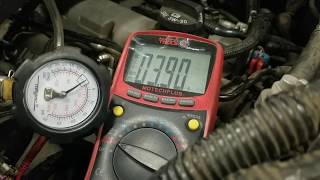
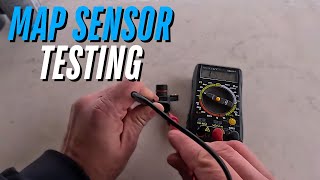
How to confirm: Visually inspect the wiring harness leading to the MAP sensor for any signs of damage, melting, or corrosion. Wiggle the connector with the engine running to see if it affects the idle. Use a multimeter to check for a stable 5-volt reference, a good ground (less than 0.1 volts or 100 millivolts), and continuity on the signal wire. A damaged wire was found to be the cause in one documented repair video.
Typical fix: Repair the damaged section of the wire or replace the pigtail connector.
Est. part cost: $10-$30 - Faulty or Stuck PCV Valve Low-to-medium Probability A PCV valve that is stuck open or closed can alter crankcase pressure, forcing oil vapor into the intake manifold. This oil can contaminate and ruin the MAP sensor, causing it to fail repeatedly.
How to confirm: Remove the MAP sensor and inspect its tip and the port for the presence of engine oil. If oil is present, the PCV system is the likely culprit. One owner on Reddit fixed recurring P0107/P0108 codes by replacing a stuck open PCV valve that was allowing oil into the intake. Another owner with a newer Elantra fixed recurring MAP sensor failures by replacing the PCV valve.
Typical fix: Replace the PCV valve and clean the oil out of the intake port and from the MAP sensor connector. If the sensor has been heavily contaminated, it should also be replaced.
Est. part cost: $10-$25 for PCV valve - Vacuum Leak ⚪ Low Probability While a vacuum leak is a possible cause for MAP sensor codes in general, for a 'Circuit High' code like P0108, the leak would have to be massive and is less likely than a sensor or wiring failure.
How to confirm: A large vacuum leak can sometimes be heard as a hissing sound. The best method is to use a smoke machine to introduce smoke into the intake system and watch for where it escapes. Pay attention to the intake manifold gaskets and all connected vacuum hoses.
Typical fix: Replace the cracked or broken vacuum hose or intake gasket.
Est. part cost: $5-$50
Rare But Worth Checking
- Clogged Catalytic Converter: A severely restricted exhaust will cause pressure to build up in the entire system, including the intake manifold. This can cause the MAP sensor to read a higher-than-normal pressure, triggering P0108. This is usually accompanied by a severe loss of power, especially at higher RPMs, and potentially a glowing red converter.
- Faulty Powertrain Control Module (PCM): → Shop Engine Control Module (ECM) In very rare cases, the fault can be internal to the PCM itself, specifically the circuit that processes the MAP sensor signal. This should only be considered after all other possibilities, including the sensor, wiring, and PCV system, have been thoroughly tested and ruled out.
Diagnosis Steps
- Read the code with an OBD-II scanner to confirm P0108 is present.
- Using the scanner's live data, view the MAP sensor reading with Key On, Engine Off (KOEO). The pressure should read close to your local atmospheric pressure (approx. 101 kPa or 14.7 PSI at sea level) and the voltage should be around 4.5V-4.8V. If it's stuck at 5.0V or reads an illogical pressure, the sensor or wiring is faulty.
- Start the engine and observe the MAP reading at idle. The pressure should drop significantly to around 30-40 kPa (9-12 inHg) and the voltage should be low (around 1.0-1.5V). If the reading stays high, this strongly points to a bad sensor.
- Turn off the engine. Unplug the MAP sensor and inspect the connector for corrosion or damage. Remove the sensor (typically one 10mm bolt) and inspect the sensor's tip and the intake port for any signs of oil contamination. If oil is present, suspect a faulty PCV valve.
- Visually inspect all vacuum hoses connected to the intake manifold for obvious cracks, disconnection, or deterioration.
- If the sensor looks clean and the readings were faulty, it's highly likely the sensor itself has failed. Replacement is the most common fix.
- If a new sensor does not fix the issue, test the wiring. Unplug the sensor and check for a 5-volt reference and a good ground at the connector with the key on. Check the signal wire for a short to power by measuring voltage with the sensor unplugged; it should be near 0V.
- As a final, less common check, test for excessive exhaust backpressure to rule out a clogged catalytic converter.
Parts You'll Likely Need
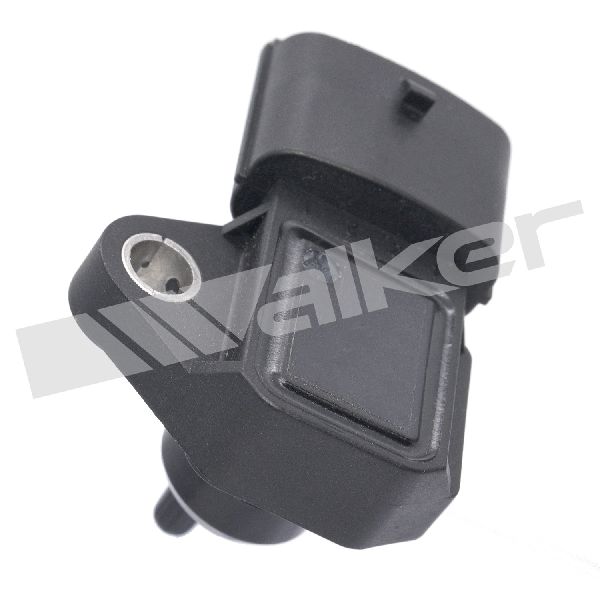
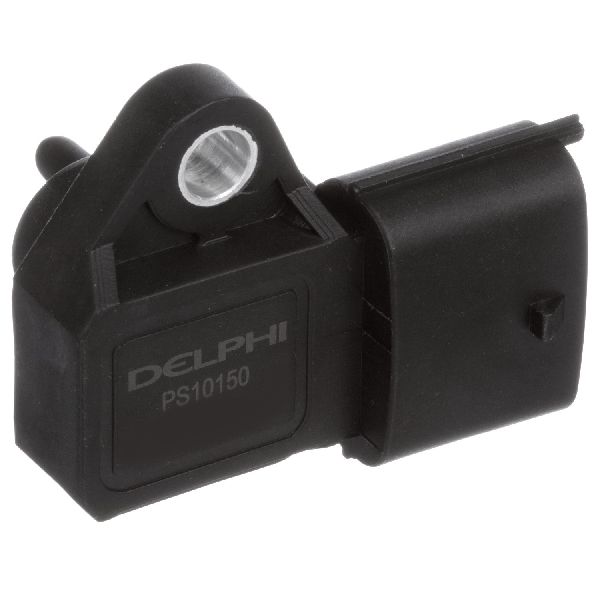
- Manifold Absolute Pressure (MAP) Sensor
(OEM #39300-22600 (may be superseded by 39300-38110))— This is the most common failure point for a P0108 code. The sensor's internal electronics fail over time, sending an incorrect high voltage signal.
Trusted brands: Hyundai/Kia (Genuine), Bosch, Delphi, NGK/NTK, Standard Motor Products (SMP)
OEM price range: $60-$140
Aftermarket price range: $25-$75
Related Codes That Often Appear With This One
- P0106 — Indicates a MAP Sensor Range/Performance problem, which can be an intermittent version of the same fault that eventually leads to a hard P0108 code. A Hyundai TSB for a newer model (21-01-041H) addresses an ECM logic update for P0106, showing it's a related fault path.
- P0107 — Indicates MAP Sensor Circuit Low Input. Seeing this with P0108 could point to severe wiring issues where the signal is shorting to both ground and power intermittently, or a failing sensor that is fluctuating wildly.
- P0113 — Intake Air Temperature (IAT) Sensor Circuit High. On many Elantra models, the IAT sensor is integrated into the same physical housing as the MAP sensor. A failure of the entire sensor unit or its connector could cause both codes to appear simultaneously.
Technical Service Bulletins (TSBs) & Recalls
- Hyundai TSB 21-01-041H: While for a newer 2020 Elantra, this TSB addresses an ECM software update to improve the logic for detecting MAP sensor faults (P0068, P0101, P0106). This shows that MAP sensor rationality checks are an area of focus for Hyundai engineers and that related codes can sometimes be logic-based.
Platform-Specific Known Issues
- A recurring P0108 code, even after replacing the sensor, should lead to an inspection of the PCV valve. A stuck valve can cause oil contamination that fouls the new sensor. One owner reported this exact scenario on Reddit, where replacing the PCV valve provided a final fix.
Mechanic-Grade Diagnostic Values
- MAP Sensor Signal Voltage (Key On, Engine Off) — expected: ~4.5V - 4.85V. Failure: Voltage is stuck at 5.0V or does not correspond to barometric pressure.
- MAP Sensor Signal Voltage (Engine at Idle) — expected: ~1.0V - 1.5V. Failure: Voltage remains high (near KOEO reading) and does not drop when the engine is running.
- MAP Sensor 5V Reference Wire (at connector, KOEO) — expected: ~5.0V. Failure: Voltage is significantly lower than 5.0V or is absent, indicating a wiring or PCM issue.
- MAP Sensor Ground Wire Voltage Drop (at connector, KOEO) — expected: Less than 0.1V (100 millivolts). Failure: Voltage is higher than 0.1V, indicating a poor ground connection which can skew sensor readings.
- DTC P0108 Set Condition — expected: Normal operating voltage range.. Failure: Sensor signal input is higher than 4.85V for 0.1 seconds.
Scan Tool Commands That Help
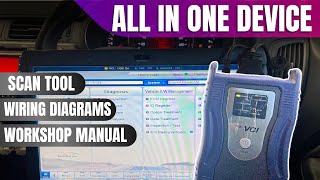
- Hyundai GDS (Global Diagnostic System): Live Data Graphing (MAP vs. TPS) — To visually confirm if the MAP sensor signal increases and decreases in direct response to throttle position changes during acceleration and deceleration. A lagging or non-responsive MAP signal on the graph points to a faulty sensor.
- Hyundai GDS (Global Diagnostic System): DTC Guide / Troubleshooting Procedure — After retrieving code P0108, the GDS provides an integrated, model-specific diagnostic flowchart that guides the technician through checks for wiring, grounds, and component tests, which is more detailed than generic repair manuals.
Wiring & Ground Locations
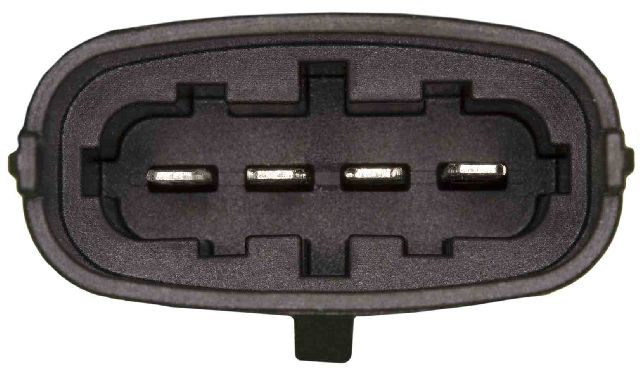
- MAP Sensor Connector — On the intake manifold, typically near the throttle body.. This 3-pin connector provides power, ground, and signal return for the sensor. Corrosion or damage here is a common cause of P0108. The pins are typically: 5V Reference, Signal, and Ground.
- Engine Ground Strap (Part 91860-2H220 for HD) — Main ground connection from the engine block/transmission to the chassis frame rail.. A corroded or loose main engine ground can cause floating voltages and unstable sensor readings across the entire engine management system, including the MAP sensor, leading to erroneous high voltage codes.
Real Owner Repair Stories
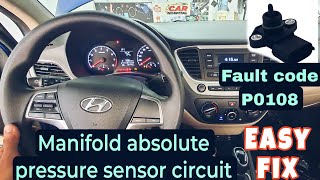
- YouTube channel 'Car hospital' (2020 Hyundai Accent (demonstrates a similar 4-wire MAP/IAT sensor system)) — Check Engine Light with codes P0108 and P0113.
❌ Tried (didn't work) Initial computer scan pointed to sensor failure.
✅ What actually fixed it A damaged brown wire in the harness leading to the MAP/IAT sensor was found. After repairing the broken wire and taping the harness, the codes were cleared and did not return. - NHTSA ODI #10629611 — An owner of a similar Hyundai model reported finding trouble codes P0335 and P0108 using an OBDII scanner after dealerships initially claimed nothing was wrong, noting the car almost stalled while crossing a busy intersection.
OEM Part Supersession History
39300-38110→39300-22600— Part consolidation and revision by Hyundai/Kia.
Heads up: While 39300-22600 replaces 39300-38110, they are generally interchangeable for this application. Always verify fitment with VIN.
Model Year Variations Within This Range
- 2001-2006 (XD Generation) vs. 2007-2010 (HD Generation): These two generations are built on different platforms (XD vs HD). While they share the 2.0L Beta II engine and similar MAP sensor diagnostics, some chassis-related components, wiring harness routing, and ground point locations may differ.
- 2004-2010: Starting in 2004, the 2.0L engine was updated with Continuously Variable Valve Timing (CVVT). This improved engine efficiency and power but did not alter the fundamental operation or diagnosis of the MAP sensor circuit for code P0108.
Diagnostic Flowchart
Other Known Issues on This Vehicle
Issues unrelated to this code that are worth knowing about as an owner of this generation:
- Crankshaft Position Sensor Failure 🔴 High — A very common issue for this generation, often causing intermittent stalling or no-start conditions. Can occur at any mileage, but more frequent after 60,000 miles. (Ref: While various recalls exist for crankshaft-related issues on other Hyundai models, a specific, widespread recall for this sensor on the 2001-2010 Elantra is not consistently documented, though the problem is widely acknowledged.)
- Automatic Transmission Problems (Slipping/Harsh Shifting) 🟠 Medium — Issues like slipping, delayed engagement, and harsh shifts are reported by many owners, sometimes as early as 70,000-100,000 miles. Faulty speed sensors within the transmission are a common cause. (Ref: Hyundai has issued numerous TSBs over the years for transmission issues, including 24-AT-002H which covers incorrect gear ratio codes that can result from internal clutch slip.)
- Front Lower Control Arm Corrosion 🔴 High — Primarily affects vehicles in the 'Salt Belt' states. Road salt can cause severe corrosion, leading to perforation and potential fracture of the control arms. (Ref: Hyundai issued recall 092 (NHTSA Campaign ID 09V124000) for 2001-2003 Elantras to address this issue.)
- Peeling Interior/Exterior Materials 🟡 Low — A common cosmetic complaint where the paint can chip easily and interior materials, like the steering wheel padding, can degrade and crumble over time, especially with sun exposure.
- Faulty Stop Lamp Switch 🟠 Medium — A malfunctioning switch can cause brake lights to fail or stay on, prevent shifting out of park, and disable cruise control. (Ref: This was part of a massive Hyundai recall (NHTSA Campaign ID 13V113000) affecting many models, including the 2007-2010 Elantra.)
Used vs. New Parts: Buying Guide for This Vehicle
When a used part is the smart pick: A used MAP sensor from a low-mileage donor vehicle is a reasonable choice for this repair. The failure mode is typically electronic, not wear-based, so a functional used part can be a cost-effective alternative to a new aftermarket part of questionable quality.
Donor-vehicle mileage cap: roughly under 80000 miles for the part to have meaningful remaining life.
What to inspect on the donor part:
- Check the sensor's tip for heavy oil or carbon contamination; avoid if dirty.
- Inspect the plastic housing for cracks or heat damage.
- Ensure the connector pins are clean, straight, and free of corrosion.
- If possible, ask the seller if the donor car ran well and did not have a Check Engine Light.
Aftermarket brands forum-validated for this vehicle:
- Standard Motor Products (SMP)
- NGK/NTK
- Delphi
- Bosch
Brands owners have reported issues with on this vehicle:
- Unbranded, 'white-box' sensors from online marketplaces often have high failure rates and may not be calibrated correctly, leading to the code returning.
Real Owner Stories
Aggregated from forums and TSBs cited above. Mileages and costs reflect what owners reported in those sources.
2010 Hyundai Elantra 2.0L — 205000 miles
Symptoms: P0107 and P0108 codes appearing together.
What fixed it: Replacing a stuck open PCV valve that was allowing oil into the intake and contaminating the sensor.
Source hint: Reddit - r/MechanicAdvice - '2010, 205K miles, P0107/P0108 Codes
2001-2010 Hyundai Elantra 2.0L
Symptoms: The engine would stall when coming to a stop and had a rough idle.
What fixed it: Repairing a damaged section of the wiring harness leading to the MAP sensor.
Source hint: documented repair video
Hyundai Azera Owner — NHTSA ODI #11292479
Symptoms: Continued to get P0108 error code and stalling after 20 minutes of running, even after replacing the alternator and valve cover gasket.
What fixed it: Removed paint and added electrical gel to all main ground wires to the body/frame.
Related OBD-II Codes
Frequently Asked Questions
Does Hyundai TSB 21-01-041H apply to my 2001-2010 Elantra?
I've replaced my MAP sensor twice on my Elantra but the P0108 code keeps returning. What else should I check?
Is there a recall for the front lower control arms on my 2001-2010 Elantra?
My Elantra is stalling and has a P0108 code; could this be related to the Crankshaft Position Sensor?
How can I tell if my MAP sensor failure is actually a wiring issue on this model?
What is the typical cost to fix a P0108 on a 2001-2010 Hyundai Elantra?
Helpful Videos

We Have This Part in Stock




The information in this article is provided for general reference and educational purposes only. Vehicle specifications, procedures, and part compatibility can vary by production date, trim level, and region. Always consult your vehicle's factory service manual and verify part numbers before purchasing or performing repairs. Safety-critical components such as airbags, seat belts, and braking systems should be installed by a qualified professional.
- Hyundai Elantra:
- 🧭 Diagnostic Flowchart
- 🎬 Helpful Videos
- 🛍️ Shop This Part
- What's Unique About the 2001-2010 Hyundai Elantra
- Symptoms You May Notice
- Most Likely Causes
- Rare But Worth Checking
- Diagnosis Steps
- Parts You'll Likely Need
- Related Codes That Often Appear With This One
- Technical Service Bulletins (TSBs) & Recalls
- Platform-Specific Known Issues
- Mechanic-Grade Diagnostic Values
- Scan Tool Commands That Help
- Wiring & Ground Locations
- Real Owner Repair Stories
- OEM Part Supersession History
- Model Year Variations Within This Range
- Other Known Issues on This Vehicle
- Used vs. New Parts: Buying Guide for This Vehicle
- Real Owner Stories
- 2010 Hyundai Elantra 2.0L — 205000 miles
- 2001-2010 Hyundai Elantra 2.0L
- Hyundai Azera Owner — NHTSA ODI #11292479
- Related OBD-II Codes
- Frequently Asked Questions
- 🎟️ Get 5% Off