

P0108 on 1999-2004 Oldsmobile Alero: MAP Sensor High Input Causes and Fixes
This code usually points to a failed Manifold Absolute Pressure (MAP) sensor or a significant vacuum leak. On the 3.4L V6, a faulty MAP sensor is the most common culprit, and it's an inexpensive and easy part to replace, typically costing between $25 and $60 for an aftermarket part. Before replacing, check the sensor's vacuum hose for cracks, as this can cause identical symptoms.
- P0108 on a 3.4L Alero is most often caused by a bad MAP sensor.
- Replacing the MAP sensor is a simple, quick, and affordable DIY job that requires basic tools, typically just a 7mm socket.
- Before replacing the sensor, always perform a quick visual inspection of the vacuum hose going to the sensor for cracks or disconnections.
- Be aware that this engine is prone to lower intake manifold gasket leaks, which can also cause this code. If replacing the sensor doesn't fix the issue, investigate for a vacuum leak, specifically around the intake manifold.
What's Unique About the 1999-2004 Oldsmobile Alero
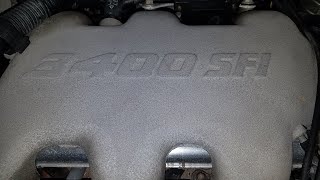
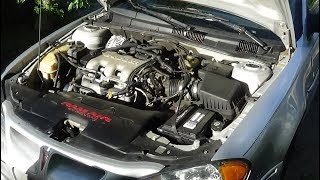
The Oldsmobile Alero shares its 3.4L LG8 V6 engine with many other GM vehicles like the Pontiac Grand Am and Chevrolet Impala. While the P0108 code is often a straightforward MAP sensor failure, this specific engine family is also known for intake manifold gasket failures. The original Dex-Cool coolant could degrade the original plastic/silicone gaskets, creating a significant vacuum leak that reduces manifold vacuum, causing the sensor to read a higher pressure and trigger a P0108 code.
Symptoms You May Notice
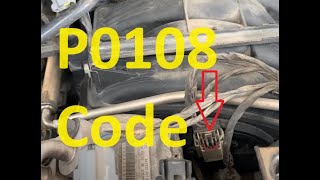
- Check Engine Light is on 🎬 Watch: A quick guide to understanding the P0108 engine code.
- Rough or unstable idle
- Hesitation or lack of power during acceleration
- Engine jerking or surging, especially under load or going up hills
- Poor fuel economy
- Black smoke from the exhaust, indicating a rich fuel condition
- Engine stalling, especially when coming to a stop or when putting the car into gear
- Hard starting or a crank-no-start condition in severe cases
- Failed emissions test
- Replacing oxygen sensors to fix the rich running condition without first diagnosing the cause of the high MAP sensor reading.
- Replacing the MAP sensor without first checking for a simple cracked vacuum hose leading to it.
Most Likely Causes
- Defective Manifold Absolute Pressure (MAP) Sensor 🔴 High Probability → Shop Manifold Absolute Pressure Sensor The MAP sensor is a critical electronic component that can fail over time due to heat cycles and age. It is the most frequent cause for P0108 on this platform.
How to confirm: With the Key On, Engine Off (KOEO), use a scan tool to compare the MAP sensor reading to the Barometric Pressure (BARO) reading. They should be nearly identical (approx. 4.0-5.0 volts). Start the engine; at idle, the voltage should drop to 0.5-2.0 volts. If the voltage is stuck high, the sensor is likely bad. 🎬 See how to test and replace the MAP sensor yourself. You can also test this with a multimeter while applying vacuum with a hand pump; the voltage should decrease smoothly as vacuum is applied.
Typical fix: Replace the MAP sensor. It is mounted on a bracket near the throttle body, secured by two 7mm bolts. 🎬 Watch this walkthrough for replacing the sensor on a 3.4L engine.
Est. part cost: $25-$60 - Vacuum Leak 🟡 Medium Probability The 3.4L V6 engine is notorious for failures of the lower intake manifold gaskets (LIM), which can cause both coolant and vacuum leaks. Degraded or cracked vacuum hoses, especially the small rubber line running to the MAP sensor itself, are also common sources of leaks.
How to confirm: Perform a smoke test to visually identify the source of any unmetered air entering the intake system. Listen for hissing sounds around the intake manifold at idle. A visual inspection may reveal cracked hoses or signs of leakage around the intake manifold gaskets.
Typical fix: Replace the leaking hose or gasket. If the lower intake manifold gasket has failed, it's a more involved repair. It is highly recommended to use the upgraded metal-frame gasket set, such as the Fel-Pro PermaDryPlus (part number MS 98014 T), to prevent recurrence.
Est. part cost: $5-$20 for hoses, $60-$100 for an upgraded intake gasket set. - Damaged Wiring or Connector ⚪ Low Probability The wiring harness and connector can become brittle and fail from age and heat exposure in the engine bay.
How to confirm: Visually inspect the MAP sensor's wiring harness and connector for any signs of corrosion, breaks, or loose pins. With the sensor disconnected and Key On, check for a 5-volt reference on the gray wire and a good ground on the orange/black or black wire with a multimeter.
Typical fix: Repair the damaged section of the wiring harness or replace the connector pigtail. An ACDelco replacement pigtail is part number PT1799.
Est. part cost: $15-$40 for a connector pigtail.
Rare But Worth Checking
- Clogged Catalytic Converter: A severe exhaust restriction can cause a lack of vacuum in the intake manifold, leading to a high MAP sensor reading. This would typically be accompanied by a severe lack of power, especially at higher RPMs, and potentially a glowing red converter.
- Faulty Powertrain Control Module (PCM): → Shop Engine Control Module (ECM) This is extremely rare. In one documented case, a faulty PCM sent incorrect voltage signals, causing P0108 along with other sensor codes (P0101, P0121). The fix was a replacement PCM. The PCM should only be considered after all other possibilities have been exhaustively ruled out.
Diagnosis Steps
- Connect an OBD-II scanner and confirm the P0108 code is present. Check for any other stored codes.
- Review the freeze-frame data to see the engine conditions (RPM, speed, etc.) when the code was set.
- Visually inspect the MAP sensor, its electrical connector, and especially the vacuum hose running to it for any obvious damage, corrosion, or loose connections.
- With the Key On, Engine Off (KOEO), use the scanner's live data function. The MAP sensor voltage should be high (approx. 4.0-5.0V) and its pressure reading should be close to the Barometric Pressure (BARO) reading. At sea level, this is around 101 kPa or 29.9 inHg.
- Start the engine. At a stable idle, the MAP sensor voltage should drop significantly to around 0.5-2.0 volts, indicating engine vacuum (typically to around 30-40 kPa or 9-12 inHg).
- If the MAP reading is stuck high even at idle, it points towards a bad sensor, a disconnected/clogged vacuum line, or a major vacuum leak.
- Check for vacuum leaks. A smoke test is the most effective method. Pay close attention to the lower intake manifold gasket area and all vacuum hoses.
- If no vacuum leaks are found, test the sensor's circuit. Disconnect the sensor. With the key on, use a multimeter to check for a 5V reference signal at terminal C (gray wire) and a good ground at terminal A (black or orange/black wire).
- If the circuit is good and there are no vacuum leaks, the MAP sensor itself is the most likely culprit.
- After replacing the part, clear the code. Some systems may require several drive cycles for the code to clear from history even if the Check Engine Light is off.
Parts You'll Likely Need
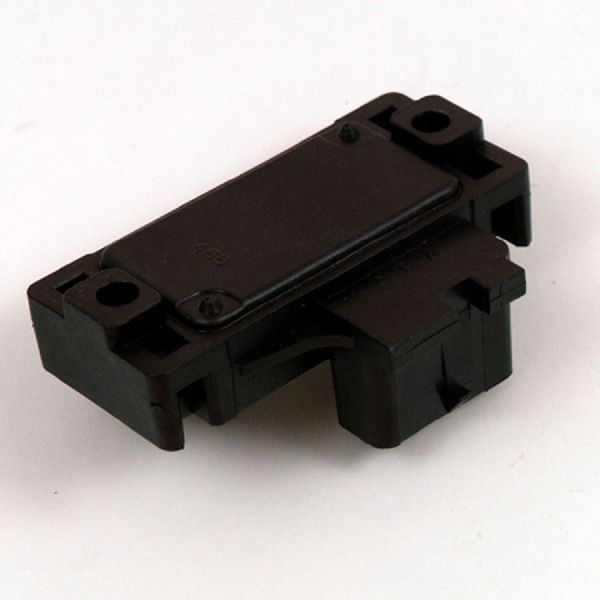
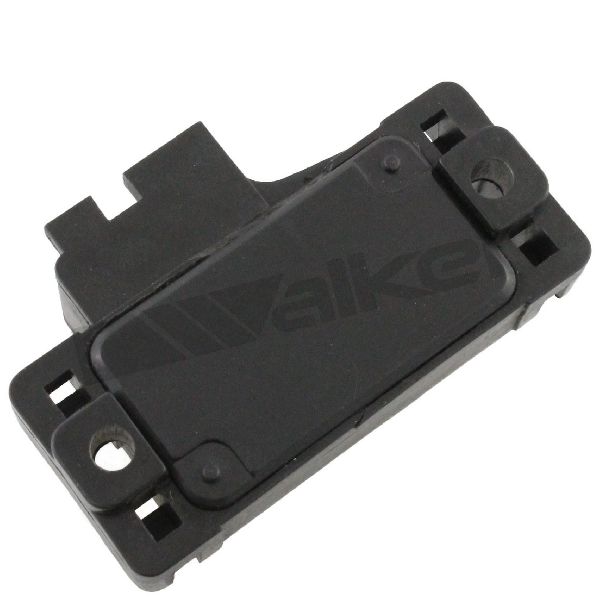
- Manifold Absolute Pressure (MAP) Sensor
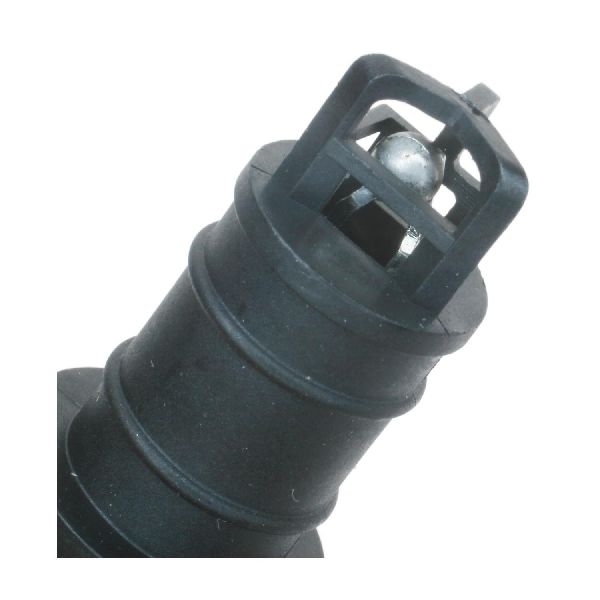
(OEM #12614973)— This is the most common failure point for a P0108 code. The sensor's internal electronics fail, causing it to send an incorrect high voltage signal. This part number may be superseded by or cross-referenced with 16249939 and ACDelco part number 213-796.
Trusted brands: ACDelco, Delphi, Standard Motor Products (SMP)
OEM price range: $60-$80
Aftermarket price range: $25-$60 - Lower Intake Manifold Gasket Set (Upgraded)
(OEM #Fel-Pro MS 98014 T)— If a vacuum leak is the cause, it is often due to the failure-prone original intake gaskets. Replacing them with the improved metal-frame design is the permanent solution.
Trusted brands: Fel-Pro
OEM price range: N/A (OEM is the problematic design)
Aftermarket price range: $60-$100
Related Codes That Often Appear With This One
- P0106 — Indicates a MAP sensor performance/range issue, which can be related to the same electrical or vacuum problems causing P0108.
- P0107 — Indicates MAP sensor circuit low input. If there is an intermittent short or open in the wiring, you might see both high and low codes stored.
- P0172 — Indicates 'System Too Rich'. The P0108 code causes the PCM to think the engine is under load, so it injects more fuel, leading to a rich condition.
- P0300 — Indicates a random/multiple cylinder misfire. A very rich fuel mixture or a large vacuum leak can cause unstable combustion, leading to misfires.
Technical Service Bulletins (TSBs) & Recalls
- No specific TSB for P0108 was found for this model. However, diagnostic procedures for other codes (like P0741 for the transmission) explicitly state not to proceed if P0108 is active, indicating P0108 should be resolved first.
Platform-Specific Known Issues
- The 3.4L LG8 V6 engine was notorious for lower intake manifold gasket failures. The original gaskets used a plastic-and-silicone design that would degrade when exposed to GM's Dex-Cool coolant, leading to vacuum and coolant leaks. A significant vacuum leak from this gasket can cause a P0108 code. The recommended fix is to replace the original gaskets with an updated metal-framed set, like the Fel-Pro MS 98014 T.
Mechanic-Grade Diagnostic Values
- MAP Sensor Voltage vs. Pressure Range — expected: Approximately 0.5V (516mV) at high vacuum (idle/decel) to 4.8V (4775mV) at zero vacuum (KOEO/WOT).. Failure: Voltage is stuck high (above 4.3V) regardless of engine vacuum, or does not change when vacuum is applied with a hand pump.
- DTC P0108 Trigger Condition — expected: MAP sensor signal voltage must remain below 4.3V during normal operation.. Failure: The PCM detects that the MAP sensor voltage is more than 4.3 volts for 3 seconds.
- Engine Idle Vacuum — expected: A healthy engine should pull a vacuum of 15-22 in. Hg at idle.. Failure: A reading of less than 15 in. Hg suggests a significant vacuum leak or internal engine issue, which could cause the MAP sensor to read high pressure (high voltage).
Wiring & Ground Locations
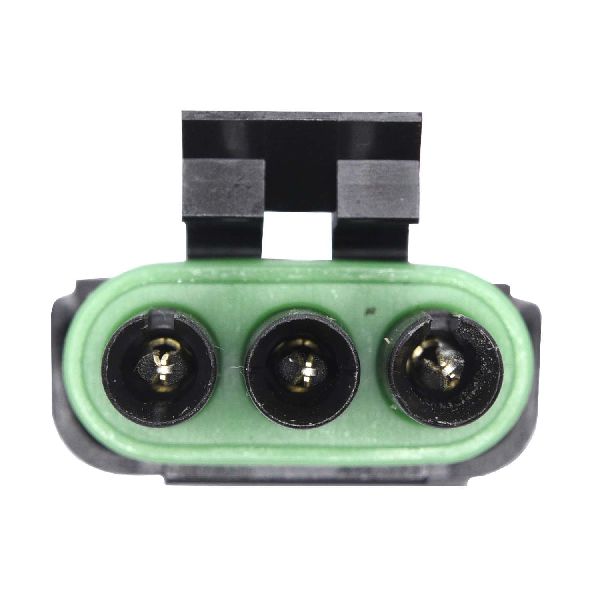
- MAP Sensor Connector — On the MAP sensor, mounted to a bracket behind the upper intake manifold.. Provides the test points for voltage and ground. Pin A (Black or Orange/Black wire) is ground. Pin C (Gray wire) is the 5V reference. The center pin (Light Green wire) is the signal back to the PCM.
- G102 / G103 — Main engine-to-chassis grounds. G102 is typically on the left side of the engine, while G103 can be on the lower front or right rear of the engine block.. The PCM and its sensors rely on a clean ground path. A corroded or loose G102 or G103 can cause a floating ground, leading to erratic voltage readings from sensors like the MAP, triggering false high-input codes.
"I Checked Everything" — The Actual Cause
- In cases where a smoke test reveals no vacuum leaks and the MAP sensor and its direct wiring test good, the root cause can be a poor ground connection for the Powertrain Control Module (PCM). A corroded or loose ground at location G102 or G103 can cause the reference voltage to be unstable, making the PCM interpret the MAP sensor's signal incorrectly as high voltage. This is missed because it's not a vacuum leak and the sensor itself is not faulty.
OEM Part Supersession History
16249939, 16187556→12614973 (Also ACDelco 213-796)— Part consolidation and minor revisions over the production life of the GM 60-degree V6 engine family.
Heads up: These numbers are generally interchangeable for this application. A newer service replacement may be ACDelco Gold part 213-4433 (GM 19236264).
Model Year Variations Within This Range
- 1999-2004: The 3.4L LG8 V6 engine and its management system were consistent throughout the Alero's production run. While the standard 4-cylinder engine changed in 2002 from a 2.4L to a 2.2L, the causes and diagnostics for a P0108 on a V6 model are not year-specific within this range.
Diagnostic Flowchart
Real Owner Stories
Aggregated from forums and TSBs cited above. Mileages and costs reflect what owners reported in those sources.
GM V6 engine (similar to 3.4L)
Symptoms: Triggered a P0108 code and needed diagnostic help to verify if the sensor was bad.
What fixed it: Diagnosed the issue by checking the MAP sensor connector, inspecting the o-rings, and testing the voltage with a multimeter while applying vacuum with a hand pump to confirm the sensor's operation.
Source hint: GM Forum - 'got a p0108 code'
Related OBD-II Codes
Frequently Asked Questions
Is there a specific Technical Service Bulletin (TSB) for the P0108 code on my 1999-2004 Alero 3.4L?
I have a P0108 code and a coolant leak on my 3.4L V6. Are these two issues related?
If my lower intake manifold gasket is causing the P0108 code, what replacement part should I use?
How do I test the MAP sensor on my Alero before buying a replacement?
Where is the MAP sensor located on the 3.4L V6, and what is the replacement part number for the connector?
Does the P0108 code affect other GM vehicles with the 3.4L engine?
Helpful Videos

![What is P0108 Engine Code [Quick Guide]](https://img.youtube.com/vi/uxh9kXKn5oA/mqdefault.jpg)
We Have This Part in Stock


The information in this article is provided for general reference and educational purposes only. Vehicle specifications, procedures, and part compatibility can vary by production date, trim level, and region. Always consult your vehicle's factory service manual and verify part numbers before purchasing or performing repairs. Safety-critical components such as airbags, seat belts, and braking systems should be installed by a qualified professional.
- Oldsmobile Alero:
- 🧭 Diagnostic Flowchart
- 🎬 Helpful Videos
- 🛍️ Shop This Part
- What's Unique About the 1999-2004 Oldsmobile Alero
- Symptoms You May Notice
- Most Likely Causes
- Rare But Worth Checking
- Diagnosis Steps
- Parts You'll Likely Need
- Related Codes That Often Appear With This One
- Technical Service Bulletins (TSBs) & Recalls
- Platform-Specific Known Issues
- Mechanic-Grade Diagnostic Values
- Wiring & Ground Locations
- "I Checked Everything" — The Actual Cause
- OEM Part Supersession History
- Model Year Variations Within This Range
- Real Owner Stories
- GM V6 engine (similar to 3.4L)
- Related OBD-II Codes
- Frequently Asked Questions
- 🎟️ Get 5% Off