

P0108 on 2014-2018 Subaru Forester XT: MAP Sensor Circuit High Causes and Fixes
On a 2014-2018 Forester XT, code P0108 almost always points to a failed Manifold Absolute Pressure (MAP) sensor or its wiring. A replacement OEM Denso sensor can be costly, but diagnosis is straightforward with a multimeter or scan tool before replacing parts. The most common cause is an internal sensor failure causing a short to its 5V reference.
- P0108 on your Forester XT is an electrical fault code indicating a high voltage signal from the MAP sensor, almost always stuck near 5V.
- The most likely cause is a failed MAP sensor, followed by a wiring/connector problem. On high-mileage vehicles, sensor contamination from carbon buildup is also a possibility.
- Do not confuse the MAP sensor (on the throttle body) with the MAF sensor (by the air filter).
- Diagnosis is straightforward: use a scan tool to check if the MAP voltage is stuck high. If it is, test the wiring for 5V reference and ground before replacing the sensor.
- The flashing cruise control and stability control lights are a normal, albeit alarming, side effect of the Check Engine Light on a Subaru.
What's Unique About the 2014-2018 Subaru Forester
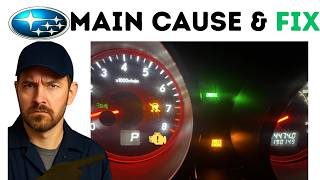
The 2014-2018 Forester XT uses the FA20F, a direct-injection turbocharged engine. While the root cause of P0108 is usually a simple sensor or wiring failure, the turbo system adds a layer of complexity. An overboosting condition, potentially from a faulty wastegate, could theoretically cause high pressure in the manifold, though this is far less common than an electrical fault. A hallmark of this code on modern Subarus is that the main Check Engine Light will be accompanied by a flashing cruise control light and an illuminated vehicle stability control (VSC) light; this is normal and designed to get the driver's attention.
🎬 Learn why your cruise control light is flashing with the CEL.Symptoms You May Notice
- Check Engine Light is on
- Cruise control light flashing and Vehicle Dynamics Control (VDC)/traction control light on
- Rough or unstable idle, engine speed may oscillate
- Engine hesitation or stumbling during acceleration
- Poor fuel economy
- Black smoke from the exhaust
- Engine stalling, especially when coming to a stop or during light throttle
- Failure to start
- Replacing the Mass Airflow (MAF) sensor. The MAF and MAP are different sensors. The MAP sensor is on the throttle body, while the MAF is near the air filter box. This code specifically points to the MAP sensor circuit.
Most Likely Causes
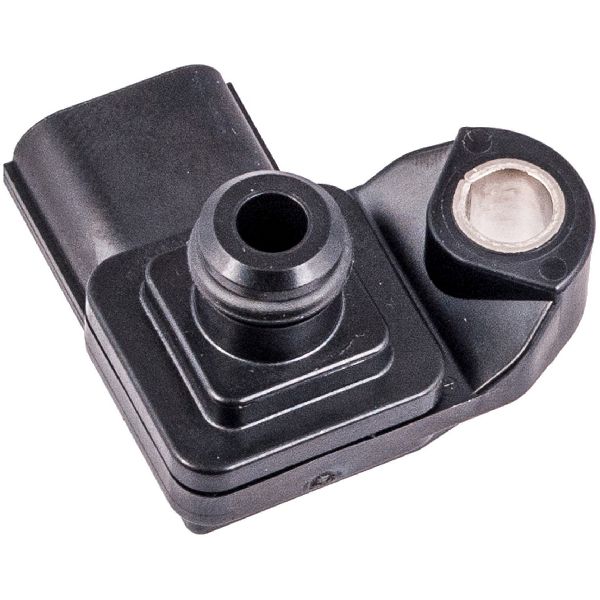
- Faulty Manifold Absolute Pressure (MAP) Sensor 🔴 High Probability → Shop Manifold Absolute Pressure Sensor The MAP sensor is a critical electronic component that operates in a high-heat engine bay environment. An internal failure can cause it to short to its 5-volt reference, sending a constant high signal to the ECM. Some owners have also reported the sensor getting physically clogged with an oily 'tar' substance due to carbon buildup from the direct injection system, leading to failure.
How to confirm: With a scan tool, check live data for the MAP sensor. With the Key On and Engine Off (KOEO), the reading should be close to the barometric pressure (BARO) reading. At idle, the voltage should be low (approx. 1.0-1.8V). If the voltage is stuck high (near 5V), the sensor has likely failed. On some Subarus, unplugging the sensor will cause the scan tool to read a maximum value (e.g., 75.3 inHg), which confirms the wiring harness is capable of sending a signal.
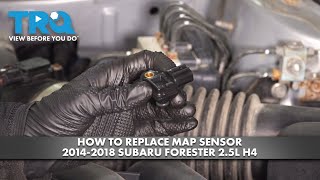
Typical fix: Replace the MAP sensor. It is located on the throttle body assembly and held by a single 8mm bolt. 🎬 See this walkthrough on how to replace the MAP sensor. It is recommended to apply a small amount of oil to the new sensor's O-ring to ensure it seats properly without damage.
Est. part cost: $150-$250 - Wiring or Connector Issue 🟡 Medium Probability Engine vibration and heat can cause wires to fray or the connector to become loose or corroded over time. A short to the 5V power wire is a common cause of a P0108.
How to confirm: Visually inspect the wiring harness and connector going to the MAP sensor for any signs of damage, corrosion, or loose pins. Use a multimeter to check for a stable 5-volt reference and a good ground at the connector with the key on. Wiggling the harness while monitoring live data can help identify an intermittent short, which may appear as sudden spikes to a maximum reading on a scan tool.
Typical fix: Repair the damaged section of wiring or clean/replace the connector pigtail. Applying dielectric grease to the connector can help prevent future corrosion.
Est. part cost: $10-$50
Rare But Worth Checking
- Clogged Catalytic Converter: A severe exhaust restriction can cause pressure to build up in the intake manifold, leading to a higher-than-normal MAP sensor reading. This would typically be accompanied by a severe loss of power, a P0420 code, and potentially other exhaust-related codes.
- Major Vacuum Leak: While counterintuitive for a 'high pressure' code, a massive vacuum leak (e.g., a disconnected PCV hose or intake boot) can sometimes confuse the ECM, especially on startup, and trigger a P0108 before settling into a different code. However, vacuum leaks more commonly cause 'low input' codes like P0107.
- Faulty Engine Control Module (ECM): → Shop Engine Control Module (ECM) In very rare cases, the fault can be internal to the ECM itself, where the circuit that reads the MAP sensor signal fails. This should only be considered after all other possibilities, including wiring and the sensor itself, have been exhaustively ruled out.
Diagnosis Steps
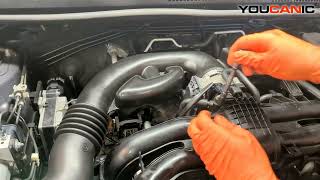
- Connect an OBD-II scanner and confirm P0108 is the primary code. 🎬 Watch: A mechanic's guide to diagnosing the P0108 code. Note any other codes present, such as P0420 (Catalyst Efficiency).
- On the scanner's live data screen, observe the 'MAP Sensor' reading. With the Key On, Engine Off (KOEO), the pressure reading should be close to the 'Barometric Pressure' (BARO) reading. They should be nearly identical at sea level.
- Start the engine. At a warm idle, the MAP sensor voltage should drop to approximately 1.0-2.0 volts. If the voltage remains high (e.g., 4.5V or higher), it confirms a fault.
- If the reading is stuck high, turn off the engine and disconnect the MAP sensor connector. Turn the key back on (KOEO). On many Subarus, the scan tool will now show a 'maxed out' reading (e.g., 75.3 inHg), which is a useful diagnostic clue.
- Inspect the connector and wiring harness for visible damage, corrosion, or loose pins.
- Using a multimeter on the disconnected harness connector (Key On, Engine Off), verify you have a 5V reference on one pin and a solid ground on another. Test the signal wire for any voltage; it should be near zero.
- If wiring and power/ground are good, the MAP sensor itself is the most likely culprit. Replace the sensor.
- After replacement, clear the codes and perform a test drive to ensure the issue is resolved.
Parts You'll Likely Need
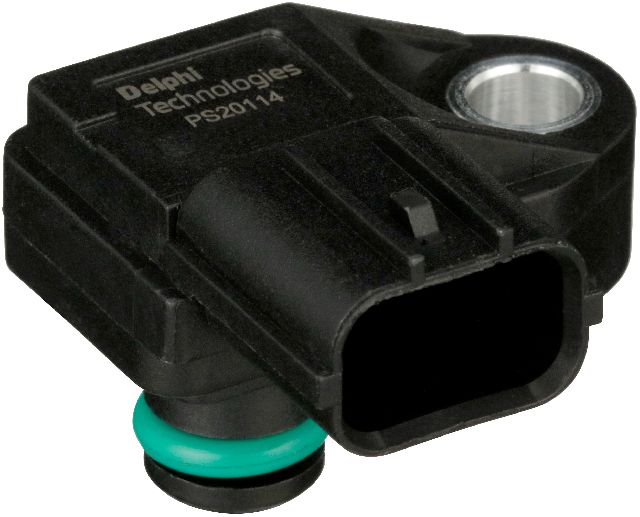
- Manifold Absolute Pressure (MAP) Sensor
(OEM #22627AA500)— This sensor is the most common failure point for a P0108 code, as an internal short will cause the signal voltage to read high continuously.
Trusted brands: Subaru (OEM), Denso (OEM Manufacturer), NGK/NTK, Standard Motor Products
OEM price range: $180-$250
Aftermarket price range: $40-$120
Platform-Specific Known Issues
- Sensor Contamination from Carbon Buildup: A user on Reddit with a 2017 WRX (same FA20F engine) reported a P0108-like issue where the MAP sensor was found to be 'caked in a tar/oil like substance'. Cleaning it was a temporary fix, but the underlying issue was severe carbon buildup requiring a full engine carbon cleaning service. This suggests that on high-mileage DIT engines, sensor failure may be precipitated by physical contamination.
Technical Service Bulletins (TSBs) & Recalls
- TSB Bulletin #07-96-15: A manufacturer service bulletin notes that certain harness changes involving the repositioning of the sensor and actuator wiring ground junction point can cause codes like P0108 to be set in error. The bulletin explains that this change moves the ground to a location unaffected by engine movement.
Mechanic-Grade Diagnostic Values
- MAP Sensor Signal Voltage (Key On, Engine Off) — expected: ~4.5 - 5.0 Volts, should match BARO reading. Failure: Voltage is significantly lower than BARO equivalent, or stuck near 0V or 5V regardless of condition.
- MAP Sensor Signal Voltage (Engine Idling, warm) — expected: ~1.0 - 2.0 Volts. Failure: Voltage remains high (near 4.5V) and does not drop when the engine starts.
- MAP Sensor Ground Wire Voltage (at connector) — expected: Less than 0.10 Volts (100 millivolts). Failure: Voltage significantly higher than 0.10V indicates a poor ground connection, which can skew sensor readings.
- MAP Sensor Live Data (Scan Tool, stuck high failure) — expected: Reading should fluctuate with throttle input.. Failure: Reading is stuck at a high, fixed value, for example near 119.5 kPa (35.29 inHg).
Wiring & Ground Locations
- MAP Sensor Connector (E124) — On the throttle body assembly, on the front of the intake manifold behind the alternator.. This is a 4-pin T-MAP (Temperature and Manifold Absolute Pressure) sensor. A short between the 5V reference and signal wire, or corrosion in the connector, will directly cause a P0108. Pinout is likely: Pin 1: 5V Reference, Pin 2: Ground, Pin 3: MAP Signal to ECM, Pin 4: Intake Air Temp Signal.
- Primary ECU Ground Point — On top of the intake manifold.. The ECU gets its primary ground reference from bolts on the intake manifold. A loose or corroded ground here can cause a floating ground, leading to erratic sensor readings, including a false P0108. This is especially critical if TGV deletes or spacers have been installed, as they can interrupt this ground path.
Real Owner Repair Stories
- Reddit user fluxds in r/WRX (2016 Subaru Forester XT) — Poor running condition, poor MPG.
✅ What actually fixed it The MAP sensor was found to be 'caked on' with deposits. After cleaning it three times, the user reported 'the car feels and runs hell of a lot better. MPG jumped up as well.' - Reddit user Extreme-Juice-25 in r/WRX (Subaru WRX (FA20F engine)) — Check Engine Light after installing an aftermarket MAP sensor.
❌ Tried (didn't work) Installed an aftermarket Omni Power MAP sensor.
✅ What actually fixed it The user stated they got the best results from using the stock (OEM) sensor. The aftermarket sensor would cause the CEL to illuminate shortly after installation, suggesting an issue with voltage scaling. They reverted to the OEM sensor.
OEM Part Supersession History
22012AA240→N/A— This is the correct OEM part number for the T-MAP sensor used on the 2014-2018 Forester XT with the 2.0L FA20F turbo engine.22627AA510→N/A— This is a common MAP sensor for other Subaru models, including the Forester, but it is for the 2.5L non-turbo engine. It is not compatible with the 2.0L turbo XT model.
Heads up: This part fits a different engine (FB25) and will not work for the FA20F engine, which requires a T-MAP sensor.22627AA500→N/A— This part number is frequently misidentified as a MAP sensor. It is an Exhaust Pressure Sensor for Subaru diesel models (often related to the DPF system) and is completely incorrect for the petrol Forester XT.
Heads up: Incorrect part type and application. Will not fit or function.
Model Year Variations Within This Range
- 2017-2018: The Forester received a facelift for the 2017 model year, which included revised exterior styling, a quieter cabin, and available Active Torque Vectoring on XT Touring models. However, these changes did not affect the FA20F engine or its management electronics, so the causes and fixes for P0108 remain identical across the 2014-2018 range.
Diagnostic Flowchart
Other Known Issues on This Vehicle
Issues unrelated to this code that are worth knowing about as an owner of this generation:
- Intake Valve Carbon Buildup 🟠 Medium — A known issue for all direct-injection (DIT) engines like the FA20F. Becomes noticeable and may require cleaning (walnut blasting) every 60,000-100,000 miles. Symptoms include misfires, rough idle, and hesitation.
- Lineartronic CVT Reliability Concerns 🟠 Medium — While many CVTs last the life of the vehicle, failures are not uncommon, particularly in earlier models of this generation (2014-2015). Failure often requires a full, expensive replacement. Subaru extended the warranty on some earlier CVTs to 10 years/100,000 miles, but this may not cover all vehicles in this range. (Ref: Warranty Extension Program (not a formal TSB for all models))
- Excessive Oil Consumption 🟡 Low — Some FA20F and FB25 engines may consume more oil than expected, often cited as up to 1 quart per 1,200-2,000 miles. While Subaru has stated this can be 'normal', it requires owners to check their oil level frequently between changes. A TSB and warranty extension were issued for some FB-series engines, but the FA20F is less commonly cited for severe issues. (Ref: TSB 02-157-14R (Primarily for FB engines, but illustrates Subaru's history with the issue))
- CAN System Parasitic Battery Drain 🟡 Low — Some owners report batteries dying unexpectedly. This has been linked in some newer Subaru models to the Controller Area Network (CAN) system not going to 'sleep' properly, causing a slow drain.
Used vs. New Parts: Buying Guide for This Vehicle
When a used part is the smart pick: A used OEM sensor from a low-mileage donor vehicle can be a cost-effective option if it is thoroughly inspected and cleaned. Given the high cost of a new OEM sensor, a used part is a reasonable choice if budget is a primary concern.
Donor-vehicle mileage cap: roughly under 60000 miles for the part to have meaningful remaining life.
What to inspect on the donor part:
- Inspect the sensor port for heavy oil or carbon 'caking'. A light film is normal, but heavy, tar-like buildup suggests the donor engine had significant blow-by.
- Check the plastic connector housing for cracks, brittleness, or a broken locking tab.
- Ensure the O-ring is present and not flattened or torn, though replacing it is always good practice.
OEM-only on this vehicle (don't cheap out):
- Manifold Absolute Pressure (MAP) Sensor
Aftermarket brands forum-validated for this vehicle:
- Denso (OEM supplier)
Brands owners have reported issues with on this vehicle:
- Unbranded, low-cost sensors from online marketplaces.
- Performance-oriented sensors (e.g., Omni Power 3-bar) unless the vehicle is specifically tuned for them, as their voltage scaling is different from stock and will cause persistent codes on an untuned car.
Real Owner Stories
Aggregated from forums and TSBs cited above. Mileages and costs reflect what owners reported in those sources.
Subaru Forester — 133000 miles
Symptoms: Lack of power under load and partial throttle, lurchiness and jerking, severe surging, difficulty holding idle, and poor mileage.
What fixed it: Professional repair of the MAP sensor wiring harness which had been repeatedly damaged by rodents.
Source hint: reddit r/SubaruForester
2017 Subaru WRX (FA20F) — ~80000 miles
Symptoms: Stuttering issue under boost; sensor found to be caked in a tar/oil like substance.
What fixed it: The MAP sensor required cleaning/replacement, but the underlying issue required a full engine carbon cleaning service (walnut blasting).
Source hint: Reddit r/WRX PSA on carbon build up with FA20s
Subaru WRX (FA20F)
Symptoms: Intermittent voltage spikes observed on a scan tool.
What fixed it: Identification of a short-to-power in the wiring harness; confirmed by unplugging the sensor to see if the scan tool maxed out at 75.3 inHg.
Source hint: MNSubaru.com thread titled 'MAP (Manifold Absolute Pressure) sensor issues P0108'
Related OBD-II Codes
Frequently Asked Questions
Is there a TSB for the excessive oil consumption I'm seeing alongside my P0108 code on my Forester?
Could the P0108 code be related to carbon buildup on my 2014-2018 Forester XT?
Why are my Cruise Control and VDC lights flashing when the Check Engine Light is for a MAP sensor?
Is there a warranty extension for the CVT transmission if I'm experiencing the lurching symptoms described with P0108?
Can I just clean the MAP sensor to fix the P0108 error?
Helpful Videos
We Have This Part in Stock


The information in this article is provided for general reference and educational purposes only. Vehicle specifications, procedures, and part compatibility can vary by production date, trim level, and region. Always consult your vehicle's factory service manual and verify part numbers before purchasing or performing repairs. Safety-critical components such as airbags, seat belts, and braking systems should be installed by a qualified professional.
- Subaru Forester:
- 🧭 Diagnostic Flowchart
- 🎬 Helpful Videos
- 🛍️ Shop This Part
- What's Unique About the 2014-2018 Subaru Forester
- Symptoms You May Notice
- Most Likely Causes
- Rare But Worth Checking
- Diagnosis Steps
- Parts You'll Likely Need
- Platform-Specific Known Issues
- Technical Service Bulletins (TSBs) & Recalls
- Mechanic-Grade Diagnostic Values
- Wiring & Ground Locations
- Real Owner Repair Stories
- OEM Part Supersession History
- Model Year Variations Within This Range
- Other Known Issues on This Vehicle
- Used vs. New Parts: Buying Guide for This Vehicle
- Real Owner Stories
- Subaru Forester — 133000 miles
- 2017 Subaru WRX (FA20F) — ~80000 miles
- Subaru WRX (FA20F)
- Related OBD-II Codes
- Frequently Asked Questions
- 🎟️ Get 5% Off