

P0108 on 2010-2015 Toyota Prius: MAP Sensor Circuit High Causes and Fixes
This code almost always points to a faulty Manifold Absolute Pressure (MAP) sensor or its wiring. On this Prius, it is very frequently caused by oil contamination from a bad or clogged PCV valve, a well-documented issue. A new OEM Denso sensor costs around $60-$90, and it's a DIY-friendly fix with a difficulty of 2/5. Cleaning the intake manifold of pooled oil is a critical step.
- P0108 on a 2010-2015 Prius is most often a failed MAP sensor.
- Before replacing the sensor, check for oil inside the intake manifold; if found, also replace the inexpensive PCV valve to prevent a repeat failure.
- Use a scan tool to check live data; the MAP reading should match the BARO reading when the engine is off.
- The OEM supplier for the sensor is Denso (part #198-1002), which is a reliable and more affordable alternative to the dealer part.
- The repair is straightforward and accessible for a DIY mechanic with basic tools.
What's Unique About the 2010-2015 Toyota Prius
On the 3rd Generation Prius, the 2ZR-FXE engine has a known tendency for its PCV (Positive Crankcase Ventilation) system to allow oil into the intake manifold. This is exacerbated by low-tension piston rings designed for fuel efficiency, which can lead to increased oil blow-by. This oil can pool and contaminate the MAP sensor, causing it to fail and trigger a P0108 code. While a bad sensor is the most common fix, cleaning the intake and replacing the PCV valve is a unique and crucial diagnostic step on this specific vehicle.
Symptoms You May Notice
- Check Engine Light is on
- Rough or unstable idle
- Hesitation or sluggish acceleration
- Decreased fuel economy
- Engine stalling, especially when coming to a stop
- Black smoke from the exhaust
- Strong smell of gasoline
- Replacing the Mass Airflow (MAF) sensor. The MAF and MAP sensors both measure air, but they are different parts. P0108 specifically points to the MAP sensor circuit.
- Replacing the MAP sensor without cleaning the intake manifold. If the intake is full of oil, the new sensor will quickly become contaminated and fail again, leading to the code returning.
Most Likely Causes
- Faulty MAP Sensor 🔴 High Probability → Shop Manifold Absolute Pressure Sensor The sensor can fail internally from age or become contaminated by oil due to a common PCV system issue on this engine. The sensor tip gets coated in oil, leading to incorrect readings.
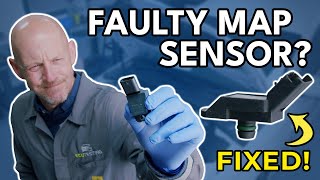
How to confirm: With the key on and engine off, use a scan tool to compare the MAP sensor reading to the Barometric Pressure (BARO) reading. They should be nearly identical (around 101 kPa at sea level). A significant difference points to a bad sensor. 🎬 Watch: How to diagnose MAP sensor codes like P0108. Visually inspect the sensor tip for oil upon removal.
Typical fix: Replace the MAP sensor. It is highly recommended to use the OEM supplier part (Denso). Before replacing, try cleaning the sensor with a dedicated MAF or electronics cleaner.
Est. part cost: $60-$90 for a Denso sensor, versus $240+ for a Toyota-branded OEM part. - Clogged PCV Valve and Oily Intake Manifold 🔴 High Probability The PCV system on the 2ZR-FXE engine is known to get stuck, allowing engine oil to be sucked into the intake manifold, where it pools and fouls the MAP sensor. This is a very common root cause for P0108 on this platform.
How to confirm: Remove the MAP sensor and throttle body. Inspect the inside of the intake manifold for pooled oil using a flashlight. If significant oil is present, a faulty PCV valve is the confirmed source.
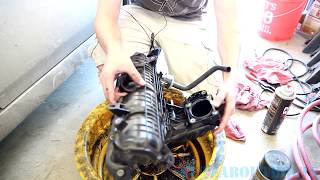
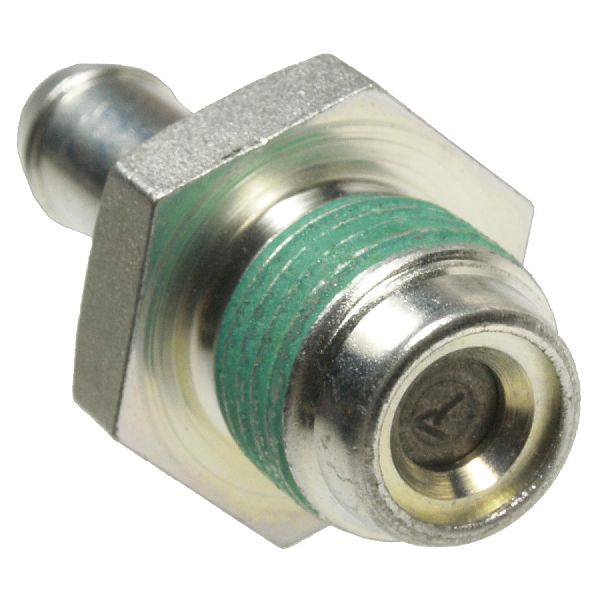
Typical fix: Replace the PCV valve (Toyota P/N: 12204-37010), 🎬 See this walkthrough on how to replace the PCV valve. clean the oil out of the intake manifold thoroughly, 🎬 Watch: Step-by-step guide to cleaning your Prius intake manifold. and clean or replace the MAP sensor. This is often done as a complete service.
Est. part cost: $10-$20 for an OEM PCV valve, plus the cost of the MAP sensor if it cannot be cleaned successfully. - Wiring or Connector Issue 🟡 Medium Probability The engine bay environment can lead to corrosion on connector pins or damage to wires over time, creating a short to power or a bad connection.
How to confirm: Visually inspect the MAP sensor connector and wiring harness for any signs of damage, corrosion, or loose connections. Use a multimeter to check for 5V reference, good ground, and a signal wire that varies with vacuum. Wiggle the harness while monitoring live data to check for intermittent faults.
Typical fix: Repair the damaged section of the wiring harness or clean/replace the connector pigtail.
Est. part cost: $10-$50 for wiring repair supplies or a new pigtail connector.
Rare But Worth Checking
- Failing 12V Auxiliary Battery: On Toyota hybrids, a weak 12V battery can cause a wide range of seemingly unrelated electrical fault codes, including sensor circuit high/low codes. If the battery is over 5 years old or tests weak, it should be addressed before chasing complex sensor issues.
- Clogged Catalytic Converter: A severely clogged catalytic converter can create excessive backpressure that may affect intake manifold pressure readings. This is a rare cause for P0108 and would typically be accompanied by other codes (like P0420) and severe performance loss.
- Faulty Engine Control Module (ECM): → Shop Engine Control Module (ECM) This is extremely rare, but the ECM's internal circuit that reads the sensor's voltage can fail. This should only be considered after all other possibilities, including wiring and grounds, have been exhaustively ruled out by a professional.
Diagnosis Steps
- Read the code with an OBD-II scanner and check for any other accompanying codes. Note freeze frame data.
- With the Key On, Engine Off (KOEO), use the scanner's live data function to view the MAP sensor voltage/pressure. Compare it to the BARO (Barometric) reading. They should be very close (e.g., ~14.7 PSI or 101 kPa at sea level). If the MAP reading is stuck high (e.g., 5.0V), the sensor or circuit is faulty.
- Start the engine. The MAP sensor reading should drop significantly at idle (indicating vacuum, typically to around 3-5 PSI). If the reading stays high, it confirms a problem.
- Visually inspect the MAP sensor's electrical connector and wiring for any obvious damage, corrosion, or loose pins. Check for 5-volt reference, good ground, and signal wire integrity with a multimeter.
- Remove the MAP sensor. It is located on the intake manifold, just below the throttle body. Inspect the sensor tip and the port for heavy oil contamination or carbon buildup.
- CRITICAL STEP FOR PRIUS: While the sensor is out, use a flashlight to inspect the inside of the intake manifold for pooled engine oil. If oil is present, the PCV valve is the root cause and must be replaced.
- If significant oil is found, the recommended repair is to replace the PCV valve (P/N: 12204-37010), thoroughly clean the oil from the intake manifold, clean the throttle body, and clean or replace the MAP sensor.
- If the sensor and wiring check out, and no oil is present, consider the rarer possibilities of a major vacuum leak or a restriction in the exhaust (clogged catalytic converter).
- If all else fails, the final step would be to suspect a faulty ECM, though this is highly unlikely.
Parts You'll Likely Need
- Manifold Absolute Pressure (MAP) Sensor
(OEM #89421-47010)— This is the most common failure point for a P0108 code, either due to internal failure or oil contamination specific to this vehicle.
Trusted brands: Denso (OEM Supplier), Toyota (Genuine), Standard Motor Products (SMP)
OEM price range: $240-$260
Aftermarket price range: $60-$120 - PCV Valve
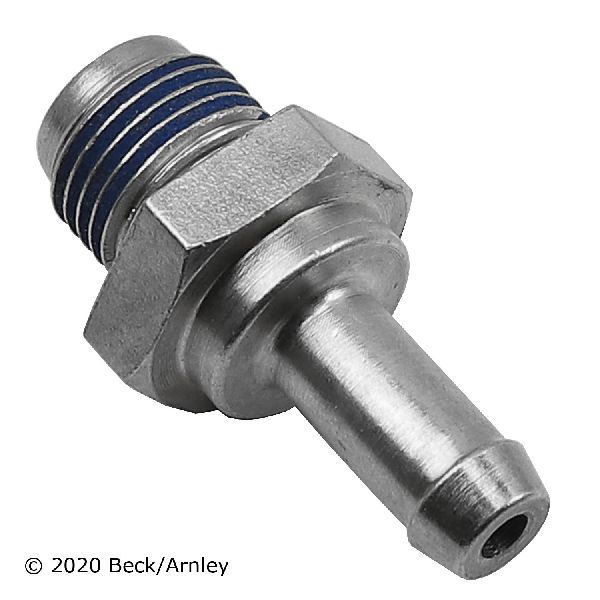
(OEM #12204-37010)— A faulty PCV valve is the most common root cause of oil contamination in the intake manifold on this engine, which leads to MAP sensor failure. It's a cheap part and essential preventative maintenance when addressing P0108.
Trusted brands: Toyota (OEM)
OEM price range: $10-$15
Aftermarket price range: $5-$10
Related Codes That Often Appear With This One
- P0107 — This code is for 'MAP Sensor Circuit Low Input'. Seeing both P0107 and P0108 can indicate an intermittent wiring problem, a connector with a poor fit, or a sensor that is failing erratically.
- P0106 — This code means 'MAP/Barometric Pressure Circuit Range/Performance'. It often appears with P0108 when the sensor's readings are erratic or don't correlate correctly with other sensor inputs, like throttle position.
- P0401 — This code for 'Insufficient EGR Flow' is extremely common on this engine due to carbon clogging the EGR cooler and passages. While not directly causing P0108, it indicates poor engine breathing and maintenance neglect that often go hand-in-hand with the PCV issues causing P0108.
Technical Service Bulletins (TSBs) & Recalls
- T-SB-0168-16: While not for P0108 directly, this TSB details the official procedure for diagnosing excessive oil consumption on the 2ZR-FXE engine, which is the root cause of the oil-fouled MAP sensor. It acknowledges redesigned pistons and rings to address the issue.
Platform-Specific Known Issues
- The PCV system design on the 2ZR-FXE engine, combined with low-tension piston rings, can lead to significant oil being drawn into the intake manifold. This fouls the MAP sensor and throttle body and is a well-documented issue in owner forums.
- A user on PriusChat with a 2010 Prius at 125k miles experienced P0108. The dealer quoted $377 to replace the sensor. The owner replaced it himself with a Denso part, but the code remained. This highlights that simply replacing the sensor without addressing underlying issues like wiring or oil contamination may not solve the problem.
Mechanic-Grade Diagnostic Values
- MAP Sensor Connector Pin Voltages (KOEO) — expected: Pin 1 (VC, 5V Reference): ~5.0V. Pin 2 (PIM, Signal): ~4.5V (matches BARO). Pin 3 (E2, Sensor Ground): ~0V (check for continuity to chassis ground).. Failure: No 5V reference points to a wiring or ECM issue. Signal voltage not matching BARO or stuck at 5V indicates a bad sensor. Lack of continuity on the ground pin (E2) indicates a broken ground wire.
- MAP Sensor Voltage at Idle (Engine Warm) — expected: 1.0V - 2.0V.. Failure: Voltage remaining high (near KOEO levels) indicates the sensor is not reading engine vacuum, likely due to internal failure or a complete blockage of the sensor port.
- Techstream Live Data Path — expected: Navigate to: Powertrain / Engine and ECT / Data List / All Data / MAP.. Failure: Use this path to monitor the MAP sensor value in kPa or PSI and compare it against the 'Atmosphere Pressure' value with KOEO. They should be nearly identical.
Scan Tool Commands That Help
- Techstream: Data List (All Data / MAP) — This is the primary function for this diagnosis. It allows the technician to view the live data from the MAP sensor in kPa. This reading can be compared to the Barometric Pressure (BARO) sensor reading with the Key On, Engine Off to quickly determine if the sensor is reading incorrectly.
Wiring & Ground Locations
- MAP Sensor Connector (E26) — On the intake manifold, just below the throttle body.. This is the primary connection point. Check for corrosion, pushed-out pins, or oil contamination. The pins are typically labeled: 1 (VC - 5V Ref), 2 (PIM - Signal), 3 (E2 - Ground).
- Engine Ground Points — There are several key ground wire clusters on the 2ZR-FXE. One is on the driver's side of the engine block, near the transaxle. Another cluster bolts directly to the cylinder head. A key ground strap runs from the engine/transaxle to the chassis near the coolant reservoir.. A poor engine ground can cause floating voltages on sensor circuits. A PriusChat user with P0108 found the sensor ground wire (E2) had no continuity to ground due to a break in the harness, which was the ultimate cause of the code after a new sensor didn't fix it.
Real Owner Repair Stories
- PriusChat user 'Bookkeepper' (2010 Toyota Prius) — P0108 code, but car drove normally with good MPG.
❌ Tried (didn't work) Replacing the MAP sensor with a new Denso part., Cleaning the original MAP sensor., Unplugging the sensor entirely (still threw P0108).
✅ What actually fixed it After checking continuity with a multimeter, the user discovered the sensor ground wire ('E2') had no continuity back to the ECM or to chassis ground. The problem was a broken ground wire within the wiring harness. Repairing the wire solved the code. - Reddit user 'LeadingImmediate6112' (2010 Toyota Prius, 205k miles) — P0107 and P0108 codes appeared after replacing the water pump.
❌ Tried (didn't work) Cleaning the MAP sensor., Searching for a vacuum leak.
✅ What actually fixed it A mechanic identified significant oil in the intake manifold, diagnosing a stuck-open PCV valve. Replacing the PCV valve and cleaning the MAP sensor finally cleared the codes.
OEM Part Supersession History
Unknown→89421-47010— Standard part for this generation.
Heads up: Part number 89421-47010 is the correct and widely available sensor for the 2010-2015 Prius. Some aftermarket listings may cross-reference 89421-52010, which may also be compatible but 89421-47010 is the confirmed OEM number.
Model Year Variations Within This Range
- 2010 - Mid-2014: Vehicles produced before the VIN cutoffs specified in T-SB-0168-16 and T-SB-0169-16 have the original low-tension piston rings. These earlier models are significantly more prone to the oil consumption issue that leads to oil pooling in the intake and fouling the MAP sensor.
- Mid-2014 - 2015: Toyota began installing updated pistons and higher-tension piston rings partway through the 2014 model year to address oil consumption. While not immune, these later models are less likely to experience severe oil blow-by that causes P0108, though the PCV system can still fail on its own.
Diagnostic Flowchart
Other Known Issues on This Vehicle
Issues unrelated to this code that are worth knowing about as an owner of this generation:
- Head Gasket Failure 🔴 High — Commonly occurs between 150,000 and 220,000 miles. Often preceded by engine rattle on startup.
- EGR (Exhaust Gas Recirculation) System Clogging 🔴 High — Extremely common, typically requires cleaning every 80,000-120,000 miles to prevent head gasket failure. Clogs EGR cooler, valve, and intake manifold ports. (Ref: T-SB-0027-16 (relates to updated parts))
- Brake Actuator Assembly Failure 🔴 High — A well-known issue where the brake booster pump fails, leading to loss of braking assist and multiple warning lights. Can occur around 100k-150k miles. (Ref: Customer Support Program ZJB (expired), various recalls on specific model years.)
- Excessive Oil Consumption 🟠 Medium — Common in higher mileage (100k+) vehicles due to low-tension piston rings and carbon buildup. Can be as high as 1 quart per 1,000 miles. (Ref: T-SB-0168-16 (Inspection), T-SB-0169-16 (Repair))
- Hybrid Inverter Failure 🔴 High — Can cause the vehicle to stall while driving. Less common than other issues but a significant safety concern. (Ref: Recalls 18V684000 and 14V053000 for the Intelligent Power Module (IPM) within the inverter.)
Used vs. New Parts: Buying Guide for This Vehicle
When a used part is the smart pick: A used intake manifold from a low-mileage donor car can be a cost-effective option if yours is heavily caked with carbon and oil sludge and you prefer not to spend hours cleaning it. A used MAP sensor is generally not recommended due to the high risk of it being oil-fouled or near the end of its life.
Donor-vehicle mileage cap: roughly under 80000 miles for the part to have meaningful remaining life.
What to inspect on the donor part:
- For an intake manifold, inspect all ports for cleanliness. Remove the throttle body and MAP sensor to look inside for any signs of pooled oil or heavy carbon.
- Check for any cracks or damage to the plastic housing, especially around mounting points and vacuum nipples.
- If possible, source from a later model year (late 2014-2015) which is less likely to have suffered from severe oil blow-by.
OEM-only on this vehicle (don't cheap out):
- PCV Valve: This is a very inexpensive yet critical part. Given the low cost of a genuine Toyota PCV valve (~$15), there is no reason to risk an aftermarket or used one.
- MAP Sensor: While not strictly OEM-only, using the OEM supplier (Denso) is highly recommended. Avoid no-name, unbranded sensors from online marketplaces.
Aftermarket brands forum-validated for this vehicle:
- Denso: As the Original Equipment Manufacturer, Denso sensors are the gold standard and are often available for significantly less than the Toyota-branded part.
- Standard Motor Products (SMP): Generally considered a reliable Tier 1 aftermarket supplier, though some forum users prefer to stick with Denso for critical sensors.
Brands owners have reported issues with on this vehicle:
- Unbranded or 'white-box' sensors from eBay or Amazon. These often have poor quality control, leading to inaccurate readings, premature failure, and the code returning quickly.
Real Owner Stories
Aggregated from forums and TSBs cited above. Mileages and costs reflect what owners reported in those sources.
2010 Toyota Prius 1.8L Hybrid — 125000 miles
Symptoms: P0108 code present. The owner was quoted $377 by a dealer to replace the sensor.
What fixed it: The owner replaced the sensor with a Denso part, but the code remained, suggesting the fix required addressing underlying wiring or oil contamination issues.
Cost: $60-$377
Source hint: PriusChat.com user report cited in vehicle_specific_issues
2010 Toyota Prius 1.8L Hybrid — 205000 miles
Symptoms: P0107 and P0108 codes; oil found in the intake manifold.
What fixed it: Replacing the stuck-open PCV valve and cleaning the MAP sensor.
Source hint: Reddit r/prius & r/MechanicAdvice
Related OBD-II Codes
Frequently Asked Questions
Does TSB-0168-16 apply to my 2010-2015 Prius if I have a P0108 code?
Can I just clean the MAP sensor on my Prius instead of buying a new one?
Is there a specific part number for the PCV valve I should use to prevent P0108 from returning?
Why did my P0108 code stay on even after I replaced the MAP sensor with a Denso part?
Are there any other Toyota or Lexus models that suffer from this same P0108 issue?
What is the cost difference between a Denso MAP sensor and a Toyota-branded one?
Helpful Videos
We Have This Part in Stock


The information in this article is provided for general reference and educational purposes only. Vehicle specifications, procedures, and part compatibility can vary by production date, trim level, and region. Always consult your vehicle's factory service manual and verify part numbers before purchasing or performing repairs. Safety-critical components such as airbags, seat belts, and braking systems should be installed by a qualified professional.
- Toyota Prius:
- 🧭 Diagnostic Flowchart
- 🎬 Helpful Videos
- 🛍️ Shop This Part
- What's Unique About the 2010-2015 Toyota Prius
- Symptoms You May Notice
- Most Likely Causes
- Rare But Worth Checking
- Diagnosis Steps
- Parts You'll Likely Need
- Related Codes That Often Appear With This One
- Technical Service Bulletins (TSBs) & Recalls
- Platform-Specific Known Issues
- Mechanic-Grade Diagnostic Values
- Scan Tool Commands That Help
- Wiring & Ground Locations
- Real Owner Repair Stories
- OEM Part Supersession History
- Model Year Variations Within This Range
- Other Known Issues on This Vehicle
- Used vs. New Parts: Buying Guide for This Vehicle
- Real Owner Stories
- 2010 Toyota Prius 1.8L Hybrid — 125000 miles
- 2010 Toyota Prius 1.8L Hybrid — 205000 miles
- Related OBD-II Codes
- Frequently Asked Questions
- 🎟️ Get 5% Off