

P0111 on 2014-2018 Jaguar F-TYPE: IAT Sensor 1 Range/Performance Fault Guide
On a 2014-2018 F-TYPE with a V6 or V8, P0111 usually means the Intake Air Temperature (IAT) sensor for Bank 1 has failed. On these supercharged engines, there are two standalone IAT sensors located at the rear of the supercharger, one for each bank. Bank 1 is the right (USA passenger) side. The sensor (part C2Z17977) is inexpensive, but access can be tight, making replacement a moderately difficult DIY.
- P0111 on your F-TYPE V6/V8 most likely points to a failed standalone IAT sensor on the intake manifold, not the MAF sensor.
- Use a scanner to check live data; a -40° temperature reading is a clear sign of a failed sensor or broken wire.
- The replacement part is inexpensive and the repair is a simple DIY job for most owners.
- Always check the wiring and connector before spending money on parts.
- The official Jaguar TSB for this issue also includes a MAF sensor code (P0100), so be aware they are diagnostically related.
What's Unique About the 2014-2018 Jaguar F-TYPE
On the supercharged AJ126 (V6) and AJ133 (V8) engines, air temperature is measured at two key points. First, a sensor integrated into the Mass Airflow (MAF) housing measures air temperature as it enters the intake system. Second, and more critically for this code, there are two dedicated IAT sensors—one for each cylinder bank—screwed into the charge air coolers (intercoolers) at the rear of the supercharger. These sensors measure the temperature of the air after it has been heated by compression. P0111 specifically refers to the sensor for Bank 1 (the right-hand bank). This setup is often a point of confusion, as the failing sensor is not the one near the air filters. The provided TSB (SSM73671) links P0111 to a MAF code (P0100), indicating the PCM cross-references these sensors, but the most common failure point for P0111 is the standalone post-supercharger sensor.
Diagnostic Flowchart
Tap your situation to follow the diagnostic path that matches what you're seeing on this vehicle.
Symptoms You May Notice
- Check Engine Light (CEL) is on
- Reduced fuel economy
- Engine hesitation or stumbling on acceleration
- Rough idle
- Hard starting, especially in very hot or cold weather
- Black smoke from the exhaust in some cases, indicating a rich fuel mixture
- Reduced supercharger boost or overall power as the PCM enters a protective mode
- Replacing the Mass Airflow (MAF) sensor immediately, without confirming that the primary sensor for this code is the standalone unit on the supercharger.
- Replacing the wrong temperature sensor. These engines have two post-supercharger IAT sensors; P0111 is for Bank 1 (right side), while the Bank 2 sensor (left side) would trigger a different code (e.g., P0116-related).
- Confusing P0111 (System Performance) with P0113 (Circuit High), which points more directly to an electrical open circuit. However, a failed sensor often causes both.
Most Likely Causes
- Faulty Standalone Intake Air Temperature (IAT) Sensor (Bank 1) 🔴 High Probability → Shop Fuel Injection Air Flow Meter The sensor is a thermistor that operates in a high-heat, high-pressure environment at the rear of the supercharger. Constant heat cycling causes the sensor's internal components to fail, leading to an open or short circuit.
How to confirm: Use an OBD-II scanner to monitor live data for 'IAT Sensor 1'. A reading stuck at -40°F or -40°C is a definitive sign of an open circuit, pointing to a failed sensor or wiring break. You can also test the sensor's resistance with a multimeter; it should not be an open circuit. At 68°F (20°C), a good sensor should read approximately 3750 ohms.
Typical fix: Replace the standalone IAT sensor for Bank 1. It is located on the right-hand side charge air cooler at the rear of the supercharger. Access is tight and may require removal of the cabin filter cowl for better reach.
Est. part cost: $25-$75 - Wiring or Connector Issue 🟡 Medium Probability Engine bay heat and vibration can cause wires to become brittle and break or connectors to become loose or corroded over time. The sensor's location at the back of the engine makes the harness susceptible to damage during other service procedures.
How to confirm: Visually inspect the wiring harness and connector going to the Bank 1 IAT sensor for any signs of damage, melting, corrosion, or loose pins. Perform a continuity test on the signal and ground wires from the sensor connector to the PCM. With the key on, check for a 5V reference on one pin and a solid ground on the other.
Typical fix: Repair the damaged section of wiring or clean/replace the connector pigtail.
Est. part cost: $5-$30 - Dirty or Faulty Mass Airflow (MAF) Sensor ⚪ Low Probability → Shop Fuel Injection Air Flow Meter The PCM compares signals from multiple sensors. If the MAF sensor (which contains its own IAT sensor) is dirty or failing, it can provide conflicting data, leading the PCM to flag the post-supercharger IAT circuit as having a performance issue, even if the sensor itself is functional.
How to confirm: This is often diagnosed when replacing the standalone IAT sensor doesn't fix the code. Check for other codes, specifically P0100-P0104. Cleaning the MAF sensor with a dedicated cleaner is a good first step.
Typical fix: Clean the MAF sensor element with MAF sensor cleaner. If the problem persists, replace the MAF sensor assembly.
Est. part cost: $150-$250
Rare But Worth Checking
- Powertrain Control Module (PCM) Fault: → Shop Engine Control Module (ECM) This is extremely rare. The PCM should only be considered after all other possibilities (sensor, wiring, other intake sensors) have been exhaustively tested and ruled out.
- Intake Air Leak (Post-MAF): A significant vacuum leak can, in some cases, cause airflow and temperature readings that the PCM finds illogical, potentially triggering a performance code like P0111. This was also noted in TSB SSM73671 for other engines, suggesting it's a known diagnostic path for JLR.
Diagnosis Steps
- Connect an OBD-II scanner and check for any other fault codes. Pay special attention to codes P0100-P0104 and P0110-P0114.
- View live data for 'Intake Air Temperature Sensor 1'. With a cold engine, the reading should be close to the ambient air temperature and the ECT reading. If it reads -40°F or another illogical fixed value, the sensor or its circuit is open/shorted.
- Locate the IAT sensor for Bank 1. On the V6/V8 engines, this is one of two sensors at the rear of the engine, screwed into the charge air coolers under the supercharger lid. Bank 1 is the right-hand (USA passenger) side.
- Visually inspect the sensor's connector and wiring for any obvious signs of damage, corrosion, or looseness. Access may require removing the upper cowl panel.
- If wiring looks good, disconnect the sensor. Test the sensor's resistance with a multimeter. It should not be an open circuit (infinite resistance). At room temperature (68°F/20°C), expect a resistance of around 3.75 kOhms.
- If the sensor tests bad, replace it. The OEM part number is C2Z17977.
- If the sensor tests good, check the wiring. With the ignition on, test for a 5V reference and a good ground at the connector pigtail. Check for continuity on both wires back to the PCM.
- If all wiring and the sensor are confirmed good, consider cleaning the MAF sensor as a next step, as conflicting signals could be the cause.
- After any repair, clear the codes and perform a drive cycle, including both city and highway driving, to ensure the fault does not return.
Parts You'll Likely Need
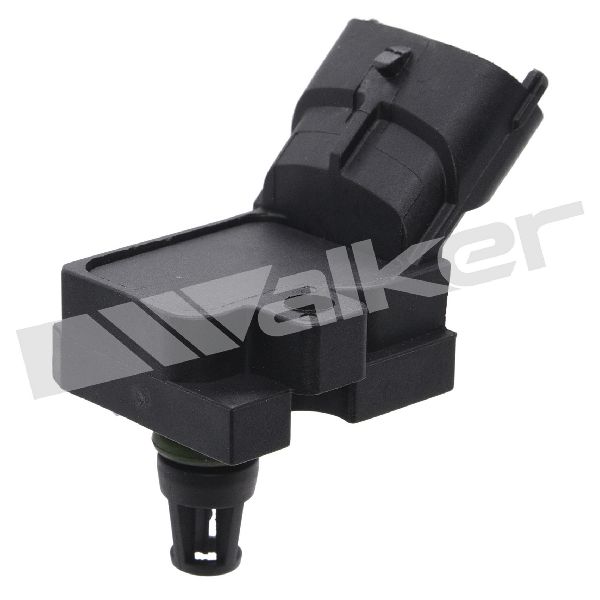
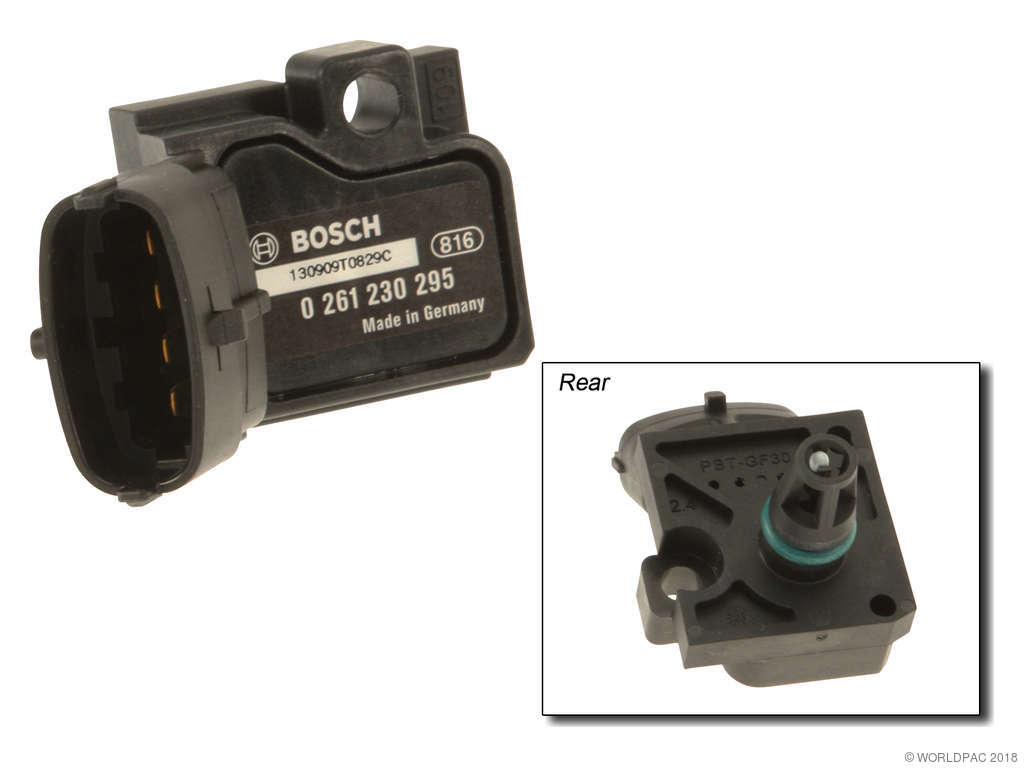
- Intake Air Temperature Sensor
(OEM #C2Z17977)— This standalone sensor is the most common failure point for the P0111 code on the F-TYPE's supercharged engines. It is a shared part across many supercharged Jaguar Land Rover vehicles.
Trusted brands: Jaguar (OEM), Bosch, Delphi, NTY, Standard Motor Products
OEM price range: $50-$100
Aftermarket price range: $25-$60
Related Codes That Often Appear With This One
- P0100 — This code for the Mass Air Flow (MAF) sensor is explicitly mentioned alongside P0111 in Jaguar's Technical Service Bulletin #SSM73671, indicating they are often diagnosed together as the PCM compares their values.
- P0113 — P0113 indicates 'IAT Sensor Circuit High', which is a more specific electrical fault (open circuit). P0111 is a performance/range code, but a sensor that has failed and is causing P0113 could also trigger P0111.
- P0171/P0174 — If the IAT sensor is incorrectly reporting colder air than is actually present, the PCM may not add enough fuel, leading to a lean condition on one or both banks.
Technical Service Bulletins (TSBs) & Recalls
- SSM73671 Attachm: Notes that DTCs P0100, P0111, and P0113 may be logged in the PCM for intake air measurement issues.
Platform-Specific Known Issues
- Jaguar issued Technical Service Bulletin #SSM73671 which groups P0111 with MAF sensor code P0100 and IAT circuit code P0113, indicating a known diagnostic pattern for intake air system faults on these powertrains.
- Owner experiences confirm the Bank 1 and Bank 2 IAT sensors are located at the rear of the supercharger, screwed into the intercoolers. Access is tight, especially for the Bank 1 (right side) sensor, often requiring removal of the plastic cowl cover at the base of the windshield for easier access.
Mechanic-Grade Diagnostic Values
- IAT Sensor Resistance — expected: Approx. 3750 Ohms at 68°F (20°C), and 2400 Ohms at 86°F (30°C). Resistance decreases as temperature increases.. Failure: Infinite resistance (open circuit), zero resistance (short circuit), or a value that does not change when the sensor's temperature is changed with a heat gun or by engine heat.
- IAT Sensor Connector Voltage (Key On, Engine Off) — expected: One pin should show a 5-volt reference signal from the PCM. The other pin should show near 0 volts (ground).. Failure: Absence of the 5V reference or a ground reading significantly above 0 volts points to a wiring harness or PCM issue, not a sensor failure.
Hidden / Shadow Codes Worth Checking
- P0111-84: The '-84' is a JLR-specific suffix code meaning 'Bus signal/message failure - signal is below allowable range'. This indicates the PCM is receiving a signal that is valid in form, but lower than the minimum expected value when cross-referenced with other sensors (like ECT and MAF/IAT1). This points directly to a performance/rationality fault rather than a simple open/short circuit. (see via JLR-specific diagnostic tools like SDD or Pathfinder, though some high-end generic scanners may display it.)
Scan Tool Commands That Help
- Jaguar SDD / Pathfinder: Live Data Monitoring for IAT1, IAT2, ECT, and MAF sensors. — This is the primary diagnostic step. It allows a technician to compare the readings of the two post-supercharger IAT sensors against each other and against the pre-supercharger IAT (in the MAF) and ECT sensors on a cold start. All should read within a few degrees of each other. If the IAT for Bank 1 reads significantly different from the others, it confirms the fault location.
- Jaguar SDD / Pathfinder: Adaptation Clear / Reset Learned Values — After replacing the IAT sensor, it is good practice to reset the PCM's learned fuel trim and air temperature adaptations. While not always strictly necessary, it forces the PCM to immediately use the new sensor's readings for fuel calculations, rather than slowly re-learning over several drive cycles.
Wiring & Ground Locations
- Engine Control Module (ECM/PCM) — Located in the left rear of the engine compartment.. The IAT sensor wiring harness runs directly to the ECM. Any damage to the ECM connectors or the module itself, though rare, can cause this code.
- G3D138A — A major ground point located under the passenger footwell.. While not the direct ground for the IAT sensor itself (which is typically grounded through the PCM), a poor body or chassis ground in this area can introduce electrical noise and intermittent sensor issues. It's a known ground point to check for general electrical gremlins on the passenger side of the vehicle.
Real Owner Repair Stories
- JaguarForums.com user report (2016+ Jaguar F-TYPE) — P0111 code present, but generic OBD-II scanner (like Torque Pro) was showing ambient air temperature for the IAT PID, causing diagnostic confusion.
❌ Tried (didn't work) Using standard IAT PIDs on generic scan tools.
✅ What actually fixed it The user noted that on 2016+ models, the standard IAT PID may not report the correct post-supercharger temperature, instead defaulting to ambient. A JLR-specific tool or an advanced scanner with correct PID support is needed for accurate live data diagnosis. One user mentioned a potential 'IAT2 PID hack' for the Torque app involving subtracting 40 degrees, but its effectiveness was unconfirmed. - JaguarForums.com user report (Jaguar XF (with similar AJ133 V8 engine)) — Persistent P0111 and other running issues.
❌ Tried (didn't work) Replaced MAF sensor, MAP sensor, Coolant Temp sensor, and finally the correct IAT sensor.
✅ What actually fixed it The ultimate fix was discovering and reconnecting a vacuum line to the MAP sensor that had been disconnected. This highlights the importance of checking for vacuum leaks, as the PCM's rationality checks can be thrown off by incorrect manifold pressure, leading it to flag a temperature sensor performance code.
OEM Part Supersession History
C2Z17977→No direct supersession noted. This part number remains current.— N/A
Heads up: This part is widely used across Jaguar and Land Rover models from 2006 onwards, including the F-TYPE, XF, XJ, XK, and F-Pace with supercharged engines.
Model Year Variations Within This Range
- 2016-2018: There are multiple owner reports indicating that after the 2016 model year, generic OBD-II scan tools may have difficulty reading the correct IAT sensor PID for the post-supercharger sensors. The scanner may default to showing the ambient air temperature instead, making live data diagnosis difficult without a JLR-specific tool or an advanced scanner with the correct software.
Helpful Videos
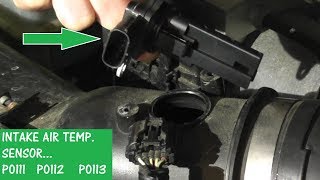
We Have This Part in Stock


The information in this article is provided for general reference and educational purposes only. Vehicle specifications, procedures, and part compatibility can vary by production date, trim level, and region. Always consult your vehicle's factory service manual and verify part numbers before purchasing or performing repairs. Safety-critical components such as airbags, seat belts, and braking systems should be installed by a qualified professional.
- Jaguar F-TYPE:
- 🧭 Diagnostic Flowchart
- 🎬 Helpful Videos
- 🛍️ Shop This Part
- What's Unique About the 2014-2018 Jaguar F-TYPE
- Symptoms You May Notice
- Most Likely Causes
- Rare But Worth Checking
- Diagnosis Steps
- Parts You'll Likely Need
- Related Codes That Often Appear With This One
- Technical Service Bulletins (TSBs) & Recalls
- Platform-Specific Known Issues
- Mechanic-Grade Diagnostic Values
- Hidden / Shadow Codes Worth Checking
- Scan Tool Commands That Help
- Wiring & Ground Locations
- Real Owner Repair Stories
- OEM Part Supersession History
- Model Year Variations Within This Range
- 🎟️ Get 5% Off