

P0111 on 2017-2018 Jaguar XE: Intake Air Temperature Sensor Faults and Fixes
Code P0111 on a 2017-2018 Jaguar XE indicates a problem with the Intake Air Temperature (IAT) sensor's performance. The most common cause is a faulty or dirty IAT sensor, which is often integrated into the Mass Airflow (MAF) sensor. Cleaning or replacing the MAF/IAT sensor assembly is the usual fix. For V6 models, there are two MAF sensors to check.
- P0111 on a Jaguar XE points to an issue with the Intake Air Temperature sensor's performance, which is integrated into the MAF sensor.
- The most likely culprit is a dirty or faulty MAF/IAT sensor assembly. The 3.0L V6 has two of them.
- Before replacing parts, try cleaning the sensor with a dedicated MAF sensor cleaner.
- Check the wiring and connector to the sensor for any visible damage or corrosion.
- On 2.0L models, check for air leaks at the intake elbow per TSB SSM73671.
- A scan tool capable of reading live data is extremely helpful for diagnosing the issue by comparing sensor readings.
What's Unique About the 2017-2018 Jaguar XE
On the Jaguar XE, regardless of whether it has the 2.0L 'Ingenium' four-cylinder or the 3.0L 'AJ126' V6, the Intake Air Temperature (IAT) sensor is integrated into the Mass Airflow (MAF) sensor assembly. This means a fault in the IAT sensor requires replacing the entire MAF unit. A key difference is that the 3.0L supercharged V6 engine has a dual intake system and is equipped with two MAF/IAT sensors, one for each cylinder bank. A P0111 code refers to Bank 1, so it's crucial to identify the correct sensor for diagnosis and replacement. TSB #SSM73671 also links this code with a MAF sensor code (P0100-38), reinforcing the connection between the two components on this platform.
Diagnostic Flowchart
Tap your situation to follow the diagnostic path that matches what you're seeing on this vehicle.
Symptoms You May Notice
- Check Engine Light is on
- Reduced fuel economy
- Rough idle or hesitation during acceleration
- Difficulty starting the engine, especially in cold weather
- Black smoke from the exhaust due to a rich fuel mixture
- Engine surging at idle
- "Restricted Performance" message on the instrument cluster
- Replacing the oxygen sensors when the issue is actually an incorrect air-fuel mixture caused by the faulty IAT sensor.
- Replacing the throttle body when the cause is a simple vacuum leak or a dirty MAF sensor.
Most Likely Causes
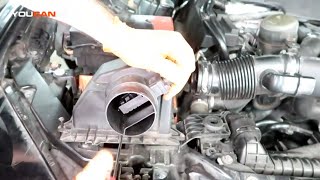
- Faulty or Dirty IAT/MAF Sensor 🔴 High Probability → Shop Fuel Injection Air Flow Meter The IAT sensor is integrated with the MAF sensor, which is positioned in the air intake tract and can get contaminated by oil, dust, or debris, leading to inaccurate readings. The 3.0L V6 has two of these sensors, doubling the chance of a failure. 🎬 Watch: How to replace the MAF sensors on a 3.0L V6.
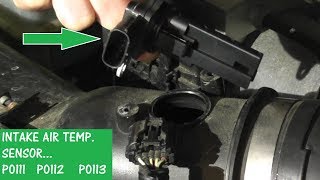
How to confirm: Inspect the sensor element for contamination. With a scan tool, monitor the IAT live data. It should read ambient temperature when the engine is cold and rise steadily as the engine warms up. A fixed reading (e.g., -40°F) or readings that don't change logically point to a bad sensor. You can also test the sensor with a multimeter set to Ohms; the resistance should change when heated with a hairdryer. 🎬 See this guide on testing and replacing the IAT sensor.
Typical fix: First, try cleaning the sensor with a dedicated MAF sensor cleaner. Do not touch the sensing elements. If cleaning doesn't work, the entire MAF/IAT sensor assembly must be replaced. On 3.0L V6 models, it is sometimes recommended to replace both sensors at the same time.
Est. part cost: $50-$200 - Damaged Wiring or Connector 🟡 Medium Probability Engine bay heat and vibration can cause wiring to become brittle or connectors to become loose or corroded over time. Water intrusion at the connector is also a possibility.
How to confirm: Visually inspect the wiring harness and connector for the MAF/IAT sensor for any signs of damage, corrosion, or loose pins. Perform a "wiggle test" on the connector and wiring while monitoring the IAT data on a scan tool to see if the reading fluctuates. Check for 5-volt reference and ground at the connector with a multimeter.
Typical fix: Repair the damaged section of wiring or replace the connector pigtail. Ensure the connector seal is intact and apply dielectric grease to prevent moisture intrusion.
Est. part cost: $10-$50 - Intake Air Leak ⚪ Low Probability Cracks in the intake boots or loose clamps can allow unmetered air to enter the engine. TSB SSM73671 specifically points to an incorrectly fitted air intake elbow below the throttle body on the 2.0L Ingenium engine as a potential cause.
How to confirm: Visually inspect all intake ducting between the MAF sensor and the throttle body for cracks or loose connections. A smoke test is the most effective method to definitively locate any leaks. 🎬 Watch: How to perform a smoke test to find vacuum leaks.
Typical fix: Replace the cracked intake boot, tighten the hose clamps, or correctly refit the intake elbow as per the TSB.
Est. part cost: $50-$150
Rare But Worth Checking
- Faulty Powertrain Control Module (PCM): → Shop Engine Control Module (ECM) This is a rare cause. All other possibilities, such as sensor, wiring, and intake leaks, should be thoroughly ruled out before considering the PCM as the culprit.
Diagnosis Steps
- Read the fault codes with an OBD-II scanner and confirm P0111 is present. Note any other codes, especially P0100, P0112, P0113, P0171, or P0174.
- With the engine cold, use the scanner's live data function to compare the Intake Air Temperature (IAT) reading with the Ambient Air Temperature (AAT) and Engine Coolant Temperature (ECT) readings. They should all be within a few degrees of each other.
- Start the engine and monitor the IAT reading. It should rise slowly and smoothly. Sudden jumps or a static value indicate a problem.
- Visually inspect the MAF/IAT sensor's wiring and connector for any damage, corrosion, or loose connections.
- If accessible, remove the MAF/IAT sensor (or sensors, on the V6) and inspect the sensing element for dirt or oil contamination.
- If dirty, clean the sensor using only a dedicated MAF sensor cleaner. Do not touch the sensing elements and allow it to dry completely before reinstalling.
- If the problem persists after cleaning, the MAF/IAT sensor assembly is likely faulty and should be replaced. For the 3.0L V6, identify the correct bank or consider replacing both for longevity.
- If the sensor and wiring are confirmed to be good, check for vacuum leaks in the intake system after the MAF sensor, paying close attention to the intake elbow on 2.0L models as noted in TSB SSM73671.
Parts You'll Likely Need
- Mass Airflow (MAF) / Intake Air Temperature (IAT) Sensor Assembly
(OEM #T2R26101 (for 2.0L Ingenium Petrol/Diesel) or T2H7707 (for some 2.0L and V6 models - verify by VIN))— This is the most common failure point for P0111, as the IAT sensor is integrated into the MAF sensor on the Jaguar XE. Part number T2R26101 is listed for 2.0L Ingenium engines. Part T2H7707 is also listed for XE models. It is critical to verify the correct part number with the vehicle's VIN.
Trusted brands: Bosch, Denso, OEM Jaguar
OEM price range: $150-$250
Aftermarket price range: $70-$150
Related Codes That Often Appear With This One
- P0100 — As cited in TSB #SSM73671, the IAT sensor is part of the Mass Airflow (MAF) sensor. A fault in one can often be associated with a fault in the other.
- P0113 — This code indicates 'IAT Sensor 1 Circuit High Input', which points more specifically to an electrical fault (like an open circuit) rather than a performance issue.
- P0112 — This code indicates 'IAT Sensor 1 Circuit Low Input', pointing to an electrical fault like a short to ground.
- P0171/P0174 — These are 'System Too Lean' codes. An air leak after the MAF sensor, a potential cause for P0111, would also cause these codes to appear.
Technical Service Bulletins (TSBs) & Recalls
- SSM73671: A Jaguar TSB that mentions P0111 in conjunction with MAF sensor codes. It suggests a possible cause is an air leak from an improperly fitted air intake elbow on 2.0L Ingenium petrol engines, and recommends a smoke test for diagnosis.
Platform-Specific Known Issues
- Jaguar Technical Service Bulletin #SSM73671 notes that code P0111 may be logged along with P0100-38. The cause may be an incorrectly fitted air intake elbow below the throttle body on 2.0L Ingenium engines, leading to an air leak.
- The 3.0L Supercharged V6 (AJ126) engine uses two MAF/IAT sensors, one for each airbox feeding each cylinder bank. P0111 refers to Bank 1, so diagnosis must focus on the correct side of the engine.
Mechanic-Grade Diagnostic Values
- MAF/IAT Sensor Connector Pin Voltages (Key-On, Engine-Off) — expected: Pin 4: ~12V (Battery Voltage); Pin 2: Ground (0V); Pin 1: ~5V (Reference); Pin 3: ~5V (Reference). Note: Pin configuration may vary; these values are based on a 2017 2.0L Turbo model.. Failure: Missing voltage on any pin, or voltage significantly different from expected values, indicates a wiring or PCM problem.
- IAT Sensor Resistance vs. Temperature (General Guide) — expected: At 20°C (68°F), resistance is approx. 38 kOhms. At 40°C (104°F), approx. 16 kOhms. At 80°C (176°F), approx. 3.8 kOhms. The sensor is a thermistor, so resistance should decrease smoothly as temperature increases.. Failure: An open circuit (infinite resistance) or short circuit (zero resistance), or resistance values that do not change with temperature, indicate a faulty sensor.
Scan Tool Commands That Help
- Jaguar Pathfinder (for MY2017+): Live Data Monitoring — To observe the IAT sensor reading in real-time. It should be compared to the Engine Coolant Temperature (ECT) and Ambient Air Temperature (AAT) on a cold start; they should be within a few degrees of each other. The reading should rise smoothly as the engine warms up.
- Jaguar Pathfinder (for MY2017+): Read and Clear DTCs — Used to retrieve the initial P0111 code and any other associated codes (like P0100). After a repair is performed, this function is used to clear the codes and turn off the Check Engine Light before a test drive to verify the fix.
Wiring & Ground Locations
- MAF/IAT Sensor Connector — On the Mass Airflow Sensor housing, which is located in the air intake duct immediately after the air filter box. The 3.0L V6 has two, one on each intake.. This is the primary connection point for the IAT sensor. Damage to the connector, pins, or wiring harness at this location is a common cause of P0111. A 'wiggle test' of this connector while monitoring live data can identify intermittent connections.
- Sensor Ground Circuit — The ground wire runs from the MAF/IAT sensor connector back to the Powertrain Control Module (PCM) or a chassis ground point. The exact ground point location can be found in the vehicle's official wiring diagram.. A poor ground connection can cause incorrect voltage readings from the sensor, leading the PCM to set a P0111 code even if the sensor itself is good. Technicians often check for a solid ground as a key step in diagnosing persistent electrical faults.
Real Owner Repair Stories
- ScannerDanner Forum, user 'forumoto' (2017 Jaguar XE 2.0 Turbo) — Car would stall when the MAF/IAT sensor was plugged in, but would run (poorly) with it unplugged. Check Engine Light would illuminate with MAF and IAT codes (including P0111) after holding the accelerator down for a period.
❌ Tried (didn't work) Replacing the MAF/IAT sensor, Replacing the Powertrain Control Module (PCM), Checking for intake air leaks (all seemed fine)
✅ What actually fixed it The final fix was not posted, but the professional diagnosis pointed directly to a wiring issue. The technician's advice was to back-probe the wires at the PCM and the sensor, and to perform a continuity test (ohm out) on each wire in the harness between the sensor and the PCM to find a short or open circuit. The problem was suspected to be in the wiring harness or a faulty sensor ground, not the components that were replaced.
"I Checked Everything" — The Actual Cause
- In a documented case involving a 2017 Jaguar XE 2.0T, the vehicle presented with P0111 and related MAF codes. An initial check for intake air leaks (the typical use for a smoke test) revealed no issues. Despite replacing the MAF sensor and even the PCM, the problem persisted. The diagnostic focus then shifted to a complex electrical fault within the wiring harness between the sensor and the PCM, as the car would stall only when the sensor was connected, indicating a circuit problem rather than a simple leak or faulty component.
OEM Part Supersession History
T2R26101→T2R26101— This part number is specific to the 2.0L Ingenium petrol and some diesel engines from 2015/2017 onwards. It is also cross-referenced to Land Rover part LR093998.
Heads up: This part is generally not compatible with the 3.0L V6 engine, which often uses a different sensor.T2H7707→T2H7707— This part number is listed for 2.0L Ingenium diesel engines and is also specified for some 3.0L V6 applications.
Heads up: It is critical to verify the correct part number by VIN, as there is overlap in application descriptions between T2H7707 and T2R26101 depending on engine type and model year.
Model Year Variations Within This Range
- 2017-2018: The dealer-level diagnostic software for these model years is Jaguar Pathfinder. Earlier models (pre-2017) used Symptom-Driven Diagnostics (SDD). While both can diagnose P0111, the interface and specific available service functions may differ. A 2017 model could potentially be serviced by either, depending on the specific vehicle build date and the workshop's equipment.
Helpful Videos
We Have This Part in Stock


The information in this article is provided for general reference and educational purposes only. Vehicle specifications, procedures, and part compatibility can vary by production date, trim level, and region. Always consult your vehicle's factory service manual and verify part numbers before purchasing or performing repairs. Safety-critical components such as airbags, seat belts, and braking systems should be installed by a qualified professional.
- Jaguar XE:
- 🧭 Diagnostic Flowchart
- 🎬 Helpful Videos
- 🛍️ Shop This Part
- What's Unique About the 2017-2018 Jaguar XE
- Symptoms You May Notice
- Most Likely Causes
- Rare But Worth Checking
- Diagnosis Steps
- Parts You'll Likely Need
- Related Codes That Often Appear With This One
- Technical Service Bulletins (TSBs) & Recalls
- Platform-Specific Known Issues
- Mechanic-Grade Diagnostic Values
- Scan Tool Commands That Help
- Wiring & Ground Locations
- Real Owner Repair Stories
- "I Checked Everything" — The Actual Cause
- OEM Part Supersession History
- Model Year Variations Within This Range
- 🎟️ Get 5% Off