

P0111 on 2010-2017 Volkswagen Golf: IAT Sensor Range/Performance Causes and Fixes
On a 2010-2017 VW Golf, code P0111 is most often caused by a faulty Intake Air Temperature (IAT) sensor. On Mk7 models (2015+), this sensor is typically integrated into the MAP sensor on the intake manifold. On Mk6 models (2010-2014), it can be a standalone sensor or part of the MAP sensor, depending on the engine. Expect to pay $40-$80 for the part, which is a simple DIY replacement.
- P0111 means the Intake Air Temperature reading is illogical, usually detected during a cold start.
- First, determine if you have a Mk6 (2010-2014) or Mk7 (2015-2017) Golf, as the sensor location is different.
- On a Mk7, the IAT is likely part of the MAP sensor on the intake manifold. Check for swapped connectors if you've had recent engine work.
- The most common fix is replacing the sensor itself, which is an easy and inexpensive DIY job.
- Use a scan tool to check the IAT live data on a cold engine; it should closely match the coolant temperature.
What's Unique About the 2010-2017 Volkswagen GOLF

The 2010-2017 Golf spans two distinct generations, the Mk6 and Mk7, which handle intake air temperature sensing differently. Mk6 models (2010-2014) with the 2.5L engine, for example, often have a standalone IAT sensor, while TDI and TSI models may integrate it. Mk7 models (2015-2017) with TSI engines almost always integrate the IAT sensor into the Manifold Absolute Pressure (MAP) sensor located directly on the intake manifold. This generation and engine-specific difference is the most critical factor in diagnosis. Furthermore, the Mk7 platform has documented, unique issues like the potential for swapped sensor connectors near the throttle body causing this code, and susceptibility to heat soak on hot days, which is addressed by a specific TSB.
Diagnostic Flowchart

Tap your situation to follow the diagnostic path that matches what you're seeing on this vehicle.
Generation note: The 2010-2017 range covers the Golf Mk6 (2010-2014) and Golf Mk7 (2015-2017). The primary difference for this code is the IAT sensor's location and integration. On many Mk6 engines like the 2.5L, it's a separate two-wire sensor in the intake tract. On most Mk7 engines (e.g., 1.4TSI, 1.8TSI, 2.0TSI), the IAT is combined with the MAP sensor (a T-MAP sensor) on top of the intake manifold. Always verify the sensor configuration for your specific engine before purchasing parts.
Symptoms You May Notice
- Check Engine Light (CEL) illuminated
- EPC (Electronic Power Control) light may be on
- Auto Start/Stop system disabled
- Reduced fuel economy
- Engine hesitation, surging, or rough idle
- Hard starting, particularly in cold weather
- Black smoke from exhaust due to a rich fuel mixture
- Potential activation of 'limp mode' with reduced power
- Replacing the Mass Airflow (MAF) sensor when the IAT sensor is a separate unit or integrated into the MAP sensor.
- Replacing the sensor without first checking the wiring, connector, and for swapped connectors (on Mk7s), which can be the actual point of failure.
- On Mk6 2.5L engines, replacing the MAP sensor when the issue is a separate, standalone IAT sensor.
Most Likely Causes

- Faulty Intake Air Temperature (IAT) Sensor or combined MAP/IAT Sensor 🔴 High Probability → Shop Fuel Injection Air Flow Meter The sensor element, a thermistor, can become contaminated by oil vapor from the PCV system or simply fail electronically over time, causing it to send erratic or out-of-range signals. On the 2.5L engine, oil pooling in the intake manifold is a known issue that can foul the sensor.
How to confirm: With a scan tool on a cold engine (off for 5+ hours), compare the IAT reading to the ambient air temp and Engine Coolant Temp (ECT). All three should be within a few degrees of each other. If the IAT is reading an extreme value (like -40°F or 250°F) or is significantly different from the others, the sensor is likely bad. You can also test the sensor's resistance with a multimeter; the resistance should change predictably with temperature. For example, a typical VW sensor might read 2250-3000 Ω at 20°C (68°F) and 900-1400 Ω at 40°C (104°F).
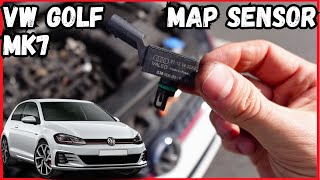
Typical fix: Replace the faulty sensor. For Mk7 models, this means replacing the MAP/IAT sensor on the intake manifold. 🎬 See this quick tutorial on replacing your Mk7 MAP sensor For Mk6, it's typically a separate sensor on the intake piping. It is also wise to clean any oil residue from the intake manifold and sensor port during replacement.
Est. part cost: $40-$80 - Damaged Wiring or Connector 🟡 Medium Probability Engine bay heat can make the plastic sensor connector and wiring insulation brittle over time, leading to cracks, corrosion on the pins, or a poor connection.
How to confirm: Visually inspect the wiring harness and connector for the IAT/MAP sensor. Wiggle the connector and wiring with the engine running while monitoring the IAT live data on a scan tool. If the temperature reading fluctuates wildly, you have a connection issue. Use a multimeter to check for a 5V reference signal and a good ground at the connector with the key on, engine off.
Typical fix: Repair the damaged section of wiring or replace the connector pigtail. Clean any corrosion from the connector pins with electrical contact cleaner and apply dielectric grease to prevent future corrosion.
Est. part cost: $10-$30 - Swapped Sensor Connectors (Mk7 models) ⚪ Low Probability On some engines like the 1.4TSI, there are two sensors with similar connectors located near the throttle body (the MAP/IAT sensor and another boost pressure sensor). If they are accidentally swapped during maintenance, the ECM will receive illogical data from both and trigger P0111.
How to confirm: If recent work has been performed in the engine bay, visually inspect the two sensors on and near the throttle body. A YouTube video of this exact issue on a Golf VII showed that the IAT reading was stuck at -40°C until the connectors were swapped back to their correct positions, which immediately brought the reading to a plausible ambient temperature. 🎬 Watch: How swapped connectors cause P0111 on a Golf VII
Typical fix: Swap the connectors back to their correct respective sensors.
Est. part cost: $0
Rare But Worth Checking
- Heat Soak on Intake Manifold Sensor (Primarily Mk7): → Shop Engine Intake Manifold A VW Technical Service Bulletin (TSB 2061109 / 01-20-05) exists for newer Golfs where high ambient temperatures cause the hood to heat up the top-mounted intake sensor (Charge Air Pressure Sensor -GX26-). This creates a temperature discrepancy at startup compared to other sensors, triggering P0111. The official fix is installing a hood insulation blanket (Part No. 5GM 863 831).
- Intake Air Leaks: A significant vacuum leak after the mass airflow sensor but before the IAT sensor could potentially cause unmetered air to alter airflow characteristics, leading to an implausible temperature reading, though this is less common.
- Dirty Engine Air Filter: → Shop Air Cleaner Assembly A severely clogged air filter can restrict airflow, potentially affecting temperature readings enough to contribute to a range/performance code. This should be checked as part of routine maintenance.
- Faulty Powertrain Control Module (PCM): → Shop Engine Control Module (ECM) In very rare cases, the PCM itself can have a faulty internal circuit for processing the IAT signal, leading to a false P0111 code even with a good sensor and wiring.
Diagnosis Steps
- Connect an OBD-II scanner and confirm P0111 is the primary code.
- With the engine cold (off for at least 4-5 hours), access live data. Compare the Intake Air Temperature (IAT), Engine Coolant Temperature (ECT), and Ambient Air Temperature (if available). They should all be within ~5°F (3°C) of each other.
- If the IAT reading is stuck at a default value (e.g., -40°F or 257°F) or is drastically different from the ECT, the sensor or its circuit is faulty.
- Locate the IAT sensor. On Mk7 models (1.8T/2.0T), it is part of the MAP sensor on the intake manifold. On Mk6 models (2.5L), it is often a separate sensor pushed into the intake manifold.
- Inspect the sensor's connector and wiring for any signs of damage, corrosion, or looseness. Check for 5V reference and ground at the connector with a multimeter.
- If you have a Mk7 and recent work was done, verify that the connectors for the two sensors near the throttle body are not swapped.
- If wiring and connectors are good, remove the sensor and inspect for oil contamination, a common issue.
- If the wiring looks good and the reading is still incorrect, the sensor itself is the most likely culprit.
- Replace the IAT sensor (or the combined MAP/IAT sensor assembly) and clear the code.
Parts You'll Likely Need
- Intake Air Temp / Pressure Sensor (MAP/IAT)
(OEM #06L906051K (or B), 04E906051A)— On Mk7 (2015-2017) Golf models with Gen3 TSI engines, the IAT is integrated into the MAP sensor. This is the most common part to fail, causing illogical temperature readings. Part numbers vary by engine; 06L906051K is common for 1.8T/2.0T, while 04E906051A is used on 1.4T.
Trusted brands: Bosch, Genuine VW
OEM price range: $60-$90
Aftermarket price range: $40-$70 - Intake Air Temperature Sensor (IAT)
(OEM #06B905379D (supersedes A/C))— On Mk6 (2010-2014) Golf models with the 2.5L engine, the IAT is often a standalone two-wire sensor that fails by giving incorrect resistance/voltage readings. It pushes into the intake manifold.
Trusted brands: Bosch, Hella, Genuine VW
OEM price range: $30-$50
Aftermarket price range: $15-$35
Technical Service Bulletins (TSBs) & Recalls

- TSB 2061109 / 01-20-05: Addresses P0111 on newer Golfs (with DGXA engine code mentioned) caused by sensor heat soak from the engine hood on hot days. It details comparing the Charge Air Pressure Sensor (-GX26-) and Intake Manifold Sensor (-GX9-) readings. The fix is to install a hood sound absorber/insulation blanket (P/N 5GM 863 831). It also advises checking that the two sensors haven't been swapped.
- VIN4APIN20200803: Notes a 2014 Golf with a customer complaint of MIL-on with code P0111, among others, but provides no diagnostic detail.
Platform-Specific Known Issues
- Swapped Connectors on Mk7 TSI: On Mk7 models, especially the 1.4TSI, accidentally swapping the electrical connectors for the MAP/IAT sensor and the nearby boost pressure sensor will cause a P0111 code with an implausible signal reading. Swapping them back resolves the issue.
- Heat Soak TSB on Mk7: VW TSB 2061109 / 01-20-05 notes that P0111 can be triggered on hot, sunny days due to the hood heating the top-mounted sensor, causing an incorrect reading at startup. The fix is a hood insulation blanket (P/N 5GM 863 831).
Mechanic-Grade Diagnostic Values
- IAT Sensor Resistance (NTC Type) — expected: Resistance changes with temperature. A typical chart is: 2250-3000 Ω at 20°C (68°F), 1500-2000 Ω at 30°C (86°F), 900-1400 Ω at 40°C (104°F), and 275-375 Ω at 80°C (176°F).. Failure: An open circuit (infinite resistance) or short circuit (zero resistance), or values that do not change with temperature when heated with a heat gun.
- Mk7 MAP/IAT Sensor (G71/G42) Pin Voltages (Key On, Engine Off) — expected: Pin 3 should show a stable 5V reference from the ECM. Pin 1 is the ground and should show less than 0.1V. Pin 2 is the IAT signal (variable voltage based on temp). Pin 4 is the MAP signal (approx. 4.5V KOEO at sea level).. Failure: Missing 5V reference on Pin 3, high voltage on the ground Pin 1, or a signal voltage on Pin 2 that doesn't correspond to ambient temperature indicates a wiring or ECM issue.
Hidden / Shadow Codes Worth Checking
- P011100 [implausible signal]: Many VW-specific scan tools like VCDS or OBDeleven will show the main P0111 code with additional text like 'implausible signal'. They also provide status bits such as 'static' (fault is currently active) or 'sporadic' / 'intermittent' (fault has occurred but is not currently present), which helps determine if it's a hard failure or a connection issue. (see via VCDS, OBDeleven, or other professional European vehicle scan tools.)
Wiring & Ground Locations
- Engine Block / Cylinder Head Ground — On many TSI engines (Mk6/Mk7), a primary engine ground point (often designated '15' in diagrams) is located on the cylinder head.. The IAT/MAP sensor circuit relies on a clean ground to provide an accurate signal. A corroded or loose engine ground can introduce voltage fluctuations, causing the sensor reading to become implausible and triggering P0111.
- Main Chassis Ground Point — For Mk7 models, a main chassis ground distribution block with multiple brown wires is located on the bulkhead behind the battery.. This is a central grounding location for many engine bay components. While less direct than the engine block ground, poor contact here can cause widespread electrical issues, including sensor signal problems.
- Mk7 MAP/IAT Sensor (G71/G42) Connector Pins — On the 4-pin connector for the sensor on the intake manifold.. Knowing the pinout is critical for testing. Pin 1: Ground, Pin 2: IAT Signal, Pin 3: 5V Reference, Pin 4: MAP Signal. This allows a technician to test for power, ground, and signal integrity directly at the sensor connector.
Real Owner Repair Stories
- YouTube channel 'Gigi's Tech' (2013/2014 VW Golf VII 1.4 TSI) — Check Engine Light with code P0111 00 (implausible signal).
❌ Tried (didn't work) Replacing the MAP/IAT sensor., Inspecting the wiring harness from the sensor to the ECU for breaks.
✅ What actually fixed it The electrical connectors for the MAP/IAT sensor on the intake manifold and the nearby boost pressure sensor on the charge pipe had been accidentally swapped. After swapping the connectors back to their correct sensors, live data immediately showed a plausible temperature reading (e.g., 40°C instead of -40°C) and the fault was resolved.
OEM Part Supersession History
06B905379, 06B905379A, 06B905379C→06B905379D, which was later superseded by 06B905379G— Standard part revisions for improved reliability or manufacturing changes.
Heads up: These parts are generally interchangeable for the specified applications (like the Mk6 2.5L), but it is always best to use the latest revision (06B905379G) when replacing.
Helpful Videos


The information in this article is provided for general reference and educational purposes only. Vehicle specifications, procedures, and part compatibility can vary by production date, trim level, and region. Always consult your vehicle's factory service manual and verify part numbers before purchasing or performing repairs. Safety-critical components such as airbags, seat belts, and braking systems should be installed by a qualified professional.
- Volkswagen GOLF:
- 🧭 Diagnostic Flowchart
- 🎬 Helpful Videos
- What's Unique About the 2010-2017 Volkswagen GOLF
- Symptoms You May Notice
- Most Likely Causes
- Rare But Worth Checking
- Diagnosis Steps
- Parts You'll Likely Need
- Technical Service Bulletins (TSBs) & Recalls
- Platform-Specific Known Issues
- Mechanic-Grade Diagnostic Values
- Hidden / Shadow Codes Worth Checking
- Wiring & Ground Locations
- Real Owner Repair Stories
- OEM Part Supersession History
- 🎟️ Get 5% Off