

P0113 on 2013-2016 Mazda CX-5: Intake Air Temp Circuit High Causes and Fixes
This code almost always means the Intake Air Temperature (IAT) sensor has failed. On the CX-5, it's integrated into the Mass Airflow (MAF) sensor. Replacing the entire MAF sensor assembly is the common fix, costing around $240 for an OEM part and is a simple DIY job.
- P0113 on a 2013-2016 Mazda CX-5 points directly to a problem with the Intake Air Temperature Sensor No. 1 circuit.
- This sensor is built into the Mass Airflow (MAF) sensor, so the entire MAF assembly must be replaced.
- The most common cause is a failed sensor, followed by damaged wiring at the connector.
- It is a minor severity code that allows the vehicle to be driven, but may cause poor fuel economy and rough idle.
- Using an OEM or Denso replacement part is strongly recommended over cheaper aftermarket alternatives.
What's Unique About the 2013-2016 Mazda CX-5
On the Mazda CX-5 with Skyactiv-G engines, there are two IAT sensors. P0113 specifically refers to IAT Sensor No. 1, which is integrated into the Mass Airflow (MAF) sensor located on the air filter housing. This means you cannot replace just the small temperature sensor; you must replace the entire MAF sensor assembly to fix a faulty IAT No. 1. The second IAT sensor is part of the Manifold Absolute Pressure (MAP) sensor on the intake manifold and is not related to this code.
Symptoms You May Notice
- Check Engine Light is on
- Rough or unstable idle, especially when cold
- Slight decrease in fuel economy
- Possible hesitation during acceleration
- Black smoke from exhaust on startup in some cases
- Replacing the wrong temperature sensor. The CX-5 has a second IAT sensor (No. 2) in the MAP sensor on the intake manifold; this is not the cause of P0113.
- Replacing the Ambient Air Temperature sensor located behind the front grille, which is used for the climate control system and exterior temperature display, not for engine management.
Most Likely Causes
- Failed IAT Sensor No. 1 (within the MAF Sensor) 🔴 High Probability The sensor is an electronic component with a finite lifespan. It's the most common failure point for this code, as confirmed in numerous owner forums and repair databases.
How to confirm: Using an OBD-II scanner, check the live data for IAT Sensor 1. A P0113 code will typically show a static, extremely low temperature reading like -40°F/-40°C, which is the PCM's default for an open circuit. If the reading is stuck at this value regardless of engine temperature, the sensor or its circuit has failed. 🎬 Watch: How to diagnose and test a Mazda CX-5 MAF sensor You can also test the sensor's resistance; it should be approximately 2.4 kΩ at 20°C (68°F) and decrease as temperature rises.
Typical fix: Replace the entire Mass Airflow (MAF) sensor assembly. Owners strongly recommend using an OEM (Mazda) or OEM-supplier (Denso) part, as cheap aftermarket sensors are known to fail quickly or be inaccurate out of the box.
Est. part cost: $180-$250 - Damaged Wiring or Connector 🟡 Medium Probability The wiring harness to the MAF sensor can become brittle over time from engine heat cycles. Wires can break right at the connector, which can be difficult to see without pulling on them gently.
How to confirm: Visually inspect the MAF sensor connector and the wiring harness leading to it for any signs of corrosion, loose pins, or physical damage like breaks or chafing. With the key on, engine off, unplug the connector. Use a multimeter to test the 5-pin connector: you should find a 5V reference wire, a 12V power wire, and a ground wire. A wiring diagram is needed for precise pin testing.
Typical fix: Repair the damaged section of wiring or replace the connector pigtail. Pigtail connectors are available from auto parts stores or online.
Est. part cost: $15-$40
Rare But Worth Checking
- Faulty Powertrain Control Module (PCM): → Shop Engine Control Module (ECM) This is extremely rare. Before considering PCM replacement, all other possibilities (sensor and wiring) must be exhaustively ruled out. A faulty PCM will usually cause multiple, unrelated error codes. In one documented case, a user shorted a wire while testing, blowing a fuse that powered multiple PCM circuits and mimicking a failed PCM.
- Dirty Air Filter: While a severely clogged air filter can cause MAF-related codes like P0101, it is a very unlikely cause for P0113, which is an electrical circuit fault code, not a performance/range code.
Diagnosis Steps
- Read the code with an OBD-II scanner to confirm P0113 is present.
- View live data on the scanner. Check the value for 'IAT Sensor 1'. If it reads -40°F or -40°C and does not change, this confirms the PCM is seeing an open circuit.
- Turn the engine off. Locate the MAF sensor on the air filter box, right after the air filter.
- Inspect the MAF sensor's electrical connector for a secure fit, corrosion, or pushed-out pins. Gently tug on each of the five wires at the back of the connector to ensure they are not broken internally right at the pin crimp.
- If wiring looks suspect, perform a pin-out test with a multimeter. With the key on, engine off, and connector unplugged, test the harness-side connector terminals for 12V power, 5V reference, and ground. Refer to a vehicle-specific wiring diagram for correct pin locations.
- If the wiring and connector look good and test correctly, the MAF/IAT sensor assembly is the most likely cause of the problem.
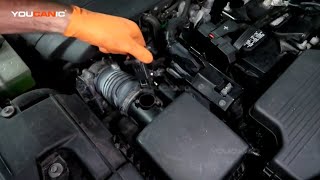
- Replacing the MAF sensor is straightforward: disconnect the negative battery terminal, unplug the connector, remove the two Phillips-head screws holding the sensor in place, and swap in the new one. Be careful not to drop the screws into the engine bay. 🎬 Watch: Step-by-step Mazda MAF sensor replacement walkthrough
- After replacement, reconnect the battery, clear the code with the scanner, and start the vehicle to ensure the Check Engine Light does not return.
Parts You'll Likely Need
- Mass Airflow (MAF) Sensor
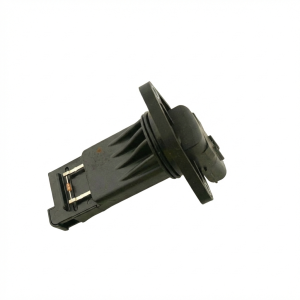
(OEM #PE01-13-215)— This assembly contains the integrated IAT Sensor No. 1, which is the root cause of the P0113 code on this vehicle.
Trusted brands: Mazda (OEM), Denso (OEM Supplier), Hitachi
OEM price range: $230-$290
Aftermarket price range: $70-$150
Related Codes That Often Appear With This One
- P0101 — Mass Airflow (MAF) Circuit Range/Performance. Since the IAT sensor is in the same housing, a fault in the unit or its connector can trigger both codes.
- P0102 — Mass Airflow (MAF) Circuit Low Input. Similar to P0101, this points to a problem with the MAF sensor assembly or its connection. Seeing P0113 and P0102 together strongly suggests a connector/wiring issue or a completely failed MAF unit.
- P0171 — System Too Lean (Bank 1). If the PCM receives an incorrect (very cold) air temperature reading, it may command an improper fuel mixture. The default -40° reading causes the PCM to think the air is extremely dense, so it adds more fuel. If another sensor (like the O2 sensor) reports this is incorrect, it can lead to conflicting codes or lean/rich conditions as the system tries to compensate.
Technical Service Bulletins (TSBs) & Recalls
- TSB 01-019/19: While not directly for P0113, this TSB is for a very common related issue on these engines - a leaking serpentine belt tensioner. It's relevant for owners performing general engine bay diagnosis.
Platform-Specific Known Issues
- Aftermarket Sensor Warning: Owner experiences posted on forums frequently warn against using cheap, non-OEM MAF sensors. Many report these parts are dead-on-arrival, fail within a few months, or provide inaccurate readings that cause other performance issues. Sticking with Mazda or Denso branded parts is highly recommended for this specific component.
Mechanic-Grade Diagnostic Values
- IAT Sensor No. 1 Resistance — expected: Approx. 2.4 kΩ at 20°C (68°F), 0.32 kΩ at 80°C (176°F).. Failure: Infinite resistance (open circuit) or near-zero resistance (short).
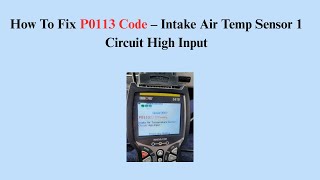
- IAT Sensor No. 1 Signal Voltage (Live Data) — expected: Approx. 2.70V at 20°C (68°F), Approx. 1.80V at 40°C (104°F).. Failure: Voltage is stuck high, near 5V (which corresponds to -40°C/F). A reading above 4.62V for 5 seconds triggers P0113. 🎬 See this guide on fixing the P0113 circuit high code
- MAF/IAT Connector Reference Voltage — expected: Approx. 5.0V at the reference wire with Key On, Engine Off.. Failure: Voltage significantly below 4.8V or above 5.2V.
Scan Tool Commands That Help
- Mazda M-MDS (or equivalent professional scanner): PID/Data Monitor for 'IAT' — This is the primary diagnostic step. It allows you to view the live voltage and temperature the PCM is seeing from IAT Sensor No. 1. A static reading of -40°C/F or a voltage stuck near 5V instantly points to an open circuit fault, which is the essence of a P0113 code.
Wiring & Ground Locations
- MAF/IAT Sensor Connector — On the Mass Airflow Sensor, which is mounted on the engine's air filter housing.. This 5-pin connector provides power, ground, and signal lines for both the MAF and IAT sensors. A loose connection, corroded pin, or broken wire at this specific connector is a common cause for P0113, P0101, and P0102 codes.
- Engine Harness Ground Points — General locations for Skyactiv engines include a ground on the passenger side motor mount, grounds on the transmission housing, and a primary ground from the driver-side fender area to the negative battery terminal.. The IAT sensor circuit relies on a solid ground connection back to the PCM and chassis. While a bad ground is a less common cause for a high-input (open circuit) code like P0113, a corroded or loose main engine ground can cause a variety of unpredictable sensor errors.
Diagnostic Flowchart
Other Known Issues on This Vehicle
Issues unrelated to this code that are worth knowing about as an owner of this generation:
- Leaking Serpentine Belt Tensioner 🟠 Medium — Common issue across many Skyactiv-G engines. Oil leaks from the tensioner's hydraulic damper, often visible as a wet film or grime on the tensioner body. Can lead to belt noise or slippage if ignored. (Ref: TSB 01-019/19 describes this exact issue, noting that high temperatures and high load can cause insufficient sealing.)
- Intake Valve Carbon Buildup 🟠 Medium — A known characteristic of early direct injection (DI) engines, including the Skyactiv-G. Oil vapors from the PCV system bake onto the back of the intake valves. Can cause cold-start misfires (P0300, P0301, etc.) and rough idle over time (typically 60k-100k miles). (Ref: TSB 01-012/19 (supersedes 01-020/15) outlines a procedure for decarboning the intake valves when misfire codes are present under specific cold-start conditions.)
- Infotainment Screen Delamination / 'Ghost Touch' 🟡 Low — Widespread issue where the touchscreen's top layer peels, cracks ('spider-webbing'), or registers phantom inputs. It is often exacerbated by heat and sun exposure. Affects many Mazda models from roughly 2014-2020. (Ref: Mazda issued a service communication (SA-027-24, NHTSA ID 10254187) acknowledging the defect and providing a repair kit (a new digitizer layer) instead of full unit replacement.)
- Corroding/Failing Rear Liftgate Struts 🟠 Medium — The liftgate support struts can corrode, causing them to break and the liftgate to drop unexpectedly. (Ref: Recall 16V644000 was issued for 2013-2016 CX-5 models to address this safety concern.)
Used vs. New Parts: Buying Guide for This Vehicle
When a used part is the smart pick: A used OEM MAF sensor from a low-mileage, rear-ended donor vehicle can be a cost-effective option, as the failure is electronic and not typically wear-related. However, given the critical nature of this sensor and the high failure rate of non-OEM parts, the risk may outweigh the savings for many DIYers.
Donor-vehicle mileage cap: roughly under 60000 miles for the part to have meaningful remaining life.
What to inspect on the donor part:
- Verify the part number on the sensor is PE01-13-215.
- Inspect the connector pins for any signs of corrosion or damage.
- Check the sensing elements inside the barrel for physical damage or heavy contamination (though cleaning is not always effective).
- Ask for the VIN of the donor car to check its history for flood or fire damage.
OEM-only on this vehicle (don't cheap out):
- Mass Airflow (MAF) Sensor: Due to the high incidence of issues with aftermarket units providing incorrect data or failing prematurely, OEM (Mazda-branded) or the direct OEM supplier (Denso) is strongly recommended for this part.
Aftermarket brands forum-validated for this vehicle:
- Denso (often the OEM supplier for Mazda electronics)
Brands owners have reported issues with on this vehicle:
- Generic, unbranded, or 'white-box' sensors from online marketplaces are frequently reported to be dead-on-arrival or cause performance issues.
Real Owner Stories
Aggregated from forums and TSBs cited above. Mileages and costs reflect what owners reported in those sources.
2015 Mazda CX-5 2.5L
Symptoms: The engine idle was very rough and the Check Engine Light was on with P0113 and other related codes.
What fixed it: Replacement of the Mass Air Flow (MAF) sensor.
Source hint: youtube_comment from T-Auto Repair
2013-2016 Mazda CX-5
Symptoms: The owner was troubleshooting a P0113 and accidentally shorted a wire, which blew a fuse and caused multiple error codes, leading to fears of a fried PCM.
What fixed it: Replacing the 'ENGINE BAR 1' fuse.
Source hint: Mazdas247.com - Thread 'Did I fry my PCM trying to fix a P0113?'
2013-2016 Mazda CX-5
Symptoms: The wiring harness to the MAF sensor became brittle and wires broke right at the plug/connector.
What fixed it: Repairing the MAF sensor wiring harness/connector.
Source hint: Mazdas247.com - Thread 'MAF Sensor Wiring Harness..HELP'
Related OBD-II Codes
Frequently Asked Questions
Can I use a cheaper aftermarket MAF sensor to fix the P0113 code on my CX-5?
Does TSB 01-019/19 regarding the serpentine belt tensioner relate to my P0113 code?
My CX-5 has a rough idle and P0113; could this be related to carbon buildup?
Is there a recall for the liftgate on my 2013-2016 CX-5?
What should the resistance be for the IAT sensor on a Skyactiv-G 2.0L/2.5L?
Is the MAF sensor on my CX-5 the same as the one on a Mazda 3 or Mazda 6?
Helpful Videos


We Have This Part in Stock

The information in this article is provided for general reference and educational purposes only. Vehicle specifications, procedures, and part compatibility can vary by production date, trim level, and region. Always consult your vehicle's factory service manual and verify part numbers before purchasing or performing repairs. Safety-critical components such as airbags, seat belts, and braking systems should be installed by a qualified professional.
- Mazda CX-5:
- 🧭 Diagnostic Flowchart
- 🎬 Helpful Videos
- 🛍️ Shop This Part
- What's Unique About the 2013-2016 Mazda CX-5
- Symptoms You May Notice
- Most Likely Causes
- Rare But Worth Checking
- Diagnosis Steps
- Parts You'll Likely Need
- Related Codes That Often Appear With This One
- Technical Service Bulletins (TSBs) & Recalls
- Platform-Specific Known Issues
- Mechanic-Grade Diagnostic Values
- Scan Tool Commands That Help
- Wiring & Ground Locations
- Other Known Issues on This Vehicle
- Used vs. New Parts: Buying Guide for This Vehicle
- Real Owner Stories
- 2015 Mazda CX-5 2.5L
- 2013-2016 Mazda CX-5
- 2013-2016 Mazda CX-5
- Related OBD-II Codes
- Frequently Asked Questions
- 🎟️ Get 5% Off