

P0113 on 2009-2013 Subaru Forester 2.5L: IAT Sensor Circuit High Causes and Fixes
On a 2009-2013 Subaru Forester, P0113 is almost always caused by a faulty Mass Airflow (MAF) sensor, which contains the Intake Air Temperature (IAT) sensor. The most likely fix is replacing the entire MAF sensor assembly. An unplugged connector is the second most common cause. This code will often illuminate the 'trifecta' of Check Engine, flashing Cruise Control, and Vehicle Dynamics Control (VDC) lights.
- P0113 on this Forester points to an electrical fault in the Intake Air Temperature (IAT) sensor circuit, which will illuminate a 'trifecta' of dash lights.
- The IAT sensor is built into the Mass Airflow (MAF) sensor, located on the engine's air intake tube.
- Before replacing parts, first check that the MAF sensor is securely plugged in, as a loose connection is a common cause.
- If the connection is good, the most likely culprit is an internal failure of the MAF/IAT sensor assembly, requiring replacement of the entire unit.
What's Unique About the 2009-2013 Subaru Forester
On the 2009-2013 Subaru Forester with the EJ253 engine, the Intake Air Temperature (IAT) sensor is not a standalone part. It is integrated into the Mass Airflow (MAF) sensor assembly. This means you cannot replace just the IAT sensor; the entire MAF sensor unit must be replaced if the sensor itself is faulty. This design is common for this era of Subaru vehicles and the MAF sensor is located in the intake tract just after the air filter housing.
Symptoms You May Notice
- Check Engine Light is on
- Flashing Cruise Control light
- Vehicle Dynamics Control (VDC) / Traction Control light is on
- Reduced fuel economy
- Rough or unstable idle
- Hesitation during acceleration
- Difficulty starting the engine, especially when cold
- Engine may stall
- Replacing only a standalone IAT sensor (this vehicle does not have one).
- Replacing the oxygen sensor, as fuel trim issues can sometimes occur alongside a P0113.
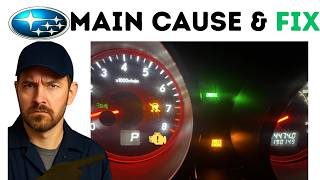
- Assuming the 'trifecta' of warning lights (CEL, VDC, Cruise) indicates a more serious problem; on this platform, it's a standard response to many engine-related fault codes. 🎬 Watch: Why your Subaru's cruise control light is flashing
Most Likely Causes
- Faulty Mass Airflow (MAF) Sensor Assembly 🔴 High Probability → Shop Fuel Injection Air Flow Meter The IAT sensor is integrated into the MAF sensor, making internal failure of the unit the most common reason for replacement. This is the most frequent resolution reported by owners.
How to confirm: After confirming the connector is secure and wiring is intact, use a scan tool to monitor the IAT temperature reading. If it shows an illogical, static low temperature (like -40°F) that doesn't change with the engine running, the sensor has failed internally.
Typical fix: Replace the entire Mass Airflow (MAF) sensor assembly. This is a simple repair involving two Phillips head screws and one electrical connector.
Est. part cost: $150-$270 - Disconnected or Loose MAF Sensor Connector 🟡 Medium Probability → Shop Fuel Injection Air Flow Meter The connector can be knocked loose or not fully seated during other engine service, such as an air filter change. An open circuit from a disconnected plug is a direct cause of the 'Circuit High' code.
How to confirm: Visually inspect and physically check that the electrical connector on the MAF sensor is fully seated and locked in place. The locking tab should click when secured.
Typical fix: Securely reconnect the MAF sensor connector. Clear the code and see if it returns.
Est. part cost: $0 - Damaged Wiring or Corroded Connector ⚪ Low Probability Wiring in the engine bay is exposed to heat cycles and potential rodent damage. The MAF sensor harness is a known area for issues.
How to confirm: Visually inspect the wires leading to the MAF sensor for breaks, fraying, or signs of being chewed. Check the connector pins for corrosion or moisture. With the key on, engine off, and connector unplugged, use a multimeter to check for ~5V reference voltage at the harness connector. One owner reported testing the green/yellow and yellow/black wires.
Typical fix: Repair the damaged section of the wiring harness or clean/replace the connector pigtail. Electrical contact cleaner can be used for minor corrosion.
Est. part cost: $10-$50
Rare But Worth Checking
- Faulty Powertrain Control Module (PCM): → Shop Engine Control Module (ECM) This is extremely rare. The PCM should only be considered after all other possibilities, including wiring, have been exhaustively ruled out. A faulty PCM will typically cause multiple other, unrelated error codes.
- Dirty Air Filter: A severely clogged air filter can sometimes contribute to erratic sensor readings, though it is not a direct cause of a 'Circuit High' fault. It's good practice to check the filter during diagnosis.
Diagnosis Steps
- Retrieve the P0113 code using an OBD-II scanner. Note the presence of other codes and the common 'trifecta' of lights (Check Engine, VDC, flashing Cruise).
- Turn the ignition off. Locate the Mass Airflow (MAF) sensor on the intake tube, just after the air filter box.
- Check that the electrical connector is firmly plugged into the MAF sensor. Disconnect and reconnect it to ensure it clicks into place.
- Disconnect the connector and inspect the pins on both the sensor and the harness side for corrosion, dirt, or damage. Clean with electrical contact cleaner if necessary.
- Inspect the visible wiring leading to the connector for any signs of damage, such as cracks, fraying, or rodent chew marks.
- (Optional Advanced) With the key on and engine off, unplug the MAF connector. Use a multimeter to probe the harness-side connector terminals. You should find a reference voltage of approximately 5 volts. Lack of voltage points to a wiring or PCM issue.
- If the connection and wiring appear intact, the MAF/IAT sensor assembly is the most likely cause. Replacement is the most reliable fix. Cleaning the sensor with dedicated MAF cleaner is sometimes suggested, but often provides only a temporary solution, if any, for a P0113 circuit fault.
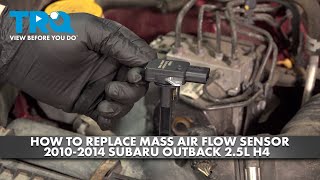
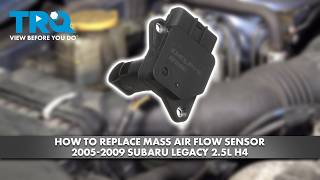
- Replace the MAF sensor assembly (typically two Phillips screws). 🎬 See this step-by-step Subaru MAF sensor replacement walkthrough Reconnect the electrical plug.
- Clear the code with the scanner, start the vehicle, and drive to see if the code returns.
Parts You'll Likely Need
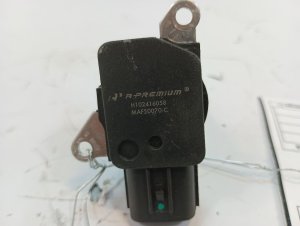
- Mass Airflow (MAF) Sensor Assembly
(OEM #22680AA380)— This assembly contains the integrated IAT sensor. On this vehicle, an internal failure of the IAT sensor requires the replacement of the entire MAF unit. This part number may also supersede 22680AA38A.
Trusted brands: Denso (OEM Supplier, cross-reference 197400-5111), Hitachi, Walker, Subaru (Genuine)
OEM price range: $190-$270
Aftermarket price range: $60-$180
Related Codes That Often Appear With This One
- P0102 — P0102 is 'Mass Air Flow (MAF) Circuit Low'. Since the IAT is part of the MAF sensor, a fault in the assembly or its connection can trigger both MAF and IAT codes.
- P0171 or P0172 — These codes indicate a lean (P0171) or rich (P0172) fuel mixture. A bad IAT reading causes the ECM to calculate the fuel mixture incorrectly, leading to these codes as a secondary effect.
Platform-Specific Known Issues
- The 'Trifecta' Warning Lights: On many Subarus of this era, a P0113 code (and many other engine-related codes) will not only illuminate the Check Engine Light but also cause the Vehicle Dynamics Control (VDC)/Traction Control light to stay on and the Cruise Control light to flash. This is normal behavior designed to get the driver's attention and disable these systems as a precaution. A user on Reddit confirmed experiencing this 'trifecta' with their P0113 code.
Mechanic-Grade Diagnostic Values
- IAT Sensor Resistance — expected: Approximately 2.0 to 6.0 kΩ at 25°C (77°F), dropping to around 0.3 kΩ at 80°C (176°F).. Failure: Infinite resistance (open circuit), zero resistance (short circuit), or a value that does not change when the sensor is heated or cooled.
- Harness Connector Reference Voltage — expected: ~5.0V with key on, engine off, connector unplugged (measured between reference wire and ground).. Failure: Voltage significantly below 5.0V or 0V points to a wiring issue or a problem with the ECM's 5V reference circuit.
- Harness Connector Signal Voltage — expected: Approximately 2.0V at 68°F (20°C) with key on, engine off, connector plugged in (back-probed).. Failure: A reading of 5.0V indicates an open in the signal wire or a faulty sensor.
Scan Tool Commands That Help
- Subaru Select Monitor (SSM): Current Data Display / Data Display — This is the dealer-level tool function used to view live data parameters like 'Intake Air Temp' to confirm the sensor is sending an illogical, static reading (e.g., -40°F), which confirms a circuit fault. Any generic OBD-II scanner with live data can also perform this function.
Wiring & Ground Locations
- B18 (MAF/IAT Sensor Connector) — On the Mass Airflow sensor, located in the intake tube directly after the air filter housing.. This is the 5-pin connector for the combined MAF/IAT sensor. A 2010 Forester wiring diagram identifies the IAT sensor circuit using pins B34 and B35 at the ECM, which correspond to pins at this connector.
- GE-1 / GE-2 (Main Engine Grounds) — On a 2013 Forester, these two grounds are located side-by-side and bolt to the top center rear of the engine block.. A poor engine ground can cause floating voltages and erratic behavior in multiple sensors, including the MAF/IAT. The ECU itself relies on a solid ground reference via the intake manifold, which must be well-grounded to the block and chassis.
OEM Part Supersession History
22680AA38A→22680AA380— Standard part revision by the manufacturer.Subaru 22680AA380→Denso 197400-5111— Denso is the Original Equipment Manufacturer (OEM) for Subaru. This is the equivalent OEM part without the Subaru branding.
Heads up: The third line of numbers on the sensor is a lot/batch number for manufacturing traceability and can be disregarded if the main part numbers match.
Model Year Variations Within This Range
- 2011-2013: These model years transitioned from the EJ253 (timing belt) engine to the FB25 (timing chain) engine. However, for the purposes of diagnosing P0113, the MAF/IAT sensor part number (22680AA380) and diagnostic procedure remain the same across this generation.
Diagnostic Flowchart
Other Known Issues on This Vehicle
Issues unrelated to this code that are worth knowing about as an owner of this generation:
- Head Gasket Failure 🔴 High — Common on EJ253 engines (2009-2010 models) typically between 100,000 and 150,000 miles. Less common but not unheard of on later years.
- Excessive Oil Consumption 🟠 Medium — A well-documented issue, particularly on the 2011-2013 models with the newer FB25 engine. Was the subject of a class-action lawsuit. (Ref: Technical Service Bulletin 02-157-14R addresses oil consumption testing.)
- Timing Belt Replacement (EJ253) 🟠 Medium — This is a required maintenance item for the 2009-2010 models with the EJ253 engine. The service interval is every 105,000 miles.
- Faulty Airbag Inflators 🔴 High — Affected 2010-2013 model years as part of the massive Takata airbag recall. (Ref: NHTSA Recall)
Used vs. New Parts: Buying Guide for This Vehicle
When a used part is the smart pick: A used OEM (Denso/Subaru branded) MAF sensor is often a smarter choice than a new, non-OEM aftermarket part. Since the failure is electronic, a used part from a lower-mileage, accident-damaged vehicle can provide OEM quality and reliability for less than half the price of a new OEM part. Avoids the risk of poor calibration common with cheap aftermarket sensors.
Donor-vehicle mileage cap: roughly under 80000 miles for the part to have meaningful remaining life.
What to inspect on the donor part:
- Verify the OEM part numbers (Subaru 22680AA380 or Denso 197400-5111) are an exact match.
- Ask the seller for the mileage of the donor vehicle if possible.
- Inspect the connector pins for any signs of corrosion or damage.
- Ensure the delicate sensor wires inside the housing are intact and not physically broken or coated in oil.
OEM-only on this vehicle (don't cheap out):
- Mass Airflow Sensor
Aftermarket brands forum-validated for this vehicle:
- Denso (OEM supplier)
- Hitachi
Brands owners have reported issues with on this vehicle:
- Spectra Premium (reported issues with idle, shifting, and performance on other vehicles)
- Cardone (remanufactured, reported issues on other vehicles)
- Store brands like Duralast can be hit-or-miss and may not be calibrated correctly for the vehicle.
Real Owner Stories
Aggregated from forums and TSBs cited above. Mileages and costs reflect what owners reported in those sources.
2009 Subaru Forester Premium X EJ253
Symptoms: Check Engine Light on, VDC light on, and flashing Cruise Control light (the 'trifecta'). Error code P0113 for intake air temp sensor 1.
What fixed it: Replaced the MAF sensor assembly after checking for 5V reference voltage at the harness.
Source hint: Reddit r/SubaruForester (2023): '2009 Subaru Forester Premium X - Error code P0113 intake air temp sensor 1'
Subaru Platform Diagnostic Report
Symptoms: An owner of a similar Subaru platform reported retrieving codes P0177, P0174, P0102, and P0113 using an OBD reader.
What fixed it: A dealership diagnosis confirmed that both the fuel pump and the mass airflow sensor had failed (NHTSA ODI #11523727).
Related OBD-II Codes
Frequently Asked Questions
Why are my Traction Control and Cruise Control lights flashing along with the Check Engine light on my Forester?
Can I just clean the sensor on my 2010 Forester to fix P0113?
Is there a specific part number I should look for when replacing the sensor?
Does the 2011-2013 Forester have a timing belt I need to worry about while fixing this?
Is there a TSB for the high oil consumption I'm noticing alongside this code?
Where exactly is the IAT sensor located on my 2.5L engine?
Helpful Videos

We Have This Part in Stock

The information in this article is provided for general reference and educational purposes only. Vehicle specifications, procedures, and part compatibility can vary by production date, trim level, and region. Always consult your vehicle's factory service manual and verify part numbers before purchasing or performing repairs. Safety-critical components such as airbags, seat belts, and braking systems should be installed by a qualified professional.
- Subaru Forester:
- 🧭 Diagnostic Flowchart
- 🎬 Helpful Videos
- 🛍️ Shop This Part
- What's Unique About the 2009-2013 Subaru Forester
- Symptoms You May Notice
- Most Likely Causes
- Rare But Worth Checking
- Diagnosis Steps
- Parts You'll Likely Need
- Related Codes That Often Appear With This One
- Platform-Specific Known Issues
- Mechanic-Grade Diagnostic Values
- Scan Tool Commands That Help
- Wiring & Ground Locations
- OEM Part Supersession History
- Model Year Variations Within This Range
- Other Known Issues on This Vehicle
- Used vs. New Parts: Buying Guide for This Vehicle
- Real Owner Stories
- 2009 Subaru Forester Premium X EJ253
- Subaru Platform Diagnostic Report
- Related OBD-II Codes
- Frequently Asked Questions
- 🎟️ Get 5% Off