

P0116 on 2017-2024 Chrysler Pacifica: Engine Coolant Temperature Performance Fixes
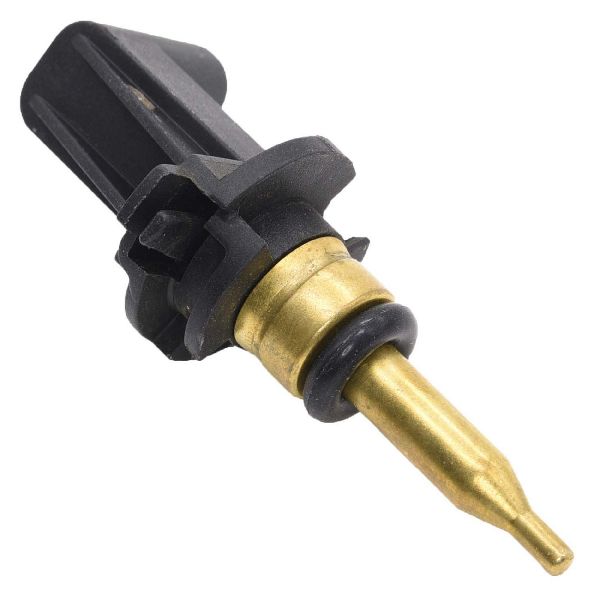
Code P0116 on a Chrysler Pacifica most often indicates a faulty Engine Coolant Temperature (ECT) sensor (Mopar P/N 5149077AB) or a thermostat that is stuck open. Replacing the ECT sensor is a common, inexpensive DIY fix, with the part costing around $20-$60.
- P0116 on a Pacifica means the engine computer is getting confusing temperature signals, not necessarily that the engine is overheating.
- The most likely fix is replacing the Engine Coolant Temperature (ECT) sensor, an affordable and accessible part for DIY repair.
- If the engine warms up very slowly, the second most likely cause is a thermostat that is stuck open.
- Always check the coolant level first, as a low level can cause incorrect sensor readings.
- Before starting, use a scan tool to compare the cold ECT and IAT sensor readings; this is a key diagnostic step.
What's Unique About the 2017-2024 Chrysler PACIFICA
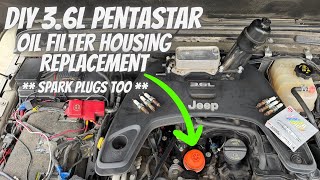
On the Pacifica's 3.6L Pentastar engine, the P0116 code is a straightforward issue often tied directly to common-fail parts like the ECT sensor or thermostat. Unlike some other Chrysler vehicles where software updates are a primary cause for this code, on the Pacifica it more frequently points to a hardware problem. A notable issue with the 3.6L Pentastar is the potential for the oil filter housing assembly, located in the engine valley, to develop coolant leaks. This can introduce air into the cooling system, causing erratic ECT sensor readings and triggering a P0116 code, even if the sensor itself is good. A notable Technical Service Bulletin (TSB #18-044-26) does list P0116 in conjunction with other seemingly unrelated codes, which could point to a more complex diagnostic path or a software issue in specific scenarios, but this is less common than a simple component failure. [⭐ MANUFACTURER TSB — highest authority]
Diagnostic Flowchart
Tap your situation to follow the diagnostic path that matches what you're seeing on this vehicle.
Generation note: This guide covers the entire first generation (RU) of the Chrysler Pacifica, including the pre-facelift (2017-2020) and post-facelift (2021-2024) models. The 3.6L Pentastar engine and its cooling system are fundamentally the same across these years, making the causes and fixes consistent. For models 2019 and newer, the ECT sensor is integrated into the thermostat housing, making it even easier to access.
Symptoms You May Notice
- Check Engine Light is on
- Temperature gauge reading is inaccurate (e.g., stays on cold or jumps to hot immediately)
- Engine cooling fans run constantly at high speed
- Reduced fuel economy
- Engine may hesitate or run rough
- Heater may not perform as expected or blow warm air
- Auto Start-Stop system may be disabled
- Replacing the radiator when the issue is a slow warm-up caused by a stuck thermostat.
- Replacing the water pump when the symptoms are caused by a faulty sensor or low coolant.
- Replacing the ECT sensor when the root cause is an air pocket in the system from a leaking oil filter housing assembly.
Most Likely Causes
- Faulty Engine Coolant Temperature (ECT) Sensor 🔴 High Probability → Shop Engine Coolant Temperature Sensor The ECT sensor is a thermistor that can degrade over time, leading to incorrect resistance readings that the PCM interprets as a performance fault.
How to confirm: With a cold engine, use a scan tool to compare the ECT and Intake Air Temperature (IAT) readings. They should be within a few degrees of each other. You can also test the sensor with a multimeter; at 68°F (20°C), its resistance should be between 2,000 and 3,000 ohms. If the reading is outside this range, the sensor has failed.
Typical fix: Replace the ECT sensor. On the 3.6L V6, it is located on the front, right side of the engine, near or integrated into the thermostat housing.
Est. part cost: $20-$60 - Stuck-Open Thermostat 🟡 Medium Probability → Shop Integrated Thermostat Housing Assembly Thermostats can fail and get stuck in the open position, allowing coolant to circulate constantly. This prevents the engine from reaching its normal operating temperature (approx. 195°F) in the time expected by the PCM.
How to confirm: Monitor the ECT live data on a scan tool while driving. If the engine temperature rises very slowly and struggles to reach the normal operating range (approx. 195-220°F), the thermostat is likely stuck open.
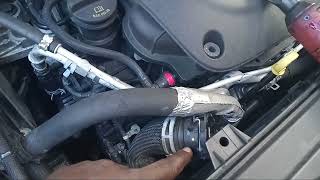
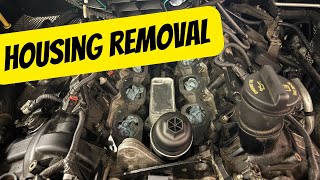
Typical fix: Replace the thermostat and thermostat housing. It's often sold as a complete assembly. 🎬 Watch: Step-by-step guide to removing the Pacifica thermostat housing. Ensure the jiggle valve on the new thermostat is positioned at the top during installation to allow air to bleed properly.
Est. part cost: $30-$80 - Low Engine Coolant Level / Air in System ⚪ Low Probability → Shop Engine Coolant / Antifreeze If the coolant level is low, the ECT sensor may be exposed to air instead of coolant, causing erratic readings. This can be caused by a leak, with a common culprit on the 3.6L Pentastar being the oil filter housing assembly. Air pockets can also become trapped in the system after a coolant service.
How to confirm: Visually inspect the coolant reservoir and radiator to ensure the coolant is at the proper level. Carefully inspect the engine valley, below the oil filter cap, for signs of coolant or oil leaks. If the system was recently serviced, it may need to be 'burped' to remove trapped air.
Typical fix: Top off the coolant to the correct level and inspect for leaks. If air is in the system, perform a cooling system bleed procedure.
Est. part cost: $15-$30 for a jug of coolant - Wiring or Connector Issue ⚪ Low Probability The wiring harness or connector for the ECT sensor can become damaged, corroded, or loose, leading to an intermittent or incorrect signal.
How to confirm: Visually inspect the ECT sensor's connector and wiring for any signs of damage, corrosion, or loose pins. Wiggle the connector while monitoring live data to see if the reading jumps. Check for continuity with a multimeter between the sensor connector and the PCM.
Typical fix: Repair the damaged wiring or replace the connector pigtail. Applying dielectric grease to the new connector can prevent future corrosion.
Est. part cost: $10-$25 for a pigtail
Rare But Worth Checking
- Powertrain Control Module (PCM) Software Issue: While less common on the Pacifica than other models, TSB 18-044-26 indicates that P0116 can appear with other codes, and in such cases, a PCM software update might be the required fix. This should be considered if simple hardware replacement doesn't solve the issue. [⭐ MANUFACTURER TSB — highest authority]
Diagnosis Steps
- Verify the Check Engine Light is on and code P0116 is present using an OBD-II scanner.
- Check the engine coolant level in the reservoir and radiator (when the engine is cool). Top off if necessary.
- With the engine cold, use the scanner's live data feature to compare the Engine Coolant Temperature (ECT) and Intake Air Temperature (IAT) readings. They should be within 5-10 degrees Fahrenheit of each other.
- Start the engine and monitor the ECT reading on the scan tool. It should rise smoothly and steadily as the engine warms up.
- If the temperature rises very slowly or never reaches ~195°F, the thermostat is likely stuck open.
- If the temperature reading is erratic, jumps suddenly, or was incorrect from the cold start, the ECT sensor or its wiring is the most likely culprit.
- Inspect the ECT sensor's electrical connector and wiring for any visible damage, corrosion, or loose connections.
- If the sensor is suspected, test its resistance with a multimeter. At room temperature (~68°F/20°C), it should read between 2k-3k Ohms. If it's out of spec, replace it.
- Carefully inspect the top of the engine, in the valley below the oil filter housing, for any signs of coolant or oil leaks, as this is a known failure point that can introduce air into the system.
Parts You'll Likely Need
- Engine Coolant Temperature Sensor
(OEM #5149077AB (or 05149077AB))— This sensor is the most frequent cause of a P0116 code, as its internal thermistor can fail and provide irrational readings.
Trusted brands: Mopar, NGK/NTK, Delphi, Standard Motor Products (SMP)
OEM price range: $40-$70
Aftermarket price range: $20-$50 - Engine Coolant Thermostat with Housing
(OEM #68253514AF (supercedes 68253514AA, 68211186AB))— A thermostat stuck in the open position is the second most common cause, as it prevents the engine from warming up at the expected rate. It is typically replaced as an assembly with the housing.
Trusted brands: Mopar, Motorad, Stant, Dorman
OEM price range: $50-$90
Aftermarket price range: $30-$70
Related Codes That Often Appear With This One
- P0128 — P0128 (Coolant Thermostat Rationality) is very similar and is often caused by a thermostat stuck open, which prevents the engine from reaching operating temperature—a condition that can also trigger P0116.
- P0117 — This code indicates 'Engine Coolant Temperature Sensor 1 Circuit Low,' pointing to a short in the sensor circuit, which can sometimes accompany a performance code like P0116 if the fault is intermittent.
- P0118 — This code indicates 'Engine Coolant Temperature Sensor 1 Circuit High,' pointing to an open circuit. Like P0117, it can appear alongside P0116 if the sensor or wiring is failing.
- P05BD-00 — This code for 'Stop-Start Mode Switch Range/Performance' is mentioned in TSB 18-044-26 along with P0116. An incorrect coolant temperature reading can disable the auto start-stop system, causing both codes to appear. [⭐ MANUFACTURER TSB — highest authority]
Technical Service Bulletins (TSBs) & Recalls
- 18-044-26: Mentions P0116-00 in a list of potential diagnostic trouble codes related to engine performance and start-stop system issues. [⭐ MANUFACTURER TSB — highest authority]
Platform-Specific Known Issues
- TSB 18-044-26: This Technical Service Bulletin from Chrysler notes that P0116-00 may be found in conjunction with other codes like P05BD-00 ('Stop-Start Mode Switch R
Mechanic-Grade Diagnostic Values
- Engine Coolant Temperature (ECT) Sensor Resistance — expected: 2000-3000 Ω at 20°C (68°F); 200-300 Ω at 90°C (194°F).. Failure: A reading significantly outside this range, or an open/short circuit (OL on a multimeter), indicates a failed sensor.
- Engine Coolant Temperature (ECT) Sensor Signal Voltage (at sensor connector) — expected: Approximately 2.0V - 3.0V with a cold engine (Key On, Engine Off). Around 0.5V with a warm engine (approx. 90°C / 194°F).. Failure: A voltage of 0V suggests a short to ground, while a reading of 5V indicates an open circuit or a bad sensor ground.
- ECT Sensor Connector 5V Reference Voltage (connector unplugged) — expected: Approximately 5.0V on one of the two pins (Key On, Engine Off).. Failure: No voltage indicates a wiring problem back to the PCM or a PCM fault.
Scan Tool Commands That Help
- Professional OBD-II Scanner (e.g., wiTECH, Autel, Launch): Circuit Test by Jumpering Connector — To definitively test the wiring harness integrity. Unplug the ECT sensor connector and jumper the two pins together. The scan tool's live data for ECT should change from its lowest possible reading (e.g., -40°F) to its highest possible reading (e.g., 302°F). If this jump occurs, the wiring and PCM are confirmed good, isolating the fault to the sensor itself.
Wiring & Ground Locations
- ECT Sensor Connector — Plugs directly into the ECT sensor, which is located on or integrated into the thermostat housing on the front of the engine.. This is a 2-pin connector. One pin is the 5V reference supplied by the PCM, and the other is the signal return/sensor ground which goes back to the PCM. Corrosion or damage here is a direct cause of sensor signal faults.
- G304 — Behind the right-side kick panel in the passenger footwell.. This is a major interior ground point for various modules and sensors. While the ECT sensor grounds through the PCM, a poor G304 ground can cause erratic behavior in the BCM or other modules that interface with the PCM, potentially creating difficult-to-diagnose electrical issues that could mimic sensor failures.
Real Owner Repair Stories
- PacificaForums.com user (2018 Chrysler Pacifica Touring L Plus, ~60,000 miles) — Check Engine Light on with code P0116. Temperature gauge was reading low and taking a very long time to warm up.
❌ Tried (didn't work) Initially suspected the ECT sensor itself due to the code definition.
✅ What actually fixed it The user identified that the engine was slow to warm up by monitoring the temperature gauge. Based on this symptom, they correctly diagnosed a stuck-open thermostat. Replacing the thermostat assembly resolved the code and the slow warm-up condition.
OEM Part Supersession History
68217305AD, 68217305AE, 68217305AF→68217305AG— Progressive updates to the thermostat assembly to improve reliability and prevent sticking.
Heads up: All previous versions are superseded by the latest part number (currently 68217305AG). It is recommended to always use the latest available revision for repairs.
Model Year Variations Within This Range
- 2017-2018: On some earlier models, the ECT sensor (P/N 5149077AB) could be a separate component from the thermostat housing, though it was located nearby.
- 2019-2024: The ECT sensor is consistently integrated directly into the thermostat housing assembly. When replacing a faulty sensor on these models, you are replacing the entire thermostat housing unit, which includes a new thermostat and sensor.
Helpful Videos


We Have This Part in Stock


The information in this article is provided for general reference and educational purposes only. Vehicle specifications, procedures, and part compatibility can vary by production date, trim level, and region. Always consult your vehicle's factory service manual and verify part numbers before purchasing or performing repairs. Safety-critical components such as airbags, seat belts, and braking systems should be installed by a qualified professional.
- Chrysler PACIFICA:
- 🧭 Diagnostic Flowchart
- 🎬 Helpful Videos
- 🛍️ Shop This Part
- What's Unique About the 2017-2024 Chrysler PACIFICA
- Symptoms You May Notice
- Most Likely Causes
- Rare But Worth Checking
- Diagnosis Steps
- Parts You'll Likely Need
- Related Codes That Often Appear With This One
- Technical Service Bulletins (TSBs) & Recalls
- Platform-Specific Known Issues
- Mechanic-Grade Diagnostic Values
- Scan Tool Commands That Help
- Wiring & Ground Locations
- Real Owner Repair Stories
- OEM Part Supersession History
- Model Year Variations Within This Range
- 🎟️ Get 5% Off