

P0116 on 2015-2024 Ford Edge 2.7L EcoBoost: ECT Sensor and Wiring Fixes
On a 2015-2024 Ford Edge with the 2.7L EcoBoost engine, code P0116 is most often caused by a poorly seated electrical connector at the Engine Coolant Temperature (ECT) sensor. Before buying parts, firmly check the connector. If that doesn't work, the ECT sensor itself is the next likely culprit, costing around $25-$60 for the part. In some cases, a faulty wiring harness shared with the knock sensor is to blame, a fix covered by a Ford TSB.
- For the 2.7L EcoBoost Edge, always check that the ECT sensor's electrical connector is fully seated before attempting any other repairs. This is the most common fix and costs nothing.
- If the connector is secure, the next most likely cause is a failed ECT sensor, which is an affordable and accessible part.
- A stuck-open thermostat can also cause this code, so watch for an engine that is slow to warm up.
- Several Ford TSBs exist for this exact problem, confirming it's a known issue with the connector, sensor, or wiring harness.
What's Unique About the 2015-2024 Ford Edge
For the Ford Edge with the 2.7L EcoBoost V6, this code is a well-documented issue. The ECT sensor is located in a difficult-to-access position in the valley between the cylinder banks, under the intake manifold. Ford has released multiple Technical Service Bulletins (TSBs) that point directly to a common manufacturing or design flaw: the electrical connector for the ECT sensor is often not fully seated. This makes a simple connector check the most critical first step, unlike on other vehicles where the sensor itself is almost always the immediate suspect. In some cases, the issue is with the wiring harness that the ECT sensor is a part of (shared with the knock sensor), leading to official recommendations to replace the entire harness along with the sensor, as noted in TSB SSM 48991.
Generation note: This range covers the second generation Ford Edge (2015-2018) and its mid-cycle refresh (2019-2024). The 2.7L EcoBoost engine was used in the 'Sport' trim before the refresh and the 'ST' trim after. The causes and TSBs cited apply across this entire year range for vehicles equipped with this engine.
Symptoms You May Notice
- Check Engine Light is on
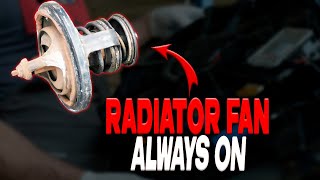
- Engine cooling fans running constantly, even when the engine is cold 🎬 Watch: Why your radiator fans might be running constantly
- Engine cooling fans not turning on, leading to potential overheating
- Erratic or non-functional engine temperature gauge on the dashboard
- Reduced fuel economy
- In some cases, an 'Engine Coolant Over Temperature' warning on the dash
- Hard starting, especially when the engine is cold
- Rough idle
- Replacing the thermostat when the actual problem is the much simpler and more common loose ECT sensor connector.
- Replacing the ECT sensor without first checking the coolant level or ensuring the connector is secure.
- Assuming the ECT sensor is bad without considering the associated wiring harness, which is a known failure point per TSB SSM 48991.
Most Likely Causes
- ECT Sensor Connector Not Fully Seated 🔴 High Probability → Shop Engine Coolant Temperature Sensor This is a widely documented issue for the 2.7L EcoBoost engine, cited in multiple Ford TSBs (SSM 46906, SSM 47791). The connector (C1016 on the Edge) may not have been fully seated during manufacturing or a previous service.
How to confirm: Locate the ECT sensor on the engine, in the valley between the cylinder banks. This may require removing some components for access. Physically inspect and push firmly on the electrical connector to ensure it is fully clicked into place. Often, an audible 'click' will be heard if it was loose.
Typical fix: Secure the connector. If the locking tab is broken, the connector pigtail may need to be replaced or secured.
Est. part cost: $0-$30 - Faulty Engine Coolant Temperature (ECT) Sensor 🟡 Medium Probability → Shop Engine Coolant Temperature Sensor The sensor itself can fail internally, sending incorrect readings. TSB SSM 48991 acknowledges this by recommending its replacement along with the wiring harness. Due to its location under the intake manifold, it is exposed to significant heat.
How to confirm: Using a scan tool, compare the ECT reading to the Intake Air Temperature (IAT) reading on a completely cold engine. They should be within a few degrees of each other. If the ECT reading is significantly different (e.g., shows -40°F), the sensor is likely bad.
Typical fix: Replace the ECT sensor. This requires removing the intake manifold for access. Ford specifies the sensor should not be reused once removed.
Est. part cost: $25-$60 - Stuck-Open Thermostat 🟡 Medium Probability → Shop Integrated Thermostat Housing Assembly Like any vehicle, the thermostat can fail over time. A stuck-open thermostat is a common cause for P0116 across many makes and models.
How to confirm: Monitor the ECT data on a scan tool while driving. If the engine takes an excessively long time to reach operating temperature (e.g., ~195-205°F) or the temperature drops significantly while cruising at highway speeds, the thermostat is likely stuck open.
Typical fix: Replace the thermostat and housing assembly.
Est. part cost: $50-$150 - Low Engine Coolant Level ⚪ Low Probability → Shop Engine Coolant / Antifreeze
How to confirm: Visually inspect the coolant reservoir when the engine is cold. If the level is below the 'MIN' line, it needs to be topped off. A low level can expose the sensor to air pockets, causing erratic readings.
Typical fix: Top off the coolant with the correct Ford-specified type (Motorcraft Orange VC-3-D or Motorcraft Yellow VC-13-G, depending on the specific model year and build date) and inspect for leaks.
Est. part cost: $20-$40
Rare But Worth Checking
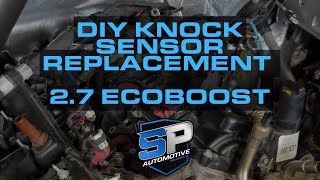
- Damaged Wiring Harness: TSBs SSM 46906 and SSM 47791 note that wiring can be damaged between specific connectors (C1016 and C1168). TSB SSM 48991 even suggests replacing the entire knock sensor harness (which includes ECT wiring, base part 12A699) to resolve the issue 🎬 See this walkthrough on replacing the knock sensor harness, indicating this is a known, albeit less common, failure point.
- Faulty Powertrain Control Module (PCM): This is extremely rare. All other possibilities, especially sensor, connector, and wiring issues, should be exhaustively ruled out before considering the PCM as the cause.
Diagnosis Steps
- Check for TSBs: Given the known issues, check for TSBs related to P0116 for your specific vehicle, specifically SSM 46906, SSM 47791, and SSM 48991.
- Inspect Coolant Level: Ensure the coolant reservoir is filled to the proper level. Let the engine cool completely before opening the system.
- Check ECT Sensor Connector: Locate the ECT sensor in the valley between the engine's cylinder banks. Firmly press on the electrical connector (C1016) to ensure it is fully seated. This is the most common fix.
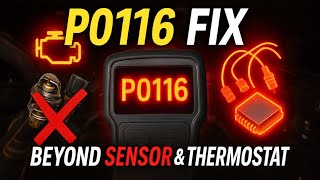
- Scan Tool Rationality Check: With a cold engine, use a scan tool to compare the 'ECT' and 'IAT' (Intake Air Temperature) sensor readings. They should be within 5°F (3°C) of each other. A large discrepancy points to a bad sensor. 🎬 Watch: Troubleshooting P0116 beyond just the sensor and thermostat
- Monitor Engine Warm-Up: Start the engine and watch the ECT data on the scan tool. The temperature should rise smoothly and steadily to around 195-205°F. If it rises erratically, jumps around, or fails to warm up properly, it points to a faulty sensor or a stuck thermostat.
- Inspect Wiring: If the connector is secure and the sensor seems to test bad, carefully inspect the wiring harness leading to the ECT sensor for any visible damage, chafing, or corrosion, paying attention to the path between connectors C1016 and C1168 as noted in TSBs.
- Test Thermostat: If the engine is slow to warm up or runs cool at speed, the thermostat is the likely cause and should be replaced.
Parts You'll Likely Need
- Engine Coolant Temperature (ECT) Sensor
(OEM #FT4Z-12A648-B)— This sensor is the second most likely failure point after its connector. TSBs recommend its replacement to fix the code. This part number supersedes FT4Z-12A648-A and DY-1298.
Trusted brands: Motorcraft, Bosch, NTK
OEM price range: $30-$50
Aftermarket price range: $20-$40 - Thermostat and Housing Assembly
(OEM #FT4Z-8575-B)— If the engine fails to reach operating temperature correctly, a stuck-open thermostat is the cause.
Trusted brands: Motorcraft, Gates
OEM price range: $100-$150
Aftermarket price range: $50-$90 - Knock Sensor Harness
(OEM #JT4Z-12A699-A)— In cases of repeated issues or visible wiring damage, Ford recommends replacing this harness, which includes the ECT sensor wiring, as per TSB SSM 48991. The base part number is 12A699.
Trusted brands: Motorcraft
OEM price range: $50-$100
Related Codes That Often Appear With This One
- P0117 — ECT Circuit Low Input - This can occur if the faulty connector or wiring creates a short. It is listed in the same TSBs as P0116.
- P0118 — ECT Circuit High Input - This often points to an open circuit, which directly relates to the common issue of the ECT connector being unplugged or a broken wire.
- P0128 — Coolant Thermostat (Coolant Temperature Below Thermostat Regulating Temperature) - This code is often triggered alongside P0116 if a stuck-open thermostat is the root cause.
- P1299 — Cylinder Head Over Temperature Protection Active - The PCM may trigger this protective mode based on the false, erratic data from the ECT circuit.
- P0330 — Knock Sensor 2 Circuit (Bank 2) - This code can appear with P0116 because the ECT sensor wiring is integrated into the knock sensor harness on the 2.7L EcoBoost. A fault in this harness can trigger both codes.
Technical Service Bulletins (TSBs) & Recalls
- SSM 47791: Notes that P0116 on 2.7L engines may be due to an ECT sensor connector that is not fully seated or has damaged wiring.
- SSM 46906: An earlier bulletin that also identifies a loose ECT sensor connector as a primary cause.
- SSM 48991: Recommends replacing both the ECT sensor (12A648) and the knock sensor harness (12A699) to correct P0116 on some 2.7L models.
Platform-Specific Known Issues
- A loose ECT sensor connector is the most common cause of P0116 on the 2.7L EcoBoost engine, as documented in Ford TSBs SSM 46906 and SSM 47791.
- Damaged wiring in the knock sensor harness, which incorporates the ECT sensor circuit, is another known issue addressed by TSB SSM 48991.
Mechanic-Grade Diagnostic Values
- ECT Sensor Resistance vs. Temperature — expected: Approximately 37,000 Ω at 50°F (10°C), 9,500 Ω at 104°F (40°C), and 2,000 Ω at 176°F (80°C). Resistance is inversely proportional to temperature.. Failure: A reading near zero ohms indicates a shorted sensor (P0117), while infinite resistance indicates an open circuit (P0118). A P0116 can be set if values are erratic or don't correlate with other sensors.
- ECT Sensor Signal Voltage at PCM — expected: The voltage should decrease as the engine warms, typically from ~3.5V-4.6V when cold to under 1.0V when at operating temperature.. Failure: Voltage that is stuck high (near 5V), stuck low (near 0V), or jumps erratically will trigger a fault. A P0116 is set when the voltage is irrational for the given conditions, such as not changing during warm-up.
Scan Tool Commands That Help
- FORScan: Live Data PID Monitoring (ECT, IAT) — Use on a cold engine to perform a rationality check. The ECT (Engine Coolant Temperature) and IAT (Intake Air Temperature) PIDs should display temperatures within a few degrees of each other. Then, monitor the ECT PID during warm-up to ensure it rises smoothly and steadily, without erratic jumps or dropouts, which would indicate a faulty sensor or wiring.
- Ford IDS (Integrated Diagnostic System): Datalogger - Monitor ECT PID — This is the dealer-level tool used to watch the ECT sensor's temperature reading in real-time as the engine warms up. It helps a technician definitively identify if the reading is smooth and steady or if it jumps erratically, pointing to a sensor or wiring fault.
- Ford IDS (Integrated Diagnostic System): Self-Test (KOEO/KOER) — The Key On Engine Off or Key On Engine Running self-tests command all modules to report any stored, pending, or continuous memory DTCs. This provides a comprehensive view of system health and can reveal other related codes that haven't illuminated the check engine light.
Wiring & Ground Locations
- G104 / G105 — Located in the left front of the engine compartment. G104 is often on the passenger side fender, while G105 can be on the top right side of the engine itself.. These are primary engine compartment ground points for the PCM and its sensor network. A poor or corroded ground here can cause erratic voltage and faulty signals for multiple sensors, including the ECT sensor, leading to a P0116 code.
- PCM Grounds — Located on the firewall, often near the PCM itself.. The ECT sensor circuit relies on a clean ground reference back to the PCM. A loose or corroded ground stud on the firewall can cause intermittent and hard-to-diagnose sensor reading issues.
- C1016 — This is the connector for the ECT sensor itself, located in the engine valley under the intake manifold on the 2.7L EcoBoost.. This specific connector is cited in multiple TSBs (SSM 46906, SSM 47791) as being frequently not fully seated from the factory, making it the number one cause of P0116 on this platform.
- C1168 — This is an inline harness connector located between the ECT sensor and the main engine harness.. TSB SSM 47791 specifically mentions that wiring can become damaged between connector C1016 (at the sensor) and C1168, causing P0116. This points to a known chafe or stress point in the harness routing.
Real Owner Repair Stories
- Ford F150 Forum user (2018 Ford F-150 2.7L EcoBoost (same engine and TSBs apply)) — Check engine light, cooling fans running on high, engine running rough in limp mode, 'Engine Coolant Over Temperature' warning on a cold start.
❌ Tried (didn't work) Initial dealer diagnosis missed the issue, focusing only on the high fans.
✅ What actually fixed it The owner informed the dealer of the relevant TSB (which became TSB 21-2168 for the F-150, an evolution of the Edge TSBs). The dealer then replaced both the ECT sensor and the associated knock sensor wiring harness as instructed by the bulletin, which resolved all symptoms.
OEM Part Supersession History
FT4Z-12A648-A→FT4Z-12A648-B (Motorcraft DY-1339)— Part revision by the manufacturer, likely for improved reliability or material changes.FT4Z-6C038-A→JT4Z-12A699-A (Base part 12A699)— Part number updated for the knock sensor harness which includes the ECT wiring. This is the part recommended for replacement in TSB SSM 48991.
Model Year Variations Within This Range
- 2015-2024 (check specific build date): The specified engine coolant changed from Motorcraft Orange Coolant (VC-3-D) to Motorcraft Yellow Coolant (VC-13-G) during this production run. While not a direct cause of P0116, using the wrong coolant can affect long-term system health. Always verify the correct coolant type for your specific vehicle via the owner's manual or a dealer.
Diagnostic Flowchart
Other Known Issues on This Vehicle
Issues unrelated to this code that are worth knowing about as an owner of this generation:
- Leaking Plastic Oil Pan 🟠 Medium — Common on 2015-2017 models. The original RTV sealant fails to adhere properly between the plastic pan and the engine block. (Ref: TSB 23-2338, TSB 19-2219)
- Internal Coolant Leak (Cracked Cylinder Head) 🔴 High → Shop Engine Coolant / Antifreeze — A known but less common issue where a crack can develop in the cylinder head, leading to coolant being burned in the exhaust. Symptoms include white smoke on startup and unexplained coolant loss.
- Carbon Buildup on Intake Valves 🟡 Low — More prevalent on first-generation 2015-2017 models which only used direct injection. The 2018+ models added port injection which helps clean the valves.
- Turbocharger Coolant/Oil Line Leaks 🟠 Medium → Shop Engine Coolant / Antifreeze — Leaks can develop from the lines feeding the twin turbochargers, leading to oil or coolant loss.
- Faulty Intake Valves (2021 models) 🔴 High — A specific batch of intake valves used in some 2021 models could fracture, potentially causing severe engine damage. (Ref: Recall 22S27 / NHTSA 22V-255)
Used vs. New Parts: Buying Guide for This Vehicle
When a used part is the smart pick: A used knock sensor/ECT wiring harness (JT4Z-12A699-A) from a low-mileage, accident-free donor vehicle can be a cost-effective alternative to a new OEM part, especially if the failure is due to a specific wire break that can be visually confirmed as intact on the donor part.
Donor-vehicle mileage cap: roughly under 40000 miles for the part to have meaningful remaining life.
What to inspect on the donor part:
- Inspect the entire length of the harness for any signs of brittleness, cracking, or oil saturation.
- Check that all connector locking tabs are intact and not broken.
- Examine the pins within the connectors for any corrosion or signs of being bent or pushed back.
- Ensure the donor vehicle was not in a front-end collision that could have stressed the wiring.
OEM-only on this vehicle (don't cheap out):
- Engine Coolant Temperature (ECT) Sensor: Given the low cost of a new OEM or quality aftermarket sensor ($25-$60) and the high labor cost to access it, installing a used sensor is not recommended.
- Thermostat: This is a wear-and-tear item. A new OEM or high-quality aftermarket part should always be used to ensure reliability.
Aftermarket brands forum-validated for this vehicle:
- ECT Sensor: Motorcraft (OEM), NTK, Bosch.
- Thermostat: Motorcraft (OEM), Gates.
Brands owners have reported issues with on this vehicle:
- Avoid no-name, unbranded electronic sensors from online marketplaces. Failure rates are high, and the significant labor involved in replacing the ECT sensor on the 2.7L EcoBoost makes using a low-quality part a major risk.
Real Owner Stories
Aggregated from forums and TSBs cited above. Mileages and costs reflect what owners reported in those sources.
2018 Ford Edge 2.7L EcoBoost
Symptoms: Check engine light on with code P0116; the temperature gauge on the dash was erratic and not functioning correctly.
What fixed it: The technician found the ECT sensor connector (C1016) was not fully seated. Pushing the connector until it clicked resolved the issue.
Source hint: https://www.fordedgeforum.com/
2018 Ford F-150 2.7L EcoBoost
Symptoms: Loss of coolant and P0116 code symptoms.
What fixed it: In some severe cases for this engine platform, a cracked cylinder head was found to be the root cause of coolant loss and related sensor issues.
Source hint: https://www.f150forum.com/f118/2018-2-7-ecoboost-loss-coolant-553654/
Related OBD-II Codes
Frequently Asked Questions
I have a 2018 Ford Edge 2.7L with a P0116 code; which TSBs should I tell my mechanic to look at?
Where is the ECT sensor located on the 2.7L EcoBoost engine?
Can I just plug the ECT sensor back in, or do I need to replace it?
My Ford Edge fans are running constantly even when the engine is cold. Is this related to P0116?
What kind of coolant should I use if I need to top off my 2015-2024 Edge?
Is the P0116 code on my Edge related to the plastic oil pan leaks?
Helpful Videos
We Have This Part in Stock


The information in this article is provided for general reference and educational purposes only. Vehicle specifications, procedures, and part compatibility can vary by production date, trim level, and region. Always consult your vehicle's factory service manual and verify part numbers before purchasing or performing repairs. Safety-critical components such as airbags, seat belts, and braking systems should be installed by a qualified professional.
- Ford Edge:
- 🧭 Diagnostic Flowchart
- 🎬 Helpful Videos
- 🛍️ Shop This Part
- What's Unique About the 2015-2024 Ford Edge
- Symptoms You May Notice
- Most Likely Causes
- Rare But Worth Checking
- Diagnosis Steps
- Parts You'll Likely Need
- Related Codes That Often Appear With This One
- Technical Service Bulletins (TSBs) & Recalls
- Platform-Specific Known Issues
- Mechanic-Grade Diagnostic Values
- Scan Tool Commands That Help
- Wiring & Ground Locations
- Real Owner Repair Stories
- OEM Part Supersession History
- Model Year Variations Within This Range
- Other Known Issues on This Vehicle
- Used vs. New Parts: Buying Guide for This Vehicle
- Real Owner Stories
- 2018 Ford Edge 2.7L EcoBoost
- 2018 Ford F-150 2.7L EcoBoost
- Related OBD-II Codes
- Frequently Asked Questions
- 🎟️ Get 5% Off