

P0116 on 2014-2018 Mazda 3 SKYACTIV: Engine Coolant Temp Sensor Causes and Fixes
On a 2014-2018 Mazda 3, code P0116 is most often caused by a faulty engine coolant temperature (ECT) sensor or a thermostat stuck open. The PCM flags this code if the engine doesn't warm up by a specific amount in a set time. Replacing the ECT sensor is a common first step, with an OEM part costing around $50-$65.
- P0116 on your Mazda 3 means the engine isn't warming up as fast as the computer expects.
- Before buying parts, check your coolant level. Low coolant is a simple fix that can cause this code.
- The most likely failed part is the Engine Coolant Temperature (ECT) sensor, followed by a thermostat that is stuck open.
- Use a scan tool's live data feature to watch the coolant temperature rise from a cold start. If it's erratic or doesn't move, suspect the sensor. If it rises very slowly, suspect the thermostat.
- The correct OEM part number for the ECT sensor is PE01-18-840.
What's Unique About the 2014-2018 Mazda 3
For the SKYACTIV-G engines in the 3rd generation Mazda 3, the P0116 code is tied to a very specific warm-up timer and temperature rise monitored by the PCM. Unlike a simple circuit fault (like P0117 or P0118), this is a 'rationality' or 'performance' check. The system is designed for high thermal efficiency, and a slow warm-up can negatively impact fuel economy and emissions, which the SKYACTIV philosophy aims to optimize. The most common culprits are not unique design flaws but rather the standard failure of parts like the thermostat or the ECT sensor itself.
Symptoms You May Notice
- Check Engine Light is on
- Reduced fuel economy
- Temperature gauge behaving erratically, staying on cold, or jumping around
- Engine may run rough or hesitate when cold, but seems normal once fully warmed up
- Heater may not blow hot air as quickly as usual, or not at all
- Cooling fans may run constantly, even when the engine is cold
- Difficulty starting the engine in some cases
- Replacing the thermostat when the ECT sensor is actually the faulty component.
- Replacing the ECT sensor when the thermostat is stuck open, which is the true cause of the slow warm-up.
- Replacing parts without checking for low coolant or air pockets in the system first.
Most Likely Causes
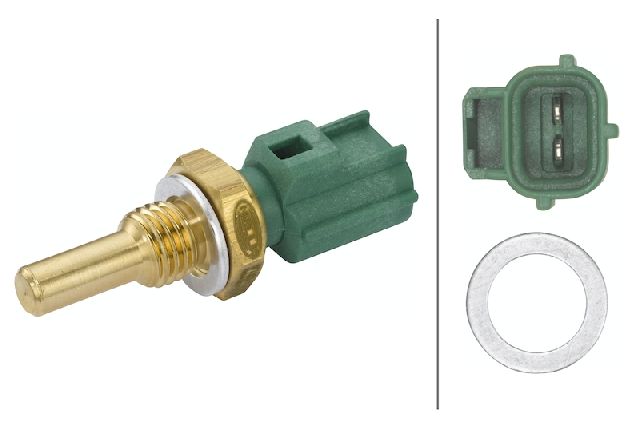
- Faulty Engine Coolant Temperature (ECT) Sensor 🔴 High Probability → Shop Engine Coolant Temperature Sensor Sensors are wear items that can degrade over time from constant heat cycles and exposure to coolant. Their internal resistance can drift, providing inaccurate but not completely failed readings, which triggers a performance code like P0116.
How to confirm: Use a scan tool to monitor the 'ECT' live data. On a cold engine, the reading should be very close to the Intake Air Temperature (IAT) and ambient temperature. If the reading is erratic, stuck at a single value (e.g., -40°F), or doesn't rise smoothly as the engine warms, the sensor is likely bad. You can also test the sensor's resistance with a multimeter; it should be around 2000-3000 Ohms at 20°C (68°F).
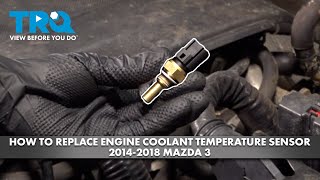
Typical fix: Replace the ECT sensor. On the SKYACTIV engine, it is located on the driver's side of the cylinder head, below the intake manifold runners. 🎬 Watch: How to replace the engine coolant temperature sensor Access can be tight.
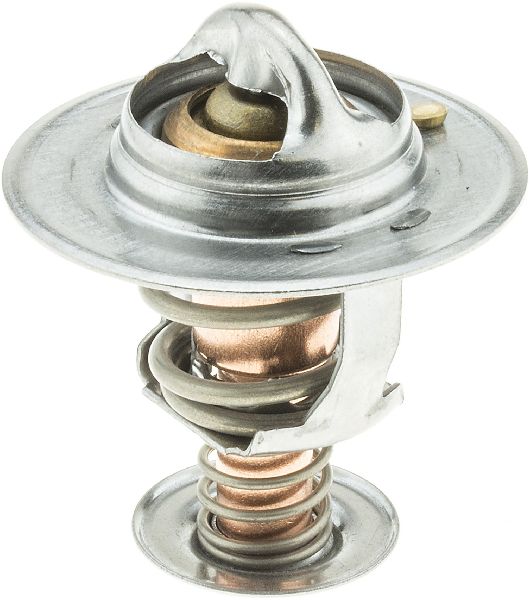
Est. part cost: $45-$65 - Thermostat Stuck Open 🟡 Medium Probability → Shop Integrated Thermostat Housing Assembly Thermostats are mechanical parts that can fail and get stuck in the open position, especially on higher mileage vehicles. This allows coolant to circulate through the radiator constantly, preventing the engine from reaching operating temperature within the PCM's expected timeframe.
How to confirm: Monitor the ECT data on a scan tool while driving. If the engine takes an excessively long time to reach operating temperature (e.g., above 180°F) or if the temperature drops significantly while driving at highway speeds (due to airflow over the radiator), the thermostat is likely stuck open. You can also feel the upper radiator hose; it should remain relatively cool until the engine warms up, then get hot suddenly when the thermostat opens.
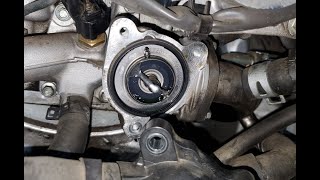
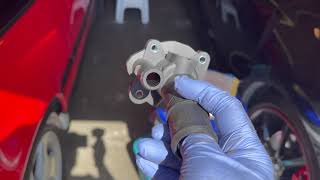
Typical fix: Replace the engine thermostat and housing assembly. This requires draining some coolant and bleeding the system afterward. 🎬 See this walkthrough for replacing the thermostat and coolant
Est. part cost: $30-$70 - Low Engine Coolant Level / Air in System 🟡 Medium Probability → Shop Engine Coolant / Antifreeze
How to confirm: Visually inspect the coolant reservoir and radiator (when the engine is cold). If the level is below the 'MIN' mark, it's too low. An air pocket in the system caused by low coolant can prevent the sensor from being submerged, leading to erratic or incorrect readings. After a repair like a sensor or thermostat replacement, air must be properly bled from the system.
Typical fix: Top off the cooling system with the correct Mazda FL22 coolant and inspect for leaks. Bleed the system by running the engine with the radiator cap off until the thermostat opens and all air bubbles are purged.
Est. part cost: $20-$30 for coolant - Wiring or Connector Issue ⚪ Low Probability
How to confirm: Visually inspect the ECT sensor's electrical connector and wiring harness for any signs of corrosion, damage, or loose connections. Perform a 'wiggle test' on the connector and harness while monitoring live ECT data on a scan tool; if the temperature reading jumps, you've found a connection issue.
Typical fix: Repair the damaged wiring or clean/replace the connector pigtail. Ensure the connector clicks securely onto the sensor.
Est. part cost: $15-$40
Rare But Worth Checking
- Faulty Powertrain Control Module (PCM): This is very rare. All other possibilities, especially the sensor, thermostat, coolant level, and wiring, should be exhaustively ruled out before considering a PCM issue.
- Clogged Heater Core or Contaminated Coolant: → Shop Engine Coolant / Antifreeze Mazda TSB 07-007/17 addresses poor heater performance which can be caused by a clogged heater core due to contaminated coolant. While the primary DTC for this is often P011A, the diagnostic steps in the TSB also reference checking for P0116, indicating a potential link if coolant flow is severely restricted.
- Incorrect PCM Software Logic (2014-2016 Models): For 2012-2016 models, particularly those using a block heater in cold climates (below 32°F / 0°C), Mazda identified that overly sensitive PCM logic could falsely trigger a P0116. A PCM software update is the fix. Check with a dealer to see if this update applies to your VIN. 🎬 Watch: Troubleshooting P0116 causes beyond the sensor and thermostat
Diagnosis Steps
- Check for other DTCs. If codes like P0117, P0118, or P0128 are present, they can help pinpoint the issue.
- Inspect the coolant level in the reservoir and radiator (only when the engine is completely cool). Top off with Mazda FL22 coolant if low and check for visible leaks.
- Connect an OBD-II scanner and view live data. With a cold engine (after sitting for 6+ hours), compare the Engine Coolant Temperature (ECT) and Intake Air Temperature (IAT) readings. They should be within a few degrees of each other and ambient temperature.
- Start the engine and monitor the ECT reading. It should rise steadily. If it warms up extremely slowly or the temperature drops at cruising speed, suspect a stuck-open thermostat.
- If the ECT reading is erratic, jumps suddenly, or shows an illogical value (like -40°F or 300°F) on a cold engine, the ECT sensor is the primary suspect.
- Perform a 'wiggle test'. While watching live ECT data, gently wiggle the sensor's electrical connector and nearby wiring. If the reading fluctuates wildly, there is a connection or wiring fault.
- If the sensor and thermostat seem to be working, perform a coolant system pressure test to check for hidden leaks that could be introducing air into the system.
- After any repair involving draining coolant, properly bleed the cooling system to remove all air pockets, as they can cause this code to return.
Parts You'll Likely Need
- Engine Coolant Temperature Sensor
(OEM #PE01-18-840A (supercedes PE01-18-840))— This sensor is the most common failure point for a P0116 code, as its readings are what the PCM uses to determine the fault.
Trusted brands: Mazda (OEM), Denso, Bosch, NTK
OEM price range: $45-$65
Aftermarket price range: $20-$45 - Engine Coolant Thermostat
(OEM #PE01-15-171)— A thermostat stuck in the open position is the second most likely cause, as it prevents the engine from warming up quickly enough to satisfy the PCM's test parameters.
Trusted brands: Mazda (OEM), Motorad, Stant
OEM price range: $40-$60
Aftermarket price range: $25-$40
Related Codes That Often Appear With This One
- P0128 — Coolant Thermostat (Coolant Temperature Below Thermostat Regulating Temperature). This code is very similar and often points directly to a thermostat that is stuck open, preventing the engine from reaching its proper operating temperature.
- P0117 — ECT Sensor 1 Circuit Low Input. This indicates a short in the sensor circuit, which can sometimes occur with a failing sensor or damaged wiring.
- P0118 — ECT Sensor 1 Circuit High Input. This indicates an open circuit, often caused by a failed sensor or a disconnected/damaged wire.
Technical Service Bulletins (TSBs) & Recalls
- TSB 07-007/17: Titled 'POOR HEATER PERFORMANCE WITH DTC P011A:00', this bulletin for 2014-2018 Mazda 3, Mazda 6, and CX-5 models involves a clogged heater core. Crucially, its diagnostic procedure instructs technicians to check for P0116, P0117, and P0118, linking a potential coolant flow issue to this family of codes.
- Bulletin #01-015-15-3064A: This manufacturer service bulletin notes that some vehicles using an auxiliary heater (block heater) may experience a check engine light with DTC P0116:00 when starting in cold weather below 32 °F (0 °C).
Platform-Specific Known Issues
- Real Owner Experience: Thermostat vs. Sensor: → Shop Integrated Thermostat Housing Assembly A user on the Mazda3Revolution forums with a 2014 Mazda 3 2.5L experienced a P0116 code. After replacing the ECT sensor did not fix the issue, they replaced the thermostat, which ultimately resolved the problem. Their symptom was the temperature gauge taking a very long time to reach the middle and sometimes dropping back down during highway driving, a classic sign of a thermostat stuck open.
Mechanic-Grade Diagnostic Values
- ECT Sensor Voltage (at sensor connector, measured by PCM) — expected: Approx. 3.10 V at 20°C (68°F), Approx. 1.40 V at 60°C (140°F), Approx. 0.87 V at 80°C (176°F). Failure: Voltage that is static, erratic, or does not decrease smoothly as the engine warms up.
- ECT Sensor Resistance (measured at sensor with a multimeter) — expected: Approx. 2,000 - 3,000 Ohms at 20°C (68°F); Approx. 250 - 350 Ohms at 80°C (176°F). Failure: An open circuit (infinite resistance), a short (near zero resistance), or readings that don't change with temperature.
Scan Tool Commands That Help
- Mazda M-MDS or similar advanced scan tool: PID/DATA Monitor for 'ECT' — This is the primary function used to observe the live temperature data reported by the sensor to the PCM. It's essential for verifying if the sensor reading is rational and rises steadily as the engine warms.
- Mazda IDS (Integrated Diagnostic System): Module Reprogramming — For 2014-2016 models that repeatedly show a P0116 in cold weather (especially with a block heater), this function is used to update the PCM to a newer calibration that corrects overly sensitive fault logic. This should only be done after ruling out hardware faults.
Real Owner Repair Stories
- ClubLexus Forum User 'Hayk' (Lexus RX (Symptoms and diagnostic path are identical to Mazda)) — P0116 code, temperature gauge reading low (max 145°F after 30+ minutes of driving), emissions monitors would not complete.
❌ Tried (didn't work) Initial diagnosis pointed to the ECT sensor, but the user decided to replace the thermostat first based on symptoms.
✅ What actually fixed it Replacing the engine thermostat and fresh coolant resolved the P0116 code and allowed the emissions monitors to finally set. Another user in the same thread confirmed this exact fix: replacing the sensor did not work, but replacing the thermostat did.
When the Usual Fixes Don't Work
- While the code definition points to the ECT sensor circuit, a significant number of real-world repairs show that a mechanically stuck-open thermostat is the root cause. The slow warm-up caused by the stuck thermostat makes the PCM believe the sensor's performance is irrational, triggering P0116. Many owners have replaced the sensor first, only to find the code returns, with the final fix being a new thermostat.
OEM Part Supersession History
PE01-18-840→PE01-18-840A— Standard part revision, likely for improved reliability or manufacturing process.
Model Year Variations Within This Range
- 2014-2016: These model years may be susceptible to a false P0116 code in very cold weather due to PCM logic. Mazda issued a software update to correct this. Later years (2017-2018) likely have the updated logic from the factory.
- 2017-2018: These models received a mid-cycle refresh with cosmetic and feature changes, but the 2.0L and 2.5L SKYACTIV-G engines and their cooling systems remained the same. Diagnosis for P0116 is identical to earlier years.
Diagnostic Flowchart
Other Known Issues on This Vehicle
Issues unrelated to this code that are worth knowing about as an owner of this generation:
- Infotainment System Ghost Touch / Delamination 🟠 Medium — Common issue, particularly on 2014-2016 models. The touchscreen may register phantom inputs or become unresponsive. (Ref: Mazda issued a warranty extension (SSPB6) for some vehicles to cover the replacement of the touch-screen component.)
- Premature Rear Brake Wear 🟠 Medium — Some owners report needing to replace rear brake pads and rotors more frequently than expected. Sticking calipers can be a cause. (Ref: Recall 1217F was issued for parking brake actuators on some models.)
- Carbon Buildup on Intake Valves 🟡 Low — As with many direct-injection (GDI) engines, minor carbon buildup can occur over high mileage (80k+ miles), potentially affecting performance. Not considered a critical or widespread failure point on SKYACTIV-G engines.
- Broken Rear Coil Springs 🟡 Low — A known but not extremely common issue where a rear coil spring can fracture.
- Front Body Control Module (F-BCM) Failure 🟠 Medium — Can cause the front windshield wipers to stop working. (Ref: Safety Recall 3219D was issued to replace the F-BCM on affected vehicles.)
Used vs. New Parts: Buying Guide for This Vehicle
When a used part is the smart pick: For this repair, using used parts is not recommended. The key components (ECT sensor, thermostat) are inexpensive wear items critical to engine management. The risk of a used part failing soon after installation outweighs the minimal cost savings. A used wiring connector pigtail could be considered if a new one is unavailable.
Donor-vehicle mileage cap: roughly under 50000 miles for the part to have meaningful remaining life.
What to inspect on the donor part:
- For a connector pigtail: check for non-brittle plastic, absence of corrosion on pins, and flexible, uncracked wire insulation.
OEM-only on this vehicle (don't cheap out):
- No parts for this job are strictly OEM-only, but using OEM or reputable OEM-supplier parts is highly recommended for fit and longevity.
Aftermarket brands forum-validated for this vehicle:
- ECT Sensor: Denso, NTK, Bosch, Delphi, Standard Motor Products (SMP)
- Thermostat: Mazda (OEM), Aisin, Motorad, Stant
Brands owners have reported issues with on this vehicle:
- Avoid unbranded, 'white-box' parts from online marketplaces, as their thermistors and mechanical calibration may not match OEM specifications, leading to the code returning.
Real Owner Stories
Aggregated from forums and TSBs cited above. Mileages and costs reflect what owners reported in those sources.
2014 Mazda 3 2.5L
Symptoms: The temperature gauge was taking a very long time to reach the middle and would sometimes drop back down during highway driving. The P0116 code was present.
What fixed it: Replacing the thermostat resolved the issue after an initial ECT sensor replacement failed to fix it.
Source hint: mazda3revolution.com thread titled 'p0128-and-p0116-codes.234929/' and vehicle_specific_issues
Related OBD-II Codes
Frequently Asked Questions
Does TSB 07-007/17 apply to my 2014-2018 Mazda 3 if I have a P0116 code?
What type of coolant should I use to top off my 2015 Mazda 3 to prevent P0116 air pocket issues?
Where is the ECT sensor located on the SKYACTIV-G 2.0L or 2.5L engine?
My Mazda 3 temperature gauge is jumping around and the heater isn't blowing hot air. Is this related to P0116?
Can a bad thermostat cause a P0116 code on a 2014 Mazda 3 2.5L?
Is there a specific test I can do on the Mazda 3 wiring to check for P0116 issues?
Can cold weather and a block heater cause a P0116 code?
Helpful Videos
We Have This Part in Stock


The information in this article is provided for general reference and educational purposes only. Vehicle specifications, procedures, and part compatibility can vary by production date, trim level, and region. Always consult your vehicle's factory service manual and verify part numbers before purchasing or performing repairs. Safety-critical components such as airbags, seat belts, and braking systems should be installed by a qualified professional.
- Mazda 3:
- 🧭 Diagnostic Flowchart
- 🎬 Helpful Videos
- 🛍️ Shop This Part
- What's Unique About the 2014-2018 Mazda 3
- Symptoms You May Notice
- Most Likely Causes
- Rare But Worth Checking
- Diagnosis Steps
- Parts You'll Likely Need
- Related Codes That Often Appear With This One
- Technical Service Bulletins (TSBs) & Recalls
- Platform-Specific Known Issues
- Mechanic-Grade Diagnostic Values
- Scan Tool Commands That Help
- Real Owner Repair Stories
- When the Usual Fixes Don't Work
- OEM Part Supersession History
- Model Year Variations Within This Range
- Other Known Issues on This Vehicle
- Used vs. New Parts: Buying Guide for This Vehicle
- Real Owner Stories
- 2014 Mazda 3 2.5L
- Related OBD-II Codes
- Frequently Asked Questions
- 🎟️ Get 5% Off