

P0116 on 2005-2010 Pontiac G6 2.4L: ECT Sensor and Thermostat Fixes
On a 2.4L Ecotec G6, code P0116 is most often caused by a faulty, stuck-open thermostat or a bad Engine Coolant Temperature (ECT) sensor. The most reliable fix is replacing the thermostat with the specific ACDelco OEM part (131-158) and the ECT sensor (ACDelco 213-4514) at the same time. Expect to pay $40-$80 for both parts.
- Code P0116 on the 2.4L G6 almost always points to a bad thermostat or a faulty ECT sensor.
- A stuck-open thermostat is an extremely common failure on this specific engine.
- Symptoms often include a non-working temperature gauge and cooling fans that run constantly.
- For a reliable, long-term fix, use the OEM ACDelco thermostat kit (part #131-158).
- Consider replacing both the thermostat and the ECT sensor at the same time, as they are located together and both are common failure points.
What's Unique About the 2005-2010 Pontiac G6
The 2.4L LE5 Ecotec engine, used across many GM platforms like the G6, Chevy Cobalt, and Saturn Aura, is well-known for thermostat failures. The thermostat's rubber seal can degrade, causing it to stick in the open position. This acts as a fail-safe to prevent overheating but frequently causes the engine to warm up too slowly, triggering a P0116 or the closely related P0128 code. Because of this high failure rate, many owners and technicians choose to replace the thermostat and the ECT sensor simultaneously, as they are located together and are both inexpensive. Using the specific ACDelco 131-158 thermostat is highly recommended by enthusiasts, as other aftermarket or even other ACDelco 'professional' versions have been reported to fail prematurely.
Symptoms You May Notice
- Check Engine Light is on
- Engine temperature gauge reads low, is stuck on 'C', or fluctuates erratically
- Temperature gauge drops at highway speeds and may rise when idling
- Cooling fans run constantly, even immediately after a cold start
- Air conditioning (A/C) system may be disabled
- Reduced fuel economy
- Heater may not blow hot air or takes a very long time to warm up
- Engine may be hard to start when cold
- Replacing only the ECT sensor when the thermostat is the actual cause. Since a stuck-open thermostat is so common on this engine, it should be considered the primary suspect, especially if symptoms include the engine temp dropping at highway speeds.
Most Likely Causes
- Stuck-Open Engine Thermostat 🔴 High Probability → Shop Integrated Thermostat Housing Assembly The thermostat assembly on the 2.4L Ecotec engine is a very common failure item, frequently sticking open due to a degrading internal rubber seal.
How to confirm: Monitor live ECT data with a scan tool. If the temperature rises very slowly and struggles to reach or stay at the normal operating range (the OEM thermostat is rated for 180°F/82°C), especially at highway speeds, the thermostat is almost certainly stuck open. You can also feel the upper radiator hose; it should not get warm at the same rate as the engine block right after a cold start.
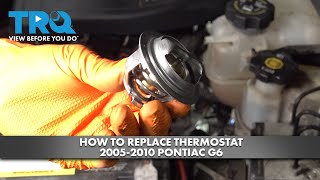
Typical fix: Replace the engine thermostat and its housing/seal. 🎬 Watch: Step-by-step guide to replacing the thermostat on your G6. It is highly recommended to use the specific OEM ACDelco part 131-158 to prevent premature failure.
Est. part cost: $30-$55 - Faulty Engine Coolant Temperature (ECT) Sensor 🔴 High Probability → Shop Engine Coolant Temperature Sensor
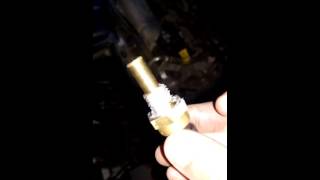
How to confirm: Use a scan tool to view live ECT data with the engine cold (after sitting for several hours). The reading should be very close to the Intake Air Temperature (IAT) and ambient air temperature. If it reads an illogical value (e.g., -40°F or 250°F on a cold engine), the sensor is bad. You can also test the sensor's resistance with a multimeter. At room temperature (68°F/20°C), it should be between 2,200 and 3,000 ohms. 🎬 See how to properly test your ECT sensor with a multimeter. At operating temperature (176°F/80°C), it should be around 250-350 ohms.
Typical fix: Replace the ECT sensor. Since it is located on the thermostat housing, it is almost always replaced at the same time as the thermostat as a preventative measure.
Est. part cost: $15-$40 - Low Engine Coolant Level 🟡 Medium Probability → Shop Engine Coolant / Antifreeze
How to confirm: Visually inspect the coolant level in the coolant reservoir when the engine is cold. If it is below the 'COLD' fill line, top it off and inspect the system for leaks. An air pocket trapped by the sensor can cause erratic readings, triggering a P0116.
Typical fix: Top off the coolant with DEX-COOL specification fluid and properly bleed any air from the system. If the level drops again, find and repair the source of the leak.
Est. part cost: $15-$25 for coolant - ECT Sensor Wiring or Connector Issue ⚪ Low Probability → Shop Engine Coolant Temperature Sensor
How to confirm: Visually inspect the ECT sensor's connector and wiring for any signs of corrosion, damage, or loose pins. Wiggle the connector while monitoring live ECT data on a scan tool; if the reading jumps erratically, a bad connection is likely. Check for a 5-volt reference signal at the connector with the key on, engine off.
Typical fix: Repair the damaged wiring or clean/replace the connector pigtail.
Est. part cost: $10-$30 for a pigtail
Rare But Worth Checking
- Faulty Engine Control Module (ECM): This is very rare. The ECM should only be considered after all other possibilities, including the thermostat, sensor, coolant level, and wiring, have been thoroughly ruled out.
- ECM Calibration Issue: Extremely rare for P0116, but on some GM vehicles, TSBs have been issued for P0128 because the diagnostic parameters were too sensitive. A dealership may need to check for an updated ECM calibration if all hardware has been replaced and confirmed working.
Diagnosis Steps
- Check for other Diagnostic Trouble Codes (DTCs) to see if other issues are present.
- With a cold engine, visually inspect the coolant level in the reservoir and top off if necessary with DEX-COOL.
- Connect an OBD-II scanner and view live data. Compare the Engine Coolant Temperature (ECT) reading to the Intake Air Temperature (IAT) reading. They should be within a few degrees of each other.
- If the cold ECT reading is illogical (e.g., -40°F), the sensor or its wiring is faulty. Inspect the wiring and connector for damage. If the wiring is good, replace the ECT sensor.
- If the cold ECT reading is plausible, start the engine and monitor the temperature as it warms up. The temperature should rise steadily to ~180-195°F and stabilize.
- If the temperature rises very slowly, drops at highway speeds, or fails to reach the normal operating range, the thermostat is almost certainly stuck open and should be replaced.
- While the engine is warming, feel the upper and lower radiator hoses. The upper hose should get hot first. The lower hose will remain relatively cool until the thermostat opens, at which point it will also get hot. If both hoses warm up at a similar slow rate, the thermostat is stuck open.
- After any repairs involving draining coolant, properly bleed the cooling system to remove air pockets. This can involve running the engine with the reservoir cap loose and the heater on high to purge air.
Parts You'll Likely Need
- Engine Coolant Thermostat Kit
(OEM #ACDelco 131-158 (replaces GM OE 12622410))— This is the most common cause of P0116 on the 2.4L Ecotec engine due to a high rate of the thermostat sticking open. The ACDelco 131-158 is the highly recommended 180°F OEM spec part.
Trusted brands: ACDelco
OEM price range: $30-$55
Aftermarket price range: $20-$40 - Engine Coolant Temperature (ECT) Sensor
(OEM #ACDelco 213-4514 (replaces GM OE 19236568))— This sensor provides the temperature reading to the ECM and is a common failure point. It can send incorrect or erratic signals, triggering the code. It is wise to replace it with the thermostat.
Trusted brands: ACDelco, Delphi, NTK
OEM price range: $20-$40
Aftermarket price range: $10-$25 - Engine Coolant / Antifreeze (DEX-COOL) — You will lose coolant when replacing the thermostat or ECT sensor and will need to top off and bleed the system. This vehicle requires DEX-COOL specification coolant.
Trusted brands: ACDelco, Prestone, Valvoline
OEM price range: $15-$25 per gallon
Aftermarket price range: $15-$25 per gallon
Related Codes That Often Appear With This One
- P0128 — P0128 (Coolant Temperature Below Thermostat Regulating Temperature) is caused by the exact same issue: the engine not warming up quickly enough. A stuck-open thermostat is the most common cause for both codes on this engine. P0116 is a range/performance code, while P0128 is a more direct 'too cold for too long' code.
Technical Service Bulletins (TSBs) & Recalls
- While no specific TSB for P0116 is widely cited for this model, TSBs for the related code P0128 on other GM vehicles (like 20-NA-167) have noted that overly sensitive ECM parameters can be a rare cause, requiring a software update.
Platform-Specific Known Issues
- The thermostat on the 2.4L LE5 engine is located on the passenger side of the engine, below the exhaust manifold heat shield. Access is tight. Many owners find that removing the passenger-side headlight assembly provides significantly better access to the two bolts holding the thermostat housing.
- When replacing the thermostat, be careful not to drop the bolts, as they can be difficult to retrieve from the subframe area.
Mechanic-Grade Diagnostic Values
- ECT Sensor Resistance vs. Temperature — expected: Approx. 8k-10kΩ at 0°C (32°F), 2.2k-3kΩ at 20°C (68°F), 250-350Ω at 80°C (176°F), and 180-250Ω at 100°C (212°F).. Failure: An open circuit (infinite resistance) or readings significantly outside this curve indicate a failed sensor.
- ECT Sensor Signal Voltage (Key On, Engine Off, Cold) — expected: 2.0V to 3.0V, depending on ambient temperature.. Failure: A reading near 5.0V suggests an open circuit or bad ground. A reading near 0V suggests a short to ground.
- ECT Sensor Signal Voltage (Engine at Operating Temp) — expected: Approximately 0.5V when the engine is fully warmed up (~190°F).. Failure: Voltage that does not decrease to this range as the engine warms, or remains high, indicates a problem with the thermostat or sensor.
- ECT Sensor Connector Reference Voltage (Key On, Engine Off) — expected: One pin should have a 5.0V reference signal from the ECM, and the other should be the low-reference (ground) pin.. Failure: Absence of the 5V reference points to a wiring issue or a problem within the ECM.
Scan Tool Commands That Help
- GM Tech 2: Graph ECT vs. IAT Sensor Data — Use during a cold start to visually verify if the ECT sensor's temperature curve is smooth and plausible as it warms up. A jagged, flat, or illogical curve strongly points to a sensor or wiring issue, helping to differentiate from a purely mechanical thermostat problem.
- GM Tech 2: Cooling Fan Relay Command — To test the cooling fan circuit independently. P0116 often puts the system into a fail-safe mode where fans run constantly. This command allows a technician to confirm the fan control system works properly on its own, ruling out a separate fan module or relay issue that could be contributing to over-cooling.
Wiring & Ground Locations
- ECT Sensor Connector — On the thermostat housing, located on the right rear (passenger side) of the 2.4L engine block.. This is the direct connection point for the sensor. The two pins are the 5-volt reference (often Yellow) and the low-reference/ground (often Tan or Black). Corrosion or damage here is a primary cause of faulty signals.
- G106 — On the 2.4L engine, this ground is located on the left rear of the engine.. This is a critical engine ground point used by the Engine Control Module (ECM). While a failure here often causes more severe issues like a no-start or other codes, a poor or corroded connection can cause erratic sensor readings, including the ECT, leading to a P0116.
OEM Part Supersession History
21018811, 55350941, 90537453, 12615097→GM 12622410 (also sold as ACDelco 131-158)— Standard part evolution, design improvements, and consolidation of part numbers across multiple Ecotec engine applications.
Heads up: While older numbers may exist, 12622410 is the current correct OEM replacement for this application. Using any other number is not recommended.
Model Year Variations Within This Range
- 2009-2010: For the 2009 model year, GM introduced the LE9 engine, an E85-compatible version of the 2.4L LE5. While the cooling system components and P0116 diagnosis are identical, it's important to be aware of which engine is present if other fuel-related codes are stored, as fuel system components differ.
Diagnostic Flowchart
Other Known Issues on This Vehicle
Issues unrelated to this code that are worth knowing about as an owner of this generation:
- Sudden Loss of Electric Power Steering (EPS) 🔴 High — Very common, typically occurs around 70,000-100,000 miles. Subject to multiple recalls (e.g., #14V153, #14772). (Ref: Recalls #14V153, #14772, #15V064000.)
- Worn Front Lower Control Arm Bushings 🟠 Medium — Common failure item causing clunking noises over bumps, steering wander, and uneven tire wear.
- Clunking from Intermediate Steering Shaft 🟠 Medium — A well-documented issue where the U-joint on the intermediate shaft binds or fails, causing a clunking or popping noise when turning the steering wheel.
- Timing Chain Tensioner Wear / Chain Rattle 🔴 High — Early versions of the 2.4L Ecotec engine are known for timing chain tensioner issues, leading to a rattling noise on cold starts. If ignored, it can lead to stretched chains or guide failure. (Ref: GM released updated tensioner designs to address this.)
- Body Control Module (BCM) Connector Corrosion 🟡 Low — The main connector on the BCM can develop poor contact, leading to strange electrical issues like inoperative tail lights. Cleaning the connector and applying a low-voltage dielectric grease often resolves this.
- Transmission Shift Cable Failure 🟠 Medium — The plastic tabs on the transmission shift cable end can fracture, preventing the vehicle from being shifted into gear or showing the correct gear. Subject to recall #12V460000. (Ref: Recall #12V460000)
Used vs. New Parts: Buying Guide for This Vehicle
When a used part is the smart pick: For this specific repair, using used parts is not recommended. The primary failure items, the thermostat and ECT sensor, are inexpensive wear-and-tear components. The risk of a used part failing shortly after installation is high and outweighs the minimal cost savings.
What to inspect on the donor part:
- Not applicable as used parts are not advised for this repair.
OEM-only on this vehicle (don't cheap out):
- Engine Coolant Thermostat
Aftermarket brands forum-validated for this vehicle:
- ACDelco (for both thermostat and sensor)
- Delphi (for ECT sensor)
- NTK (for ECT sensor)
Brands owners have reported issues with on this vehicle:
- Unnamed or 'white-box' thermostats are frequently reported on forums to fail prematurely or not regulate temperature correctly, causing the P0116 or P0128 code to return.
Real Owner Stories
Aggregated from forums and TSBs cited above. Mileages and costs reflect what owners reported in those sources.
2006-2011 Chevrolet HHR (2.4L LE5)
Symptoms: The thermostat's rubber seal degraded and jammed the unit open, causing the engine to stay below operating temperature and triggering P0116/P0128 codes.
What fixed it: Replacement of the thermostat using the specific ACDelco 131-158 part.
Source hint: Chevy HHR Network - Thread titled 'A
2005-2010 Pontiac G6 (2.4L LE5)
Symptoms: Check engine light with P0116/P0128; owners reported the issue was almost always the thermostat failing to allow the engine to warm up.
What fixed it: Replacing the thermostat and ECT sensor together.
Source hint: g6ownersclub.com
Related OBD-II Codes
Frequently Asked Questions
Why is my Pontiac G6 temperature gauge stuck on 'C' and the cooling fans running constantly?
Is there a specific thermostat part I should use for my 2.4L G6 to fix P0116?
I'm having trouble reaching the thermostat on my 2.4L LE5 engine. Is there a trick to it?
Could my P0116 code be related to the Electric Power Steering (EPS) recalls on the G6?
Can I just replace the ECT sensor to fix the P0116 code?
Helpful Videos
We Have This Part in Stock


The information in this article is provided for general reference and educational purposes only. Vehicle specifications, procedures, and part compatibility can vary by production date, trim level, and region. Always consult your vehicle's factory service manual and verify part numbers before purchasing or performing repairs. Safety-critical components such as airbags, seat belts, and braking systems should be installed by a qualified professional.
- Pontiac G6:
- 🧭 Diagnostic Flowchart
- 🎬 Helpful Videos
- 🛍️ Shop This Part
- What's Unique About the 2005-2010 Pontiac G6
- Symptoms You May Notice
- Most Likely Causes
- Rare But Worth Checking
- Diagnosis Steps
- Parts You'll Likely Need
- Related Codes That Often Appear With This One
- Technical Service Bulletins (TSBs) & Recalls
- Platform-Specific Known Issues
- Mechanic-Grade Diagnostic Values
- Scan Tool Commands That Help
- Wiring & Ground Locations
- OEM Part Supersession History
- Model Year Variations Within This Range
- Other Known Issues on This Vehicle
- Used vs. New Parts: Buying Guide for This Vehicle
- Real Owner Stories
- 2006-2011 Chevrolet HHR (2.4L LE5)
- 2005-2010 Pontiac G6 (2.4L LE5)
- Related OBD-II Codes
- Frequently Asked Questions
- 🎟️ Get 5% Off