

P0117 on 2005-2012 Ford Escape Hybrid: CHT Sensor Circuit Low Causes and Fixes
P0117 on a 2005-2012 Escape Hybrid almost always points to a failed Cylinder Head Temperature (CHT) sensor or a corroded connector, not a traditional coolant sensor. Expect to pay $20-$50 for a new sensor and replace it yourself in under an hour. TSB 12-5-5 was issued for this exact problem.
- P0117 on this vehicle points to the Cylinder Head Temperature (CHT) sensor, not a traditional coolant sensor.
- The root cause is almost always water intrusion into the sensor's electrical connector, a known issue addressed by Ford TSB 12-5-5.
- Before replacing parts, always inspect the CHT connector for green or white corrosion.
- The definitive DIY repair involves replacing both the CHT sensor and its pigtail connector, using heat-shrink connectors and dielectric grease to prevent recurrence.
- Diagnosis is straightforward with a scan tool: a stuck high temperature reading that drops to a default low (-40°F) when the sensor is unplugged confirms a bad sensor/connector.
What's Unique About the 2005-2012 Ford Escape Hybrid
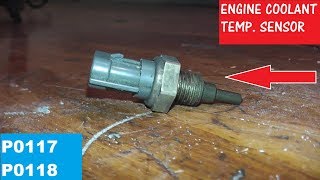
Unlike many vehicles that use an Engine Coolant Temperature (ECT) sensor submerged in coolant, the 2005-2012 Escape Hybrid with the 2.3L or 2.5L engine uses a Cylinder Head Temperature (CHT) sensor. This sensor threads into the metal of the cylinder head to infer temperature. The sensor is located in a recessed well on the top of the engine between the #2 and #3 ignition coils, a location notorious for collecting water from rain or car washes. This design flaw leads to corrosion of the sensor and its electrical connector (C1164), which is the primary cause of P0117 on this platform.
Generation note: This guide covers the first generation (2005-2007) with the 2.3L engine and the second generation (2008-2012) with the 2.5L engine. The cause, diagnosis, and fix for code P0117 are nearly identical for both, as they both use a CHT sensor in a similar location. Ford issued TSB 12-5-5 which covers the 2.5L engine family for this exact issue.
Symptoms You May Notice
- Check Engine Light is on
- Temperature gauge on the dashboard reads maximum HOT, even on a cold start
- Engine cooling fans run constantly at high speed
- Reduced engine power or 'limp mode'
- A/C compressor may be disabled
- Possible hard starting or rough idle
- Replacing the thermostat. A thermostat issue typically causes a P0128 (Engine running too cool) code or actual overheating, not a P0117 electrical circuit fault.
- Looking for a traditional ECT sensor. Owners waste time searching for a sensor in a coolant passage, but this vehicle uses a CHT sensor threaded directly into the cylinder head.
Most Likely Causes
- Corroded Cylinder Head Temperature (CHT) Sensor Connector 🔴 High Probability → Shop Engine Cylinder Head The CHT sensor is located in a recessed well on the cylinder head that collects water, causing the connector pins to corrode and short the circuit. This is a well-documented issue addressed by Ford TSB 12-5-5. 🎬 Watch: Diagnose false overheat and misfires on the 2.5L A manufacturer service bulletin for other Ford models, SSM 47791, also notes that P0117 can be caused by an ECT sensor connector that is not fully seated.
How to confirm: Visually inspect the sensor connector (C1164) for green or white corrosion, rust stains, or signs of water intrusion after pulling back the rubber boot and unplugging it from the sensor.
Typical fix: If corrosion is severe, replace the connector with a new pigtail (Motorcraft WPT-1120). Use heat-shrink butt connectors for the splice and apply a liberal amount of dielectric grease to the new connector to prevent future moisture intrusion.
Est. part cost: $15-$35 - Failed Cylinder Head Temperature (CHT) Sensor 🔴 High Probability → Shop Engine Cylinder Head The sensor can fail internally from thermal stress or moisture damage, creating a short circuit that sends a constant low voltage signal to the PCM. It is often replaced along with the connector as a best practice. TSB 21-2168 notes that an intermittent drop in the engine coolant temperature can trigger P0117 and an Engine Coolant Over Temperature warning.
How to confirm: With a scan tool, observe the ECT/CHT live data. If it reads a fixed, extremely high temperature on a cold engine, the sensor is the primary suspect. Disconnecting a good sensor should make the reading go to a default low value (like -40°F); if this happens when you disconnect your sensor, the sensor itself is confirmed bad.
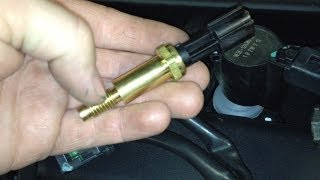
Typical fix: Replace the Cylinder Head Temperature sensor. The sensor requires a 19mm deep socket for removal.
Est. part cost: $20-$50 - Damaged Wiring Harness ⚪ Low Probability
How to confirm: If the scan tool still shows a high temperature after disconnecting the CHT sensor, it indicates the signal wire (typically Yellow/Green) is shorted to ground somewhere between the sensor and the PCM.
Typical fix: Repair the shorted section of the wiring harness.
Est. part cost: $5-$100
Rare But Worth Checking
- Faulty Powertrain Control Module (PCM): → Shop Engine Control Module (ECM) This is extremely rare. The PCM should only be considered after the sensor, connector, and wiring have been definitively ruled out as the cause.
Diagnosis Steps
- Connect an OBD-II scanner and confirm P0117 is the primary code.
- View live data on the scanner. Observe the Engine Coolant Temperature (or CHT) reading. On a cold engine, it should be close to the ambient air temperature. If it reads an impossibly high value (e.g., 250°F+), the fault is active.
- Turn off the vehicle. Remove the plastic engine cover. Locate the CHT sensor on the cylinder head, in the recessed well between the center two spark plug wells (#2 and #3).
- Before disconnecting, check that the drain hole for the cam cover trough is clear of debris, as a clog contributes to water pooling.
- Pull the rubber boot up, then disconnect the CHT sensor's electrical connector (C1164). Inspect both the sensor pins and connector terminals for any signs of corrosion, moisture, or damage.
- Turn the key to the 'On' position (engine off). Re-check the live data reading for temperature. With the sensor disconnected, the reading should now be a default low value (e.g., -40°F).
- If the reading drops to -40°F, the wiring and PCM are likely good. The problem is either the CHT sensor itself or the corroded connector. It is highly recommended to replace both the sensor and the connector pigtail and apply dielectric grease.
- If the reading remains stuck at a high temperature even with the sensor disconnected, there is a short to ground in the wiring harness that needs to be located and repaired.
Parts You'll Likely Need
- Cylinder Head Temperature (CHT) Sensor
(OEM #3F1Z-12A648-A)— This is the sensor that provides the temperature reading to the PCM. It can fail internally, causing the P0117 code. Often replaced with the connector as a set.
Trusted brands: Motorcraft, NGK/NTK, Standard Motor Products
OEM price range: $30-$50
Aftermarket price range: $20-$40 - CHT Sensor Connector Pigtail
(OEM #WPT-1120 (replaces WPT-338))— The original connector is prone to corrosion, which is a primary cause of this code. If cleaning is not possible, replacing the connector is necessary.
Trusted brands: Motorcraft, Dorman, Michigan Motorsports
OEM price range: $25-$40
Aftermarket price range: $15-$30
Technical Service Bulletins (TSBs) & Recalls
- TSB 12-5-5: Issued for 2.5L engines in Escape, Fusion, and Mariner, this TSB specifically addresses false overheat conditions (DTCs P0117, P1299, etc.) caused by water intrusion into the CHT sensor connector. The fix involves inspecting for corrosion, replacing the sensor/pigtail as needed, and applying dielectric grease to seal the connector.
- TSB 21-2168: A manufacturer bulletin noting that an illuminated MIL and Engine Coolant Over Temperature warning with DTC P0117 may be caused by an intermittent drop in the engine coolant temperature.
- SSM 47791: A service message indicating that P0117 may be due to an engine coolant temperature (ECT) sensor connector which is not fully seated.
Platform-Specific Known Issues
- Owner Repair Experience on GreenHybrid.com: A user on the GreenHybrid forums with a 2008 Escape Hybrid reported the classic P0117 symptoms: temp gauge pegged high and fans running constantly on a cold start. Following advice, they inspected the CHT sensor connector and found it filled with green corrosion. The user replaced both the sensor (Motorcraft 3F1Z-12A648-A) and the pigtail (WPT-1120), using heat-shrink butt connectors and filling the new connector's boot with dielectric grease. The repair took 45 minutes and immediately solved the problem. They noted the key was pulling the rubber boot straight up to access the connector tab and using a 19mm deep socket for the sensor itself. 🎬 See this step-by-step CHT sensor replacement walkthrough
Mechanic-Grade Diagnostic Values
- CHT Sensor Resistance (Cold Engine) — expected: Approximately 58,750 Ohms at 50°F (10°C). A common generic test is 2,000-3,000 Ohms at 68°F (20°C).. Failure: Very low resistance (near 0 Ohms) indicates a shorted sensor, which causes P0117.
- CHT Sensor Resistance (Hot Engine) — expected: Approximately 2,000 - 2,500 Ohms at 194°F (90°C).. Failure: Resistance that does not change as the engine warms up, or a value that remains near zero.
- CHT Signal Voltage at PCM (Key On, Engine Off, Cold) — expected: Approximately 3.52 Volts.. Failure: Voltage below 0.2 Volts indicates a short to ground in the sensor or wiring, triggering P0117.
- Reference Voltage at CHT Connector 🎬 Watch: How to test and replace a P0117 sensor — expected: ~5 Volts on one pin (VREF) with the key on, engine off, and connector unplugged.. Failure: No voltage indicates a problem with the PCM or the wiring from the PCM.
Scan Tool Commands That Help
- Ford IDS (or FORScan): Live Data Monitoring (PID: CHT, CHT_V) — Use this to monitor the raw voltage (CHT_V) and the PCM's interpreted temperature (CHT). For P0117, you would expect to see a voltage stuck low (e.g., <0.2V) and a temperature stuck high (e.g., >280°F). This is the primary method for confirming the fault is active.
- Ford IDS (or FORScan): Key-On-Engine-Off (KOEO) Self-Test — This commands the PCM to check all sensor circuits for electrical faults like opens or shorts. Running this test will confirm if the P0117 fault is currently detectable by the PCM without starting the engine.
Wiring & Ground Locations
- CHT Sensor Signal Wire — For the 2.5L engine, this is typically a Yellow/Green (YE-GN) wire at the CHT sensor connector. It runs to pin 33 of the PCM connector C175E.. This is the wire that carries the temperature signal. A short to ground on this wire is a direct cause of P0117. Testing for a short to ground here is critical if the code persists after replacing the sensor.
- CHT Sensor Ground/Return Wire — Typically a Brown/White (BN-WH) wire at the CHT sensor connector. It runs to pin 32 of the PCM connector C175E and serves as the Signal Return (SIGRTN).. This is the ground reference for the sensor provided by the PCM. While less common to fail than the signal wire, a poor connection here can cause erratic readings.
- G104 / G105 — Located on the left front of the engine compartment, near the Battery Junction Box (BJB).. These are major chassis and engine ground points. While not directly for the CHT sensor's dedicated return line, a corroded or loose main ground can introduce electrical noise and voltage offsets that can, in rare cases, affect sensor readings.
- G110 — For the 2.3L/2.5L engines, this ground is located on the left rear of the engine compartment.. This is another critical engine ground point. Verifying it is clean and tight is a good practice when diagnosing any electrical fault, including stubborn sensor codes.
Real Owner Repair Stories
- Ford Truck Enthusiasts Forums (Ford Truck with symptoms identical to Escape Hybrid P0117 (details not specified but diagnostic logic is universal)) — Check engine light on, code P0117 active. Scan tool showed engine temp at 302°F on a cold start, causing the truck to enter a de-fueling/limp mode.
❌ Tried (didn't work) Replacing the ECT/CHT sensor., Replacing the EGR valve and housing.
✅ What actually fixed it The owner found the issue was a short in the wiring harness. While testing for a short, they pulled on the harness and the fault cleared. This confirmed the issue was not the sensor but a damaged wire making intermittent contact with ground. - NHTSA ODI #11613716: An owner reported that code P0117 was pulled from their vehicle and was traced to concerns about overheating of the cylinder head causing cracks and leaks into the oil.
OEM Part Supersession History
F5AZ-12A648-A, F5AZ-12A648-AB→3F1Z-12A648-A (also sold as Motorcraft DY1144)— Part consolidation and revision over time.
Heads up: The listed part numbers are generally interchangeable for this application.WPT-338→WPT-1120— Updated connector kit from Ford/Motorcraft.
Heads up: WPT-1120 is the correct and current service pigtail for this CHT sensor connector.
Model Year Variations Within This Range
- 2005-2007 (2.3L) vs 2008-2012 (2.5L): While the CHT sensor part number, location, and failure mode are virtually identical, the specific PCM pinouts and some ground locations may vary slightly. The TSB 12-5-5 officially covers the 2.5L engine, but the same water intrusion issue affects the 2.3L. Wiring diagrams for the specific year (e.g., 2006 vs 2011) should be consulted for precise pin tracing.
Diagnostic Flowchart
Other Known Issues on This Vehicle
Issues unrelated to this code that are worth knowing about as an owner of this generation:
- Motor Electronics Cooling System (MECS) Pump Failure 🔴 High — Common after 50,000-100,000 miles. Leads to 'Stop Safely Now' warning and vehicle shutdown as the hybrid electronics overheat. (Ref: NHTSA Campaign 14V526 (Recall); Ford TSB 08-24-5.)
- Cracked/Corroded ABS Tone Ring 🟠 Medium — Very common in regions with road salt. Rust forms under the press-fit ring on the axle shaft, causing it to crack and sending erratic signals to the ABS module, disabling ABS and traction control.
- HVAC Blend Door Actuator Failure 🟡 Low — Extremely common. Owners report a clicking or 'percolating' sound from the dash, and an inability to control air temperature on one or both sides. There are multiple actuators; some are easy to replace, one is notoriously difficult.
- High Voltage Battery Airflow Blend Door Actuator Failure 🟠 Medium — A specific blend door actuator (B1239-60) in the rear cargo area fails, preventing proper cooling of the high-voltage battery. This can reduce performance and battery life if not addressed.
Used vs. New Parts: Buying Guide for This Vehicle
When a used part is the smart pick: For this specific repair, using used parts is NOT recommended. The failure is due to a known design flaw (water intrusion) and wear-and-tear on inexpensive electronic components. A used sensor or connector from a junkyard is highly likely to have the same corrosion or be near the end of its life.
What to inspect on the donor part:
- Not applicable as new parts are strongly advised.
OEM-only on this vehicle (don't cheap out):
- While not strictly 'OEM-only', using a Motorcraft sensor (3F1Z-12A648-A) and pigtail (WPT-1120) is highly recommended for fitment and reliability. The cost difference is minimal compared to the labor of re-doing the job.
Aftermarket brands forum-validated for this vehicle:
- NGK/NTK
- Standard Motor Products (SMP)
Brands owners have reported issues with on this vehicle:
- No-name, unbranded sensors from online marketplaces should be avoided as their thermistor accuracy and durability can be questionable, potentially causing incorrect fuel trim and fan control even if they clear the code initially.
Real Owner Stories
Aggregated from forums and TSBs cited above. Mileages and costs reflect what owners reported in those sources.
2008 Ford Escape Hybrid 2.3L — ~100000 miles
Symptoms: Temperature gauge pegged high and fans running constantly on a cold start.
What fixed it: Replaced both the sensor (Motorcraft 3F1Z-12A648-A) and the pigtail (WPT-1120), using heat-shrink butt connectors and filling the new connector's boot with dielectric grease.
Source hint: GreenHybrid.com - Owner Repair Experience
2010 Ford Escape Hybrid 2.5L
Symptoms: False overheat condition and P0117 code.
What fixed it: Inspected for corrosion, replaced the sensor/pigtail as needed, and applied dielectric grease to seal the connector per technical instructions.
Source hint: TSB 12-5-5
2011 Ford Escape Hybrid 2.5L
Symptoms: P0117 code triggered by water pooling in the cylinder head.
What fixed it: Cleaned the cam cover trough and its drain hole to prevent water from pooling, in addition to addressing the sensor fault.
Source hint: Ford-Trucks.com - 2.5L engine owner experience
Ford Escape Owner
Symptoms: An owner reported P0117 and noted concerns about the overheating of the cylinder head causing cracks and leaks into the oil.
What fixed it: The owner traced the issue to a Ford recall (13V583000) related to engine overheating.
Source hint: NHTSA ODI #11613716
Related OBD-II Codes
Frequently Asked Questions
Does TSB 12-5-5 apply to my 2011 Ford Escape Hybrid with the 2.5L engine?
My temperature gauge is pegged at HOT on a cold start; could this be the CHT sensor?
What specific parts do I need to fix the P0117 corrosion issue on my Escape Hybrid?
Why does water keep collecting in my CHT sensor well?
Can I use a used CHT sensor from a salvage yard to save money?
Will a P0117 code affect my A/C system?
Helpful Videos
We Have This Part in Stock


The information in this article is provided for general reference and educational purposes only. Vehicle specifications, procedures, and part compatibility can vary by production date, trim level, and region. Always consult your vehicle's factory service manual and verify part numbers before purchasing or performing repairs. Safety-critical components such as airbags, seat belts, and braking systems should be installed by a qualified professional.
- Ford Escape Hybrid:
- 🧭 Diagnostic Flowchart
- 🎬 Helpful Videos
- 🛍️ Shop This Part
- What's Unique About the 2005-2012 Ford Escape Hybrid
- Symptoms You May Notice
- Most Likely Causes
- Rare But Worth Checking
- Diagnosis Steps
- Parts You'll Likely Need
- Technical Service Bulletins (TSBs) & Recalls
- Platform-Specific Known Issues
- Mechanic-Grade Diagnostic Values
- Scan Tool Commands That Help
- Wiring & Ground Locations
- Real Owner Repair Stories
- OEM Part Supersession History
- Model Year Variations Within This Range
- Other Known Issues on This Vehicle
- Used vs. New Parts: Buying Guide for This Vehicle
- Real Owner Stories
- 2008 Ford Escape Hybrid 2.3L — ~100000 miles
- 2010 Ford Escape Hybrid 2.5L
- 2011 Ford Escape Hybrid 2.5L
- Ford Escape Owner
- Related OBD-II Codes
- Frequently Asked Questions
- 🎟️ Get 5% Off