

P0117 on 2007-2016 GMC Acadia 3.6L V6: Engine Coolant Temp Sensor Fixes
On a 2007-2016 Acadia, code P0117 is most often caused by a failed Engine Coolant Temperature (ECT) sensor or its wiring. The sensor itself is an inexpensive part (around $15-$40), and replacing it is the most common fix. Primary symptoms are often the cooling fans running constantly, an incorrect temperature gauge, and sometimes a "Steering Assist is Reduced" message on the dash.
- P0117 on your Acadia almost always points to a bad Engine Coolant Temperature (ECT) sensor or its wiring.
- The most obvious symptom is usually the radiator fans running at full speed all the time.
- Before buying parts, disconnect the sensor with the key on; if the temperature reading on a scan tool changes drastically, you've confirmed the sensor is the likely culprit.
- The sensor is in a tight spot, but you can likely replace it yourself by just removing the airbox, saving on labor costs.
- Always use DEX-COOL antifreeze when topping off the system after the repair.
What's Unique About the 2007-2016 GMC Acadia
On the first-generation GMC Acadia with the 3.6L V6, the Engine Coolant Temperature (ECT) sensor is notoriously difficult to access. It is tucked near the thermostat housing, below the exhaust crossover pipe and close to the hot exhaust manifold, which can make the wiring vulnerable to heat damage over time. While the official service manual may suggest extensive disassembly (like removing the intake manifold), many owners and technicians have developed shortcuts to replace the sensor by only removing the air intake box and using a deep 19mm or 13/16" socket with a swivel. This code may also strangely trigger a "Steering Assist is Reduced" message on the dashboard, a known software quirk in this GM platform where the PCM defaults to a protective mode due to the perceived high engine temperature.
🎬 Watch: Fix the steering assist message and temp gaugeSymptoms You May Notice
- Check Engine Light is on
- Cooling fans run constantly at high speed, even when the engine is cold
- Temperature gauge on the dashboard reads incorrectly (may be stuck on cold or maxed out hot)
- Reduced fuel economy
- Engine may run rough, hesitate, or be hard to start, especially when cold.
- Air conditioning (A/C) will not work or blows warm air.
- A "Steering Assist is Reduced" message may appear on the driver information center.
- Black smoke from the exhaust due to a rich fuel mixture.
- Replacing the thermostat. A P0117 code is an electrical circuit fault, indicating the signal is out of range. A faulty thermostat is a mechanical part that typically causes the engine to run too cool or too hot, which would more likely trigger a P0128 code (Coolant Temperature Below Thermostat Regulating Temperature).
Most Likely Causes
- Faulty Engine Coolant Temperature (ECT) Sensor 🔴 High Probability → Shop Engine Coolant Temperature Sensor The sensor is a simple electronic component (a thermistor) that can fail over time due to thermal stress from its location near the exhaust. It is the most common point of failure for P0117.
How to confirm: With a scan tool, observe the live ECT data. If it shows a static, extreme temperature (e.g., -40°F or 280°F+) that doesn't change as the engine warms up, the sensor is likely bad. Disconnecting the sensor should cause the reading to jump to the opposite extreme (e.g., from 280°F to -40°F), which strongly suggests the sensor itself is the problem.
Typical fix: Replace the ECT sensor. This often requires a deep 19mm or 13/16" socket. Top off any lost coolant with DEX-COOL.
Est. part cost: $15-$40 - Damaged Wiring or Connector 🟡 Medium Probability The sensor's wiring is located near the hot exhaust manifold, making it susceptible to melting, chafing, or becoming brittle over time. The connector itself can also corrode or become loose, and the locking tab often becomes brittle and breaks.
How to confirm: Visually inspect the entire length of the wiring harness from the sensor as far back as you can see. Look for melted plastic, exposed wires (especially the yellow signal wire), or green corrosion inside the connector. Perform a continuity test or a short-to-ground test on the signal wire if visual inspection is inconclusive.
Typical fix: Repair the damaged section of wire or replace the connector pigtail. The pigtail is a common repair part.
Est. part cost: $10-$30 - Low Engine Coolant or Air in the System ⚪ Low Probability → Shop Engine Coolant / Antifreeze While more likely to cause an actual overheating condition (P1258) or a thermostat code (P0128), a significant coolant leak can lead to air pockets. If an air pocket gets trapped at the sensor location, it can cause erratic readings, though this is less likely to cause a persistent 'Circuit Low' fault.
How to confirm: Check the coolant level in the reservoir and radiator (when the engine is cool). If the level is very low, there is a leak that needs to be addressed. After refilling, the system must be properly bled to remove air pockets.
Typical fix: Find and repair the source of the coolant leak (e.g., water pump, hoses, radiator), then refill and bleed the cooling system.
Est. part cost: $20-$500+ (depending on the leak source)
Rare But Worth Checking
- Faulty Powertrain Control Module (PCM): → Shop Engine Control Module (ECM) This is extremely rare. The PCM should only be considered after all other possibilities, including the sensor and wiring, have been definitively ruled out. A failed driver circuit inside the PCM can cause the code, but this is not a common failure mode.
Technical Service Bulletins (TSBs) & Recalls
Manufacturer documentation highlights that P0117 can sometimes be part of a larger electrical communication failure. For example, GMC Bulletin #PIT5713A notes that P0117 may appear alongside a variety of other DTCs (such as U0073, U0100, and P0107) resulting in warning messages and the Malfunction Indicator Lamp (MIL) being displayed.
Diagnosis Steps
- Connect an OBD-II scanner and confirm P0117 is the active code. Note any other codes, like P0118 or P0128.
- View live data on the scanner. Check the reading for 'Engine Coolant Temperature'. A P0117 will typically show a static, extreme high value like 284°F or a low voltage below 0.14V.
- Let the engine cool completely. Check the coolant level in the reservoir and radiator.
- Locate the ECT sensor on the 3.6L V6, on the driver's side cylinder head, near the thermostat housing and below the exhaust crossover pipe.
- Visually inspect the sensor's connector and wiring for obvious signs of damage like melting, corrosion, or frayed wires. Pay close attention to the area near the exhaust.
- With the key on and engine off, disconnect the ECT sensor's electrical connector. The locking tab may be brittle.
- Check the live data on your scanner again. The temperature reading should now show the opposite extreme value (e.g., jump from 284°F to -40°F). This action will likely trigger code P0118. If this happens, the PCM and wiring are likely good, and the sensor itself has failed.
- If the reading does not change when disconnected, you have a wiring problem. Check for a short to ground on the yellow signal wire between the PCM and the sensor connector.
- If the sensor is determined to be the cause, replace it using a deep 19mm or 13/16" so 🎬 Watch: How to replace the sensor on a GMC Acadiacket. Be prepared for a small amount of coolant to spill. Top off the coolant with DEX-COOL as needed.
- Clear the codes with the scanner and take the vehicle for a test drive to ensure the code does not return and that the A/C and temperature gauge function normally.
Parts You'll Likely Need
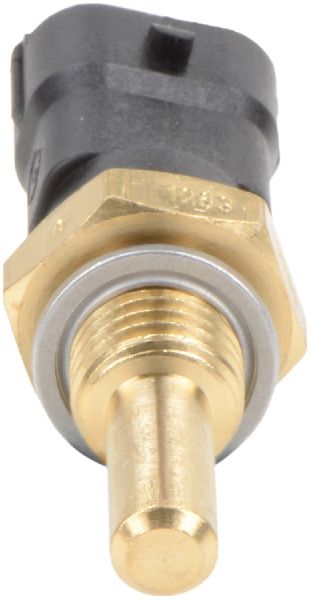
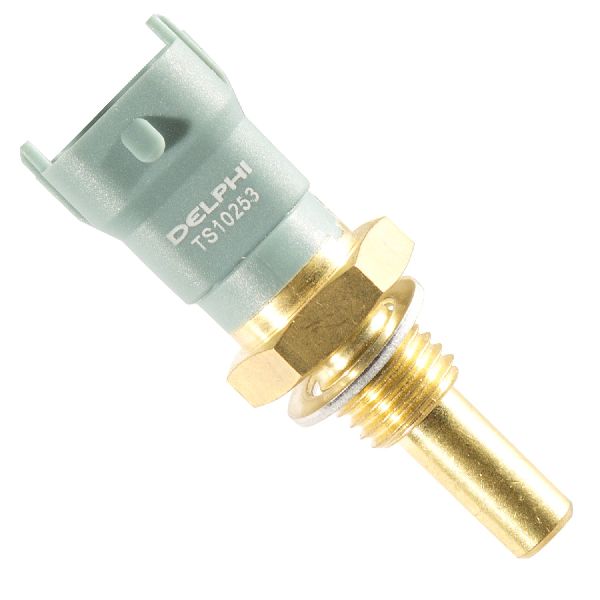
- Engine Coolant Temperature (ECT) Sensor
(OEM #12608814 (Superseded by ACDelco 213-4514))— This sensor is the most common failure point for a P0117 code. It directly measures the temperature and sends the signal that the PCM has identified as faulty.
Trusted brands: ACDelco, Delphi, Standard Motor Products
OEM price range: $25-$45
Aftermarket price range: $15-$30 - Engine Coolant (DEX-COOL)
(OEM #12378390)— A small amount of coolant will be lost when replacing the sensor. The system must be topped off with the correct type of coolant to the proper level.
Trusted brands: ACDelco, Prestone
OEM price range: $20-$25 per gallon
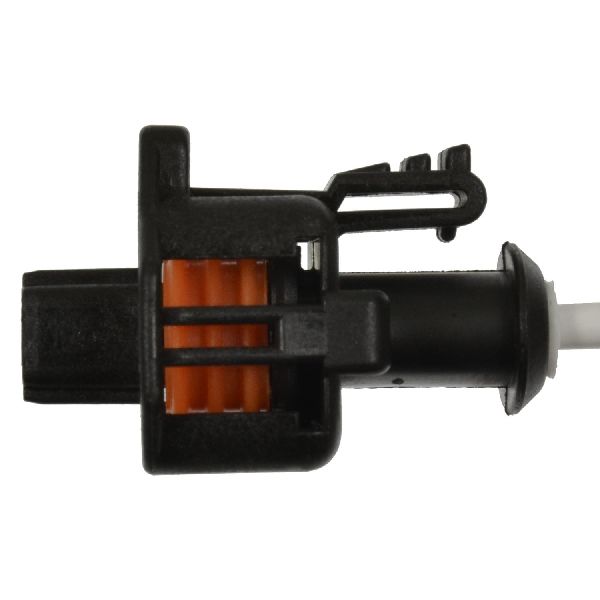
Aftermarket price range: $18-$22 per gallon - ECT Sensor Connector Pigtail
(OEM #ACDelco PT2183 (or equivalent))— If the wiring or connector is damaged due to heat or brittleness, replacing the pigtail is the standard repair. The original connector's locking tab is prone to breaking.
Trusted brands: ACDelco, Dorman
OEM price range: $20-$30
Aftermarket price range: $10-$20
Related Codes That Often Appear With This One
- P0118 — This is the opposite code, for 'ECT Circuit High'. It can appear during diagnosis when you disconnect the sensor to test the circuit, as an open circuit reads as high voltage / extremely low temperature (-40°F).
- P0128 — Indicates the engine isn't reaching operating temperature, often due to a stuck-open thermostat. While a separate issue, problems in the cooling system can sometimes lead to multiple codes. A faulty ECT sensor can also sometimes trigger a P0128 if its failure mode is intermittent or causes erratic readings.
- P1258 — This code indicates an actual engine overheat condition ('Engine Coolant Overtemperature - Engine Protection Active'). While P0117 is usually a false alarm from a bad sensor, if the sensor fails in a way that it can't report a real overheating event, P1258 might get triggered by other parameters as the engine enters protection mode.
Mechanic-Grade Diagnostic Values
- ECT Sensor Resistance (disconnected from harness) — expected: 2000-3000 Ω at 20°C (68°F). Failure: A reading significantly outside this range, or an open/infinite reading, indicates a failed sensor.
- ECT Sensor Resistance (disconnected from harness) — expected: 200-300 Ω at 90°C (194°F). Failure: Sensor resistance that does not drop into this range as the engine warms indicates a faulty sensor.
- ECT Sensor Signal Wire Voltage (Key On, Engine Off, Cold) — expected: ~2.0V - 3.5V. Failure: A reading near 0V indicates a short to ground, which is the direct cause of a P0117 code.
- ECT Sensor Signal Wire Voltage (Engine at Operating Temp) — expected: ~0.5V - 1.0V. Failure: Voltage that remains high and does not decrease as the engine warms up points to a sensor or thermostat issue.
- ECT Sensor Low Reference Wire Voltage (Key On, Engine Off) — expected: Near 0V. Failure: Significant voltage on this wire indicates a problem with the sensor ground circuit within the PCM or harness.
Scan Tool Commands That Help
- GDS2 / Tech2: Cooling Fan Relay Command / Fan Speed Control — After confirming the P0117 code and constant fan operation, this bidirectional command can be used to manually turn the fans off or vary their speed. If the fans respond correctly to the scan tool, it confirms the fan control circuits and relays are working. This helps prove the fan issue is a *reaction* to the false temperature signal from the P0117 fault, not a separate fan control problem.
Wiring & Ground Locations
- ECT Sensor Wires — At the sensor connector, below the exhaust crossover pipe on the driver's side of the engine.. The two wires are typically Yellow (Signal) and Tan (Low Reference/Sensor Ground). A P0117 is caused by the Yellow signal wire shorting to ground. Testing this wire for a short is a key diagnostic step if a new sensor doesn't fix the code.
- PCM Connector Pin 74 — At the Powertrain Control Module (PCM) connector.. On some GM models of this era, the Yellow signal wire from the ECT sensor terminates at pin 74. A technician can perform a continuity test between the sensor connector and this pin to rule out an open wire, or test for a short to ground at this pin to isolate the fault to the harness. Always verify with a vehicle-specific diagram.
- G103 — On the left (driver's) side of the engine compartment, on the inner fender panel, sometimes near the brake booster.. This is a major ground point for the Body Control Module (BCM) and other critical components. While not a direct ground for the ECT sensor (which is grounded through the PCM), a poor G103 connection can cause widespread electrical issues that could mimic sensor faults.
- G110 — On the right front of the engine, mounted to the cylinder head.. This is a primary engine ground point. A loose or corroded connection here can affect the Engine Control Module's (ECM) ability to get stable readings from its sensors.
Real Owner Repair Stories
- The Subaru Forums user 'orex880815' (2011 Subaru Impreza 2.5i (Illustrates a universal principle)) — P0117 code appeared immediately after replacing the radiator.
❌ Tried (didn't work) Replacing the ECT sensor did not clear the code initially., Clearing the code with a scanner did not work; it came back immediately.
✅ What actually fixed it The code disappeared on its own after driving the vehicle for a few miles. The owner concluded that air pockets were trapped in the cooling system after the radiator replacement, and driving the car allowed the system to properly bleed itself, resolving the sensor fault.
OEM Part Supersession History
12191170, 15326388, 15369305, 25037062→12608814— Part consolidation and design updates over many model years.
Heads up: The newer part number (12608814) is the correct service replacement for the entire 2007-2016 generation and is backward compatible with vehicles that used the older numbers.
Model Year Variations Within This Range
- 2007-2008 vs 2009-2016: The 3.6L V6 engine was updated from the LY7 (port injection) in 2007-2008 to the LLT (direct injection) from 2009-2016. However, for the purposes of diagnosing a P0117 code, the function, general location, and failure mode of the ECT sensor and its circuit remained consistent across the first generation.
Diagnostic Flowchart
Other Known Issues on This Vehicle
Issues unrelated to this code that are worth knowing about as an owner of this generation:
- Premature Timing Chain Wear/Stretch 🔴 High — Very common, especially on 2007-2012 models. Often occurs between 70,000 and 120,000 miles. Can lead to catastrophic engine failure if ignored. (Ref: GM Special Coverage 11340C (expired); TSB 12-06-01-009F.)
- 3-5-R Transmission Wave Plate Failure 🔴 High — Common on 2007-2009 models with the 6T75 transmission. Typically results in loss of 3rd, 5th, and Reverse gears, requiring a transmission rebuild. Often occurs before 100,000 miles. (Ref: GM Special Coverage 14404B (expired).)
- Power Steering Pump/Line Leaks 🟠 Medium — Frequent issue across all model years. Leaks can occur from the pump, high-pressure lines, or steering rack, leading to whining noises and loss of power assist.
- Excessive Oil Consumption 🟠 Medium — Commonly reported issue, often linked to stuck piston rings from PCV system issues or extended oil change intervals. Can lead to low oil levels and related engine damage. (Ref: TSB 10-06-01-008 series addresses this for various GM engines.)
- Leaking Water Pump 🟠 Medium → Shop Engine Water Pump — The water pump seal can fail, causing a coolant leak. On the 3.6L, a 'weep hole' can allow coolant to leak into the crankcase, contaminating the engine oil, which can lead to severe engine damage if not caught early.
Used vs. New Parts: Buying Guide for This Vehicle
When a used part is the smart pick: A used part is NOT recommended for this repair. The primary failure items are the ECT sensor and its connector pigtail, both of which are inexpensive to purchase new.
What to inspect on the donor part:
- Avoid used electronic sensors entirely. They are wear items and a used part may have limited life remaining or could be faulty from the start.
- Avoid used wiring pigtails. The plastic becomes brittle and wires can be damaged from heat exposure, which is the likely reason the original failed.
OEM-only on this vehicle (don't cheap out):
- While not strictly OEM-only, using a reputable brand is critical. Poor quality sensors can fail quickly or provide inaccurate readings, leading to a repeat of the same problem.
Aftermarket brands forum-validated for this vehicle:
- ACDelco (Original Equipment)
- Delphi
- Standard Motor Products (SMP)
Brands owners have reported issues with on this vehicle:
- Unnamed, no-brand, or ultra-low-cost sensors from online marketplaces should be avoided as their quality and accuracy are not guaranteed.
Real Owner Stories
Aggregated from forums and TSBs cited above. Mileages and costs reflect what owners reported in those sources.
2007-2016 GMC Acadia 3.6L V6
Symptoms: Check engine light, constant high-speed fans, no A/C, and the 'Steering Assist Reduced' message appearing on the dashboard.
What fixed it: Replacement of the ECT sensor using a deep 19mm or 13/16" socket.
Source hint: acadiaforum.net: Multiple threads confirm the common symptoms of P0117 including constant fans, no A/C, and the 'Steering Assist Reduced' message.
2009-2016 Chevrolet Traverse 3.6L V6
Symptoms: Identical P0117 symptoms including the temperature gauge reading incorrectly and the engine being hard to start when cold.
What fixed it: Replacement of the ECT sensor and/or the wiring connector pigtail due to the difficult access location and heat damage.
Source hint: traverseforum.com: As a platform-mate, Traverse owners report the exact same P0117 symptoms and repair procedures.
Related OBD-II Codes
Frequently Asked Questions
Why is my 2007-2016 GMC Acadia displaying a 'Steering Assist is Reduced' message along with the check engine light?
My Acadia's cooling fans are running at high speed even when the engine is cold. Is this related to P0117?
Where is the ECT sensor located on the 3.6L V6 engine?
Is there a TSB for the timing chain issues mentioned in the known issues section?
Can I use a used ECT sensor from a donor vehicle to fix this?
What type of coolant should I use when topping off after the sensor replacement?
Helpful Videos
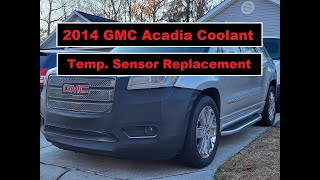
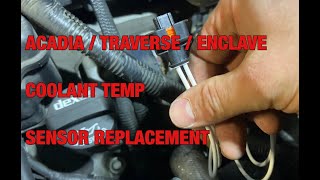
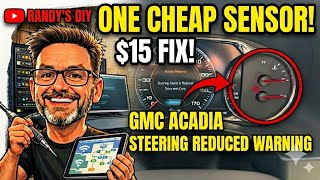
We Have This Part in Stock


The information in this article is provided for general reference and educational purposes only. Vehicle specifications, procedures, and part compatibility can vary by production date, trim level, and region. Always consult your vehicle's factory service manual and verify part numbers before purchasing or performing repairs. Safety-critical components such as airbags, seat belts, and braking systems should be installed by a qualified professional.
- GMC Acadia:
- 🧭 Diagnostic Flowchart
- 🎬 Helpful Videos
- 🛍️ Shop This Part
- What's Unique About the 2007-2016 GMC Acadia
- Symptoms You May Notice
- Most Likely Causes
- Rare But Worth Checking
- Technical Service Bulletins (TSBs) & Recalls
- Diagnosis Steps
- Parts You'll Likely Need
- Related Codes That Often Appear With This One
- Mechanic-Grade Diagnostic Values
- Scan Tool Commands That Help
- Wiring & Ground Locations
- Real Owner Repair Stories
- OEM Part Supersession History
- Model Year Variations Within This Range
- Other Known Issues on This Vehicle
- Used vs. New Parts: Buying Guide for This Vehicle
- Real Owner Stories
- 2007-2016 GMC Acadia 3.6L V6
- 2009-2016 Chevrolet Traverse 3.6L V6
- Related OBD-II Codes
- Frequently Asked Questions
- 🎟️ Get 5% Off