

P0117 on 2010-2015 Toyota Prius: Engine Coolant Temperature Sensor Causes and Fixes
On a 2010-2015 Prius, code P0117 is most often a failed Engine Coolant Temperature (ECT) sensor. This sensor tells the car's computer the engine is overheating, even if it's not. Replacing the sensor is a common DIY fix, with an OEM part costing about $70. Before replacing, verify it's not a true overheating event caused by a failing water pump, another known issue on this platform.
- P0117 on your Prius most likely means you need a new Engine Coolant Temperature (ECT) sensor.
- Before buying parts, use a scanner to check the live coolant temperature on a cold engine. If it's maxed out (280°F+), the sensor or its wiring is shorted.
- If you also have code P148F, your water pump has likely failed and the engine is genuinely overheating. This is a more serious problem that needs immediate attention to avoid engine damage.
- Replacing the sensor is a manageable DIY job with basic tools and a 19mm deep socket.
What's Unique About the 2010-2015 Toyota Prius
On the Gen 3 Prius, the P0117 code is a straightforward issue that is almost always electrical, pointing to the sensor or its wiring. However, it's critical to distinguish it from an actual overheating event. The 2ZR-FXE engine in this Prius can suffer from failures of its electric water pump. If P0117 appears along with other codes like P148F ('Engine Coolant Pump Over Revolution'), it is a strong indicator that the engine is genuinely overheating due to a failed water pump, and the P0117 is a resulting symptom, not the root cause. Owners should first verify if the engine is truly overheating before assuming the sensor is the sole problem, as ignoring a bad water pump can lead to severe engine damage, including head gasket failure.
Symptoms You May Notice
- Check Engine Light activated
- Red Triangle of Death on the dashboard
- High temperature warning message on the multi-function display
- Engine hesitation or feeling sluggish
- Radiator cooling fans run continuously at high speed
- Coolant seen boiling over or being forced from the reservoir cap (in cases of actual overheating)
- No heat from the cabin vents, which can be a sign of low coolant or air in the system.
- Replacing the thermostat. While a stuck thermostat can cause overheating, it typically sets a P0128 code (Coolant Thermostat Below Threshold). P0117 is more specific to an electrical circuit fault or extreme overheating, not slow warm-up.
- Replacing the water pump when only the sensor is bad. If there are no other codes (especially P148F) and no physical signs of overheating, the much cheaper and easier sensor replacement should be performed first.
Most Likely Causes
- Failed Engine Coolant Temperature (ECT) Sensor 🔴 High Probability → Shop Engine Coolant Temperature Sensor The ECT sensor is a thermistor that can fail over time by developing an internal short, causing the low voltage signal that triggers the P0117 code. This is the most frequently reported fix by Prius owners when no actual overheating is present.
How to confirm: Check the live data stream with an OBD-II scanner (like a ScanGauge or an app such as Dr. Prius/Torque Pro). If the coolant temperature reads an impossibly high value (e.g., 280°F or higher) immediately after a cold start, the sensor is almost certainly bad. You can also test the sensor with a multimeter; at 68°F (20°C), its resistance should be between 2,000 and 3,000 ohms.
Typical fix: Replace the Engine Coolant Temperature sensor. This requires a 19mm deep socket. Some coolant will be lost, so have Toyota Super Long Life Coolant ready to top off the system. The sensor is located on the driver's side of the engine block.
Est. part cost: $50-$100 - Damaged Wiring or Connector 🟡 Medium Probability The wiring harness in the engine bay is exposed to heat and vibration, which can lead to frayed wires or corrosion in the connector pins over time, causing a short to ground. The connector (D6) can be difficult to release due to its location and age.
How to confirm: Visually inspect the wiring harness leading to the ECT sensor for any signs of damage, melting, or chafing. Unplug the connector and check for corrosion, moisture, or bent pins. A short in the wiring will produce the same symptoms as a shorted sensor.
Typical fix: Repair the damaged section of wire or clean/replace the connector pigtail. Ensure the connection is secure and protected from heat.
Est. part cost: $5-$25 - Failing Engine Water Pump / Actual Overheating ⚪ Low Probability → Shop Engine Water Pump The electric water pump on the 2ZR-FXE engine is a known failure point. The impeller can separate from the motor shaft, causing it to spin freely without circulating coolant. This causes the engine to genuinely overheat, which drops the ECT sensor's resistance and triggers a P0117 code as a real temperature warning.
How to confirm: Check for other diagnostic codes, specifically P148F (Engine Coolant Pump Over Revolution), which directly points to a water pump issue. Also check for physical signs of overheating, such as steam from the engine bay, the coolant reservoir boiling over, or a loss of coolant.
Typical fix: Replace the engine water pump and thermostat. This is a more involved repair. The OEM water pump is highly recommended over aftermarket alternatives.
Est. part cost: $150-$300
Rare But Worth Checking
- Faulty Engine Control Module (ECM): → Shop Engine Control Module (ECM) This is extremely rare. The ECM should only be considered after all other possibilities, including the sensor, wiring, and entire cooling system, have been thoroughly ruled out.
- Low Engine Coolant Level / Air in System: → Shop Engine Coolant / Antifreeze If the coolant level is very low, air pockets can form in the system. This can cause the water pump to spin in air (triggering P148F) and lead to localized overheating around the sensor, triggering P0117. This is often a symptom of another problem, like a leak or a failing head gasket.
Diagnosis Steps
- Connect an OBD-II scanner and verify P0117 is the active code. Note any other codes present, especially P148F or misfire codes (P030x).
- With the engine cold (off for several hours), view the live data for the Engine Coolant Temperature (ECT). It should be close to the ambient air temperature. If it immediately reads a very high value (like 280°F / 140°C), the sensor or its wiring is shorted.
- If the reading is high on a cold engine, turn the vehicle off. Locate the ECT sensor on the driver's side of the engine block.
- Inspect the sensor's connector and nearby wiring for any visible damage, corrosion, melting, or frayed insulation.
- If the wiring appears intact, the ECT sensor is the most likely cause. Proceed with replacement. A 19mm deep socket is required.
- If the live data shows a plausible temperature that then rises rapidly and triggers the code while driving, investigate for a true overheating condition. Check coolant level in the radiator and reservoir. Listen for the water pump operating. Check for coolant leaks or signs of coolant being pushed out of the reservoir.
- If P148F is present, the water pump is the primary suspect and should be replaced.
- After any repair, clear the codes and perform a test drive, monitoring live coolant temperature to ensure it operates in the normal range (typically 185-205°F) and the issue is resolved.
Parts You'll Likely Need
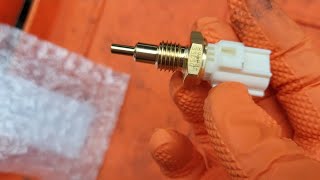
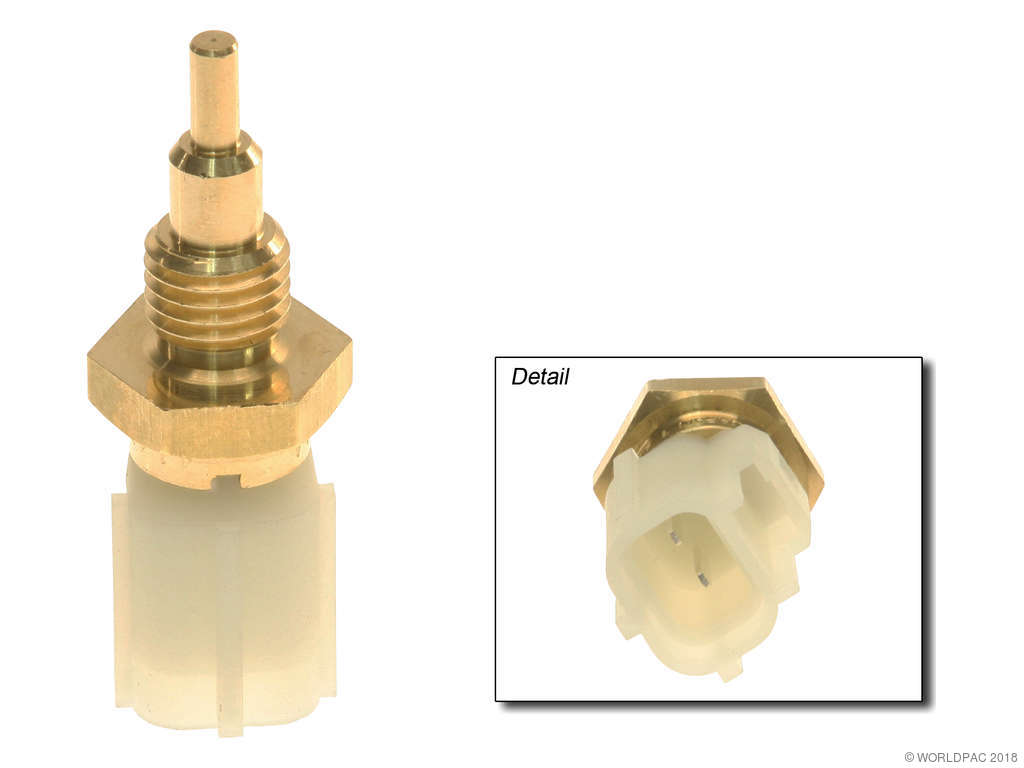
- Engine Coolant Temperature Sensor
(OEM #89422-35010)— This sensor is the most common failure point for an isolated P0117 code. It is a thermistor that shorts internally. This part number is widely used across many Toyota and Lexus models.
Trusted brands: Toyota (Genuine OEM), Denso (OEM supplier)
OEM price range: $70-$100
Aftermarket price range: $20-$50
Related Codes That Often Appear With This One
- P0116 — P0116 indicates a range/performance problem with the ECT circuit. If the sensor is failing intermittently, it might trigger both codes as its signal fluctuates in and out of the expected range before failing completely into a shorted state (P0117).
- P148F — This code means 'Engine Coolant Pump Over Revolution' and is a strong indicator that the water pump has failed and is not circulating coolant. Seeing P148F with P0117 means the P0117 is a symptom of a real, severe overheating event.
- P0301 — A misfire code (P0300, P0301, etc.) appearing with P0117 and P148F can be a sign of a failing head gasket, which may have been caused by the overheating event. Coolant leaking into the cylinder overnight can cause a rough start and misfire until it's burned off.
Platform-Specific Known Issues
- Real Overheating vs. Sensor Failure: A key diagnostic challenge on the Gen 3 Prius is distinguishing a false P0117 (bad sensor) from a real one (bad water pump). A thread on PriusChat with a 2013 Prius V owner detailed getting both P0117 and P148F after driving up a steep hill, confirming a real overheating event due to a failed water pump. Another owner on the same forum noted that the combination of P0117, P148F, and a misfire code (P0301) pointed to a failed water pump that may have led to head gasket damage.
Mechanic-Grade Diagnostic Values
- ECT Sensor Resistance — expected: Approx. 2.32 to 2.59 kΩ at 20°C (68°F); Approx. 0.310 to 0.326 kΩ at 80°C (176°F).. Failure: Resistance significantly outside these ranges, especially near 0 Ω (short circuit), indicates a failed sensor.
- ECT Sensor Circuit Voltage at ECM — expected: Normal operating range is typically 0.5V (hot) to 3.5V (cold).. Failure: A voltage reading below 0.14V for more than 0.5 seconds will trigger DTC P0117.
- Techstream Live Data (ECT Sensor) — expected: Should display ambient temperature on a cold engine. Should gradually rise to a normal operating temperature of ~185-205°F.. Failure: If the scan tool immediately shows 140°C (284°F) or higher, it indicates a short circuit in the sensor or wiring. If it shows -40°C (-40°F), it indicates an open circuit (which would set a P0118).
Scan Tool Commands That Help
- Toyota Techstream: Active Test: 'Activate the Electric Water Pump' — This command is critical for diagnosing if a P0117 is caused by a true overheating event. It allows a technician to command the engine's electric water pump to turn on independently of engine temperature. If the pump can be activated and heard running (or its RPMs monitored in the data list), but the engine still overheats, it points towards a coolant flow blockage or air in the system. If the pump does not activate, it confirms a failed water pump or a fault in its control circuit.
- Toyota Techstream: Freeze Frame Data — When P0117 is stored, the ECM also records a snapshot of all major sensor values at the exact moment the fault was detected. This data is invaluable for determining the conditions that led to the code, such as engine speed, vehicle speed, and calculated load, helping to differentiate between a cold start electrical failure and a failure under load.
Wiring & Ground Locations
- EB — A main engine ground point cluster is located on the driver's side of the engine bay, near the fuse box and underneath the coolant reservoir.. The ECT sensor circuit relies on a clean ground reference. While the sensor itself grounds through the ECM, the ECM is grounded to the chassis at points like these. A corroded or loose ground at 'EB' can introduce voltage offsets and instability in sensor readings across the engine, potentially contributing to sensor circuit codes.
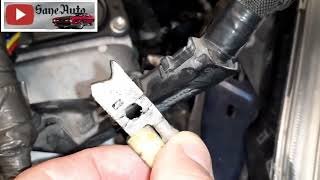
- ECT Sensor Connector (Historically D6 in some diagrams) — On the driver's side of the engine block, often tucked near other components, making it difficult to access the release tab.. This is the direct connection to the sensor. The terminals (THW and E2) run directly to the ECM. A poor connection, moisture intrusion, or damaged pins here will directly cause a P0117 (short) or P0118 (open). Technicians often use long-reach pliers to release the stubborn connector tab.
Real Owner Repair Stories
- PriusChat Forum User (2010 Toyota Prius, 132k miles) — Engine overheat light (flashing or solid), no cabin heat, and a P0117 code stored.
❌ Tried (didn't work) The owner suspected air in the cooling system after recently having a coolant hose disconnected. They attempted to bleed the system but were unsuccessful.
✅ What actually fixed it A visit to the dealership resulted in a diagnosis of a malfunctioning engine water pump. The owner replaced the water pump themselves, which resolved all symptoms of overheating and cleared the P0117 code. - YouTube DIY Repair Video (2012 Toyota Prius) — Car started to overheat, high-temperature coolant light came on, followed by the Check Engine Light with code P0117.
❌ Tried (didn't work) The issue appeared shortly after a head gasket and thermostat replacement was performed by a mechanic, who did not replace the ECT sensor.
✅ What actually fixed it The owner diagnosed the P0117 as a failed ECT sensor itself. The video details the replacement of the sensor, which fixed the problem. The owner noted the mechanic's labor quote was 2.5 hours, but they completed it as a DIY project.
OEM Part Supersession History
89422-20010→89422-35010— Part consolidation and potential minor internal revisions over decades of use. The part is used across a vast range of Toyota/Lexus models from the 1980s to the late 2010s.
Model Year Variations Within This Range
- 2010-early 2014: Earlier Gen 3 models are more prone to oil consumption issues due to piston ring design. While not directly causing P0117, excessive oil burning can contribute to a clogged EGR system, leading to engine hot spots and potentially contributing to overheating conditions that could manifest with a P0117 code as a symptom of a larger problem. Toyota updated the pistons and rings partway through the 2014 model year.
Diagnostic Flowchart
Other Known Issues on This Vehicle
Issues unrelated to this code that are worth knowing about as an owner of this generation:
- Excessive Oil Consumption 🔴 High — Common on 2010-2014 models, typically becoming noticeable after 100,000 miles. Caused by clogged piston oil return holes and poorly designed piston rings. (Ref: T-SB-0169-16 (Repair Procedure) and T-SB-0168-16 (Inspection Procedure) were issued, outlining a fix involving new pistons and rings for vehicles under warranty/specific conditions.)
- EGR System Clogging 🔴 High — Very common, especially on vehicles with over 100,000 miles. Carbon buildup clogs the EGR valve, cooler, and intake manifold passages. (Ref: This can lead to engine knocking, rough idle on cold starts, and eventually head gasket failure due to uneven cylinder temperatures.)
- Brake Actuator Assembly Failure 🔴 High — A known issue, though more prevalent in the previous generation, it still affects early Gen 3 models. The actuator can fail internally, causing a loss of braking assist and multiple warning lights. (Ref: Toyota issued a Warranty Enhancement Program (ZG1 for Gen 2, other programs for Gen 3) to extend coverage for this expensive repair.)
- Hybrid Inverter Failure 🔴 High — Affects 2010-2014 models. The inverter's Intelligent Power Module (IPM) can overheat and fail, causing the hybrid system to shut down, potentially while driving. (Ref: Recalls were issued (e.g., NHTSA 18V684000, 14V053000) to update software or replace the inverter module.)
- Head Gasket Failure 🔴 High — Often a consequence of other issues like a clogged EGR system or failed water pump leading to overheating. Not a primary failure itself, but a common result of neglected maintenance.
Used vs. New Parts: Buying Guide for This Vehicle
When a used part is the smart pick: For this specific repair, using a used part is generally not recommended. The primary failure parts, the ECT sensor and the electric water pump, are relatively inexpensive new and are wear items. The labor involved in replacing them often outweighs the cost savings of a used part with an unknown history.
Donor-vehicle mileage cap: roughly under 80000 miles for the part to have meaningful remaining life.
What to inspect on the donor part:
- For an ECT sensor, it's impossible to judge quality visually. Not recommended.
- If considering a used water pump (not advised), check for any signs of leaks, corrosion on the electrical connector, or physical damage to the housing.
OEM-only on this vehicle (don't cheap out):
- Engine Water Pump: Forum consensus and mechanic experience strongly recommend using the Genuine Toyota OEM pump. Aftermarket electric water pumps for the Prius have a significantly higher failure rate, often failing shortly after installation.
- Engine Coolant Temperature (ECT) Sensor: While less critical than the water pump, using the OEM (Toyota) or the OEM supplier (Denso) part is highly recommended to ensure accurate temperature readings and proper connector fitment.
Aftermarket brands forum-validated for this vehicle:
- Denso (For the ECT sensor, as they are the original equipment supplier to Toyota).
Brands owners have reported issues with on this vehicle:
- Unbranded or 'white-box' electrical components like the ECT sensor and especially the electric water pump. A non-functional aftermarket sensor can lead to wasted diagnostic time, and a failed aftermarket water pump can cause catastrophic engine damage.
Real Owner Stories
Aggregated from forums and TSBs cited above. Mileages and costs reflect what owners reported in those sources.
2013 Toyota Prius v 2ZR-FXE
Symptoms: The owner experienced a P0117 code and a P148F code simultaneously after driving up a steep hill, indicating a real overheating event.
What fixed it: Replacement of the failed electric water pump.
Source hint: vehicle_specific_issues - 'Real Overheating vs. Sensor Failure' (PriusChat thread)
2012 Toyota Prius v 2ZR-FXE
Symptoms: The vehicle exhibited stuttering and threw a P0117 code.
What fixed it: The issue was diagnosed as a failing head gasket, showing that P0117 can be a symptom of severe mechanical failure.
Source hint: forum_citations - '2012 Prius V w/P0117 code' (PriusChat.com)
2012 Toyota Prius 2ZR-FXE
Symptoms: The owner reported a combination of P0117, P148F, and a P0301 misfire code.
What fixed it: The water pump had failed, which led to subsequent head gasket damage.
Source hint: vehicle_specific_issues - 'Real Overheating vs. Sensor Failure' (PriusChat thread)
Related OBD-II Codes
Frequently Asked Questions
Can a bad water pump on my 2010-2015 Prius cause a P0117 code even if the sensor is working?
My Prius has P0117 and is stuttering; could this be related to the head gasket?
Is there a specific TSB for the oil consumption issues mentioned in the context of my Gen 3 Prius?
What live data values should I look for on my ScanGauge to confirm a sensor failure?
Are there any recalls for the hybrid system that might coincide with cooling warnings?
What tool do I need to replace the ECT sensor on my 1.8L Prius engine?
Helpful Videos
We Have This Part in Stock


The information in this article is provided for general reference and educational purposes only. Vehicle specifications, procedures, and part compatibility can vary by production date, trim level, and region. Always consult your vehicle's factory service manual and verify part numbers before purchasing or performing repairs. Safety-critical components such as airbags, seat belts, and braking systems should be installed by a qualified professional.
- Toyota Prius:
- 🧭 Diagnostic Flowchart
- 🎬 Helpful Videos
- 🛍️ Shop This Part
- What's Unique About the 2010-2015 Toyota Prius
- Symptoms You May Notice
- Most Likely Causes
- Rare But Worth Checking
- Diagnosis Steps
- Parts You'll Likely Need
- Related Codes That Often Appear With This One
- Platform-Specific Known Issues
- Mechanic-Grade Diagnostic Values
- Scan Tool Commands That Help
- Wiring & Ground Locations
- Real Owner Repair Stories
- OEM Part Supersession History
- Model Year Variations Within This Range
- Other Known Issues on This Vehicle
- Used vs. New Parts: Buying Guide for This Vehicle
- Real Owner Stories
- 2013 Toyota Prius v 2ZR-FXE
- 2012 Toyota Prius v 2ZR-FXE
- 2012 Toyota Prius 2ZR-FXE
- Related OBD-II Codes
- Frequently Asked Questions
- 🎟️ Get 5% Off