

P0118 on 2017-2022 Honda CR-V: Engine Coolant Temperature Sensor Circuit High Fixes
On a 2017-2022 Honda CR-V, code P0118 is almost always caused by a failed Engine Coolant Temperature (ECT) Sensor 1. This is a simple and affordable DIY fix, with the part costing between $25 and $65. Check the sensor's wiring connector first to ensure it's not unplugged or corroded, as an open circuit is the direct cause of the 'Circuit High' fault.
- P0118 on your CR-V means the computer thinks the engine is freezing cold due to a high voltage signal from the main coolant sensor (ECT Sensor 1).
- The most common fix is replacing the ECT Sensor 1, which is an inexpensive part and a straightforward DIY job.
- Before buying parts, always check that the sensor's electrical connector is plugged in securely and the wiring isn't damaged.
- Make sure you are replacing ECT Sensor 1 (on the engine), not ECT Sensor 2 (on the radiator). The correct OEM part number is typically 37870-RWC-A01.
What's Unique About the 2017-2022 Honda CR-V
For the 5th generation Honda CR-V (2017-2022), this code specifically points to ECT Sensor 1, which is mounted on the engine, not the secondary sensor (ECT Sensor 2) located on the radiator. The failure is typically a standard component fault in the sensor or its wiring, rather than a unique design flaw of the 1.5L Turbo (L15B7) or 2.4L (K24W) engines. Owners often experience symptoms like the cooling fans running constantly or difficulty starting a warm engine because the computer incorrectly believes the engine is freezing cold, leading to excessive fuel injection.
Symptoms You May Notice
- Check Engine Light is on
- Cooling fans running constantly, even when the engine is cold
- Difficulty starting the engine, especially when it's already warm
- Rough or high idle
- Reduced fuel economy
- Black smoke from the tailpipe, especially during a cold start
- Inaccurate or non-functional temperature gauge on the dashboard
- Strong smell of gasoline from the exhaust due to a rich fuel mixture
- Replacing the thermostat. While a stuck-open thermostat can cause the engine to warm up slowly (and may trigger other codes), it will not cause the 'Circuit High' electrical fault of a P0118.
- Replacing ECT Sensor 2 on the radiator. P0118 specifically refers to Sensor 1 on the engine block/head. Replacing the radiator sensor (often Part No. 37870-RZA-007) will not fix this code.
Most Likely Causes
- Failed Engine Coolant Temperature (ECT) Sensor 1 🔴 High Probability → Shop Engine Coolant Temperature Sensor ECT sensors are thermistors that fail over time due to thermal stress. They can develop an internal open circuit, which prevents the sensor from pulling the PCM's 5-volt reference signal down, causing the PCM to read a high voltage.
How to confirm: Using an OBD-II scanner, check the live data for the ECT sensor. If it reads an extremely low temperature (e.g., -40°F) 🎬 Watch: How to diagnose a P0118 code even when the engine is warm, the sensor has likely failed. You can also test the sensor with a multimeter; at room temperature (around 68°F/20°C), it should have a resistance between 2,000 and 3,000 ohms. If it shows infinite resistance (open circuit), it is bad. At normal operating temperature (around 195°F/90°C), resistance should drop to 200-400 ohms.
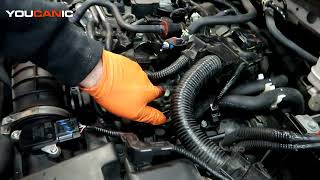
Typical fix: Replace the ECT Sensor 1. This involves disconnecting the electrical connector, unscrewing the old sensor (typically with a 19mm deep socket 🎬 See this Honda coolant sensor replacement walkthrough), and quickly installing the new one with its O-ring to minimize coolant loss. Have a rag ready.
Est. part cost: $25-$65 - Damaged Wiring or Unplugged Connector 🟡 Medium Probability The wiring harness connector can become unplugged during other engine service, or the wires can become brittle and break from engine heat and vibration. Oil leaks from the valve cover can also degrade the wiring insulation over time.
How to confirm: Visually inspect the ECT Sensor 1 and its electrical connector. Ensure the connector is securely plugged in. Check for any signs of corrosion on the pins, or frayed, broken, or melted wires in the harness leading to the sensor. An unplugged sensor will cause an open circuit, resulting in a P0118 code. Wiggling the connector while monitoring live data can reveal an intermittent connection.
Typical fix: Securely reconnect the connector if it's loose. If the connector or wiring is damaged, a new pigtail connector may need to be spliced in, or the damaged section of wire repaired.
Est. part cost: $15-$30 for a pigtail connector - Low Engine Coolant Level ⚪ Low Probability If the coolant level is so low that the sensor tip is exposed to air instead of coolant, it can't get an accurate reading and may send an erratic or out-of-range signal to the PCM, potentially triggering the code.
How to confirm: Check the coolant level in the radiator (when the engine is completely cool) and the overflow reservoir. If it is low, there is a leak in the cooling system that must be found and repaired.
Typical fix: Top off the coolant with Honda Type 2 blue coolant and bleed the system. More importantly, identify and repair the source of the coolant leak (e.g., bad hose, radiator leak, water pump).
Est. part cost: $20-$40 for Honda Type 2 coolant
Rare But Worth Checking
- Faulty Powertrain Control Module (PCM): This is extremely rare. All other possibilities, especially the sensor and wiring, should be exhaustively ruled out before considering a PCM replacement. A proper diagnosis would involve checking for the 5-volt reference and ground signals at the sensor connector.
Diagnosis Steps
- Connect an OBD-II scanner and confirm the P0118 code is present.
- View the live data stream on the scanner. Check the value for 'Engine Coolant Temperature'. If it shows an impossibly low value like -40°F, it strongly indicates a circuit fault.
- Turn the engine off and let it cool completely.
- Locate ECT Sensor 1. On the 1.5L Turbo engine, it is on the thermostat housing, often under the air intake ducting. On the 2.4L engine, it is on the side of the cylinder head, below the VTEC solenoid assembly. 🎬 Watch: CR-V ECT sensor 1 circuit high voltage fix
- Inspect the sensor's electrical connector. Ensure it is plugged in tightly and look for any green corrosion or damaged wires.
- If the connector looks good, disconnect it. With the key on and engine off, use a multimeter to check for a 5-volt reference on one pin and a good ground on the other. If 5V and ground are present, the wiring to the PCM is likely okay.
- To test the circuit integrity, you can use a jumper wire to connect the two terminals in the sensor's harness connector. The live data reading on your scan tool should change from -40°F to a very high temperature (e.g., 280°F+). This confirms the wiring and PCM are working, isolating the fault to the sensor itself.
- If the wiring and circuit test good, the most probable cause is a failed sensor. Proceed with replacing ECT Sensor 1.
- After replacement, clear the code with the scanner and perform a drive cycle to ensure the fix was successful.
Parts You'll Likely Need
- Engine Coolant Temperature Sensor 1
(OEM #37870-RWC-A01)— This is the primary sensor that provides engine temperature data to the PCM. It is the most common failure point for a P0118 code, typically failing with an internal open circuit.
Trusted brands: Honda (Genuine), Denso, NGK/NTK, Standard Motor Products (SMP)
OEM price range: $45-$65
Aftermarket price range: $25-$50
Related Codes That Often Appear With This One
- P0117 (ECT Sensor 1 Circuit Low Input): This code may appear intermittently if there is a wiring short that accompanies an open circuit, though it's more common to see one or the other consistently.
Mechanic-Grade Diagnostic Values
- ECT Sensor Resistance (Cold Engine) — expected: 2,000 - 3,000 Ohms (Ω) at 20°C / 68°F. Failure: Infinite resistance (Open Loop) or a value significantly outside this range indicates a failed sensor.
- ECT Sensor Resistance (Warm Engine) — expected: 200 - 400 Ohms (Ω) at 90°C / 194°F. Failure: Resistance that does not drop into this range as the engine warms up points to a faulty sensor.
- ECT Sensor Connector Voltage (Key On, Engine Off, Sensor Unplugged) — expected: ~5.0 Volts on the reference wire. Failure: No voltage indicates a problem with the PCM or the wiring from the PCM.
Scan Tool Commands That Help
- Honda HDS (Honda Diagnostic System): Engage SCS Line (Service Connector Short) — This function is used as part of the official Honda diagnostic procedure to stabilize the system before performing continuity checks on the ECT sensor wiring to the PCM.
Wiring & Ground Locations
- G101 — Bolted to the thermostat housing on the engine.. This is a primary ground point for the ECU and multiple sensors, including the ECT sensor. Corrosion or a loose connection at this single point can cause a high resistance in the ground circuit, leading to a P0118 code even if the sensor and wiring harness are good.
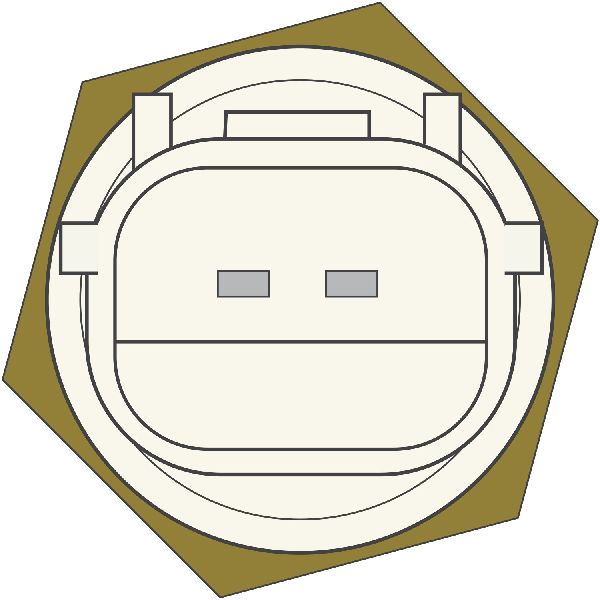
- ECT Sensor Connector Pin 2 — The harness-side connector for ECT Sensor 1.. This is the signal return wire, referred to as the TWW wire in Honda diagrams. An open circuit in this wire between the sensor and the PCM will cause a P0118 code.
- PCM Connector C (51-pin), Pin 31 — One of the main connectors at the Powertrain Control Module (PCM).. This is the terminal for the sensor ground (SG2 wire). Continuity should be checked between this pin and the corresponding wire at the sensor connector to verify the ground path.
- PCM Connector B (51-pin), Pin 50 — One of the main connectors at the Powertrain Control Module (PCM).. This is the terminal for the sensor signal (TWW wire). Continuity should be checked between this pin and Pin 2 of the sensor connector to verify the signal wire integrity.
Real Owner Repair Stories
- Jeep Gladiator Forum user Gladiator_92 (2021 Jeep Gladiator EcoDiesel (Symptoms and fix are analogous to the CR-V)) — Check engine light with P0118, radiator fan running at 100%, and live data showing ECT values fluctuating wildly from -40 to 205 degrees.
❌ Tried (didn't work) Clearing the code would temporarily resolve the issue, but it would always return.
✅ What actually fixed it Replacing the engine coolant temperature sensor resolved all symptoms. The owner noted some minor temperature fluctuations initially, which were attributed to potential air pockets in the cooling system that resolved after a few drive cycles.
OEM Part Supersession History
37870-RWC-A01→N/A— This remains the current, widely used part number for ECT Sensor 1.
Heads up: Be cautious of parts listings that cross-reference 37870-RWC-A01 with 37870-RTA-005 or 37870-RZA-007. While they may physically fit, 37870-RZA-007 is typically ECT Sensor 2 (radiator sensor), and using it in place of ECT Sensor 1 will not resolve a P0118 code. Always verify the part is for the engine-side sensor position.
Model Year Variations Within This Range
- 2017-2019: The 1.5L Turbo (L15B7) engine was standard on EX, EX-L, and Touring trims. The base LX trim used a naturally aspirated 2.4L (K24W) engine. The diagnostic procedure for P0118 is the same, but the physical location of the sensor differs slightly between the two engines.
- 2020-2022: Following the 2020 model year refresh, the 1.5L Turbo engine became standard across all non-hybrid CR-V trims (LX, EX, EX-L, Touring). The 2.4L engine was discontinued for the CR-V in the US market.
Diagnostic Flowchart
Other Known Issues on This Vehicle
Issues unrelated to this code that are worth knowing about as an owner of this generation:
- Gasoline Dilution of Engine Oil (1.5T) 🔴 High — More common on 2017-2018 models, especially in cold climates with short-trip driving patterns. Can lead to premature engine wear. (Ref: Honda issued product updates (e.g., TSB 18-114) and a warranty extension to address this. The fix involves software updates for the ECU and TCU, and sometimes a new A/C control unit.)
- Sticky Steering (EPS) 🔴 High — Affects 2022 and later models primarily. Owners report a momentary sticking or increased effort required at highway speeds. (Ref: Honda issued TSB 23-037, instructing dealers to replace the electronic power steering gearbox. NHTSA opened an investigation (EA23003).)
- Parasitic Battery Drain 🟠 Medium — Reported frequently on 2017-2019 models. The battery may drain overnight or after a few days of sitting. (Ref: No specific recall, but common causes include a faulty Vehicle Stability Assist (VSA) modulator software, faulty door handle sensors, or a malfunctioning Body Control Module (BCM).)
- Infotainment System Glitches 🟡 Low — Common on 2017-2019 models. Symptoms include a blank or dim screen, random beeping, or unresponsive controls. (Ref: No recall, but dealers can often resolve the issue by performing a software update on the infotainment unit.)
- Fuel Pump Failure 🔴 High — Affects a wide range of Honda models, including the 2018-2020 CR-V. The fuel pump impeller can degrade and cause the pump to fail, leading to stalling. (Ref: Honda issued recalls (e.g., KGC, KGD, expanding on 21V-215) to replace the fuel pump module.)
Used vs. New Parts: Buying Guide for This Vehicle
When a used part is the smart pick: For this specific repair, buying a used ECT sensor is not recommended. The part is inexpensive, readily available new, and is a critical sensor for engine management. The risk of getting a used part that is near the end of its service life outweighs the minimal cost savings.
Donor-vehicle mileage cap: roughly under 50000 miles for the part to have meaningful remaining life.
What to inspect on the donor part:
- If buying a used connector pigtail, ensure the wiring is flexible and not brittle.
- Check connector pins for any signs of green or white corrosion.
- Verify the plastic locking tab is intact and not broken.
OEM-only on this vehicle (don't cheap out):
- While not strictly OEM-only, using a Genuine Honda sensor (37870-RWC-A01) is the safest choice to guarantee correct resistance curves and longevity. The price difference is often minimal.
Aftermarket brands forum-validated for this vehicle:
- Denso
- NGK / NTK
- Standard Motor Products (SMP)
Brands owners have reported issues with on this vehicle:
- Avoid unbranded, 'white-box' sensors from online marketplaces, as their internal thermistors may not match the OEM resistance curve, leading to incorrect temperature readings even if they don't set a P0118 code.
Real Owner Stories
Aggregated from forums and TSBs cited above. Mileages and costs reflect what owners reported in those sources.
2001 Honda CR-V
Symptoms: The owner reported starting problems and the vehicle threw error code P0118.
What fixed it: The issue was identified as a P0118 engine coolant temperature circuit high input fault.
Source hint: honda-tech.com thread titled 'crv 2001 start problems error code p0118'
1997 Honda CR-V
Symptoms: The owner received a P0118 code specifically related to the engine coolant temperature.
What fixed it: Diagnosis of the engine coolant temperature circuit.
Source hint: Reddit r/MechanicAdvice post '97hondacrv_got_a_p0118_engine_coolant'
Related OBD-II Codes
Frequently Asked Questions
Where is the ECT Sensor 1 located on my 2017-2022 Honda CR-V with the 1.5L Turbo engine?
My 2017 CR-V is throwing P0118 and also has gasoline dilution in the oil; are these related?
Can I use any coolant to top off my system if low levels triggered the P0118 code?
What size tool do I need to replace the ECT sensor on my CR-V?
Is there a specific TSB for the P0118 code on the 2017-2022 CR-V?
Will a loose connector cause a P0118 on my Honda?
Helpful Videos
We Have This Part in Stock




The information in this article is provided for general reference and educational purposes only. Vehicle specifications, procedures, and part compatibility can vary by production date, trim level, and region. Always consult your vehicle's factory service manual and verify part numbers before purchasing or performing repairs. Safety-critical components such as airbags, seat belts, and braking systems should be installed by a qualified professional.
- Honda CR-V:
- 🧭 Diagnostic Flowchart
- 🎬 Helpful Videos
- 🛍️ Shop This Part
- What's Unique About the 2017-2022 Honda CR-V
- Symptoms You May Notice
- Most Likely Causes
- Rare But Worth Checking
- Diagnosis Steps
- Parts You'll Likely Need
- Related Codes That Often Appear With This One
- Mechanic-Grade Diagnostic Values
- Scan Tool Commands That Help
- Wiring & Ground Locations
- Real Owner Repair Stories
- OEM Part Supersession History
- Model Year Variations Within This Range
- Other Known Issues on This Vehicle
- Used vs. New Parts: Buying Guide for This Vehicle
- Real Owner Stories
- 2001 Honda CR-V
- 1997 Honda CR-V
- Related OBD-II Codes
- Frequently Asked Questions
- 🎟️ Get 5% Off