

P0118 on 2007-2012 Hyundai Santa Fe: Engine Coolant Temp Circuit High Causes and Fixes
P0118 on a 2007-2012 Santa Fe most often means the Engine Coolant Temperature (ECT) sensor has failed or its wiring is damaged. The engine's computer thinks the coolant is an impossible -40°F, causing cooling fans to run constantly, a high initial idle, and poor fuel economy. Replacing the sensor is the usual fix, a low-cost part that can be a DIY job. However, checking for a broken wire at the connector is critical.
- P0118 means the computer sees a signal for an extremely cold engine (high voltage >4.9V), usually due to an open circuit.
- The most likely cause is a failed Engine Coolant Temperature (ECT) sensor, followed closely by a broken wire at the sensor connector.
- Symptoms include the check engine light, cooling fans running constantly, high initial idle, and poor fuel mileage.
- Before replacing the sensor, test the wiring by jumping the connector pins to see if the temperature reading on a scan tool changes from minimum (-40°F) to maximum (250°F+).
- Always bleed the cooling system after replacing the sensor to prevent air pockets that can cause overheating.
What's Unique About the 2007-2012 Hyundai Santa Fe
The 2007-2012 Hyundai Santa Fe (CM generation) uses a standard OBD-II system, and the P0118 code follows the universal SAE definition. The ECT sensor on these models is a Negative Temperature Coefficient (NTC) thermistor; its resistance decreases as temperature increases. A P0118 code indicates an open circuit, which could be an internal failure of the sensor or a break in the wiring. Some Hyundai sensors contain two thermistors: one for the PCM and one for the dashboard temperature gauge. This means the gauge might appear to work normally even when the PCM is receiving a fault signal, which can be misleading. Owner experiences suggest that while the sensor is a frequent culprit, it's crucial to check the wiring for damage right at the connector before assuming a new part will fix the issue, as wiring faults are also known to cause this code.
Symptoms You May Notice
- Check Engine Light is on
- Cooling fans run continuously at high speed, even when the engine is cold.
- Engine runs rough, hesitates, or idles high (e.g., 2,000 RPM) for a few seconds after starting.
- Reduced fuel economy
- Temperature gauge on the dashboard reads cold or does not move (though on some models it may read normally if a separate sensor is used for the gauge).
- Difficulty starting the engine, particularly in cold weather.
- Replacing the thermostat. A stuck-open thermostat will cause slow engine warm-up (and potentially code P0128), but it will not cause an electrical circuit high input code like P0118.
Most Likely Causes
- Faulty Engine Coolant Temperature (ECT) Sensor 🔴 High Probability → Shop Engine Coolant Temperature Sensor Sensors are wear-and-tear items that can fail over time by developing an internal open circuit. The thermistor inside degrades and breaks the electrical path.
How to confirm: After confirming the wiring is intact, replacing the sensor is the most direct confirmation. Alternatively, test the sensor's resistance with a multimeter. At room temperature (around 68°F/20°C), it should read approximately 2.0-3.0 kΩ. If the reading is infinite (open circuit), the sensor is bad.
Typical fix: Replace the Engine Coolant Temperature (ECT) sensor.
Est. part cost: $20-$50 - Damaged Wiring or Connector 🟡 Medium Probability The engine bay environment can cause wires to become brittle and break, especially right at the connector where vibration is concentrated. Rodents can also chew through them. The connector pins can also corrode over time.
How to confirm: Visually inspect the harness for breaks, chafing, or corrosion at the connector. Use a multimeter to check for the 5V reference signal and ground at the connector with the key on. Jumper the two connector terminals with a paperclip; if the scan tool reading changes from -40°F to a very high temp (e.g., 284°F+), the wiring and PCM are good, and the sensor is the fault. 🎬 Watch: A step-by-step walkthrough for testing and replacement.
Typical fix: Repair the broken or shorted wire. Clean or replace the electrical connector pigtail.
Est. part cost: $5-$25 - Low Engine Coolant ⚪ Low Probability Not specific to this vehicle, but if the coolant level is so low that the sensor is exposed to air instead of coolant, it can cause erratic readings, though this more commonly causes a P0117 (low input) or P0128 (thermostat rationality) code.
How to confirm: Check the coolant level in the reservoir and radiator (when the engine is cold). If it is low, top it off and inspect for leaks.
Typical fix: Top off the coolant and repair any leaks found in the cooling system.
Est. part cost: $15-$30
Rare But Worth Checking
- Faulty Thermostat: → Shop Integrated Thermostat Housing Assembly A stuck-open thermostat will typically set a P0128 code (Coolant Temp Below Thermostat Regulating Temp), not a P0118. However, in rare cases, erratic thermostat behavior could contribute to confusing signals, but it should not be the primary suspect for a circuit high code.
- Faulty Powertrain Control Module (PCM): This is extremely rare. The PCM should only be considered a potential cause after the sensor and all wiring have been thoroughly tested and confirmed to be in good working order.
Diagnosis Steps
- Connect an OBD-II scanner to confirm P0118 is the active code and check for any others.
- View live data on the scanner and observe the Engine Coolant Temperature reading. It will likely be at its minimum value (e.g., -40°F). Compare it to the Intake Air Temperature (IAT) with the engine cold; they should be similar. A large discrepancy points to the ECT circuit. 🎬 See this guide on testing for P0118 fault codes.
- Perform a visual inspection of the ECT sensor's wiring and connector. Look for any obvious signs of damage, corrosion, or broken wires right at the back of the connector.
- Disconnect the ECT sensor connector. With a jumper wire or paperclip, connect the two terminals in the harness-side connector.
- Observe the live data reading on the scan tool. The temperature should now jump to its maximum value (e.g., 250°F or higher).
- If the reading jumps to maximum, the wiring and PCM are good. The fault is with the ECT sensor itself. Replace the sensor.
- If the reading does not change when the connector is jumped, there is an open circuit in the wiring between the sensor and the PCM, or a bad PCM (which is rare).
- To verify wiring, use a multimeter on the harness connector (key on, engine off). One wire should have a 5-volt reference, and the other should have a good ground (low resistance to the battery negative terminal).
- If the sensor is suspected, you can test its resistance when removed. It should be around 2.0-3.0 kΩ at 20°C (68°F) and drop to around 200-300 Ω at 90°C (194°F).
- After replacing the sensor or repairing the wiring, clear the code and perform a drive cycle. Ensure you properly bleed the cooling system to remove any air pockets.
Parts You'll Likely Need
- Engine Coolant Temperature Sensor (ECT)
(OEM #39220-38030 (supersedes 39230-26700 and 39220-38020))— This sensor is the most common failure point for a P0118 code, as its internal thermistor can fail and create an open circuit. Part number 39220-38030 is a common genuine Hyundai part that fits many models.
Trusted brands: Hyundai OE, Denso, Bosch, Standard Motor Products
OEM price range: $40-$70
Aftermarket price range: $20-$50
Platform-Specific Known Issues
- Sensor Location Varies by Engine: On the 2.7L and 3.3L/3.5L V6 engines, the ECT sensor is typically located on the cylinder head, near the thermostat housing, between the cylinder banks. On the 2.4L 4-cylinder engine, it is generally on the side of the cylinder head near the thermostat housing. Access may require removing the engine cover and/or air intake ducting. 🎬 Watch: How to locate and replace the Santa Fe sensor.
- Wiring Failure at Connector: A common point of failure is the wire breaking inside the insulation right at the back of the sensor's electrical connector due to engine vibration and heat cycles. A visual inspection might not be enough; gently tugging on the wires may reveal the break. Repairing this often requires a new connector pigtail.
Mechanic-Grade Diagnostic Values
- ECT Sensor Resistance vs. Temperature — expected: -40°C (-40°F): 48.14 kΩ | -20°C (-4°F): 14.13-16.83 kΩ | 20°C (68°F): 2.2-3.0 kΩ | 40°C (104°F): 1.15 kΩ | 80°C (176°F): 0.332 kΩ | 90°C (194°F): 0.2-0.3 kΩ | 100°C (212°F): 0.177 kΩ. Failure: An infinite resistance reading (open circuit) or values significantly outside this range for a given temperature indicates a faulty sensor.
- ECT Sensor Signal Voltage at PCM (Key On, Engine Off) — expected: Approx. 3.0 - 3.5V on a cold engine (~20°C/68°F). Voltage should decrease as the engine warms up, to around 0.5V - 1.3V at operating temperature.. Failure: A reading of ~5.0V indicates an open circuit (P0118 condition). A reading of 0V indicates a short to ground (P0117 condition).
- PCM Fault-Setting Threshold — expected: The PCM will set code P0118 if the sensor signal voltage remains above 4.9V for more than 40 seconds.. Failure: This is the specific condition that triggers the Check Engine Light for this code.
Scan Tool Commands That Help
- Hyundai GDS (Global Diagnostic System): Live Data Graphing (ECT Sensor) — The dealership-level GDS tool can provide high-resolution graphing of the ECT sensor voltage. This is useful for spotting intermittent dropouts or glitches that a standard numeric display might miss, especially while wiggling the harness to check for breaks.
Wiring & Ground Locations
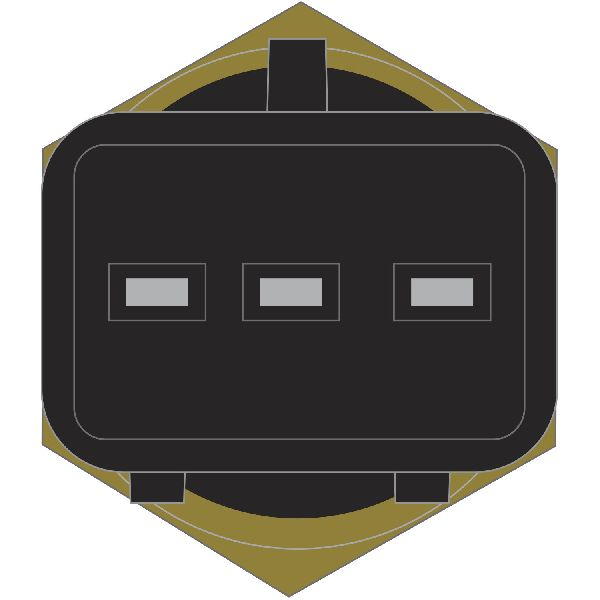
- ECT Sensor Connector — On the ECT sensor itself, which is located near the thermostat housing on the cylinder head. Location varies slightly between the 2.4L, 2.7L, 3.3L, and 3.5L engines.. This is the most common point of wiring failure. It is a 3-pin rectangular plug. The pins can corrode, and the wires can break internally right at the back of the connector.
- ECT Sensor Signal Wire to PCM — For some models, this is a gray wire running from the sensor connector to the PCM. On others, it may be a yellow wire.. An open circuit (break) in this wire is the primary cause of P0118 if the sensor itself is good. A technician would need to check continuity from the sensor connector to the corresponding PCM pin.
- PCM Connector Pin (Example) — On some models, the ECT signal wire (yellow) corresponds to pin 74 of the blue PCM connector, and the ground wire (gray) corresponds to pin 63.. Knowing the specific PCM pin numbers is essential for definitively testing the wiring harness for continuity or shorts without guesswork.
Real Owner Repair Stories
- 2CarPros Forum (2007 Hyundai Santa Fe, 3.3L V6) — Check Engine Light with code P0118, cooling fans run constantly, engine revs to 2,000 RPM on startup for about 10 seconds then idles normally.
❌ Tried (didn't work) Replacing the engine coolant temperature sensor.
✅ What actually fixed it The issue was diagnosed by a certified technician as a likely break in the gray signal wire between the ECT sensor and the PCM. The owner was advised to inspect the harness closely for damage, as this is a common failure point after the sensor itself has been ruled out.
OEM Part Supersession History
39230-26700, 39220-38020→39220-38030— Part consolidation and potential design/material improvements over the service life of the vehicles.
Heads up: The new part number 39220-38030 is the correct, direct replacement for the earlier numbers and should be used for all 2007-2012 Santa Fe models.
Model Year Variations Within This Range
- 2007-2009 vs 2010-2012: The primary difference affecting this code is the engine lineup. 2007-2009 models used the 2.7L and 3.3L V6 engines. The 2010 facelift introduced the 2.4L I4 and 3.5L V6. While the P0118 code's meaning is the same, the physical location of the ECT sensor and the routing of its wiring harness differ significantly between these four engines.
Diagnostic Flowchart
Used vs. New Parts: Buying Guide for This Vehicle
When a used part is the smart pick: For this repair, buying a used ECT sensor is not recommended. The part is a low-cost wear item, and the risk of getting another failed or near-failure sensor from a salvage yard is high. A used wiring connector pigtail is a viable option if the original is damaged, provided the wires are in good condition with sufficient length to splice.
Donor-vehicle mileage cap: roughly under 80000 miles for the part to have meaningful remaining life.
What to inspect on the donor part:
- For a connector pigtail: check for brittle plastic, ensure the locking tab is intact, and inspect for any signs of corrosion on the pins. The wires should be flexible, not stiff or cracked.
OEM-only on this vehicle (don't cheap out):
- While not strictly 'OEM-only', using a genuine Hyundai sensor (part #39220-38030) is highly recommended for fit and accuracy. The cost difference is often minimal compared to the potential for issues with off-brand sensors.
Aftermarket brands forum-validated for this vehicle:
- Bosch
- Delphi
- Denso
- Standard Motor Products (SMP)
Brands owners have reported issues with on this vehicle:
- Unnamed, no-brand 'white box' parts from online marketplaces should be avoided, as their thermistor accuracy and longevity can be questionable.
Real Owner Stories
Aggregated from forums and TSBs cited above. Mileages and costs reflect what owners reported in those sources.
2007 Hyundai Santa Fe
Symptoms: Check engine light with code P0118, cooling fans run constantly, and the engine starts at a high idle of 2,000 RPM for about 10 seconds before settling down.
What fixed it: After replacing the sensor didn't fix the issue, a technician advised inspecting the wiring harness. The problem was a broken wire or corroded connector, as P0118 is a circuit code.
Source hint: 2carpros.com - 2007-hyundai-santa-fe-code-p0118-coolant-sensor
2010 Hyundai Sonata
Symptoms: Check Engine Light with code P0118 COOLANT TEMP SENSOR CIRCUIT HIGH INPUT.
What fixed it: The coolant temp sensor wiring was repaired.
Source hint: Auto Doctor of Franklin
Documented NHTSA Reports
Hyundai Manufacturer Reference
Symptoms: A technician reported that a P0118 code appeared alongside other engine issues, though the specific meaning of the code was not immediately clear to the service provider at the time of the incident.
Context: NHTSA ODI #10095960 describes a situation where a P0118 code was present following engine damage, highlighting that this code can sometimes appear in conjunction with broader mechanical failures.
Related OBD-II Codes
Frequently Asked Questions
Where is the Engine Coolant Temperature (ECT) sensor located on my 2007-2012 Santa Fe?
I replaced the ECT sensor, but the P0118 code came back immediately. What should I check next?
My scan tool shows the coolant temperature at -40°F. Does this confirm the sensor is bad?
How can I test the ECT sensor circuit with just a paperclip?
Why are my cooling fans running constantly at high speed with code P0118?
What resistance reading should I get from a good ECT sensor on this Santa Fe?
Is this P0118 issue common on other vehicles besides the Santa Fe?
Helpful Videos
We Have This Part in Stock

The information in this article is provided for general reference and educational purposes only. Vehicle specifications, procedures, and part compatibility can vary by production date, trim level, and region. Always consult your vehicle's factory service manual and verify part numbers before purchasing or performing repairs. Safety-critical components such as airbags, seat belts, and braking systems should be installed by a qualified professional.
- Hyundai Santa Fe:
- 🧭 Diagnostic Flowchart
- 🎬 Helpful Videos
- 🛍️ Shop This Part
- What's Unique About the 2007-2012 Hyundai Santa Fe
- Symptoms You May Notice
- Most Likely Causes
- Rare But Worth Checking
- Diagnosis Steps
- Parts You'll Likely Need
- Platform-Specific Known Issues
- Mechanic-Grade Diagnostic Values
- Scan Tool Commands That Help
- Wiring & Ground Locations
- Real Owner Repair Stories
- OEM Part Supersession History
- Model Year Variations Within This Range
- Used vs. New Parts: Buying Guide for This Vehicle
- Real Owner Stories
- 2007 Hyundai Santa Fe
- 2010 Hyundai Sonata
- Documented NHTSA Reports
- Hyundai Manufacturer Reference
- Related OBD-II Codes
- Frequently Asked Questions
- 🎟️ Get 5% Off