

P0118 on 2017-2020 Lincoln Continental: ECT Sensor Circuit High Causes and Fixes
On a 2017-2020 Lincoln Continental, especially with the 2.7L engine, code P0118 is often caused by a loose or damaged Engine Coolant Temperature (ECT) sensor connector, as noted in manufacturer TSBs SSM 47791 and 46906. Before replacing the sensor, inspect the connector for a secure fit. If the connection is good, a faulty ECT sensor is the next likely cause. TSB SSM 48991 also points to a related wiring harness issue shared with the knock sensor, recommending replacement of both sensors to reso
- For a 2017-2020 Lincoln Continental, P0118 means the computer is getting a 'circuit high' signal from the ECT sensor, indicating an open circuit or faulty sensor.
- Always check the ECT sensor's electrical connector first, especially on 2.7L models, as Lincoln TSBs identify this as a very common point of failure.
- If the connector is secure, the ECT sensor itself is the next most likely part to have failed. The OEM Motorcraft part number is FT4Z-12A648-B.
- Do not ignore this code. Driving without an accurate temperature reading risks engine damage from a potential, undetected overheating event.
What's Unique About the 2017-2020 Lincoln CONTINENTAL
For the 2017-2020 Lincoln Continental, particularly models equipped with the 2.7L V6 engine, this code is frequently triggered by a simple connection issue rather than a failed sensor. Ford/Lincoln issued multiple Technical Service Bulletins (TSBs) highlighting that the ECT sensor's electrical connector can become loose, damaged, or not fully seated. This creates the high voltage condition that sets the P0118 code. TSB SSM 48991 further specifies that the issue may lie within the shared wiring harness for the ECT and knock sensors, instructing technicians to replace both components to ensure a complete repair. For 2018-2020 models with the 2.7L engine, the sensor was moved to a highly inaccessible location under the intake manifold, leading Ford to issue TSB 21-2168 recommending a relocation kit as the preferred repair.
Diagnostic Flowchart
Tap your situation to follow the diagnostic path that matches what you're seeing on this vehicle.
Symptoms You May Notice
- Check Engine Light is on
- Engine temperature gauge reads incorrectly (stuck on cold or shows an overheat warning)
- Cooling fans run continuously, even when the engine is cold
- Reduced fuel economy
- Engine runs rough, hesitates, or idles poorly
- Difficulty starting the engine, especially when cold
- Black smoke from the exhaust due to a rich fuel mixture
- A/C system may not function correctly
- Replacing the thermostat. A faulty thermostat typically causes a P0128 code (Coolant Temperature Below Thermostat Regulating Temperature), not a circuit high code like P0118.
Most Likely Causes
- Loose or Damaged ECT Sensor Connector 🔴 High Probability → Shop Engine Coolant Temperature Sensor This is a known issue documented in Lincoln TSBs #SSM 47791 and #SSM 46906, specifically for the 2.7L engine. The connector's location makes it prone to vibration and improper seating.
How to confirm: Visually inspect the ECT sensor connector. Physically check that it is fully seated and clicks into place. Wiggle the connector while observing live data on a scan tool to see if the temperature reading fluctuates wildly.
Typical fix: Reseat the connector firmly. If the locking tab is broken or pins are corroded, replace the connector pigtail 🎬 Watch: Two quick DIY methods to fix a P0118 code. (Motorcraft WPT-1141 is a common pigtail, but verify fitment).
Est. part cost: $15-$40 for a new connector pigtail. - Failed Engine Coolant Temperature (ECT) Sensor 🔴 High Probability → Shop Engine Coolant Temperature Sensor The sensor is a thermistor that can fail internally, creating an open circuit which results in a high voltage signal. This is a common failure point across many Ford platforms.
How to confirm: With a scan tool, check live data. A reading of -40°F or similar indicates a fault. You can also test the sensor's internal resistance with a multimeter; at 68°F (20°C), it should be between 2,000 and 3,000 ohms. If it shows an open circuit (infinite resistance), it's bad.
Typical fix: Replace the ECT sensor. This usually involves partially draining the coolant, unscrewing the old sensor, and installing the new one. On the 2.7L engine (2018-2020), the sensor is notoriously difficult to access, located under the intake manifold; Ford recommends a relocation kit per TSB 21-2168.
Est. part cost: $25-$100 - Damaged Wiring Harness 🟡 Medium Probability TSB #SSM 48991 explicitly notes that the wiring harness shared by the ECT and knock sensor can be the source of this code on 2.7L engines. The TSB directs technicians to replace both sensors as a unit to correct the condition.
How to confirm: Perform a continuity test on the signal and ground wires between the ECT connector and the PCM. Check for any visible signs of chafing, melting, or breaks in the wiring, particularly where it is shared with the knock sensor harness.
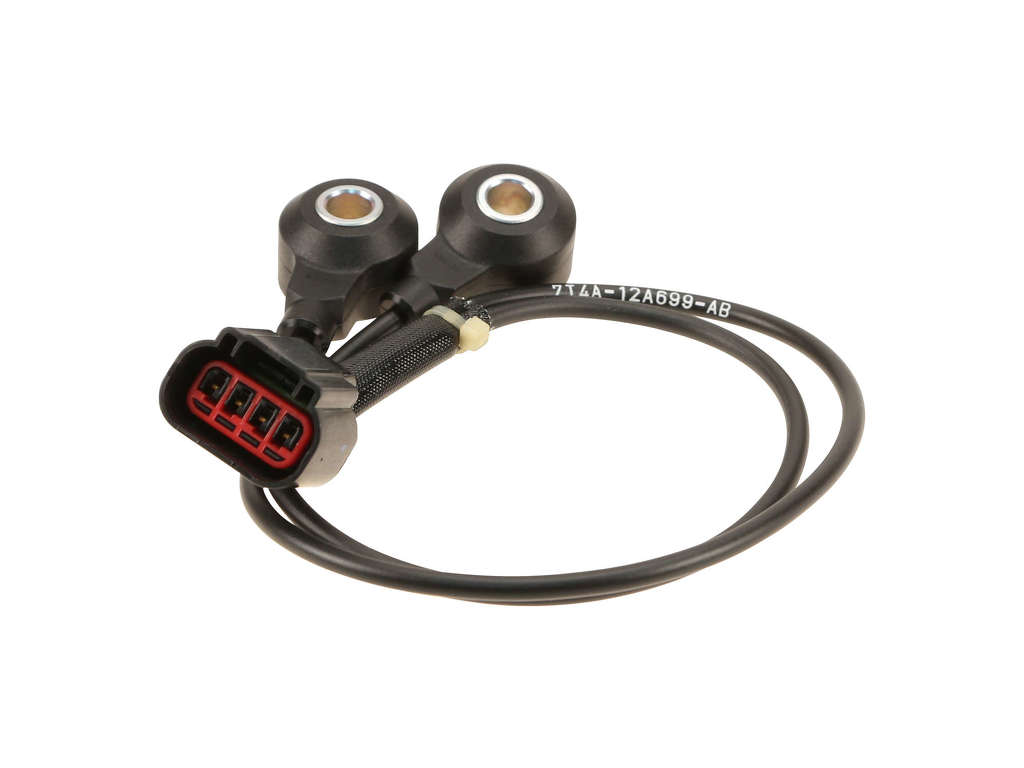
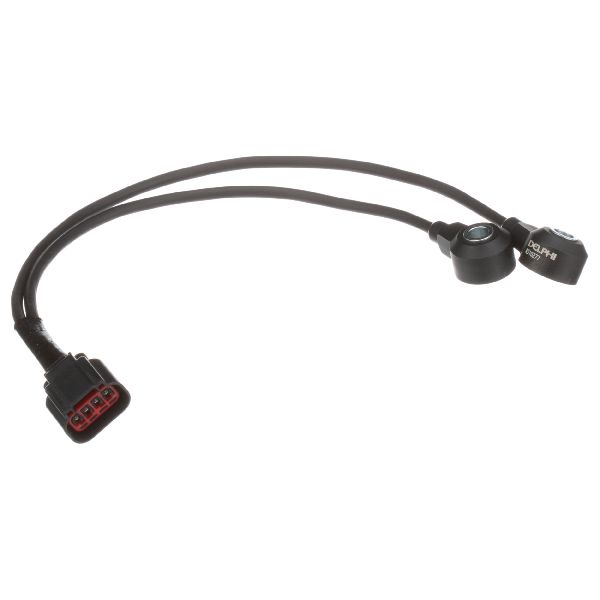
Typical fix: Repair the specific section of damaged wire. Per TSB #SSM 48991, the official repair is to replace both the ECT sensor (12A648) and the knock sensor (12A699) together.
Est. part cost: $10-$50 for wire and connectors, or more for a harness section and both sensors. - Low Engine Coolant ⚪ Low Probability
How to confirm: Check the coolant level in the reservoir when the engine is completely cold. If it's low, an air pocket may have formed around the sensor, causing it to send an open-circuit reading (high voltage).
Typical fix: Top off the coolant with the correct Motorcraft Orange or Yellow coolant specified for your vehicle and bleed the system to remove air pockets. Investigate the source of the coolant loss, as the 3.7L engine has a known issue with internal water pump failure.
Est. part cost: $20-$40 for a gallon of coolant.
Rare But Worth Checking
- Faulty Powertrain Control Module (PCM): This is extremely rare. The PCM should only be suspected after all other possibilities, including the sensor, connector, and all wiring, have been thoroughly tested and ruled out. A PCM software update could also be a potential fix in some rare cases.
Diagnosis Steps
- Connect an OBD-II scanner and confirm P0118 is present. Check for any other related codes, especially those listed in the TSBs (P0116, P0117, P0119, P1299, P0330).
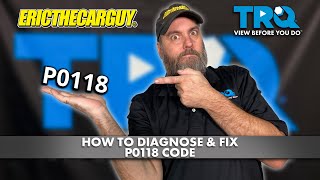
- View live data on the scanner. 🎬 Watch: EricTheCarGuy explains how to diagnose P0118 high input codes. Look at the Engine Coolant Temperature (ECT) reading. A value of -40°F or -40°C is a definitive sign of a P0118 fault condition (open circuit).
- Allow the engine to cool completely. Locate the ECT sensor. On the 2.7L and 3.0L V6 engines, it is notoriously difficult to access, located under the intake manifold.
- Following TSBs #SSM 47791 and #SSM 46906, carefully inspect the sensor's electrical connector for damage, corrosion, or a loose fit. Ensure it is securely latched. This is the most common cause.
- Disconnect the sensor. The scan tool reading should not change from -40°F. Use a jumper wire to short the two pins in the wiring harness connector. The scan tool reading should jump to a very high temperature (e.g., 250°F+). If it does, the wiring and PCM are good, and the sensor has failed.
- If the jumper test does not result in a high temperature reading, there is an open circuit in the wiring harness between the connector and the PCM, or a faulty PCM.
- Inspect the wiring harness for any signs of damage, as suggested by TSB #SSM 48991, paying close attention to the harness shared with the knock sensor.
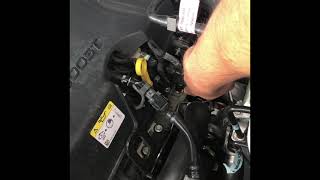
- If the wiring and connector are confirmed to be good, replace the ECT sensor. Given the difficult location on the 2018+ 2.7L engine, the official Ford repair is to install the relocation kit (Part No. ML3Z-14A411-H) 🎬 See this walkthrough of the TSB 21-2168 relocation kit installation. per TSB 21-2168.
Parts You'll Likely Need
- Engine Coolant Temperature (ECT) Sensor
(OEM #FT4Z-12A648-B)— This sensor is the most common part to fail after confirming the wiring and connector are intact. It is also replaced as part of the TSB #SSM 48991 repair.
Trusted brands: Motorcraft, NTK, Delphi
OEM price range: $27-$45
Aftermarket price range: $20-$40 - ECT Sensor Connector Pigtail
(OEM #WPT-1141 (Verify))— If the connector itself is damaged, corroded, or has a broken locking tab, replacing the pigtail is necessary for a secure connection, which is a primary cause of P0118.
Trusted brands: Motorcraft, Dorman
OEM price range: $25-$40
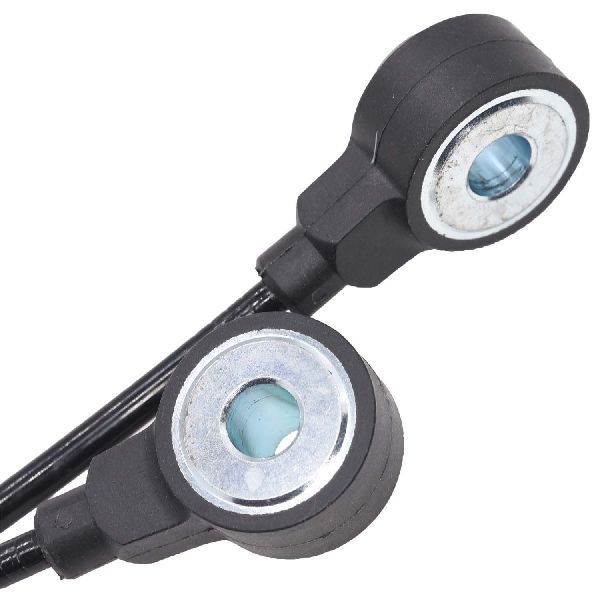
Aftermarket price range: $15-$30 - Knock Sensor
(OEM #12A699 (Base part number))— Required for the TSB #SSM 48991 repair on 2.7L engines, which addresses a harness issue by replacing both the ECT and knock sensors. Ford designates this as the causal part for warranty claims.
Trusted brands: Motorcraft
OEM price range: $40-$60
Aftermarket price range: $25-$45
Related Codes That Often Appear With This One
- P0116 — Indicates an issue with the ECT sensor's range or performance, often set alongside circuit-specific codes like P0118 due to the same root cause.
- P0117 — This is for 'Circuit Low Input,' the opposite of P0118. Seeing them together intermittently could point to a severe wiring or connector issue with intermittent shorting and opening.
- P0119 — Indicates an intermittent signal from the ECT sensor, often caused by a loose connection or damaged wire, which is a primary suspect for P0118 on this vehicle.
- P1299 — This code for 'Cylinder Head Over Temperature Protection Active' can be triggered by a faulty ECT sensor reading (either high or low), even if the engine isn't actually overheating. The PCM activates this mode as a precaution.
- P0330 — Knock Sensor 2 Circuit Malfunction. TSB SSM 48991 links this code with P0118 because they share a wiring harness on the 2.7L engine, indicating a harness fault is the likely culprit.
Technical Service Bulletins (TSBs) & Recalls
- SSM 48991: Potential issue with ECT or knock sensor wiring harness on 2.7L engines, requiring replacement of both sensors.
- SSM 47791: ECT sensor connector not fully seated or damaged on 2.7L engines.
- SSM 46906: ECT sensor connector not fully seated or damaged on 2.7L engines.
Platform-Specific Known Issues
- TSB #SSM 48991: Notes that for 2017-2020 Continental models with the 2.7L engine, an illuminated MIL with DTC P0118 (among others) may be due to the engine coolant temperature (ECT) sensor or knock sensor wiring harness. The official repair is to replace both the ECT sensor (part 12A648) and the knock sensor (part 12A699).
- TSB #SSM 47791: States that on 2018 models with a 2.7L engine, DTC P0118 may be caused by an ECT sensor connector which is not fully seated or is damaged.
- TSB #SSM 46906: Similar to the above, this TSB for 2017 models with a 2.7L engine points to a not fully seated or damaged ECT sensor connector as the likely cause for P0118.
Mechanic-Grade Diagnostic Values
- ECT Sensor Resistance — expected: 2,000 - 3,000 Ohms (2kΩ - 3kΩ). Failure: Infinite resistance (Open Line) or a value far outside the expected range at a known temperature.
- ECT Sensor Signal Voltage (Key On, Engine Off, Cold Engine) — expected: ~3.2V - 3.5V. Failure: Voltage is >4.9V, which indicates an open circuit and sets code P0118.
- ECT Connector Jumper Test (Live Data) — expected: ~250°F - 302°F (121°C - 150°C). Failure: Temperature reading on scan tool remains at -40°F. This indicates an open in the wiring harness to the PCM, not a bad sensor.
- PCM Fault-Setting Threshold — expected: Voltage must remain below 4.98V. Failure: The PCM will store DTC P0118 if the ECT sensor voltage is greater than 4.98 volts for more than 2 seconds.
Hidden / Shadow Codes Worth Checking
- Mode $06, TID:$01, CID:$11 (example): Mode $06 provides results from the PCM's non-continuous self-tests. A technician can view the test results for the ECT circuit to see if it has passed, failed, or is approaching a failure threshold, even before a DTC is set. The specific Test ID (TID) and Component ID (CID) for the ECT sensor must be looked up for the specific vehicle. (see via Advanced OBD-II scan tool with Mode $06 capability. The raw data may need to be converted from hexadecimal.)
Scan Tool Commands That Help
- Ford IDS (Integrated Diagnostic System): Key On, Engine Off (KOEO) On-Demand Self Test — This is a primary function used at the start of diagnosis. The IDS commands the PCM to check all sensor inputs against their expected ranges. For P0118, it would immediately flag the out-of-range high voltage from the ECT circuit.
- Ford IDS (Integrated Diagnostic System): Datalogger (Live Data) — Used to monitor the ECT sensor voltage (ECT_V) and temperature (ECT) PIDs in real-time while wiggling the harness and connector to check for intermittent opens in the circuit.
Wiring & Ground Locations
- ECT Sensor Connector (2.7L) — On 2017 models, it's more accessible on the driver's side of the engine. On 2018-2020 models, it is located deep in the engine valley, underneath the intake manifold.. This connector is a primary failure point due to being improperly seated or damaged, as noted in TSBs. Its location dictates the difficulty of the repair.
- ECT Sensor Signal Return (Ground) — This is not a chassis ground. It is a dedicated wire that runs from one of the pins on the ECT sensor connector directly back to a specific pin on the Powertrain Control Module (PCM).. A break in this return wire will cause an open circuit, setting P0118. Technicians should not waste time looking for a loose ground bolt on the engine block for this circuit.
- Connector C1047 (2.7L Engine) — This is the connector for the ECT sensor itself on the 2.7L EcoBoost engine.. A technician can perform resistance and voltage tests at this connector's pins to isolate the fault between the sensor and the wiring harness.
Real Owner Repair Stories
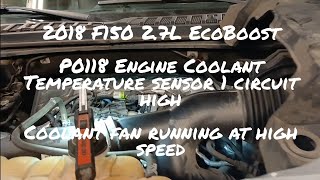
- Reddit user in r/f150 (2018 Ford F-150 2.7L EcoBoost) — Got an "Engine Coolant Over Temperature" warning on the dash, cooling fan running at high speed immediately on startup, and the engine temperature gauge was pegged on cold.
❌ Tried (didn't work) Initial online research pointed to an easy sensor replacement near the dipstick, which is only correct for pre-2018 models.
✅ What actually fixed it The vehicle was taken to a Ford dealer. The dealer confirmed the sensor had failed and was located under the intake manifold. They performed the repair outlined in a TSB by installing a relocation kit. The new sensor is placed on an external coolant line, and the old, failed sensor is left in place but disconnected. The total cost was around $1500.
OEM Part Supersession History
FT4Z-12A648-A (also service part DY-1298)→FT4Z-12A648-B— Standard part revision, likely for improved reliability or manufacturing process.N/A→ML3Z-14A411-H (Relocation Kit)— To address the high-labor cost of replacing the ECT sensor on 2018+ 2.7L engines, Ford issued TSB 21-2168 with this kit. It relocates the sensor to an upper heater hose.
Heads up: This kit is the recommended repair for 2018-2020 F-150s with the 2.7L engine and is applicable to other vehicles like the Continental sharing the same engine design and issue.
Model Year Variations Within This Range
- 2018-2020 (with 2.7L EcoBoost engine): The Engine Coolant Temperature (ECT) sensor was relocated from a relatively accessible position on the side of the engine (on 2017 and earlier models) to a highly inaccessible location under the intake manifold. This change dramatically increases the labor time and cost for a standard sensor replacement, making the TSB-recommended relocation kit the preferred fix.
Helpful Videos
![How to Fix FORD P0118 Engine Code in 3 Minutes [2 DIY Methods / Only $7.33]](https://img.youtube.com/vi/QsygZ_C9NA8/mqdefault.jpg)
We Have This Part in Stock


The information in this article is provided for general reference and educational purposes only. Vehicle specifications, procedures, and part compatibility can vary by production date, trim level, and region. Always consult your vehicle's factory service manual and verify part numbers before purchasing or performing repairs. Safety-critical components such as airbags, seat belts, and braking systems should be installed by a qualified professional.
- Lincoln CONTINENTAL:
- 🧭 Diagnostic Flowchart
- 🎬 Helpful Videos
- 🛍️ Shop This Part
- What's Unique About the 2017-2020 Lincoln CONTINENTAL
- Symptoms You May Notice
- Most Likely Causes
- Rare But Worth Checking
- Diagnosis Steps
- Parts You'll Likely Need
- Related Codes That Often Appear With This One
- Technical Service Bulletins (TSBs) & Recalls
- Platform-Specific Known Issues
- Mechanic-Grade Diagnostic Values
- Hidden / Shadow Codes Worth Checking
- Scan Tool Commands That Help
- Wiring & Ground Locations
- Real Owner Repair Stories
- OEM Part Supersession History
- Model Year Variations Within This Range
- 🎟️ Get 5% Off