

P0118 on 2008-2012 Porsche Cayenne: Engine Coolant Temperature Sensor Fixes
This code indicates a fault with the Engine Coolant Temperature (ECT) sensor circuit. On 2011-2012 models, it's an easy DIY fix involving a sensor on a coolant hose. On 2008-2010 models, the sensor is at the rear of the engine, requiring significant labor to replace.
- First, identify your Cayenne's generation: 2008-2010 is the 957, 2011-2012 is the 958. This is the most important step.
- For 2011-2012 (958) models, replacing the ECT sensor is a straightforward DIY job.
- For 2008-2010 (957) models, the sensor is extremely hard to reach. This repair is complex and labor-intensive, and professional help is recommended for most owners.
- The most common symptoms are a Check Engine Light, an erratic temperature gauge, and cooling fans running constantly.
- Always verify the correct part number for your vehicle's VIN before ordering parts.
What's Unique About the 2008-2012 Porsche Cayenne
The 2008-2012 Cayenne range spans two completely different generations, and the fix for P0118 varies dramatically between them. For the 2008-2010 (957 generation), the sensor is buried at the back of the engine, making replacement a difficult, labor-intensive job that often requires removing the intake manifold for access. In stark contrast, for the 2011-2012 (958 generation), the sensor is located on an accessible coolant hose on the passenger side of the engine, turning the repair into a much simpler task.
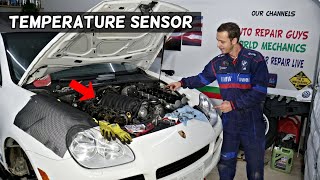
Generation note: The 2008-2012 vehicle range covers two Porsche Cayenne generations: - 2008-2010 (957): First generation (facelift). The ECT sensor is very difficult to access at the rear of the engine, behind the intake manifold. 🎬 See this video for the 957 generation sensor location. The job often requires removing the secondary air pump and its bracket for access. - 2011-2012 (958.1): Second generation. The ECT sensor is easily accessible on a coolant hose on the passenger side of the engine.
Symptoms You May Notice
- Check Engine Light is illuminated
- Temperature gauge on the dashboard is erratic, reading zero, maxed out, or fluctuating wildly.
- Radiator cooling fans run constantly at high speed, even when the engine is cold.
- Reduced fuel economy due to the engine running a rich fuel mixture.
- Hard starting or rough idling, especially when the engine is cold.
- Black smoke from the exhaust on occasion.
- Engine may hesitate until it warms up.
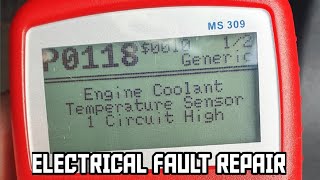
- A faulty thermostat is a common issue on Cayennes, particularly the 957 and 958 generations, and can cause temperature-related warnings (often code P2181). However, a thermostat issue typically won't cause the extreme, illogical temperature readings (-40°F) associated with a P0118 circuit fault. 🎬 Watch: EricTheCarGuy explains the P0118 code and high input faults. Some owners have reported that a failing thermostat caused erratic gauge behavior before ultimately fixing it with a thermostat replacement.
Most Likely Causes
- Failed Engine Coolant Temperature (ECT) Sensor 🔴 High Probability → Shop Engine Coolant Temperature Sensor The sensor is a thermistor that can fail over time due to age and constant heat cycles, leading to an internal open circuit.
How to confirm: Using a scan tool, observe the live data for the coolant temperature. If it shows an illogical value (e.g., -40°F) when the engine is at ambient temperature, the sensor is likely bad. You can also test the sensor's resistance with a multimeter; an open circuit (infinite resistance) indicates failure. The resistance should change predictably with temperature.
Typical fix: Replace the faulty Engine Coolant Temperature sensor and its O-ring/seal. On 958 models, be sure to lubricate the new O-ring with a suitable coolant gasket lubricant.
Est. part cost: $20-$60 - Damaged Wiring or Connector 🟡 Medium Probability Engine bay heat can make wiring and plastic connectors brittle over time, leading to breaks or poor connections. The plastic locking tabs on connectors become especially fragile.
How to confirm: Visually inspect the wiring harness leading to the ECT sensor for any signs of cracking, melting, or breaks. Check the connector for corrosion or loose pins. A 'Circuit High' code specifically points to an open circuit, which can be a disconnected plug, a broken wire, or a bad ground. Wiggle the harness and connector while watching live data on a scan tool; any dropouts indicate a bad connection.
Typical fix: Repair the damaged section of the wiring harness or replace the sensor pigtail connector.
Est. part cost: $15-$40
Rare But Worth Checking
- Faulty Engine Control Module (DME): This is very uncommon. Before condemning the DME, all other possibilities, including the sensor and its entire circuit, must be thoroughly tested and ruled out.
Diagnosis Steps
- Connect an OBD-II scanner and confirm P0118 is the active code.
- View live data from the Engine Coolant Temperature sensor. If it reads an extremely low value (like -40°F or -40°C) even on a warm engine, this points strongly to a sensor or circuit issue.
- Turn the engine off. Locate the ECT sensor. The location varies significantly by generation (see 'Generation Notes').
- Inspect the sensor's electrical connector and nearby wiring for any visible damage, corrosion, or loose connections.
- If wiring looks good, disconnect the sensor. With the key on, measure the voltage at the connector. You should see a 5-volt reference signal on one pin and a ground on the other.
- A useful wiring test is to bridge the two pins on the vehicle's harness connector with a paperclip or jumper wire. With the jumper in place, the scan tool's live data should show a very high temperature (e.g., 250°F+). If it does, the wiring to the DME is good, and the original sensor is faulty.
- If the sensor and wiring test good, the issue may be a rare fault within the DME itself.
Parts You'll Likely Need
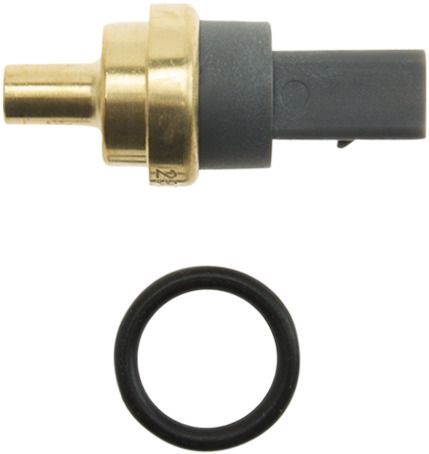
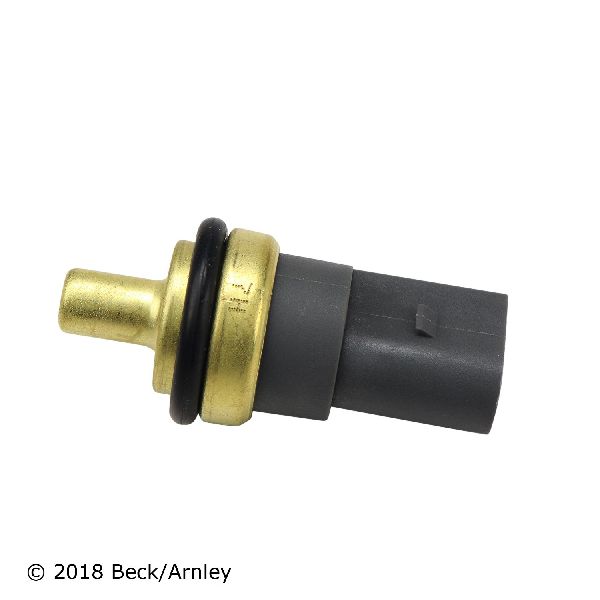
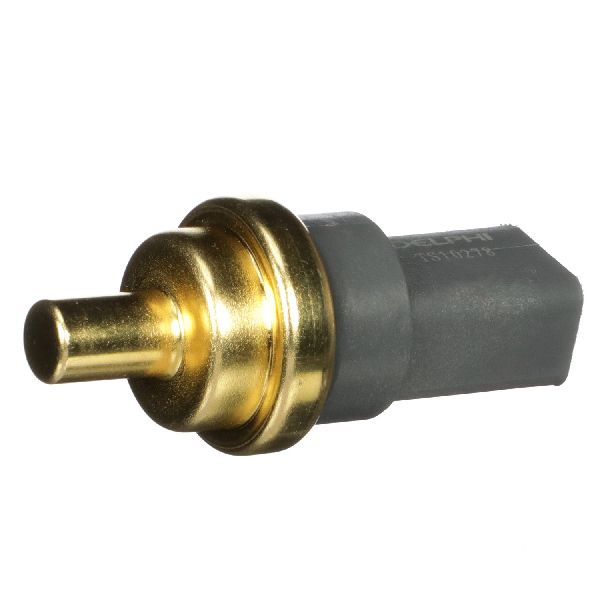
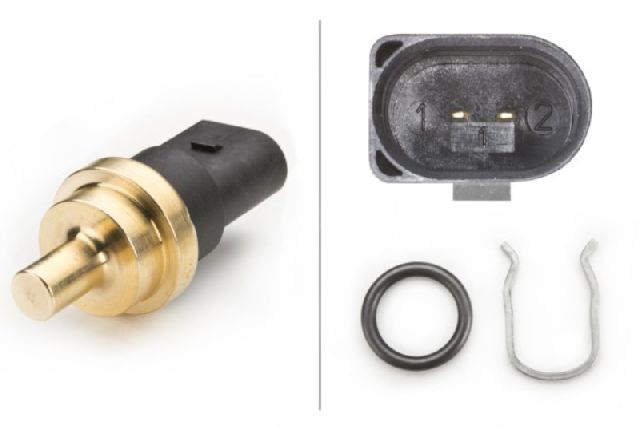
- Engine Coolant Temperature Sensor
(OEM #99760642001 (for 2008-2010 957 models), 95860613501 / 95860613511 (for 2011-2012 958 models))— This is the most common failure point for code P0118. It's critical to get the correct part for your specific generation and engine. Always verify with your VIN.
Trusted brands: Genuine Porsche, Hella, Vemo, Bosch, Facet
OEM price range: $40-$70
Aftermarket price range: $15-$45
Related Codes That Often Appear With This One
- P0117 — P0117 is 'ECT Circuit Low Input'. These codes are two sides of the same coin, pointing to a problem with the same sensor circuit. An intermittent wiring issue could cause either code to appear.
Platform-Specific Known Issues
- Extreme Difficulty on 2008-2010 (957) Models: On 957 models, the ECT sensor is located at the rear of the engine under the intake manifold, making replacement a 4-6 hour job for a professional. Many DIY guides recommend full intake manifold removal for access. Some owners on forums like Rennlist report that brittle plastic vacuum nipples on the manifold can break during removal, complicating the job further. It is possible, though very difficult, to reach the sensor by only removing the secondary air pump.
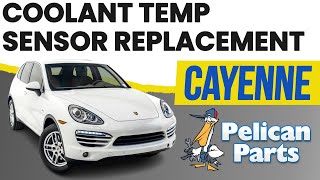
- Simple Repair on 2011-2012 (958) Models: On 958 models, the sensor is easily accessible on a coolant hose on the passenger side of the engine. The job involves removing a few engine covers, unplugging the sensor, removing a retaining clip, and quickly swapping the old sensor for the new one. 🎬 Watch: Step-by-step sensor replacement for 2011-2012 Cayenne models. Some coolant will be lost, so a top-off is necessary. The entire process can take less than an hour for a DIYer.
Mechanic-Grade Diagnostic Values
- ECT Sensor Resistance (disconnected) — expected: Approx. 2,200 - 3,000 Ω at 20°C (68°F); Approx. 250 - 350 Ω at 80°C (176°F).. Failure: Infinite resistance (open circuit) or a reading that doesn't change with temperature indicates a failed sensor.
- ECT Sensor Connector Voltage (Key On, Engine Off, Sensor Unplugged) — expected: One pin should have a 5-volt reference from the DME, the other should be ground.. Failure: No 5V reference or no ground indicates a wiring problem between the connector and the DME.
- Scan Tool Live Data (Sensor unplugged, Key On) — expected: The temperature reading should drop to its lowest possible value, typically -40°F or -40°C.. Failure: If the value does not drop to the minimum, it could suggest a short in the wiring harness.
- Scan Tool Live Data (Sensor connector pins jumped) — expected: The temperature reading should jump to its highest possible value, often 250°F+ (approx. 120°C+).. Failure: If the temperature does not max out, it confirms an open or high-resistance fault in the wiring or ground circuit leading back to the DME.
Scan Tool Commands That Help
- PIWIS (Porsche Dealer Tool) or advanced equivalent (e.g., Autel MaxiSys): Instrument Cluster Coding: 'Kuhlwassertemperatur kennlinie' (Coolant Water Temperature Curve) — This is not for diagnosing P0118, but for correcting the notoriously buffered/inaccurate dashboard temperature gauge. Owners may notice the gauge reads a steady 194°F (90°C) across a wide range of actual temperatures (e.g., 185°F to 225°F). A technician can use this function to map the output values (Y-axis) to match the input values (X-axis), resulting in a gauge that displays the true, unbuffered coolant temperature. This is an enhancement for enthusiast owners who want accurate data after a repair.
- N/A - Manual Procedure: Throttle Body Adaptation/Recalibration — On 957 V8 models, if the intake manifold is removed to access the ECT sensor, the throttle body must be disconnected. After reassembly, a recalibration is required. With the key in the 'ON' position (engine off), wait for approximately 60 seconds. You may hear distinct clicking or whirring sounds from the throttle body as it calibrates its position. The car should not be started until this process is complete.
Wiring & Ground Locations
- Main Engine-to-Chassis Ground Strap (957) — Located on the passenger side of the engine block, running from the lower block to the chassis, often routed under the exhaust header.. This strap is exposed to heat and corrosion and is a common failure point. A poor ground can introduce high resistance into multiple sensor circuits, potentially causing intermittent or persistent electrical faults like P0118 that are difficult to trace.
- Engine Bay Ground Point (958) — A primary ground point is located in front of the driver's seat, accessible via a small carpet door in the floor. Wires leading to this point are typically brown.. While less exposed than the 957's under-engine strap, corrosion at this main grounding point can cause a wide array of electrical gremlins, including sensor circuit faults.
- DME Ground (General) — ECU/DME ground points are often located on the firewall or inner fenders. On some Porsche models, a critical ECU ground is located under other components in the engine bay and can become loose.. The ECT sensor circuit relies on a solid ground path back to the DME. A faulty, corroded, or loose DME ground can cause a 'Circuit High' fault because the reference voltage has no stable path, mimicking an open circuit.
Real Owner Repair Stories
- YouTube Channel 'YK RECREATION' (Vehicle appears to be a VW/Audi platform mate, demonstrating a universally applicable diagnostic process for P0118.) — Check Engine Light with code P0118 'Engine Coolant Temp Circuit High' and cooling fans constantly running at high speed, even when cold.
❌ Tried (didn't work) Replacing the primary coolant temperature sensor., Replacing a secondary coolant temperature sensor.
✅ What actually fixed it The wiring harness for the ECT sensor had rubbed against a hot coolant pipe, melting the insulation and causing a fault in the wire. The fix was to repair the damaged section of the wire and re-route the harness away from the pipe to prevent it from happening again. - Rennlist user 'Type_LT' (Porsche Cayenne Diesel (958)) — Temperature gauge reading low (around 100°F) when it should have been near 200°F. Eventually, the reading dropped to -40°F.
✅ What actually fixed it The user confirmed the sensor was the fault. Disconnecting the sensor with a diagnostic tool connected caused the reading to drop to -40°F, as expected for an open circuit. An ohmmeter test on the sensor itself showed megaohms (an open circuit), confirming internal failure. The final fix was replacing the G62 sensor (PN 95860662320 for this model).
OEM Part Supersession History
95860613501→95860613511— Part revision by the manufacturer. Reasons are not officially published but are typically for improved material, design, or a change in supplier.
Heads up: The new part number 95860613511 is the correct and current replacement for 95860613501 and is fully compatible.
Diagnostic Flowchart
Other Known Issues on This Vehicle
Issues unrelated to this code that are worth knowing about as an owner of this generation:
- Cylinder Bore Scoring (V8 Models) 🔴 High — More common on 2003-2010 (955/957) naturally aspirated 4.5L/4.8L V8s, especially in colder climates, but can affect all Alusil/Lokasil block V8s. Symptoms include a distinct ticking/knocking noise (piston slap) and increased oil consumption.
- Transfer Case Failure (958 Models) 🔴 High — A well-documented problem on 2011-2018 (958) models, often appearing as shuddering or jerking during low-speed acceleration. Many fail before 50,000 miles. Regular fluid changes (every 30-40k miles) are recommended as a preventative measure. (Ref: No recall, but it is a widely known issue. Porsche updated the transfer case design in later years.)
- Shearing Camshaft Adjuster Bolts (V8 Models) 🔴 High — Primarily affects 2010-2012 V8 engines. The original aluminum bolts can shear, causing the timing to jump and leading to catastrophic engine failure. It can happen without warning at various mileages. (Ref: Porsche issued a recall (Campaign AH08 in the US) to replace the aluminum bolts with steel ones. Owners should verify this was performed.)
- Coolant Pipe Leaks (957 V8 Models) 🟠 Medium — The original plastic coolant pipes located under the intake manifold become brittle and can crack, causing a major coolant leak. Upgraded aluminum pipes are the permanent solution. This was a more severe issue on the earlier 955, but the 957 still has plastic components that can fail.
Used vs. New Parts: Buying Guide for This Vehicle
When a used part is the smart pick: For this specific repair, buying a used ECT sensor is not recommended. The part is a low-cost wear item, and the labor cost (especially on 957 models) is extremely high. The risk of a used sensor failing shortly after installation far outweighs the small cost savings.
What to inspect on the donor part:
- Not applicable as used purchase is not advised.
OEM-only on this vehicle (don't cheap out):
- While not strictly 'OEM-only', given the high labor cost for the 957-generation repair, using a Genuine Porsche or OEM-supplier (like Hella, Bosch, Vemo) sensor is strongly advised to minimize the risk of premature failure and a repeat repair.
Aftermarket brands forum-validated for this vehicle:
- Hella
- Vemo
- Bosch
- Delphi
- NGK
- Beck Arnley
Brands owners have reported issues with on this vehicle:
- Avoid unbranded, 'white-box' parts from online marketplaces, especially for the 957 model. The potential for poor quality control and early failure makes them a significant gamble.
Real Owner Stories
Aggregated from forums and TSBs cited above. Mileages and costs reflect what owners reported in those sources.
2011 VW Touareg TDI
Symptoms: Fans running at full speed and the engine temperature gauge reading zero after the car had been sitting for two days.
What fixed it: The owner replaced the G62 coolant temperature sensor to resolve the issue.
Source hint: Ross-Tech Forums - 'p0118, G62 coolant temp sensor replaced, fans running and engine temp reading zero..'
2011 Cayenne Turbo
Symptoms: The temperature gauge dropped to zero and a check engine light came on.
What fixed it: Diagnosis pointed to a faulty Engine Coolant Temperature sensor or a connection issue.
Source hint: Rennlist - 'Cayenne Turbo Coolant Temperature location'
2008-2010 Cayenne (957)
Symptoms: While attempting a repair that required intake manifold removal to access components underneath, a plastic vacuum fitting on the manifold broke.
What fixed it: This story highlights a common complication during the repair of P0118 on 957 models, rather than the fix for the code itself. The owner had to deal with repairing the broken manifold fitting.
Source hint: Rennlist - 'Cheap brittle plastic crap... Removing intake manifold.'
Related OBD-II Codes
Frequently Asked Questions
How difficult is it to replace the ECT sensor on my 2009 Porsche Cayenne?
Is the P0118 repair easier on a 2012 Porsche Cayenne?
My 2011 Cayenne V8 is making a strange noise. Is there a recall I should check for?
My temperature gauge is at zero and the fans are running constantly. What does the scan tool data mean?
Should I buy a cheap aftermarket ECT sensor for my Cayenne?
How can I test if the wiring is good before replacing the sensor?
Helpful Videos

We Have This Part in Stock


The information in this article is provided for general reference and educational purposes only. Vehicle specifications, procedures, and part compatibility can vary by production date, trim level, and region. Always consult your vehicle's factory service manual and verify part numbers before purchasing or performing repairs. Safety-critical components such as airbags, seat belts, and braking systems should be installed by a qualified professional.
- Porsche Cayenne:
- 🧭 Diagnostic Flowchart
- 🎬 Helpful Videos
- 🛍️ Shop This Part
- What's Unique About the 2008-2012 Porsche Cayenne
- Symptoms You May Notice
- Most Likely Causes
- Rare But Worth Checking
- Diagnosis Steps
- Parts You'll Likely Need
- Related Codes That Often Appear With This One
- Platform-Specific Known Issues
- Mechanic-Grade Diagnostic Values
- Scan Tool Commands That Help
- Wiring & Ground Locations
- Real Owner Repair Stories
- OEM Part Supersession History
- Other Known Issues on This Vehicle
- Used vs. New Parts: Buying Guide for This Vehicle
- Real Owner Stories
- 2011 VW Touareg TDI
- 2011 Cayenne Turbo
- 2008-2010 Cayenne (957)
- Related OBD-II Codes
- Frequently Asked Questions
- 🎟️ Get 5% Off