

P0118 on 2013-2018 Toyota RAV4 2.5L: Engine Coolant Temperature Sensor Fixes
On a 2013-2018 RAV4, code P0118 is almost always a failed Engine Coolant Temperature (ECT) sensor. This causes a high voltage signal, making the computer think the engine is at -40°. Expect to pay $25-$50 for an aftermarket sensor or $65-$100 for an OEM one; it's a straightforward DIY fix for many.
- P0118 on your RAV4 means the computer is getting a signal for an extremely cold engine (-40°), usually due to a bad Engine Coolant Temperature (ECT) sensor.
- The most common symptoms are a Check Engine Light and cooling fans that won't turn off.
- Diagnosis is straightforward: check the live data on a scan tool. If it reads -40°, the sensor or its wiring is the problem.
- The most likely fix is replacing the ECT sensor itself, which is an affordable part and a manageable DIY job for most.
- Always confirm the diagnosis before replacing parts. A simple wiring test using a paperclip can isolate a bad sensor from a wiring problem.
What's Unique About the 2013-2018 Toyota RAV4
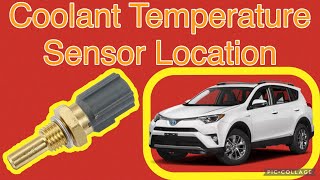
The 2013-2018 RAV4 (XA40 generation) uses the reliable 2AR-FE engine, which is shared with the Camry, Scion tC, and other Toyota models. There are no unique design flaws that make this vehicle especially prone to P0118; the causes and fixes are standard for this type of engine. The ECT sensor is a common two-wire thermistor that fails in a predictable way. The primary challenge on this vehicle can be accessing the sensor, which is located on the cylinder head near the thermostat housing, underneath the air filter housing. 🎬 See exactly where the sensor is located on this engine While not difficult, it can be a tight space to work in, and some coolant will be lost during the swap.
Symptoms You May Notice
- Check Engine Light is on
- Cooling fans run continuously at high speed, even when the engine is cold
- Engine is difficult to start, especially when cold
- Poor fuel economy
- Rough or unstable idle, particularly before the engine warms up
- Temperature gauge on the dashboard may not move or indicates the lowest possible reading
- Black smoke from the exhaust during a cold start (due to an overly rich fuel mixture)
- Engine may run rough or misfire
- Replacing the thermostat. A thermostat stuck open would cause a P0128 code (Coolant Temperature Below Thermostat Regulating Temperature), not a P0118. A thermostat stuck closed would cause overheating and likely a P0117 (Circuit Low) if the sensor is working.
Most Likely Causes
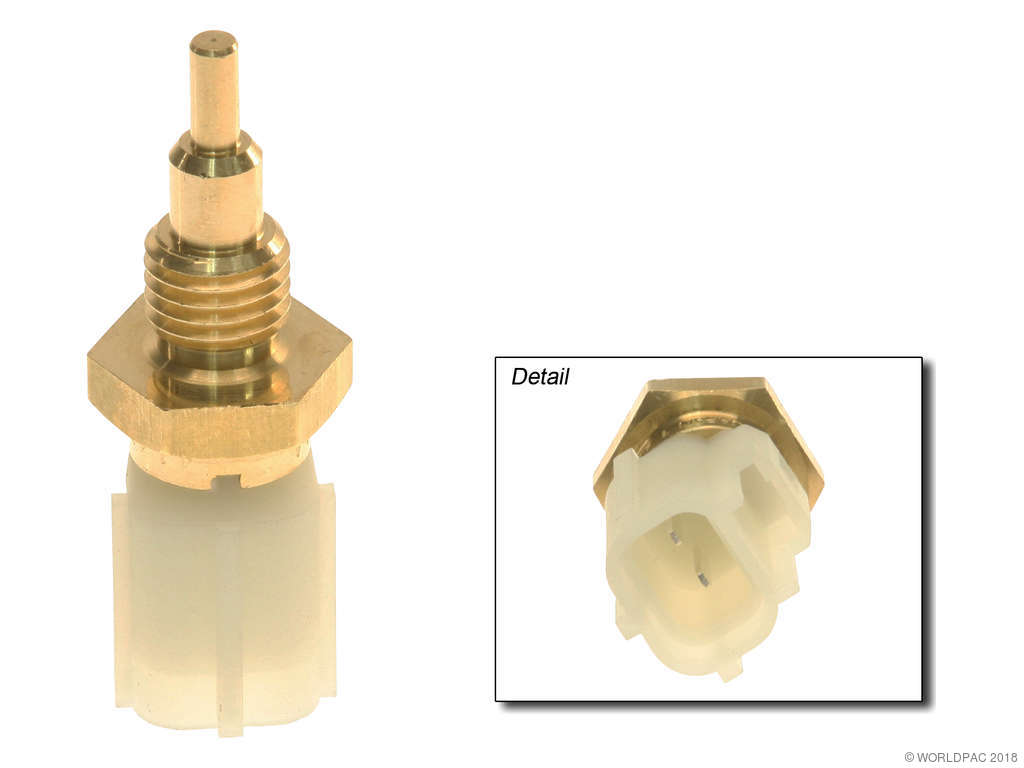
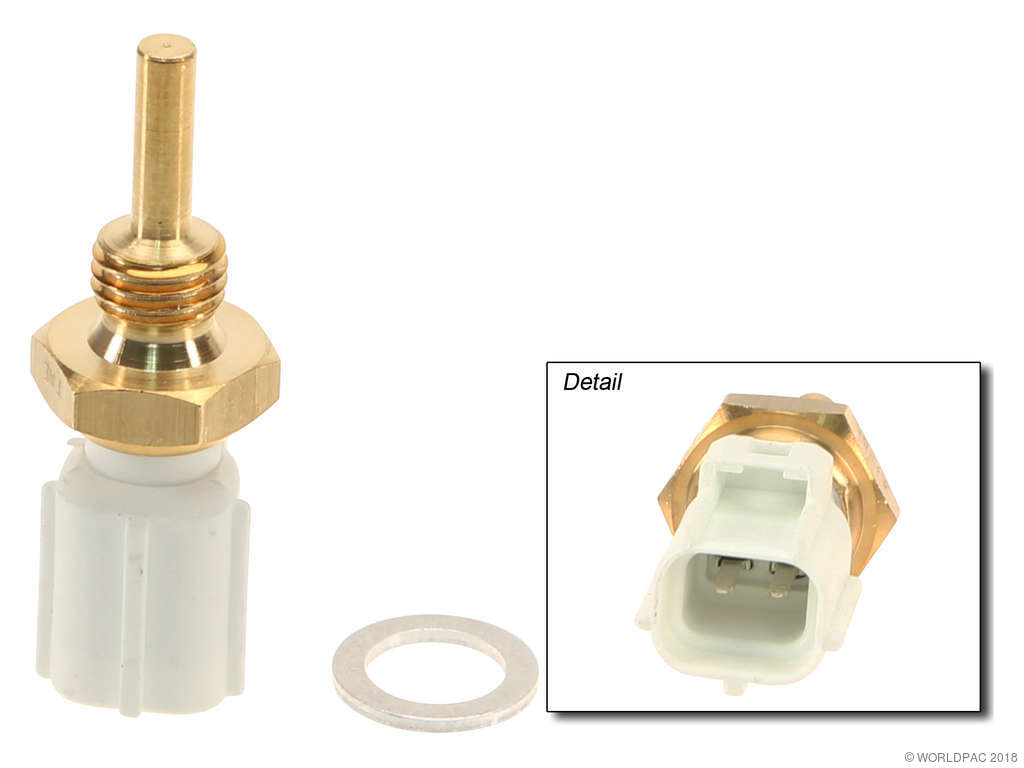
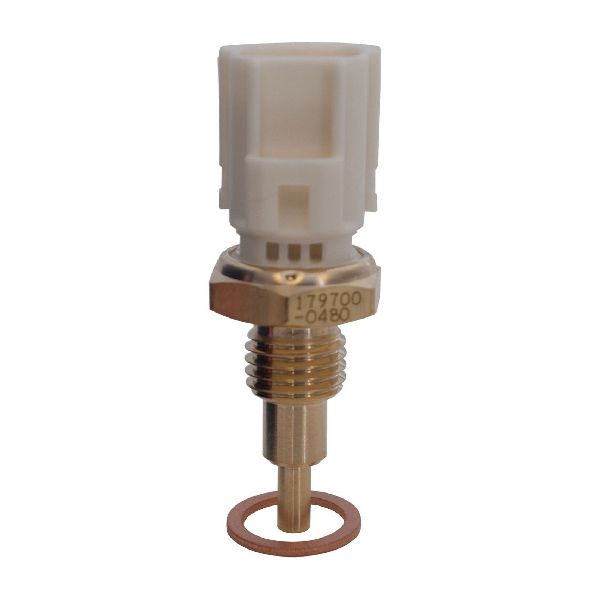
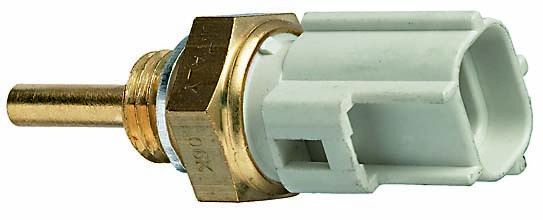
- Failed Engine Coolant Temperature (ECT) Sensor 🔴 High Probability → Shop Engine Coolant Temperature Sensor The internal thermistor in the sensor can fail over time, creating an open circuit which results in the high voltage signal. This is the most common point of failure for this code.
How to confirm: With the engine cold, use a scan tool to check the ECT reading. If it shows -40°, the sensor is the likely culprit. You can also test the sensor's resistance with a multimeter. At room temperature (~68°F/20°C), it should have a resistance of 2,000-3,000 Ohms. If it reads infinite resistance (OL), it is internally open and has failed.
Typical fix: Replace the ECT sensor. It is recommended to have the new sensor ready to swap in quickly to minimize coolant loss. The sensor is held in by a clip, making removal and installation relatively fast once accessed.
Est. part cost: $65-$100 - Damaged Wiring or Connector 🟡 Medium Probability Wires can become brittle from heat cycles and chafe against other components. More commonly, the connector itself can become loose or disconnected during other maintenance, like changing an air filter. Rodents can also chew through the thin wires.
How to confirm: Visually inspect the wiring harness leading to the ECT sensor for any signs of damage, melting, or breaks. Ensure the connector is fully seated and locked. To test the circuit, disconnect the sensor and jump the two pins in the harness-side connector with a paperclip; the scan tool reading should change from -40° to a very high temperature (e.g., 284°F / 140°C). If it does, the wiring and ECM are good.
Typical fix: Repair the broken wire or replace the damaged connector pigtail. If the connector is simply loose, securely plug it back in.
Est. part cost: $10-$30
Rare But Worth Checking
- Faulty Engine Control Module (ECM): This is extremely rare. The ECM should only be considered after the sensor and wiring have been thoroughly tested and proven to be good.
- Low Engine Coolant Level: While a low coolant level typically causes overheating and a P0117 (low input) or P0128 code, if the sensor is completely uncovered by coolant, it can lead to erratic readings that might, in rare cases, trigger a P0118.
Diagnosis Steps
- Connect an OBD-II scanner and confirm the P0118 code is present.
- View the live data stream. Check the value for the Engine Coolant Temperature (ECT). If it reads -40°F or -40°C with a cold or warm engine, this confirms the 'Circuit High' condition.
- Turn the vehicle off. Locate the ECT sensor on the cylinder head, near the thermostat housing, below the air filter assembly.
- Visually inspect the sensor's electrical connector and nearby wiring for any obvious damage, corrosion, or loose connections. A common real-world failure is simply a loose connector. 🎬 Watch: Real-world diagnosis of a loose ECT connector on a RAV4
- Disconnect the sensor. Turn the ignition to the 'ON' position (engine off). Use a multimeter to verify there is a 5-volt reference on one wire and a good ground on the other.
- With the connector still unplugged and key 'ON', use a small paperclip or jumper wire to bridge the two terminals on the wiring harness connector. The ECT value on your scan tool should now read a very high temperature (e.g., 284°F / 140°C or higher). If it does, the wiring and ECM are good, and the sensor itself is faulty.
- If the jumper test does not change the reading from -40°, there is an open circuit in the wiring harness between the connector and the ECM. You will need to trace the THW (signal) and ETHW (ground) wires back to the ECM.
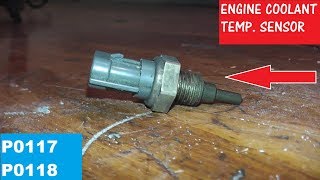
- To confirm a bad sensor, you can test its internal resistance with a multimeter. At room temperature (~68°F/20°C), it should have a resistance of 2,000-3,000 Ohms. If it reads infinite resistance (OL), it is internally open and must be replaced. 🎬 Watch: How to test and replace the coolant temperature sensor
Parts You'll Likely Need
- Engine Coolant Temperature Sensor
(OEM #89422-33030)— This sensor's internal thermistor is the most common failure point for a P0118 code, causing an open circuit. This part number is widely used across many Toyota models from this era.
Trusted brands: Denso (OEM supplier), Aisin, Genuine Toyota
OEM price range: $65-$100
Aftermarket price range: $25-$50
Related Codes That Often Appear With This One
- P0117 — If the wiring is intermittently shorting and opening, you might see both P0117 (Circuit Low) and P0118 (Circuit High) codes stored.
- P0128 — While less common, if the sensor is failing but not completely open, it might read incorrectly and contribute to a P0128 code if the ECM doesn't see the engine reach operating temperature quickly enough.
Platform-Specific Known Issues
- Access to the ECT sensor requires removing the air filter housing, but is otherwise straightforward. A YouTube video by Irfan Chaudhry for a 2017 RAV4 shows the exact location and a real-world diagnosis where the connector was simply loose.
- No special tools are required, but a deep socket or wrench will be needed for the sensor if it is the screw-in type, though many are held by a simple clip.
Mechanic-Grade Diagnostic Values
- ECT Sensor Resistance vs. Temperature — expected: Approx. 90,000-100,000Ω at -40°C, 2,200-3,000Ω at 20°C (68°F), and 250-350Ω at 80°C (176°F).. Failure: An infinite resistance reading (Open Loop/OL) at any temperature indicates a failed, open sensor.
- ECT Sensor Circuit Voltage at ECM — expected: Signal voltage should be between 0.5V (hot) and 3.5V (cold).. Failure: A sustained voltage reading above 4.91V for more than 0.5 seconds will trigger the P0118 code.
- ECT Live Data on Cold Soak — expected: On a cold engine that has sat overnight, the ECT reading should be nearly identical to the Intake Air Temperature (IAT) and Ambient Air Temperature readings.. Failure: If the IAT is 70°F and the ECT reads -40°F, it confirms a fault in the ECT circuit.
Hidden / Shadow Codes Worth Checking
- Pending DTC: Toyota's system may store a 'Pending DTC' before the main DTC is set and the MIL is illuminated. If a P0118 is cleared and doesn't immediately return, checking for a pending code after a short drive cycle can confirm if the fault is still present. (see via Using a scan tool like Toyota Techstream, navigate to: Powertrain / Engine and ECT / Trouble Code / Pending.)
Scan Tool Commands That Help
- Toyota Techstream: Data List -> Coolant Temp — This is the primary function used to view the live temperature value the ECM is seeing. A reading of -40°C (-40°F) confirms the open circuit condition for P0118.
- Toyota Techstream: Utility -> All Readiness — After a repair, this function is used to check the status of the diagnostic monitor for the ECT circuit to confirm the system has run its self-test and passed.
- Toyota Techstream: Active Test -> Control the Cooling Fan — While not a direct test for P0118, it can be used to verify the cooling fan circuit is working correctly, as a P0118 will cause the fans to run constantly in fail-safe mode. This helps rule out a separate fan control issue.
Wiring & Ground Locations
- ECT Sensor Connector — On the cylinder head, near the thermostat housing, typically below the air filter housing assembly on the 2AR-FE engine.. This is the primary point of failure for wiring issues, either through a loose connection, corrosion on the pins, or damage to the pigtail.
- ECM Pins THW and ETHW — A wiring diagram for the 2AR-FE shows the ECT sensor signal wire (THW) at pin 64 and the sensor ground wire (ETHW) at pin 65 of the ECM connector.. If the jumper test at the sensor connector fails, a continuity test must be performed from the sensor connector directly to these pins to find the break in the harness.
- Engine Block Ground — The 2AR-FE has several key grounding points for the engine harness, typically bolted to the cylinder head or engine block.. The ETHW wire relies on a solid engine ground. While less common for a P0118 (which is an open circuit), a poor ground can cause erratic sensor readings and other codes.
Real Owner Repair Stories
- PriusChat forum user (2011 Toyota Prius (similar ECT circuit logic)) — P0118 code appeared immediately after a head gasket replacement and coolant change. Scan tool showed -40 degrees. Clearing the code resulted in it returning instantly.
❌ Tried (didn't work) Spraying brake cleaner on connectors., Jumping the connector pins (did not trigger the expected P0117 code)., Attempting continuity checks from the ECM to the wrong sensor.
✅ What actually fixed it The user realized they were diagnosing the wrong temperature sensor. They had forgotten to plug in the primary engine coolant temperature sensor located on the engine head itself after reassembling the engine. Plugging in the correct sensor resolved the code.
OEM Part Supersession History
89422-33030→89422-0D010— Standard part number consolidation and minor revisions by the manufacturer.
Heads up: The parts are cross-compatible. Ordering either number from an OEM source will yield the correct, current part.
Diagnostic Flowchart
Other Known Issues on This Vehicle
Issues unrelated to this code that are worth knowing about as an owner of this generation:
- Torque Converter Shudder 🟠 Medium — Common on 2013-2015 models. Occurs under light throttle between 25-50 mph. (Ref: Toyota TSB-0023-15 Rev2 and Warranty Enhancement Program ZH1. Fix involves ECM reprogram and/or torque converter replacement.)
- Infotainment System Glitches 🟡 Low — Frequently reported issue involving screen freezing, rebooting, or unresponsiveness. Can occur after 40,000 miles. (Ref: Software updates were released, but may not solve all problems. See TSB T-TT-0578-19 for Bluetooth issues.)
- VVT-i Cam Gear Rattle on Cold Start 🟠 Medium — A brief (~1 second) rattle or grind upon cold startup. Common on higher-mileage 2AR-FE engines. (Ref: No official TSB, but widely discussed in owner forums. Caused by wear in the VVT actuator locking pin mechanism.)
- Water Pump Failure 🟠 Medium — Noted as a potential failure point, though less frequent than on the previous generation. Symptoms include pink coolant residue or leaks.
Used vs. New Parts: Buying Guide for This Vehicle
When a used part is the smart pick: For this specific repair, a used part from a salvage yard is NOT recommended. The ECT sensor is an inexpensive electronic component that is a common failure point. The labor to access the sensor outweighs the small cost savings of a used part with unknown remaining life.
What to inspect on the donor part:
- Not applicable as used part is not recommended.
OEM-only on this vehicle (don't cheap out):
- While not strictly 'OEM-only', using the OEM supplier (Denso) or a trusted Japanese OEM like Aisin is highly recommended over generic, no-name brands. The cost difference is minimal, and the quality and accuracy of the thermistor are critical for proper engine management.
Aftermarket brands forum-validated for this vehicle:
- Denso (OEM supplier)
- Aisin
- Genuine Toyota
Brands owners have reported issues with on this vehicle:
- Unnamed, 'white-box' parts from online marketplaces should be avoided. They may have incorrect resistance curves, leading to poor performance, bad fuel economy, and a potential return of engine codes.
Real Owner Stories
Aggregated from forums and TSBs cited above. Mileages and costs reflect what owners reported in those sources.
2017 Toyota RAV4 2.5L
Symptoms: Check engine light on, poor idling, overheating symptoms, and a faulty fan motor.
What fixed it: The ECT sensor plug was found to be disconnected; securely plugging the connector back in resolved the issue.
Source hint: YouTube video by Irfan Chaudhry titled '2017 Rav-4 P0118, Poor Idling, Overheating = Loose ECT plug, Faulty Fan Motor'
2013-2018 Toyota RAV4 2.5L
Symptoms: P0118 code present with a damaged or brittle wiring harness connector.
What fixed it: Replacement of both the ECT sensor and its pigtail connector using the clip-style mount.
Source hint: YouTube video titled 'Engine Coolant Temperature Sensor Connector Repair and Replace #P0118'
Related OBD-II Codes
Frequently Asked Questions
Where is the ECT sensor located on my 2013-2018 RAV4 2.5L?
Is there a TSB for the P0118 code on my RAV4?
What specific replacement sensor brand should I use for my 2AR-FE engine?
Can a loose connector cause the P0118 code on a 2017 RAV4?
What should the resistance of the ECT sensor be if I test it myself?
Why are my cooling fans running at high speed when the engine is cold?
Helpful Videos
We Have This Part in Stock


The information in this article is provided for general reference and educational purposes only. Vehicle specifications, procedures, and part compatibility can vary by production date, trim level, and region. Always consult your vehicle's factory service manual and verify part numbers before purchasing or performing repairs. Safety-critical components such as airbags, seat belts, and braking systems should be installed by a qualified professional.
- Toyota RAV4:
- 🧭 Diagnostic Flowchart
- 🎬 Helpful Videos
- 🛍️ Shop This Part
- What's Unique About the 2013-2018 Toyota RAV4
- Symptoms You May Notice
- Most Likely Causes
- Rare But Worth Checking
- Diagnosis Steps
- Parts You'll Likely Need
- Related Codes That Often Appear With This One
- Platform-Specific Known Issues
- Mechanic-Grade Diagnostic Values
- Hidden / Shadow Codes Worth Checking
- Scan Tool Commands That Help
- Wiring & Ground Locations
- Real Owner Repair Stories
- OEM Part Supersession History
- Other Known Issues on This Vehicle
- Used vs. New Parts: Buying Guide for This Vehicle
- Real Owner Stories
- 2017 Toyota RAV4 2.5L
- 2013-2018 Toyota RAV4 2.5L
- Related OBD-II Codes
- Frequently Asked Questions
- 🎟️ Get 5% Off