

P0121 on 2009-2012 Buick LaCrosse: Throttle Position Sensor Causes and Fixes
On a 2009-2012 Buick LaCrosse, code P0121 is most often caused by a dirty throttle body. The fix is to clean the throttle body and perform an idle relearn procedure. If cleaning doesn't work, the entire throttle body assembly, which contains the non-serviceable sensor, needs to be replaced.
- Start by cleaning the throttle body. This is the most common, cheapest, and easiest fix for P0121 on this vehicle.
- You MUST perform an idle relearn procedure after cleaning or replacing the throttle body to avoid a high or erratic idle.
- The throttle position sensors (TPS) are built into the throttle body. If cleaning doesn't work, you must replace the entire assembly.
- Do not confuse the throttle body with the accelerator pedal sensor; P0121 points to an issue at the engine, not under the dashboard.
- This code will likely put your car in 'Reduced Engine Power' mode, making it unsafe for normal driving.
What's Unique About the 2009-2012 Buick LaCrosse
On these GM vehicles, the throttle position sensors are not separate, replaceable parts; they are integrated directly into the electronic throttle body assembly. The most frequent cause of P0121 is not a failed sensor, but rather carbon buildup on the throttle plate and bore. This buildup prevents the plate from closing properly, causing the sensor's reported position to conflict with what the ECM expects at idle, leading to a 'performance' code. Therefore, cleaning the throttle body is the most critical first step in diagnosis. If cleaning does not work, it often points to an internal electronic failure of the sensors within the sealed unit, which then requires full replacement.
Generation note: The 2009-2012 range covers two different LaCrosse generations. The 2009 model is the final year of the first generation, while 2010-2012 models belong to the second generation. These generations use different engines (e.g., 3.8L V6 in 2009 vs. 2.4L, 3.0L, 3.6L in 2010-2012) and may have different throttle body designs and part numbers. However, the cause, symptoms, and diagnostic principles for code P0121 are largely the same across both, as the electronic throttle control system functions similarly.
Symptoms You May Notice
- Check Engine Light is on
- "Reduced Engine Power" or "Service Stabilitrak" message on the dash
- Vehicle is in 'limp mode' with severely limited acceleration and speed
- Hesitation or stumbling when pressing the gas pedal.
- Rough, surging, or unstable idle.
- Engine may stall at low speeds or when coming to a stop.
- Hard starting condition.
- Replacing the accelerator pedal position (APP) sensor. The APP sensor is located at the gas pedal and has its own set of trouble codes (e.g., P2138). P0121 specifically points to a problem at the throttle body itself.
Most Likely Causes
- Dirty Throttle Body 🔴 High Probability → Shop Fuel Injection Throttle Body The PCV (Positive Crankcase Ventilation) system routes oil vapor and combustion byproducts back into the intake, which can bake onto the throttle body and plate over time, restricting movement and causing the plate's actual position to deviate from the ECM's commanded position.
How to confirm: Remove the air intake duct from the throttle body. Visually inspect the throttle plate and the inside of the throttle body bore for a layer of black carbon or oily grime.
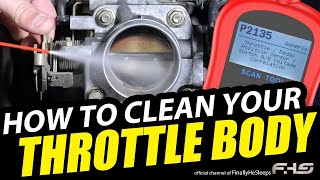
Typical fix: Thoroughly clean the throttle body bore and plate 🎬 See this step-by-step guide on cleaning your throttle body with a dedicated throttle body cleaner and a soft cloth or brush. An idle relearn procedure must be performed afterward.
Est. part cost: $5-$15 for cleaner - Faulty Throttle Body Assembly 🟡 Medium Probability → Shop Fuel Injection Throttle Body The internal electronic sensors are non-serviceable and can fail over time due to heat and vibration. This is the next logical failure point if cleaning does not resolve the issue, and is a known issue on this platform.
How to confirm: If a thorough cleaning and idle relearn do not fix the code, and the wiring is confirmed to be good, the throttle body assembly itself is the likely culprit. A scan tool can monitor the TPS 1 and TPS 2 voltages; erratic readings or dropouts while slowly opening the throttle indicate a bad sensor.
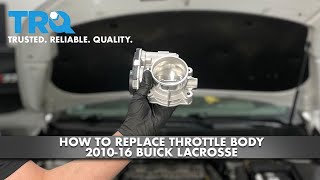
Typical fix: Replace the entire throttle body assembly. 🎬 Watch: How to replace the throttle body on a Buick LaCrosse This part includes the new integrated throttle position sensors. An idle relearn procedure is required after replacement.
Est. part cost: $120-$250 - Wiring or Connector Issue ⚪ Low Probability The engine harness connector at the throttle body is exposed to heat and vibration, which can lead to corrosion on the pins or, rarely, a broken wire inside the insulation.
How to confirm: Disconnect the throttle body connector and inspect the pins for corrosion or damage. With the key on, check for the 5-volt reference and good ground at the connector. Perform a 'wiggle test' on the harness while monitoring TPS voltage on a scan tool to see if the signal cuts out.
Typical fix: Clean corroded connector pins with an electrical contact cleaner. Repair any broken or frayed wires.
Est. part cost: $5-$25 for cleaner or wiring supplies
Rare But Worth Checking
- Faulty Engine Control Module (ECM): This is very uncommon. The ECM should only be considered after all other possibilities, including the throttle body and wiring, have been definitively ruled out.
Diagnosis Steps
- Connect an OBD-II scanner to confirm the P0121 code and check for any other related codes like P2135.
- Disconnect the negative battery terminal.
- Remove the engine cover and the air intake duct connected to the throttle body.
- Visually inspect the throttle body for heavy carbon buildup. If dirty, proceed to clean it.
- Spray throttle body cleaner onto a microfiber cloth and the throttle body bore. Do not spray directly into the intake for an extended period. Manually open the throttle plate to clean the edges and the area where it seats.
- Reassemble the intake ducting and reconnect the battery.
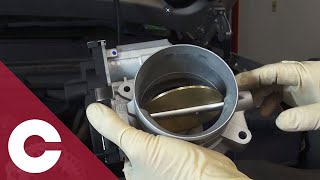
- Perform the Idle Relearn Procedure. 🎬 Watch: How to perform a GM throttle body relearn This can be attempted manually (start engine, let it idle in Drive with the A/C on for 5 minutes, then in Park with A/C off for 5 minutes) or, more reliably, with a capable OBD-II scan tool. A common manual procedure is: start engine, idle for 3 mins, turn off for 1 min, restart and idle for 3 mins.
- If the code returns, inspect the wiring harness and connector at the throttle body for damage or corrosion.
- If the wiring is good and cleaning did not solve the problem, the throttle body assembly likely needs to be replaced.
Parts You'll Likely Need
- Throttle Body Assembly
(OEM #12631186 (2.4L), 12589056 (3.0L), 12694873 (3.6L))— This is the most common repair if cleaning the original part does not solve the problem. The sensors are integrated and cannot be replaced separately. Part numbers are engine-specific; verify the correct part for your specific engine and model year.
Trusted brands: ACDelco (OEM), Bosch, Hitachi, Dorman
OEM price range: $170-$250
Aftermarket price range: $90-$180 - Throttle Body Cleaner — Required for the most common and first-step fix: cleaning the throttle plate and bore.
Trusted brands: CRC, Berryman, Gumout
Aftermarket price range: $5-$15
Related Codes That Often Appear With This One
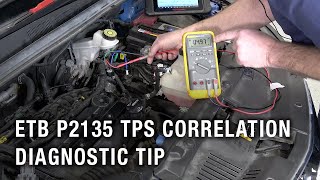
- P2135 — This code means 'Throttle/Pedal Position Sensor/Switch A/B Voltage Correlation'. It is very common to see with P0121 because it indicates the signals from the two redundant throttle position sensors inside the throttle body do not agree with each other, which is a primary way the ECM detects a fault. TSB PIP5029G specifically addresses P0121 and P2135 appearing together, pointing to an internal throttle body fault.
- P0507 — This code for 'Idle Air Control System RPM Higher Than Expected' can appear after cleaning or replacing the throttle body if the idle relearn procedure is not performed. The ECM is still using old data and can't control the idle properly with the new, cleaner airflow.
Technical Service Bulletins (TSBs) & Recalls
- TSB PIP5029G: Addresses codes P0121 and P2135, often caused by carbon buildup or internal electronic failure of the throttle body. The recommended procedure is to clean the throttle body and perform an idle relearn. If the code returns, the throttle body assembly should be replaced.
- TSB Bulletin #PIP4578B: A manufacturer service bulletin notes that high mileage vehicles may experience an idle surge, reduced engine power mode, and/or DTC P0121 along with other throttle-related codes.
- GM Special Coverage Adjustment 14582A: While expired, this program extended the warranty on the throttle body for 10 years/120,000 miles on many similar GM vehicles for issues causing 'Reduced Engine Power,' confirming the high failure rate of the component.
Mechanic-Grade Diagnostic Values
- TPS1 and TPS2 Voltage Sweep (Scan Tool) — expected: TPS1 should sweep smoothly from ~0.5V at idle to ~4.5V at wide-open throttle. TPS2 should do the opposite, sweeping from ~4.5V to ~0.5V. The two signals are inverse and should always sum to ~5V.. Failure: Any glitches, spikes, or dropouts in the voltage reading as the throttle is slowly opened indicates a failing sensor within the throttle body.
- Throttle Actuator Motor Resistance (Multimeter) — expected: 2 to 15 Ohms between the two motor terminals on the throttle body connector.. Failure: A reading of no continuity (Over Limit) or a resistance less than 1 Ohm indicates a defective throttle actuator motor.
- TPS1 Resistance Sweep (Multimeter) — expected: With the throttle body off the vehicle, resistance between the signal and ground pins should increase smoothly as the throttle plate is opened and decrease as it is closed.. Failure: Resistance value does not change, or jumps erratically, indicating a bad sensor.
- TPS2 Resistance Sweep (Multimeter) — expected: With the throttle body off the vehicle, resistance between the second signal and ground pins should decrease smoothly as the throttle plate is opened and increase as it is closed (inverse of TPS1).. Failure: Resistance value does not change, or jumps erratically, indicating a bad sensor.
Scan Tool Commands That Help
- GDS2 (GM Dealer Tool) or equivalent high-end scanner: Idle Learn Reset / Throttle Body Relearn — This is the most reliable method to perform the idle relearn procedure after cleaning or replacing the throttle body. A manual relearn can sometimes be incomplete, but the scan tool command forces the ECM to erase old learned values and start fresh, preventing high idle or stalling issues.
- GDS2 or equivalent bidirectional scanner: Throttle Plate Actuator Control — This command allows the technician to command the throttle plate to specific percentages (e.g., 10%, 25%, 50%) while monitoring TPS1 and TPS2 voltage on the live data screen. This is a definitive test to confirm smooth sensor operation and actuator response without having to manually manipulate the throttle.
Wiring & Ground Locations
- Throttle Body Connector (often designated X105 on GM schematics) — The 6-pin electrical connector plugged directly into the electronic throttle body assembly.. This is the primary point of failure for wiring issues. The pins for the 5V reference, low reference (ground), and the two TPS signal wires are located here. Corrosion or a loose pin in this connector will directly cause P0121 and P2135.
- G105 / G106 — On similar GM platforms, these are primary engine grounds located on a transmission stud or on the left side of the engine.. The Engine Control Module (ECM) relies on a clean ground connection to accurately read sensor data. A corroded or loose G105/G106 ground can introduce electrical noise and voltage offsets, potentially causing the ECM to misinterpret the TPS signals and set a P0121 code, even if the throttle body itself is good.
Real Owner Repair Stories
- Reddit r/AskMechanics (General GM vehicle (applicable to LaCrosse)) — Rough idle, poor acceleration, and codes P0121, P0221, P2135.
❌ Tried (didn't work) Initial diagnosis pointed towards a bad throttle body.
✅ What actually fixed it The user cleaned the throttle body, which is the first step, but the key to the final fix was performing a proper throttle body relearn procedure afterward. This recalibrated the sensor's baseline and resolved the idle and performance issues.
OEM Part Supersession History
12631186→12694871— Standard part revision, likely for improved reliability or manufacturing process.
Heads up: The new part number (12694871) is a direct replacement for the old one (12631186) for the 2.4L engine.
Diagnostic Flowchart
Other Known Issues on This Vehicle
Issues unrelated to this code that are worth knowing about as an owner of this generation:
- Premature Timing Chain Stretch (3.6L V6 LLT Engine) 🔴 High — Very common, often appearing between 70,000 and 120,000 miles. Exacerbated by extended oil change intervals. (Ref: Special Coverage Adjustment 11340C (expired); TSB 12-06-01-009F.)
- 6T70/6T75 Transmission Wave Plate Failure 🔴 High — Common in earlier models (pre-2010), leading to loss of 3rd, 5th, and Reverse gears. Can occur as early as 30,000 miles but more common closer to 100,000. (Ref: Special Coverage 14404B (expired).)
- Water Pump Failure (3.6L V6) 🟠 Medium — Failures are common around 100,000 miles. The pump is driven by the timing chain, making replacement labor-intensive and expensive.
- Carbon Buildup on Intake Valves (Direct Injection Engines) 🟠 Medium — A common issue on all direct-injection engines (2.4L, 3.0L, 3.6L), leading to cold start misfires and general performance decline over time.
Used vs. New Parts: Buying Guide for This Vehicle
When a used part is the smart pick: A used throttle body from a reputable salvage yard can be a cost-effective option, especially if it comes from a low-mileage, rear-ended vehicle. Since the failure is electronic/wear-related, a part with less use has a higher chance of a long service life.
Donor-vehicle mileage cap: roughly under 75000 miles for the part to have meaningful remaining life.
What to inspect on the donor part:
- Inspect the connector pins for any green or white corrosion; they should be clean and straight.
- Ensure the throttle plate moves smoothly by hand (if possible) and isn't physically damaged.
- Ask for the VIN of the donor vehicle to verify its mileage and check for any reported front-end damage.
- Prefer parts that have been stored indoors and are not covered in excessive grime or moisture.
Aftermarket brands forum-validated for this vehicle:
- ACDelco (OEM/Professional Line)
- Bosch
- Hitachi
Brands owners have reported issues with on this vehicle:
- Unbranded, 'white box' parts from online marketplaces should be avoided due to inconsistent quality control. While Dorman is a major brand, forum discussions show mixed reviews on their electronic components, with some users reporting premature failures compared to OEM.
Real Owner Stories
Aggregated from forums and TSBs cited above. Mileages and costs reflect what owners reported in those sources.
2010 Buick LaCrosse — 105250 miles
Symptoms: Malfunctions when accelerating hard and/or during left turns. A 'Stabilitrack needs maintenance' message appears briefly, followed by 'Low Power' mode and a check engine light.
What fixed it: The owner was investigating code P2138 which the manual suggests could be several things related to the throttle/pedal system.
Source hint: Car Talk Community
2010-2012 Buick LaCrosse (similar GM engine) — ~100000 miles
Symptoms: Persistent high idle after cleaning the throttle body to address a P0121 code.
What fixed it: Performing a complete idle relearn procedure.
Source hint: The Chevrolet Cobalt SS Forum - Thread 'P0121 throttle body cleaning and high idle'
2009-2012 Buick LaCrosse (older model equivalent) — ~120000 miles
Symptoms: Hesitation and poor throttle response.
What fixed it: Replacing the Throttle Position Sensor (TPS).
Source hint: GMForum.com - Thread 'DTC P0121 Throttle Position (TP) Sensor Performance error code'
Related OBD-II Codes
Frequently Asked Questions
Is there a TSB for P0121 and P2135 codes on my Buick LaCrosse?
Does the 2009-2012 Buick LaCrosse have an extended warranty for throttle body issues?
Why does my LaCrosse show 'Service Stabilitrak' when I have a throttle code like P0121?
Can I just clean the throttle body on my 3.6L LaCrosse to fix P0121?
What is the manual idle relearn procedure for the Buick LaCrosse?
If cleaning doesn't work, do I have to replace the whole throttle body?
Helpful Videos


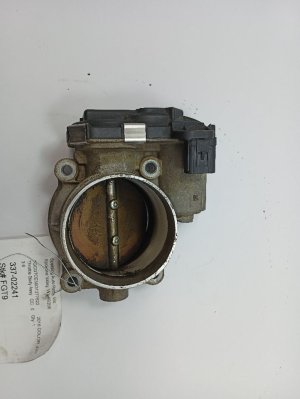
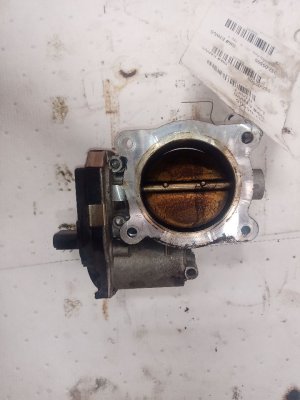
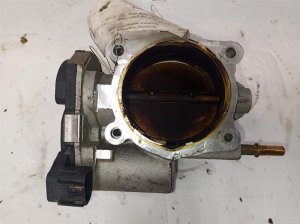
We Have This Part in Stock

The information in this article is provided for general reference and educational purposes only. Vehicle specifications, procedures, and part compatibility can vary by production date, trim level, and region. Always consult your vehicle's factory service manual and verify part numbers before purchasing or performing repairs. Safety-critical components such as airbags, seat belts, and braking systems should be installed by a qualified professional.
- Buick LaCrosse:
- 🧭 Diagnostic Flowchart
- 🎬 Helpful Videos
- 🛍️ Shop This Part
- What's Unique About the 2009-2012 Buick LaCrosse
- Symptoms You May Notice
- Most Likely Causes
- Rare But Worth Checking
- Diagnosis Steps
- Parts You'll Likely Need
- Related Codes That Often Appear With This One
- Technical Service Bulletins (TSBs) & Recalls
- Mechanic-Grade Diagnostic Values
- Scan Tool Commands That Help
- Wiring & Ground Locations
- Real Owner Repair Stories
- OEM Part Supersession History
- Other Known Issues on This Vehicle
- Used vs. New Parts: Buying Guide for This Vehicle
- Real Owner Stories
- 2010 Buick LaCrosse — 105250 miles
- 2010-2012 Buick LaCrosse (similar GM engine) — ~100000 miles
- 2009-2012 Buick LaCrosse (older model equivalent) — ~120000 miles
- Related OBD-II Codes
- Frequently Asked Questions
- 🎟️ Get 5% Off