

P0121 on 2006-2013 Chevrolet Corvette: Causes, Fixes, and Throttle Body Issues
On a C6 Corvette, code P0121 is most often caused by a dirty throttle body creating a mismatch between the expected and actual throttle position. A thorough cleaning is the first and most common fix. If that fails, the entire throttle body assembly, which includes the integrated sensor, likely needs replacement. After cleaning or replacement, an idle relearn procedure may be required, which can often be completed through normal driving.
- P0121 on a C6 Corvette almost always relates to the throttle body, not the gas pedal.
- The most probable and cheapest fix is to thoroughly clean the carbon buildup from the throttle body.
- If cleaning doesn't work, the entire throttle body assembly must be replaced as the sensor is built-in.
- Do not continue driving with this code, as the car can enter a 'Reduced Engine Power' mode at any time, creating a safety hazard.
- Be aware of the throttle body change in 2009 ('silver blade' vs. 'gold blade') if you need to order a replacement part.
What's Unique About the 2006-2013 Chevrolet CORVETTE
The 2006-2013 C6 Corvette is known for being sensitive to airflow changes, and P0121 is a common code, especially on higher-mileage cars. As noted in GM Technical Service Bulletin #PIP4578B, this code is frequently linked to carbon buildup (coking) in the throttle body, which causes the throttle plate to stick or respond slowly. This leads to the dreaded "Reduced Engine Power" message and is often seen with other related codes. The issue is less about a specific faulty part from the factory and more about the effects of long-term use within the PCV (Positive Crankcase Ventilation) system dirtying the throttle body. As the carbon builds, the ECM learns to open the throttle plate more at idle to compensate; after cleaning, this learned value is too high, which can cause a high idle until an idle relearn is performed.
Diagnostic Flowchart
Tap your situation to follow the diagnostic path that matches what you're seeing on this vehicle.
Symptoms You May Notice
- Check Engine Light is on
- "Reduced Engine Power" message disp 🎬 Watch: Why your C6 Corvette goes into Reduced Engine Power mode.layed
- "Service Active Handling" or "Service Traction Control" message may appear
- Poor or hesitant acceleration
- Unstable, rough, or high idle, especially after cleaning the throttle body
- Engine may stall at low speeds or when coming to a stop
- Cruise control may disengage intermittently
- Replacing the accelerator pedal position (APP) sensor. While the code definition can include 'Pedal Position', on the C6 Corvette, P0121 almost always points to the throttle body at the engine, not the pedal assembly inside the car.
Most Likely Causes
- Dirty Throttle Body 🔴 High Probability → Shop Fuel Injection Throttle Body As vehicles accumulate mileage, oil vapor from the PCV system and other contaminants build up around the throttle plate, causing it to stick or move sluggishly. This prevents the blade from closing to its true zero position, creating a discrepancy between the sensor reading and what the ECM expects. This is a well-documented issue referenced in GM TSB #PIP4578B.
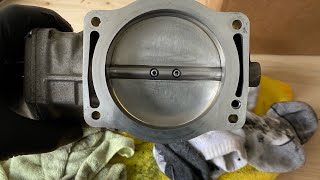
How to confirm: Remove the air intake duct from the throttle body and visually inspect the throttle bore and plate for a black, sticky layer of carbon buildup. The buildup is often heaviest on the back of the blade and the bore where the blade seats.
Typical fix: Remove the throttle body from the intake manifold for a thorough cleaning with a dedicated throttle body cleaner and a soft brush or microfiber towel. Pay special attention to the edges of the throttle plate and the bore where it seats.
Est. part cost: $5-$15 - Failing Throttle Body Assembly 🟡 Medium Probability → Shop Fuel Injection Throttle Body The throttle position sensor is integrated into the throttle body assembly on the C6 Corvette and is not sold as a separate component. Wear and tear on the internal electronic sensor's resistive strips or the actuator motor's gears can cause erratic signals or dead spots, which a simple cleaning cannot fix.
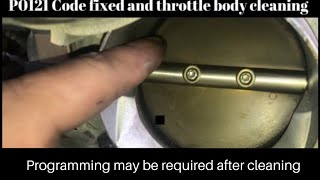
How to confirm: If cleaning the throttle body does not resolve the code (or it returns quickly), and wiring is confirmed to be good, the assembly itself is the next likely failure point. A scan tool can monitor TPS 1 and TPS 2 voltage for jumps or dead spots while the pedal is slowly pressed. 🎬 See how to diagnose P0121 and test throttle sensor voltages. The voltages should move smoothly and in opposition to each other.
Typical fix: Replace the entire throttle body assembly. An idle relearn procedure will be necessary after replacement.
Est. part cost: $150-$400 - Wiring or Connector Issue ⚪ Low Probability Engine vibrations and heat can, over time, cause wires to chafe or pins in the connector at the throttle body to become loose or corroded. The harness is in a high-heat area and can become brittle.
How to confirm: With the engine off, disconnect the throttle body connector and inspect for corrosion, moisture, or pushed-out pins. Check for tension or chafing on the harness near the throttle body and alternator. Gently wiggle the harness with the engine running to see if it triggers the fault.
Typical fix: Repair the damaged section of wiring or clean/replace the connector pigtail.
Est. part cost: $10-$50
Rare But Worth Checking
- Faulty Engine Control Module (ECM): This is very rare. The ECM is the last component to suspect after all other possibilities (throttle body, wiring) have been exhaustively ruled out.
- Aftermarket Cold Air Intake: → Shop Engine Air Intake Resonator Some aftermarket intakes can cause turbulent airflow across the MAF sensor, leading to readings that conflict with the throttle position and trigger a P0121 or P0068 code.
Diagnosis Steps
- Check for other stored DTCs. Codes like P1516, P2101, or P0068 strongly point towards a throttle body issue.
- Disconnect the air intake tube from the throttle body.
- Visually inspect the throttle plate and bore for significant carbon buildup. This is the most common cause.
- If dirty, remove the four 10mm bolts holding the throttle body to the intake manifold, unplug the electrical connector, and clean it thoroughly off the vehicle using throttle body cleaner and a rag. 🎬 Watch this walkthrough on how to clean your Corvette throttle body. Do not use harsh chemicals like brake cleaner.
- While the throttle body is off, inspect the electrical connector and harness for any signs of damage, corrosion, or loose pins.
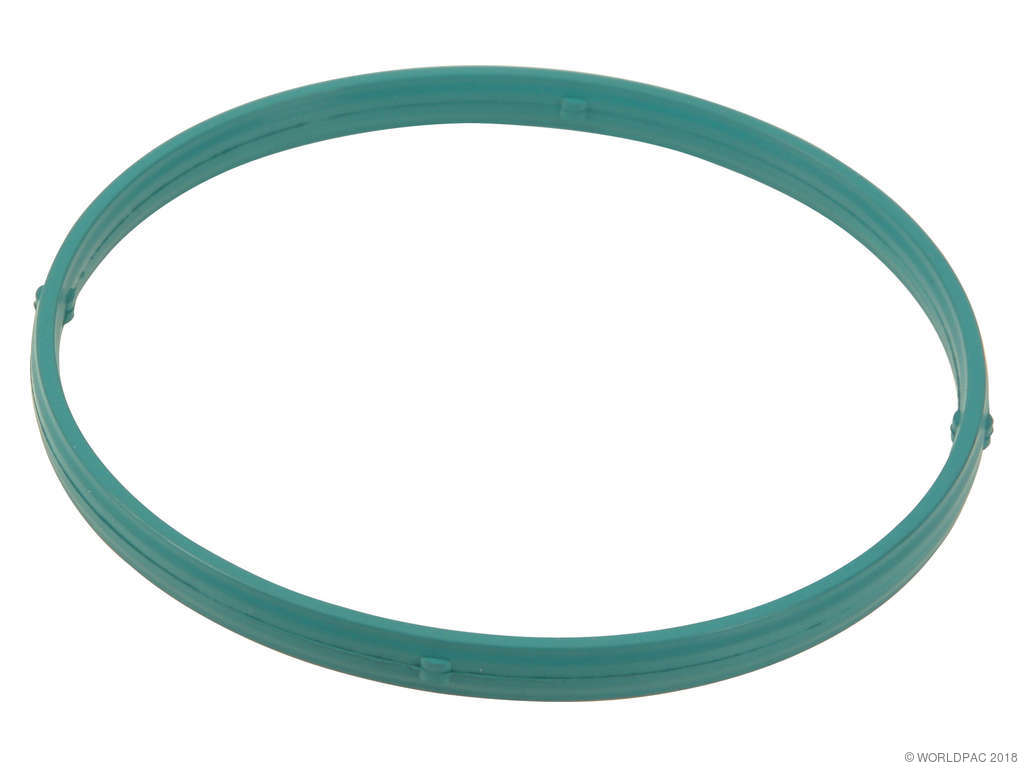
- Reinstall the throttle body with a new gasket and clear the codes. Torque bolts to 89 lb-in (10 N·m).
- Perform an Idle Relearn Procedure. This can be done with a scan tool or, often, just by driving. A common manual procedure is to start the engine and let it idle in Park for 3 minutes, then turn it off for 60 seconds, then restart and idle for another 3 minutes. Many owners report that simply driving the car for 50-100 miles will allow the ECM to relearn the new idle position on its own.
Parts You'll Likely Need
- Throttle Body Assembly (2009-2013 LS3/LS7 'Gold Blade')
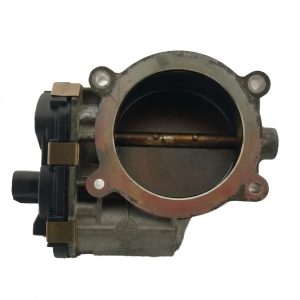
(OEM #12605109 / 19420707)— This is the required fix if cleaning does not solve the problem. Part number 19420707 supersedes 12605109. This is a 90mm throttle body.
Trusted brands: ACDelco
OEM price range: $250-$400
Aftermarket price range: $150-$250 - Throttle Body Assembly (2006-2008 LS2 'Silver Blade')
(OEM #12570790)— Required fix for earlier C6 models if cleaning fails. This is also a 90mm throttle body but uses different electronics than the later 'gold blade' version.
Trusted brands: ACDelco, SKP
OEM price range: $300-$500
Aftermarket price range: $160-$300 - Throttle Body Cleaner — This is the first and most crucial item for the most common fix, which is cleaning the carbon buildup from the throttle plate and bore.
Trusted brands: CRC, Berryman
Aftermarket price range: $5-$15
Related Codes That Often Appear With This One
- P1516 — This code relates to the Throttle Actuator Control (TAC) module performance. It often appears with P0121 because the ECM detects a conflict between what it's telling the throttle to do and the position being reported.
- P2101 — This code means 'Control Module Throttle Actuator Position Performance'. It's another code that points directly to a problem with the electronic throttle body's operation, often triggered by the same root causes as P0121.
- P0068 — This code indicates a disagreement between the Mass Airflow (MAF) sensor, Manifold Absolute Pressure (MAP) sensor, and the throttle position. A sticking throttle plate can cause this correlation fault.
- P2176 — This code, 'Throttle Actuator Control System - Idle Position Not Learned', often appears after a throttle body has been cleaned or replaced but an idle relearn procedure has not been completed. TSB PIP4578B specifically mentions this scenario.
Technical Service Bulletins (TSBs) & Recalls
- PIP4578B: Notes that on high mileage vehicles, DTCs P0068, P0121, P1516, P2101, P2119, and/or P2176 can be caused by throttle body issues. It explicitly states that if the throttle body is cleaned without performing an 'idle learn reset', the ECM may continue to compensate for the previous carbon buildup, causing the code to return along with new codes like P0506 or P0507.
Platform-Specific Known Issues
- A GM Technical Service Bulletin (TSB #PIP4578B) directly addresses P0121 on high-mileage vehicles, often accompanied by codes P0068, P1516, P2101, P2119, and/or P2176, pointing towards throttle body issues causing idle surge or reduced power.
- On Corvettes, many powertrain faults, including P0121, can trigger a secondary "Service Active Handling" or "Service Traction Control" warning on the driver information center. This is because the stability system relies on the ECM's ability to reduce engine torque, which it cannot guarantee with a throttle fault.
- After cleaning a very dirty throttle body, it is common for the car to idle high (1200-1500 RPM) because the ECM is still using the learned compensation for the old carbon buildup. Many owners on CorvetteForum report that this condition will resolve itself after 50-100 miles of normal driving as the computer relearns.
Mechanic-Grade Diagnostic Values
- TPS 5-Volt Reference — expected: 4.8-5.2 Volts with key on, engine off.. Failure: Voltage outside this range indicates a problem with the ECM or wiring.
- TPS Ground Circuit — expected: Less than 0.1 Volts (100 mV) when checking voltage drop.. Failure: Higher voltage indicates a poor ground connection, which is a known issue on Corvettes.
- TPS1 vs TPS2 Signal Voltage (Live Data) — expected: Voltages should move smoothly and in opposite directions as the throttle is opened and closed. For example, as TPS1 increases from ~0.5V to ~4.5V, TPS2 should decrease from ~4.5V to ~0.5V.. Failure: Any spikes, dropouts, or non-linear movement indicates a failing throttle body assembly.
Scan Tool Commands That Help
- Tech2 / GDS2: Idle Learn Reset — Use this function after cleaning or replacing the throttle body to reset all learned airflow compensation values to zero. This accelerates the relearn process and can stabilize a rough or high idle more quickly than a manual drive cycle.
- Tech2 / GDS2: Throttle Position Live Data (TPS1 vs TPS2) — This is the primary diagnostic screen to confirm a faulty sensor. Graphing TPS1 and TPS2 voltages while slowly operating the pedal (engine off) will clearly show any dropouts or glitches that indicate internal sensor failure.
Wiring & Ground Locations
- Throttle Body Connector (X152) — Directly on the throttle body assembly at the front of the engine.. This is the primary connection point for all power, ground, and signal wires for the integrated TPS sensors. It is a common point of failure due to heat and vibration, leading to loose pins or corrosion.
- G102 — On the right front frame rail, near the headlamp assembly.. This ground point serves several key engine components. While not the primary ECM ground, a poor connection here can introduce electrical noise that may affect sensor readings.
- G105 / G106 — G105 is on the lower left side of the engine block. G106 is on the right side of the engine block, above the starter.. These are the main engine block and PCM grounds. A loose or corroded connection at G106 specifically supplies the PCM, TAC module, and MAF sensor, and can directly cause erratic sensor behavior and codes like P0121.
Real Owner Repair Stories
- CorvetteForum Member (C6 Corvette (year not specified)) — Intermittent 'Reduced Engine Power' mode, Service Active Handling light, and codes P0121 and P2101.
❌ Tried (didn't work) Cleaning the throttle body multiple times., Replacing the throttle body with a new unit., Checking the wiring harness and connector at the throttle body.
✅ What actually fixed it The root cause was a failing alternator. The alternator was producing electrical noise and fluctuating voltage, which interfered with the sensitive throttle body electronics, causing the intermittent codes. Replacing the alternator resolved all issues.
OEM Part Supersession History
12605109→19420707— Standard part number update by GM.
Heads up: This is the 'gold blade' throttle body for LS3/LS7 engines. It is not directly compatible with 2006-2008 LS2 cars, which use the 'silver blade' P/N 12570790, due to opposite blade rotation and different PCM programming.
Model Year Variations Within This Range
- 2006-2008 (LS2): Uses a 'silver blade' throttle body (P/N 12570790) controlled by an E40 or E67 ECM. The throttle blade rotates in one direction.
- 2009-2013 (LS3/LS7): Uses a 'gold blade' throttle body (P/N 12605109/19420707) controlled by an E38 ECM. The throttle blade rotates in the opposite direction of the LS2 version, making them non-interchangeable without a custom tune.
Helpful Videos
Used OEM Parts in Stock
New Aftermarket Parts Available




The information in this article is provided for general reference and educational purposes only. Vehicle specifications, procedures, and part compatibility can vary by production date, trim level, and region. Always consult your vehicle's factory service manual and verify part numbers before purchasing or performing repairs. Safety-critical components such as airbags, seat belts, and braking systems should be installed by a qualified professional.
- Chevrolet CORVETTE:
- 🧭 Diagnostic Flowchart
- 🎬 Helpful Videos
- 🛍️ Shop This Part
- What's Unique About the 2006-2013 Chevrolet CORVETTE
- Symptoms You May Notice
- Most Likely Causes
- Rare But Worth Checking
- Diagnosis Steps
- Parts You'll Likely Need
- Related Codes That Often Appear With This One
- Technical Service Bulletins (TSBs) & Recalls
- Platform-Specific Known Issues
- Mechanic-Grade Diagnostic Values
- Scan Tool Commands That Help
- Wiring & Ground Locations
- Real Owner Repair Stories
- OEM Part Supersession History
- Model Year Variations Within This Range
- 🎟️ Get 5% Off