

P0121 on 2014-2018 Chevrolet Corvette: Causes and Fixes for Throttle Position Faults
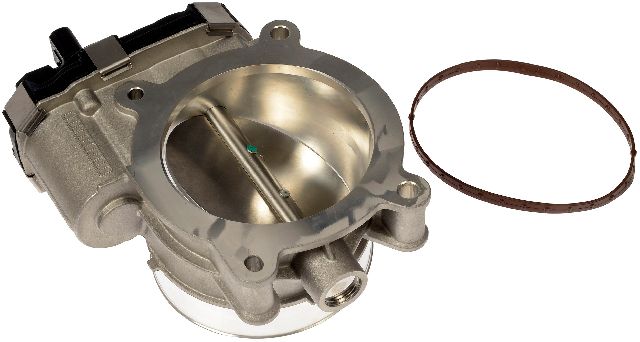
This code on a C7 Corvette usually points to a faulty throttle body, which contains the non-serviceable throttle position sensor (TPS). Symptoms include 'Reduced Engine Power' and erratic idle. Replacing the entire throttle body assembly (e.g., ACDelco #12678223 or its successor #12740727) is the most common fix. Cleaning the throttle body of carbon can be a temporary solution but requires a specific idle relearn procedure to avoid further issues.
- P0121 on a 2014-2018 Corvette is a serious code that can put the car into a dangerous 'Reduced Engine Power' mode.
- The most likely cause is a failure of the entire throttle body assembly, which contains the non-serviceable position sensor.
- Cleaning carbon buildup from the throttle body may fix the code, but a specific 'idle relearn procedure' with a scan tool is highly recommended by GM to prevent a persistent high idle.
- Replacing the accelerator pedal is a common misdiagnosis; the fault is almost always at the throttle body itself.
- The correct OEM replacement for the LT1 engine is ACDelco part #12678223.
What's Unique About the 2014-2018 Chevrolet CORVETTE
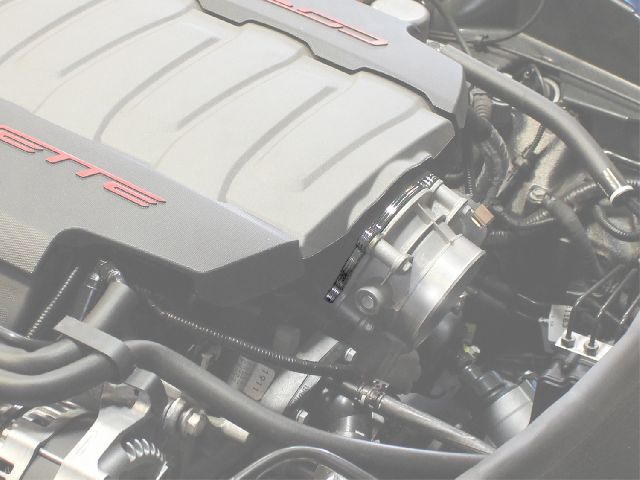
On the C7 Corvette's electronic 'drive-by-wire' system, the throttle position sensor is integrated into the throttle body assembly and is not sold as a separate part. A GM Technical Service Bulletin (PIP4578B) specifically links P0121 with other throttle-related codes and symptoms like idle surges and reduced power mode. The TSB explains that as carbon builds up, the ECM learns to open the throttle plate more to compensate. If the throttle body is cleaned, the ECM's learned compensation is now excessive, leading to high idle and new codes unless an 'idle learn reset' is performed with a GM-specific scan tool.
Diagnostic Flowchart
Tap your situation to follow the diagnostic path that matches what you're seeing on this vehicle.
Symptoms You May Notice
- Check Engine Light is on
- Vehicle enters 'Reduced Engine Power' mode
- Hesitation or stumbling during acceleration
- Unstable, surging, or high idle, especially after cleaning the throttle body
- Engine may be hard to start or may stall
- Sudden surges in speed or unpredictable throttle response
- Replacing the accelerator pedal position (APP) sensor. While the APP sensor can cause similar symptoms, P0121 is more directly tied to the sensor on the throttle body itself. A scan tool can differentiate by showing which sensor's signal is erratic. Some owners have replaced the APP sensor only to find the P0121 code returns, eventually tracing it to the throttle body.
Most Likely Causes
- Failing Throttle Body Assembly 🔴 High Probability → Shop Fuel Injection Throttle Body The integrated throttle position sensor (TPS) or the throttle actuator motor within the sealed assembly are common failure points. TSB #PIP4578B acknowledges issues on high-mileage vehicles that lead to this and related codes.
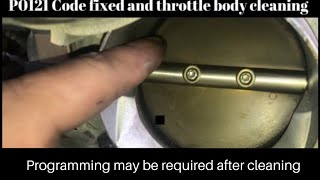
How to confirm: Use a diagnostic scan tool to monitor the voltage of TPS 1 and TPS 2. The readings should be smooth and consistent as the throttle is commanded open. Any jumps, flat spots, or erratic readings indicate a faulty sensor. One owner confirmed a bad throttle body by performing a static resistance test on the throttle body motor. 🎬 Watch: Diagnosing and repairing the P0121 code on a Chevy.
Typical fix: Replace the entire throttle body assembly. The ACDelco OEM part for the LT1 is #12678223, which has been superseded by #12740727. After replacement, a throttle relearn procedure is required.
Est. part cost: $150-$750 - Carbon Buildup in Throttle Body 🟡 Medium Probability → Shop Fuel Injection Throttle Body Direct injection engines can be prone to intake carbon buildup, which can restrict the movement of the throttle plate. This causes a mismatch between the commanded and actual position, triggering the code.
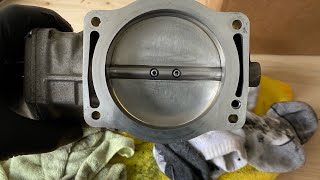
How to confirm: Remove the intake tube and visually inspect 🎬 See this walkthrough on cleaning your Corvette's throttle body. the throttle body bore and plate for significant black carbon deposits that could impede movement.
Typical fix: Clean the throttle body bore and plate with a dedicated throttle body cleaner and a soft brush. Be careful not to force the plate open manually. CRITICAL: After cleaning, an 'idle learn reset' must be performed using a scan tool (like a GM Tech 2 or GDS2) as per TSB PIP4578B. Failure to do so can result in a persistent high idle and new trouble codes. Some owners report the car may relearn on its own after an extended drive cycle, but this is not guaranteed.
Est. part cost: $10-$20 - Wiring or Connector Issue ⚪ Low Probability Engine bay heat and vibration can, over time, cause wiring to become brittle or connections to loosen. The harness is also susceptible to water damage.
How to confirm: Inspect the wiring harness and connector going to the throttle body for any signs of damage, corrosion, loose pins, or moisture. Wiggle the harness while monitoring TPS voltage on a scan tool to see if the signal fluctuates.
Typical fix: Repair the damaged section of the wiring harness or clean/replace the connector.
Est. part cost: $5-$50
Rare But Worth Checking
- Failing Powertrain Control Module (PCM): This is extremely rare. All other possibilities, including the throttle body and wiring, should be exhaustively ruled out before considering PCM replacement.
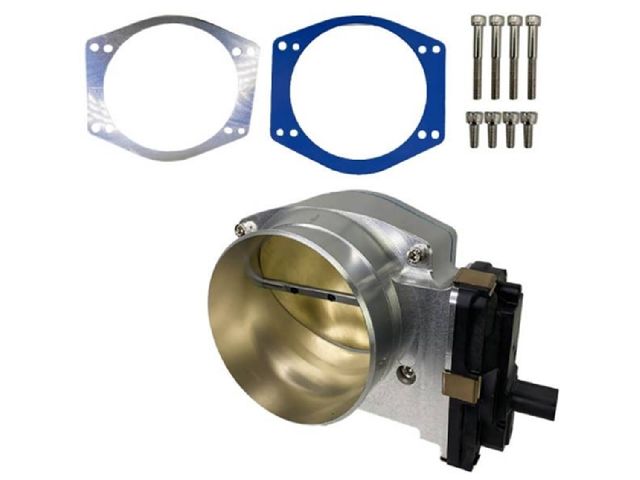
- Aftermarket Ported Throttle Body: → Shop Fuel Injection Throttle Body Improperly ported or calibrated aftermarket throttle bodies (e.g., from Soler or Tony Mamo) can sometimes cause this code if the sensor's baseline values or airflow characteristics are outside the ECM's expected range. This can sometimes be resolved by clearing the code and performing a full battery disconnect and relearn procedure.
Diagnosis Steps
- Connect an OBD-II scanner and verify P0121 is present. Check for any other codes, especially those listed in TSB #PIP4578B, as they strongly suggest a throttle body issue.
- With the ignition on but the engine off, use the scanner's live data function to monitor the voltages for both Throttle Position Sensor 1 and Throttle Position Sensor 2.
- Slowly press the accelerator pedal to the floor and release it. The voltage readings should change smoothly with no spikes or dropouts. Typically, one sensor will sweep from low to high voltage, and the other from high to low. A dip or spike near idle is a common sign of failure.
- If the voltage is erratic, jumpy, or doesn't change, the throttle body assembly is likely faulty.
- If the voltage is stable, inspect the wiring harness and connector at the throttle body for any visible damage, corrosion, or loose pins. Wiggle the connector to see if it induces a fault.
- Remove the intake ducting and inspect the throttle body for heavy carbon buildup that could be physically jamming the throttle plate.
- If the inspection reveals heavy carbon, clean the throttle body thoroughly. If the wiring is damaged, repair it. If both are fine but the sensor data was erratic, replace the throttle body assembly.
- After Repair/Cleaning: Perform a throttle relearn procedure. The official GM method requires a scan tool to 'Reset Idle Learn' as noted in TSB PIP4578B. A manual method reported by owners involves disconnecting the battery for at least 30 minutes, then starting the engine and letting it idle for several minutes, followed by a drive cycle at various speeds.
Parts You'll Likely Need
- Throttle Body Assembly
(OEM #ACDelco 12678223 (For 6.2L LT1))— This is the most common cause of P0121, as the internal throttle position sensor fails. The sensor is not serviceable separately from the throttle body on this vehicle.
Trusted brands: ACDelco (OEM), Standard Motor Products, Hitachi, BBK (Performance), Soler Performance (Ported)
OEM price range: $400-$750
Aftermarket price range: $150-$350
Related Codes That Often Appear With This One
- P0068 — MAP/MAF - Throttle Position Correlation. This code is explicitly mentioned in TSB #PIP4578B as appearing with P0121.
- P1516 — Throttle Actuator Control (TAC) Module Throttle Actuator Position Performance. Also mentioned in TSB #PIP4578B and reported by owners experiencing limp mode.
- P2101 — Control Throttle Actuator Control Motor Circuit Range/Performance. Also mentioned in TSB #PIP4578B and seen with throttle body failures.
- P2119 — Throttle Actuator Control Throttle Body Range/Performance. Also mentioned in TSB #PIP4578B.
- P2176 — Throttle Actuator Control System - Idle Position Not Learned. Also mentioned in TSB #PIP4578B.
- P0506 / P0507 — Idle Air Control System RPM Lower/Higher Than Expected. TSB #PIP4578B warns these codes can appear after cleaning a throttle body if the idle learn is not reset.
Technical Service Bulletins (TSBs) & Recalls
- PIP4578B: Addresses idle surge, reduced engine power, and a group of DTCs including P0121 on high mileage vehicles. It specifies that carbon buildup is a likely cause and that a scan tool idle learn reset is required after cleaning.
Platform-Specific Known Issues
- GM Technical Service Bulletin #PIP4578B directly addresses this issue. It explains that on high-mileage vehicles, the ECM adapts to carbon buildup. Cleaning the throttle body without using a scan tool to perform an 'idle learn reset' can cause the now-incorrect learned values to command a high idle, potentially setting new codes like P0506 or P0507.
Mechanic-Grade Diagnostic Values
- TPS1 vs. TPS2 Signal Voltage (Live Data) — expected: Voltages should move smoothly and in opposite directions as the throttle is pressed. For example, as TPS1 sweeps from ~0.5V to ~4.5V, TPS2 should sweep from ~4.5V to ~0.5V.. Failure: Any jumps, spikes, flat spots, or non-opposing movement indicates a sensor fault.
- TPS 5-Volt Reference Circuit Voltage — expected: 4.8 - 5.2 Volts with key on, engine off.. Failure: Voltage outside this range suggests a problem with the ECM's reference output or a short in the wiring.
- TPS Ground Circuit Voltage Drop — expected: Less than 0.1 Volts (100 mV).. Failure: Higher voltage indicates a poor or corroded ground connection, which can cause erratic sensor readings.
Scan Tool Commands That Help
- GM GDS2 (or equivalent professional scanner): Idle Learn Reset / Throttle Relearn — This function is critical after cleaning or replacing the throttle body. It erases the old learned idle airflow compensation values from the ECM, preventing a high idle and related codes (P0506/P0507) that occur when the clean throttle body flows more air than the ECM expects at the old learned position.
Wiring & Ground Locations
- Passenger Fender Well Ground Stud — On the passenger side of the engine bay, on the fender well structure, typically located to the rear of the air filter housing.. This is a common and accessible grounding point for various engine bay components. A loose or corroded connection here can introduce electrical noise and intermittent ground issues for nearby sensors.
- Engine Block to Frame Ground — A large ground strap connecting the engine block (often near the starter or on the side of the block) to the vehicle's frame rail. The main negative battery cable may connect at the frame end (e.g., G303).. This is the primary path for the engine's electrical system to ground to the battery. A poor connection here can cause widespread issues, including incorrect sensor readings and problems with the ECM, as it may not have a stable ground reference.
Real Owner Repair Stories
- CorvetteForum user (C7 Corvette (model year not specified)) — Car went into limp mode, throwing codes P0121 and P060e.
❌ Tried (didn't work) Replacing the original throttle body with an aftermarket 'TRQ' brand unit. The issue returned and the new part failed within a month.
✅ What actually fixed it The owner purchased a genuine OEM throttle body from a reputable vendor (Soler Performance). After installation, the car's performance was restored, and the codes did not return.
OEM Part Supersession History
ACDelco 12678223→ACDelco 12740727— Standard part lifecycle update. The new part number is the current replacement for the original.
Heads up: The parts are interchangeable. 12740727 is the correct part to order if 12678223 is unavailable.
Model Year Variations Within This Range
- 2014-2018: While the stock 87mm OEM throttle body is the same part number for both the LT1 (Stingray/Grand Sport) and LT4 (Z06) engines, ported aftermarket throttle bodies are often not interchangeable. Vendors specify different part numbers for ported LT1 vs. LT4 versions, and installing an LT4-ported throttle body on an LT1 is known to cause check engine lights.
Helpful Videos

Used OEM Parts in Stock
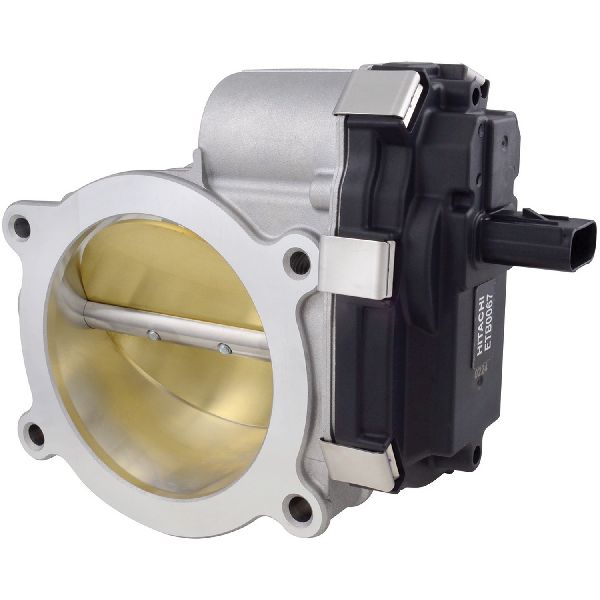
New Aftermarket Parts Available


The information in this article is provided for general reference and educational purposes only. Vehicle specifications, procedures, and part compatibility can vary by production date, trim level, and region. Always consult your vehicle's factory service manual and verify part numbers before purchasing or performing repairs. Safety-critical components such as airbags, seat belts, and braking systems should be installed by a qualified professional.
- Chevrolet CORVETTE:
- 🧭 Diagnostic Flowchart
- 🎬 Helpful Videos
- 🛍️ Shop This Part
- What's Unique About the 2014-2018 Chevrolet CORVETTE
- Symptoms You May Notice
- Most Likely Causes
- Rare But Worth Checking
- Diagnosis Steps
- Parts You'll Likely Need
- Related Codes That Often Appear With This One
- Technical Service Bulletins (TSBs) & Recalls
- Platform-Specific Known Issues
- Mechanic-Grade Diagnostic Values
- Scan Tool Commands That Help
- Wiring & Ground Locations
- Real Owner Repair Stories
- OEM Part Supersession History
- Model Year Variations Within This Range
- 🎟️ Get 5% Off