

P0121 on 2006-2010 GMC Savana: Throttle Position Sensor Causes and Fixes
On a 2006-2010 GMC Savana, code P0121 is most often caused by a dirty or failing throttle body. Cleaning the throttle body bore and plate is a common first step; if that fails, replacing the entire throttle body assembly is the most likely fix. This issue is common across GM trucks and SUVs of this era with Vortec engines.
- P0121 on a 2006-2010 Savana almost always points to an issue with the throttle body.
- The most common and inexpensive first step is to thoroughly clean the throttle body of carbon buildup.
- If cleaning doesn't work, the entire throttle body assembly likely needs to be replaced.
- Do not drive the vehicle extensively with this code, as it can enter a 'Reduced Engine Power' mode at any time, creating a safety hazard.
- This is a DIY-friendly repair for those with basic tools, but a throttle relearn procedure may be necessary after parts replacement.
What's Unique About the 2006-2010 Gmc SAVANA
On these GM vans and their truck/SUV platform mates, P0121 is frequently associated with the "Reduced Engine Power" warning, a safety feature that severely limits throttle response and vehicle speed. The issue is often not the sensor itself but rather the mechanical operation of the throttle body due to carbon buildup or electronic failure within the sealed unit. A Technical Service Bulletin (TSB #PIP4578B) specifically addresses this code on high-mileage vehicles, linking idle surge and reduced power mode to carbon accumulation that forces the throttle plate open beyond its learned idle position. The PCM flags this as a performance error because the actual throttle angle (e.g., 20%) doesn't match the expected angle at idle (e.g., 7%).
Diagnostic Flowchart
Tap your situation to follow the diagnostic path that matches what you're seeing on this vehicle.
Symptoms You May Notice
- Check Engine Light is on
- "Reduced Engine Power" message displayed
- Poor or hesitant acceleration
- Unstable or rough idle
- Engine stalling at low speeds or when stopping
- Sudden surges in speed
- Engine is hard to start
- High idle RPM after cleaning the throttle body
- Replacing the accelerator pedal position (APP) sensor. While the pedal sensor can cause similar symptoms, code P0121 on this platform points specifically to a performance issue at the throttle body, not the pedal. A forum user confirmed that P0121 is not related to the APP sensor.
Most Likely Causes
- Dirty Throttle Body 🔴 High Probability → Shop Fuel Injection Throttle Body Over time, carbon and grime from the PCV system build up in the throttle bore, restricting the movement of the throttle plate. This causes the plate to stick or move slowly, creating a mismatch between the commanded and actual throttle position that the PCM detects as a performance fault.
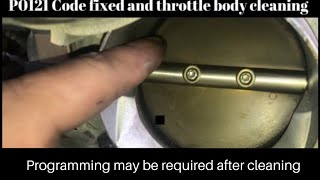
How to confirm: Visually inspect the inside of the throttle body for a layer of black carbon buildup, especially around the edges of the throttle plate and the bore where it seats. A scan tool may show a high throttle angle percentage at idle (e.g., over 15-20%) when it should be much lower (typically under 10% after cleaning). 🎬 Watch: How to clean your throttle body and clear the code.
Typical fix: Remove the throttle body and clean it thoroughly with a dedicated throttle body cleaner and a soft brush or rag. After cleaning, an idle relearn procedure is often necessary, which can sometimes be accomplished through a series of drive cycles or by using a professional scan tool to reset idle values.
Est. part cost: $5-$15 - Failing Throttle Body Assembly 🟡 Medium Probability → Shop Fuel Injection Throttle Body The Throttle Position Sensor (TPS) and the actuator motor are integrated into the throttle body and are not serviced separately. On high-mileage vehicles, the internal electronics of the sensor can fail, or the plastic gears in the actuator motor can wear out. The provided TSB #PIP4578B specifically mentions this code in relation to high-mileage vehicles, pointing to component wear.
How to confirm: If cleaning the throttle body does not resolve the code, the issue is likely internal to the assembly. A scan tool can monitor the TPS voltage for erratic readings, dropouts, or a signal that doesn't change smoothly as the throttle is slowly pressed. The two TPS signals should move in opposite directions; if one signal is erratic or flat, the sensor is bad. If the code returns immediately after cleaning, replacement is the next step.
Typical fix: Replace the entire throttle body assembly. A throttle relearn procedure is required after installation to calibrate the new part with the PCM.
Est. part cost: $150-$300 - Wiring Harness or Connector Issue ⚪ Low Probability The wiring harness leading to the throttle body is subject to engine heat and vibration, which can cause wires to break or the connector pins to develop poor contact over time, a condition known as fretting corrosion. On some GM trucks, the harness can chafe against brackets or other engine components, such as the fan clutch harness.
How to confirm: Visually inspect the wiring harness for any signs of damage, chafing, or melting, particularly near the throttle body connector and where it might rub on the engine. Unplug the connector and check for corrosion or loose pins (pin drag). Wiggle the harness with the engine running to see if it triggers the fault.
Typical fix: Repair the damaged section of wire or replace the connector pigtail. Applying dielectric grease to the connector can help prevent future corrosion.
Est. part cost: $10-$50
Rare But Worth Checking
- Faulty Powertrain Control Module (PCM): This is very rare. All other possibilities, especially the throttle body and its wiring, should be exhaustively ruled out before considering PCM replacement. A faulty PCM is the least likely cause.
- Poor Engine Ground: A corroded or loose main engine ground strap (e.g., G103, G104, G105) can cause erratic sensor readings throughout the system. This is often overlooked but can mimic a failed component. A service bulletin for these vans notes the importance of secure connections at G104, G105, and G106.
Diagnosis Steps
- Scan the PCM for any other stored trouble codes. Note any codes that appear alongside P0121, as they can help pinpoint the problem, especially codes listed in TSB PIP4578B.
- Visually inspect the air intake tube for any cracks or loose connections between the MAF sensor and the throttle body.
- Remove the air intake tube from the throttle body. Inspect the throttle bore and plate for heavy carbon buildup.
- If dirty, remove and thoroughly clean the throttle body. Reinstall and perform a throttle relearn procedure. This may involve letting the engine idle for 3 minutes, turning it off for 60 seconds, and repeating, or simply driving the vehicle for several cycles. A professional scan tool provides the most reliable method for an idle learn reset.
- If the code returns, inspect the throttle body electrical connector for corrosion, damage, or loose pins. Check the wiring harness for any signs of chafing or heat damage, paying close attention to areas where it may rub on engine brackets.
- Using a scan tool with live data, monitor the voltage of TPS Sensor 1 and Sensor 2. The voltage for one sensor should sweep up (e.g., ~0.5V to ~4.5V) while the other sweeps down. The sum of the two voltages should remain constant (around 5V). Watch for any drops, spikes, or non-linear movement as you slowly press and release the gas pedal. 🎬 See this walkthrough for diagnosing and repairing the P0121 fault.
- Check for a stable 5-volt reference signal and a good ground at the throttle body connector using a multimeter.
- Inspect and clean the main engine ground connections, particularly G103 (passenger side cylinder head) and G104 (left front of engine).
- If cleaning and wiring inspection do not resolve the issue, and the sensor signals are erratic, the throttle body assembly is the most likely faulty component and should be replaced.
Parts You'll Likely Need
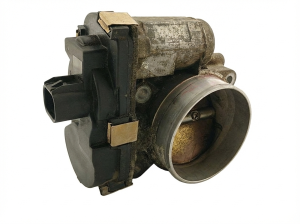
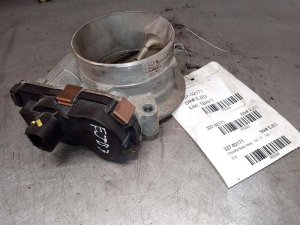
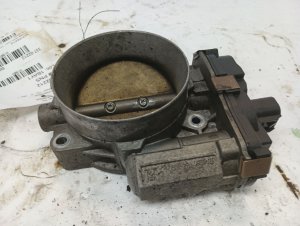
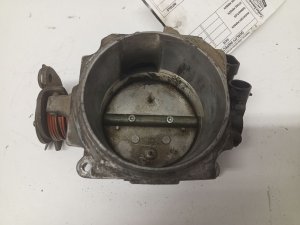
- Throttle Body Assembly
(OEM #Part numbers vary by year. For approx. 2006-2007, use GM #12596576. For approx. 2009-2010, use ACDelco #217-3151 (GM #12670981). Always verify with VIN.)🎬 Watch: Step-by-step throttle body cleaning and replacement guide. — This is the most common fix when cleaning the original unit fails. The assembly includes the integrated throttle position sensor and actuator motor, which are the typical failure points and are not sold separately.
Trusted brands: ACDelco, Delphi, Hitachi
OEM price range: $250-$350
Aftermarket price range: $150-$250 - Throttle Body Cleaner — Often, a thorough cleaning is all that is needed to resolve the code by freeing a sticky throttle plate. This is the first and most cost-effective step.
Trusted brands: CRC, Berryman
OEM price range: $5-$15
Aftermarket price range: $5-$15
Related Codes That Often Appear With This One
- P0068 — Relates to a mismatch between MAP/MAF sensor readings and throttle position, often triggered by the same root cause of incorrect air intake due to a faulty throttle body. This code is explicitly mentioned in TSB PIP4578B.
- P1516 — A GM-specific code indicating the PCM has commanded the throttle to a certain position but sees an incorrect response, often leading to Reduced Engine Power mode. This is also mentioned in TSB PIP4578B.
- P2101 — Indicates a fault with the throttle actuator control (TAC) motor circuit's performance, which is housed within the throttle body assembly. Also listed in TSB PIP4578B.
- P2135 — Indicates a correlation error between the two throttle position sensors (TPS1 and TPS2) within the throttle body assembly. This points directly to a failing sensor inside the throttle body.
Technical Service Bulletins (TSBs) & Recalls
- PIP4578B: Addresses idle surge, reduced engine power, and DTCs including P0121, P0068, P1516, and P2101 on high mileage vehicles. It states that carbon buildup causes the PCM to learn a higher throttle angle at idle. The official fix is to thoroughly clean the throttle body bore and plate and then perform an 'idle learn reset' with a Tech 2/GDS scan tool.
Platform-Specific Known Issues
- A known issue, documented in TSB #PIP4578B, relates this code to idle surges and Reduced Engine Power mode on high-mileage vehicles, pointing towards wear of the throttle body assembly. The TSB explicitly recommends cleaning the throttle body and performing an idle learn reset as the primary repair step.
- Owners on forums frequently report that simply cleaning the throttle body resolves the P0121 code and the associated Reduced Engine Power mode. However, many also report that a high idle condition can occur after cleaning, which usually resolves itself after several drive cycles as the computer relearns the new clean idle position.
- In some cases, even after cleaning or replacing the throttle body, the code persists. This often points to an overlooked wiring issue, such as a chafed harness under the EVAP valve bracket or near the throttle body connector itself.
Mechanic-Grade Diagnostic Values
- TPS1 vs. TPS2 Voltage Sweep — expected: Using a scan tool, one sensor's voltage should increase (e.g., ~0.5V to ~4.5V) while the other decreases. The sum of both voltages should remain relatively constant at ~5.0V throughout the throttle range.. Failure: Any jumps, dropouts, or flat-lining in either signal indicates a failed sensor within the throttle body. If one signal is good but the other is erratic, the assembly is faulty.
- Throttle Angle Percentage at Idle (Scan Tool) — expected: On a clean, healthy throttle body, the angle at idle should be a low single-digit or low-teens percentage (e.g., 4-12%).. Failure: A throttle angle at idle that is consistently high (e.g., 20% or more) strongly suggests carbon buildup is holding the throttle plate open, causing the P0121 performance code.
- TPS Resistance Sweep — expected: With the connector unplugged, measure resistance between a signal pin and the ground pin. As you manually (and carefully) open the throttle plate, the resistance should change in a smooth, linear fashion with no sudden jumps or dropouts.. Failure: An erratic, jumping, or unchanging resistance reading indicates a worn or dead spot in the sensor's internal potentiometer.
Scan Tool Commands That Help
- Tech 2 / GDS2: Idle Learn Reset / Throttle/Idle Learn — This function should be used after cleaning or replacing the throttle body to erase the old learned idle values from the PCM. This forces the computer to relearn the new closed-throttle position, preventing a high idle or idle surge. It is typically found under 'Module Setup' or 'Special Functions'.
Wiring & Ground Locations
- Throttle Body Connector (6-Pin) — Directly on the electronic throttle body assembly.. This is the primary connection point. It contains pins for the Throttle Actuator Control (TAC) motor and the two Throttle Position Sensors (TPS1 & TPS2). Testing for 5V reference, good ground, and the two opposing signal voltages occurs here. A common failure is a broken wire or poor pin contact right at the connector.
- G103 — On the front of the passenger side (right) cylinder head.. This is a primary engine ground. A poor connection here can cause unstable sensor reference voltages, leading to erratic readings from the TPS and other sensors, potentially triggering a P0121 code.
- G104 / G105 — G104 is on the left front corner of the engine/cylinder head. G105 is on the lower front of the right side of the engine.. These are critical engine-to-chassis grounds. A GM Service Bulletin mentions ensuring these grounds are clean and tight is crucial for resolving various electrical issues, including those that could manifest as sensor performance codes.
- G302 / G303 — Located behind the left kick panel in the driver's footwell.. These are major interior/dash ground points. While less likely to cause this specific code than engine grounds, a problem here could affect the PCM or data communication, indirectly contributing to diagnostic challenges.
Real Owner Repair Stories
- GMTNation Forum User 'AtlWrk' (GM Truck/SUV Platform (Trailblazer)) — Reduced Engine Power light and P0121 code.
❌ Tried (didn't work) Wiggling the harness at the throttle body and gas pedal did not replicate the fault.
✅ What actually fixed it The user identified that P0121 is specific to the throttle body, not the pedal. They stated that 90% of the time it's a wiring issue, not the throttle body itself. The two most common culprits are chafing on the fan clutch harness or a subtle break in the wiring right at the throttle body connector, specifically mentioning the dark green signal wire. - Reddit User r/AskMechanics (General GM) — Persistent P0121 after replacing parts.
❌ Tried (didn't work) Cleaning throttle body, Replacing throttle position sensor (on models where possible), Replacing accelerator pedal sensor
✅ What actually fixed it The consensus was that the next steps are to perform a scan tool 'relearn' procedure, as the PCM needs to be calibrated to the new part. If that fails, the problem is almost certainly a wiring issue, such as a loose terminal in the connector ('pin drag') or a broken wire inside the insulation that isn't visually obvious.
OEM Part Supersession History
12596576→N/A— This part number is typically associated with earlier models in the range.
Heads up: This part is for the earlier model years and may not be compatible with 2009+ vehicles.12632172, 12669016, 12671015→12670981 (ACDelco 217-3151)— Part design was updated for later model years.
Heads up: This later-style throttle body is for 2009 and newer models and is generally not backwards compatible with the 2006-2007 vehicles without wiring or PCM changes.
Model Year Variations Within This Range
- 2006-2008 vs 2009-2010: The electronic throttle body assembly itself is different between the earlier and later years of this generation. Part numbers for 2006-2007 models (e.g., GM 12596576) are different from those for 2009-2010 models (e.g., GM 12670981). It is critical to verify the correct part number by VIN, as the units are not interchangeable.
Helpful Videos


Used OEM Parts in Stock
New Aftermarket Parts Available

The information in this article is provided for general reference and educational purposes only. Vehicle specifications, procedures, and part compatibility can vary by production date, trim level, and region. Always consult your vehicle's factory service manual and verify part numbers before purchasing or performing repairs. Safety-critical components such as airbags, seat belts, and braking systems should be installed by a qualified professional.
- Gmc SAVANA:
- 🧭 Diagnostic Flowchart
- 🎬 Helpful Videos
- 🛍️ Shop This Part
- What's Unique About the 2006-2010 Gmc SAVANA
- Symptoms You May Notice
- Most Likely Causes
- Rare But Worth Checking
- Diagnosis Steps
- Parts You'll Likely Need
- Related Codes That Often Appear With This One
- Technical Service Bulletins (TSBs) & Recalls
- Platform-Specific Known Issues
- Mechanic-Grade Diagnostic Values
- Scan Tool Commands That Help
- Wiring & Ground Locations
- Real Owner Repair Stories
- OEM Part Supersession History
- Model Year Variations Within This Range
- 🎟️ Get 5% Off